


Antiquité Tardive - Late Antiquity - Spätantike - Tarda Antichità
Revue Internationale d'Histoire et d'Archéologie (IVe-VIIIe siècle)
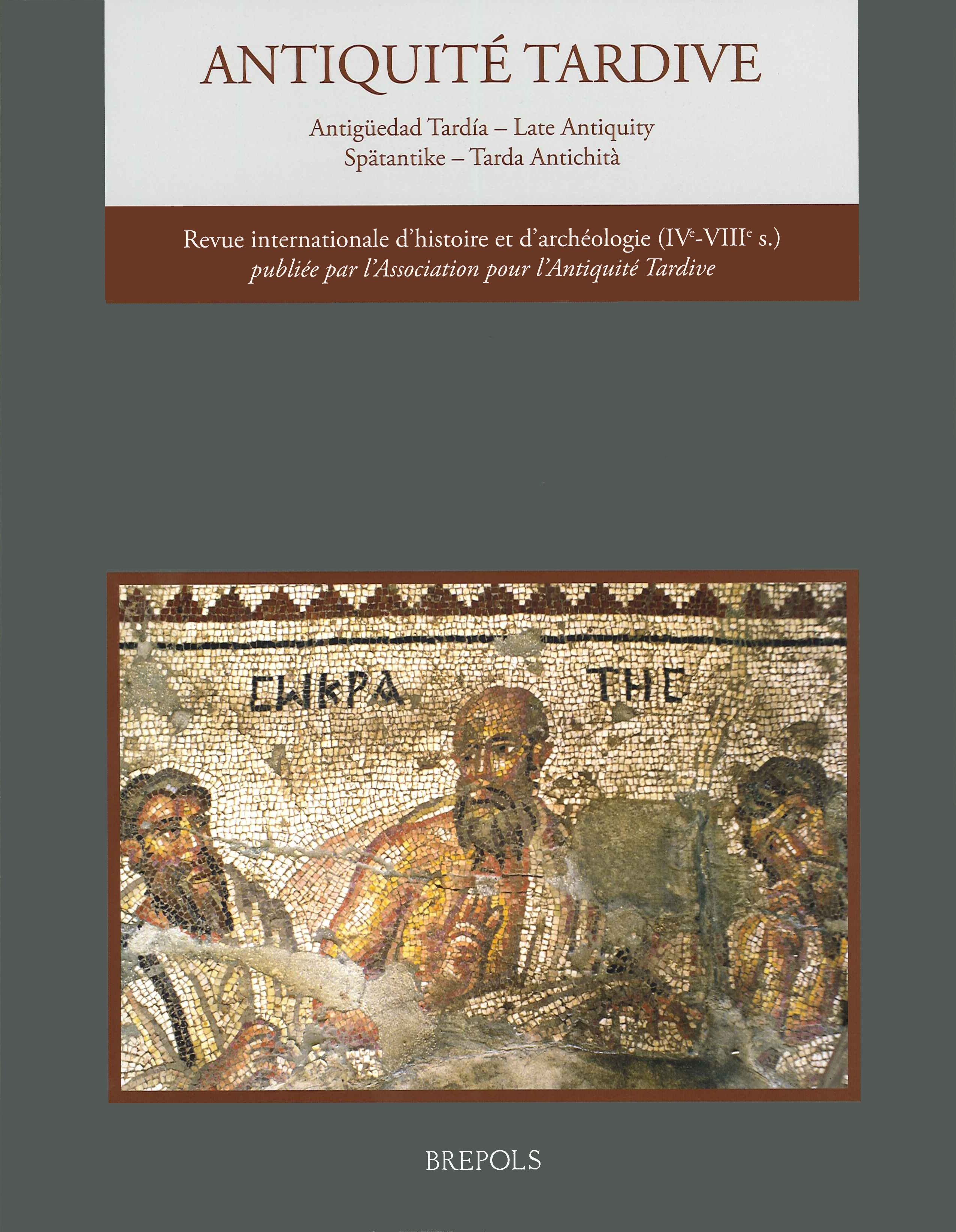
Volume 26, Issue 1, 2018
-
-
Front Matter ("Tables des matières", "Éditorial", "In memoriam : Noël Duval (1929-2018)", "Comité de rédaction de la Revue et Conseil d'administration de l'Association pour l'Antiquité tardive", "Principales abréviations de la Revue")
show More to view fulltext, buy and share links for:Front Matter ("Tables des matières", "Éditorial", "In memoriam : Noël Duval (1929-2018)", "Comité de rédaction de la Revue et Conseil d'administration de l'Association pour l'Antiquité tardive", "Principales abréviations de la Revue") show Less to hide fulltext, buy and share links for: Front Matter ("Tables des matières", "Éditorial", "In memoriam : Noël Duval (1929-2018)", "Comité de rédaction de la Revue et Conseil d'administration de l'Association pour l'Antiquité tardive", "Principales abréviations de la Revue")
-
- 1 - Le quotidien institutionnel des cités tardives
-
-
-
Le peuple et le gouvernement des cités (IVe-VIe siècles)
show More to view fulltext, buy and share links for:Le peuple et le gouvernement des cités (IVe-VIe siècles) show Less to hide fulltext, buy and share links for: Le peuple et le gouvernement des cités (IVe-VIe siècles)AbstractThe relations between the people and their leaders were an essential element in the functioning of local politics in late Antiquity, and its study is a necessary step in any inquiry into the government of cities. To understand these relationships, the author considers all the means, institutional or non-institutional, that the majority of the urban population had to influence the government of the cities. For the 4th and 5th centuries, are successively considered: the popular participation in local elections, the intervention of the people in the decision-making process, the integration of plebeians, through the collegia, to the administration of the city and the various forms of collective action. The main objective of this review is to evaluate the continuities and changes in these practices compared to previous eras and to identify the new possibilities for popular participation that have developed in these centuries. In the end, the author turns to the 6th century to consider the consequences of these transformations in what is called the Post-Curial Civic Government.
-
-
-
-
Civic honours and political participation in Late Antique Italy
show More to view fulltext, buy and share links for:Civic honours and political participation in Late Antique Italy show Less to hide fulltext, buy and share links for: Civic honours and political participation in Late Antique ItalyBy: Carlos MachadoAbstractDurant toute la période antique tardive, les honneurs civiques traditionnels sont restés un élément important de la vie des cités. Les conseils municipaux, les magistrats et tous ceux qui avaient part à la vie politique décernaient une très grande variété de distinctions afin d'établir et de consolider leurs relations avec les notables locaux et les sénateurs, potentiels patrons. Ces distinctions comprenaient des titres, des acclamations, des représentations peintes ou sculptées. Le phénomène est particulièrement observable en Italie, car la présence d'une puissante élite impériale et une longue tradition de culture urbaine y jouaient un rôle important dans la vie politique et sociale. La contribution analyse la diversité des situations régionales qui caractérise la culture des honneurs civiques en Italie, de même que l'évolution du phénomène dans le temps. Le peuple, dans ses diverses composantes, tenait une place cruciale dans ce phénomène et dans la vie municipale en général, votant et décernant des honneurs selon ses propres objectifs et ses propres priorités politiques, jouant un rôle parallèle à celui que tenaient les conseils et les magistrats. La vie politique locale dans l'Italie tardo-antique était plus complexe et dynamique qu'on ne l'estime d'ordinaire, en particulier à partir du ive siècle après J.-C.
-
-
-
L'entretien des centres civiques dans les provinces occidentales de l'Empire (IVe-VIIe siècles)
show More to view fulltext, buy and share links for:L'entretien des centres civiques dans les provinces occidentales de l'Empire (IVe-VIIe siècles) show Less to hide fulltext, buy and share links for: L'entretien des centres civiques dans les provinces occidentales de l'Empire (IVe-VIIe siècles)By: Marc HeijmansAbstractThis article deals, for the western part of the Empire, with the question of the maintenance and survival of the civic centers of the High Empire during late Antiquity. Because of the changes in the municipal administration, its financial management, the takeover of the so-called "barbarian" peoples, and the emergence of Christianity, the buildings of the civic centers (forum, curia, basilica) have become useless and may have underwent rather different evolutions, between a simple abandonment, a re-use or a voluntary dismantling for the reuse of building materials. The chronology of these events, however, varies from one region to another, sometimes as early as the third century, notably in Gaul, but in most cases, abandonment does not occur before the end of the fourth century or the beginning of the fifth century. The rise of Christianity as a state religion under Theodosius is probably one of the explanations of this evolution.
-
-
-
La législation impériale sur les gouvernements municipaux dans l'Antiquité tardive
show More to view fulltext, buy and share links for:La législation impériale sur les gouvernements municipaux dans l'Antiquité tardive show Less to hide fulltext, buy and share links for: La législation impériale sur les gouvernements municipaux dans l'Antiquité tardiveAbstractAt risk of being unable to encompass the huge, scattered legislative production on western cities and city councils which has been preserved for Late Antiquity, the present issue deliberately focused on the context of enunciation of the legal texts, choosing those concerned by municipal government as a testing ground. In particular, the fact that very frequently texts which were given universal validity as leges genarales by the Theodosian Code were originally issued as rescripts or parts of mandata radically changes our vision of the history of mutual relations between the Empire and cities. When put in such a perspective, those texts help to specify the limits in which the central power interfered with the autonomy of late Roman civic institutions and structures.
Whether curials fled to the army, higher state bureaucracy, provincial offices or the Christian Church, the emperors unfailingly adopt the same doctrine: the absolute regard towards the eminent rights of the cities should result in returning any defector to the city council. Such a principle would have dried up the recruitment of state officials unless city councils had not, as it frequently happened, neglected their claim on fugitive members.
A whole side of the laws on the municipal government regards the civic munera, i.e. obligations of decurions, corpora and rich enough privates designated for fulfilling public services, some needed by the city, others by the imperial government. Those public services privately provided include: registry office, land registry, public fiscal system, military enlistment (praebitio tironum), compulsory transportation and cursus publicus, police and justice, and hospitium.
Another sector of this legislation regards the relations between the cities and the agents of imperial power (palatine scrinia, governors) in situations where the imperial law interferes with the inner life of the cities. A significant part of the imperial legislation aims at giving assistance to the cities in defence of their councils, of municipal lands. The long debated and much frustrating question of the confiscation for the benefit of the imperial finances of the cities'revenues drawn from their landed and real estate may well have found its final solution.
Religious matters are par excellence fields of intervention or interference of the imperial law against the autonomy of the cities. The Christian emperors edicted restrictive laws about the exemption of clerics from municipal duties and the admission of curials in the Church. Similar rules were laid for hebraic priests.
-
- 2 - L'État, l'Église et les curies
-
-
-
The Defensor Civitatis and the Late Roman City
show More to view fulltext, buy and share links for:The Defensor Civitatis and the Late Roman City show Less to hide fulltext, buy and share links for: The Defensor Civitatis and the Late Roman CityBy: Robert M. FrakesAbstractLa fonction tardive de defensor civitatis (« défenseur de la cité ») nous est connue grâce aux informations fournies par de multiples sources, parmi lesquelles la papyrologie et les constitutions impériales, qui nous révèlent à la fois le fonctionnement local de la charge et la politique impériale la concernant. La contribution offre un réexamen de la charge de defensor ; elle analyse brièvement plusieurs phases importantes de son histoire au ive siècle, puis propose une présentation générale de ses transformations au ve et au début du vie siècle, transformations qui, paradoxalement, modifièrent la fonction sans pour autant cesser de la ramener à ses obligations initiales de protection de la population. Les très nombreuses tâches confiées aux défenseurs et les liens de ces derniers avec les élites civiques ont sans aucun doute eu un impact négatif sur la mission initiale de protection du defensor, d'autant que les évêques offraient aussi un autre moyen de bénéficier d'une justice accessible. Toutefois, les sources montrent que, dans les cités tardives du ve et du début du vie siècle, les plus humbles continuaient à voir dans le defensor civitatis leur protecteur.
-
-
-
-
I vescovi et il governo della cità (IV-VI secolo d.C.)
show More to view fulltext, buy and share links for:I vescovi et il governo della cità (IV-VI secolo d.C.) show Less to hide fulltext, buy and share links for: I vescovi et il governo della cità (IV-VI secolo d.C.)By: Rita Lizzi TestaAbstractThis paper concerns the role of bishops in the government of the late antique City. By making them responsible for 'nourishing the poor' - with the support of imperial legislation and a superior status that some privileges granted them - Constantine ensured that they continued to publicly carry out many functions as peacemakers and in the protection of their faithful, which they had exercised within their own congregation even before the end of persecutions. These activities were in close relationship with the city government and its defense but they did not concern its administration. Until the first half of the sixth century, in any region of the Empire, the extension of the areas in which the episcopal patronage came to be exercised never implied the integration of the bishop into the bureaucracy or his assimilation to imperial officials. Therefore, the Pragmatica Sanctio (cap. 12), commissioning the bishops and the highest local notables of the election and control of the provincial governors, was a real innovation. Being anticipated by the provisions of some Justinian Novellae, it reflected the institutional changes that in the last years of the Ostrogoth kingdom were also maturing in the Italian peninsula, as some letters of the praetorian prefect Cassiodorus indicate. In the Byzantine East, as well as in Merovingian and Frankish Gaul, new relationships were established between political authorities and bishops, so that the latter's patronage finally differed in nature, no longer only in extension, from that exercised in previous centuries.
-
- 3 - Le gouvernement des cités dans l'Empire : des trajectoires régionales variées
-
-
-
Privileged cities: provincial, regional and imperial capitals
show More to view fulltext, buy and share links for:Privileged cities: provincial, regional and imperial capitals show Less to hide fulltext, buy and share links for: Privileged cities: provincial, regional and imperial capitalsBy: Hendrik DeyAbstractCette contribution traite du gouvernement municipal dans les cités les plus privilégiées, les capitales provinciales, régionales et impériales, de tout l'Empire romain, du ive au viie siècle. On concentrera l'analyse sur la spécificité des groupes curiales dans les capitales régionales et provinciales, et leurs interactions avec les agents du pouvoir dans le gouvernement et la gestion de leurs cités, ainsi que sur les responsabilités administratives civiques des évêques, traditionnellement surestimées. Enfin, on passera en revue la situation des deux capitales par excellence, Rome et Constantinople, et en particulier le rôle de l'État et de ses agents, des Sénats et des sénateurs, et des papes/patriarches dans la gestion des deux cités. Tant à l'est qu'à l'ouest de l'Empire, les capitales privilégiées par les agents de l'État ont précocement anticipé la transition du gouvernement curiale caractéristique de la cité romaine à la cité des notables et des fonctionnaires impériaux/royaux du Haut Moyen Âge.
-
-
-
-
Les cités de l'Afrique romaine au Bas-Empire : les curies et l'évasion des notables municipaux
show More to view fulltext, buy and share links for:Les cités de l'Afrique romaine au Bas-Empire : les curies et l'évasion des notables municipaux show Less to hide fulltext, buy and share links for: Les cités de l'Afrique romaine au Bas-Empire : les curies et l'évasion des notables municipauxAbstractResearch works on Late Roman Africa are undeniably dominated by the thesis of Claude Lepelley, who clearly revealed the prosperity of the African cities during Late Antiquity. This prosperity is noticeable among public works, sign of wealth of the cities, and among the functioning of the municipal institutions, which, in spite of important changes, shows great continuity with the Principate. This proper functioning rested on the municipal council, and the question thus arises of the evasion of municipal curials to the superior orders of the Roman society, in particular to the Senate. Claude Lepelley put into perspective this evasion, sign for him of the ambition of the wealthiest and prominent citizens, and not of an elite's crisis. Five laws of the Theodosian Code, which were promulgated during the years 338-340, and nominally addressed to African cities, seem to be consistent with the image of a flight of the municipal elites to the Senate, with the aim of evading their duties towards their cities, but the comparison with the epigraphical documentation corrects this negative impression and suggests that the curial model remained attractive in the social sphere of the wealthy Africans.
-
-
-
Civic administration in Illyricum and Thrace
show More to view fulltext, buy and share links for:Civic administration in Illyricum and Thrace show Less to hide fulltext, buy and share links for: Civic administration in Illyricum and ThraceBy: Efthymios RizosAbstractDans les Balkans, les changements dans la vie institutionnelle des cités sont attestés de diverses manières. Dans les provinces du Bas-Danube, des inscriptions de Novae et de Tropaeum indiquent que les titres des anciens municipia ont été remplacés par le titre de civitas/polis, un changement symbolique qui reflétait les réformes administratives tétrarchiques et qui accompagnait des transformations plus profondes en matière d'urbanisme. La construction de cités nouvelles, comme Tropaeum ou Cabyle, représente l'émergence d'une forme de communauté étroitement associée à l'armée et aux structures du gouvernement impérial. Les édifices publics de ces cités ne comprennent que des fortifications et dépôts militaires. Cette impression est confirmée par un document épigraphique de Cabyle en Thrace, qui mentionne la participation de dekaprotoi/decemprimi (chefs décurions) et du logistes/curator civitatis de la cité à l'administration d'un gynaeceum, une manufacture impériale. Ce document, datant de 309/310, donne une attestation précieuse de la structure d'un conseil municipal dans les premières années suivant la réforme tétrarchique.
L'Illyricum nous offre plusieurs attestions épigraphiques de la fonction de defensor ou patronus civitatis/ekdikos. Cette fonction surtout juridique semble être établie dans la première moitié du ive siècle et, comme celle du curator, elle doit aussi avoir été principalement ouverte à l'élite équestre. La première attestation du defensor dans le Code Theodosien en 364 interdit l'élection de décurions à cette charge, ce qui semble renvoyer à des irrégularités observées particulièrement en Illyricum. En principe, les defensores attestés par l'épigraphie semblent avoir été d'anciens officiels impériaux de rang équestre. Parmi les activités de ces magistrats, on trouve des actes d'évergétisme, surtout dans les communautés traditionnelles de l'Achaïe, mais aussi la liaison avec les autorités fiscales du gouvernement impérial et la collecte des impôts.
Un cas particulier parmi les cités de la région est Thessalonique, siège de l'administration préfectorale d'Illyricum. Il semble que les Préfets du Prétoire d'Illyricum jouaient un rôle dans le gouvernement de leur capitale, analogue au rôle du Préfet urbain de Constantinople. Aux vie et viie siècles, le pouvoir dans cette cité semble avoir été principalement aux mains de la Préfecture et de l'archevêché. En ce sens, Thessalonique reflétait la fin d'un processus d'expansion de la puissance de l'Église et du gouvernement central, s'imposant au pouvoir des institutions municipales.
-
- 4 - Le devenir des curiales dans les royaumes successeurs de l'Empire
-
-
-
Curials and local government in Visigothic Hispania
show More to view fulltext, buy and share links for:Curials and local government in Visigothic Hispania show Less to hide fulltext, buy and share links for: Curials and local government in Visigothic HispaniaAbstractL'Antiquité tardive en Hispanie se caractérise par une diminution du rôle des curiales, qui se voient remplacés peu à peu par d'autres fonctionnaires. Dans un premier temps, les Wisigoths permirent aux villes hispaniques de se gouverner, sous une forme inspirée du Code Théodosien. Cependant, au vie siècle, les villes tombèrent sous l'autorité de comtes nommés par le roi. Les curiales perdirent la responsabilité de la perception fiscale, tandis que les iudices furent investis de l'administration de la justice. Les évêques eux aussi exercèrent une influence dans la politique urbaine. La compétence des curiales fut enfin réduite à la gestion des travaux publiques et à des fonctions notariales. Dans le même temps, les sources archéologiques suggèrent que les élites locales habitaient dans des résidences plus modestes qu'auparavant et qu'ils donnèrent une part de leur richesse à l'Église. Au cours du viie siècle, les curiales hispaniques disparurent pratiquement. Dans les régions septentrionales de la Péninsule, qui restèrent hors du contrôle des Wisigoths jusqu'au vie siècle, on trouve en tant que leaders des rectores, des seniores loci et un sénat cantabrien.
-
-
-
-
Istituzioni curiali e amministrazione della città nell'Italia ostrogota e bizantina
show More to view fulltext, buy and share links for:Istituzioni curiali e amministrazione della città nell'Italia ostrogota e bizantina show Less to hide fulltext, buy and share links for: Istituzioni curiali e amministrazione della città nell'Italia ostrogota e bizantinaAbstractIt is largely acknowledged by scholars that the decline of the municipal councils was one of the factors that would have marked - with negative consequences - the life of the Late Antique city. An analysis of the sources from the second half of the fifth to the beginning of the sixth century suggests two tendencies that seem to be in contradiction with each other at first sight. On the one hand, the posts of greater political and managerial responsibility for municipal self-government (the curator, the defensor and, in the East, the patēr tēs poleōs) are held by individuals who are not directly appointed by the councils; on the other hand, the presence of councilors in the social landscape of the Italian cities during the period in question is still very relevant. The contradiction, however, is only ostensible when one reflects on what were the real functions of the decurions in Ostrogothic and early Byzantine Italy, namely 1/the preservation in the municipal archives of the legal transactions carried out in the city district, and 2/the division among its inhabitants of the tax burden. These two functions were far from marginal, so much so that the Pragmatica sanctio pro petitione Vigilii intervened to alleviate the responsibility of the decurions in carrying out the second. In their activity, the decurions acquired administrative skills that, in some cases, as in Ravenna, churches used to their advantage by recruiting former members of the curiae into their own personnel. The curiae continued to have a longer existence in those Italian regions, such as Sicily, in which the role of the central power was stronger, since the latter acted as an instrument of their protection, not the opposite. The disappearance of the Praetorian prefecture in Italy, between 639 and 685, implied the collapse of the whole Late Roman administrative system in which municipal institutions were inserted. The curiae did not cease to operate when their members lost their role as urban patrons, nor when they ceased to represent a true local ruling class, but when they were no longer able to perform those procedures that constituted the essence of the Late Roman municipal tradition, by ensuring an institutional link between the city, as well as its territory and between the city and the empire.
-
- Varia
-
-
-
Begleitetes Bad und assistierte Toilette der Herrin: argentum balneare in der Spätantike
show More to view fulltext, buy and share links for:Begleitetes Bad und assistierte Toilette der Herrin: argentum balneare in der Spätantike show Less to hide fulltext, buy and share links for: Begleitetes Bad und assistierte Toilette der Herrin: argentum balneare in der SpätantikeAbstractParmi les ustensiles en argent pour le bain et la toilette, on trouve des bassines, des aiguières, des patères, des seaux, des miroirs, ainsi que des cassettes pour les huiles parfumées. Les trésors d'argenterie du iiie au ve siècle montrent une augmentation de la diversité de l'argentum balneare et de sa valeur intrinsèque. Les ensembles les plus riches apparaissent lors du passage à l'Antiquité tardive chrétienne. On y trouve des cadeaux de mariage avec représentations figurées. Elles ne montrent pas de scènes de la vie quotidienne, mais des images du bain ou des soins de la mariée, dans une référence mythologique à Vénus, ou alors l'importante toilette de la maitresse de maison (matrona), en rapport avec son statut social. L'évocation de Vénus à propos de la mariée et le rapprochement du cortège de Vénus et de sa suite avec le mariage constituent une illustration des epithalamia.
Après le milieu du ve siècle, on ne trouve plus de ces grands dépôts d'argenterie, qui constituaient jusqu'alors notre principale source de renseignements sur l'argentum balneare. Des bassines, aiguières, patères et seaux plus tardifs apparaissent encore, mais sous forme de mobilier funéraire ou de dépôts isolés. De l'argenterie pour la toilette est mentionnée dans la liste de donation de deux services à la cathédrale d'Auxerre, vers l'an 600. Ces ustensiles ne sont alors plus mentionnés comme des objets relevant de la sphère féminine. Ils ne comportent plus de représentations figurées, illustrant la toilette avant le mariage ou les soins dépensiers de la matrona. Un changement de mentalité est ainsi perceptible, dans lequel les valeurs chrétiennes ont sans doute joué un rôle important.
-
-
-
-
Fabricae armorum, Ars barbaricaria et ateliers monétaires en contexte urbain. Entre adaptations techniques et contrôle étatique (ive-viie s.)
show More to view fulltext, buy and share links for:Fabricae armorum, Ars barbaricaria et ateliers monétaires en contexte urbain. Entre adaptations techniques et contrôle étatique (ive-viie s.) show Less to hide fulltext, buy and share links for: Fabricae armorum, Ars barbaricaria et ateliers monétaires en contexte urbain. Entre adaptations techniques et contrôle étatique (ive-viie s.)By: Damien GladAbstractLate Roman and early Byzantine helmets shape is the result of a long technical research began as early as classical times in the Middle East. They have a common characteristic that distinguishes them from imperial Roman helmet. The manufacture of the composite bowl is the work of both imperial workshops and mints drawn together into walled cities, between the end of the 3rd and the beginning of the 7th centuries. Barbarian migrations and the fall of the pars occidentalis have not reversed this system. On the contrary, there appeared to be a constant search of technical innovation within imperial workshops. These looked for ease of the damaged parts service or replacement. Eastern workshops have their headquarters located in major fortified cities, with mint, such as Constantinopolis, Nicomedia, Cyzicus, Thessaloniki and Antioch, that last far beyond the 5th century. They were the focal area of an intellectual profusion where war industry and science have interacted. It cannot therefore be concluded that Empire ability to supply and equip its troops has been seriously disrupted, during this period, by the loss of numerous territories with the severance of some supply chains.
-
-
-
Amphorenladungen spätantiker Schiffswracks im westlichen Mittelmeerraum. Möglichkeiten und Grenzen der Rekonstruktion römischen Seehandels
show More to view fulltext, buy and share links for:Amphorenladungen spätantiker Schiffswracks im westlichen Mittelmeerraum. Möglichkeiten und Grenzen der Rekonstruktion römischen Seehandels show Less to hide fulltext, buy and share links for: Amphorenladungen spätantiker Schiffswracks im westlichen Mittelmeerraum. Möglichkeiten und Grenzen der Rekonstruktion römischen SeehandelsBy: Karl Heiner DahmAbstractAs unique remnants of bygone commercial voyages, shipwrecks and their cargo have often been (mis)used to draw conclusions within broader discussions on Late Antique economy in the Roman empire. On the basis of all known shipwrecks loaded with amphorae, this essay aims to point out the potential and the limits of maritime archaeology for reconstructing Roman sea trade in the western Mediterranean between 300 and 500 AD. Due to methodological shortcomings the results of quantitative approaches have only limited value; neither should the shrinking numbers of shipwrecks be taken as an indicator of an overall decline of sea trade in Late Antiquity, nor their loaded cargo as representative of the amount of traded goods from different regions. With qualitative approaches, however, shipwrecks provide invaluable insights for tracking the existence of single trade routes as well as for outlining specific patterns of distribution.
-
-
-
Dynamiques d'occupation de la périphérie septentrionale de Jérusalem du IVe au VIIe siècle
show More to view fulltext, buy and share links for:Dynamiques d'occupation de la périphérie septentrionale de Jérusalem du IVe au VIIe siècle show Less to hide fulltext, buy and share links for: Dynamiques d'occupation de la périphérie septentrionale de Jérusalem du IVe au VIIe siècleAbstractFrom the reign of Constantine the Great, Jerusalem became a Christian holy city. This evolution but also the climatic, economic and political contexts had an impact on the areas around the city. Archaeological evidences point toward an ongoing urban expansion in and around Jerusalem between the 4th and the 7th century. Urban construction expanded far beyond the city walls, especially to the North and East. This article define the evolutionary patterns in the northern periphery of Jerusalem from the beginning of the 4th century to the beginning of the 7th century. Two specific spaces have been highlighted thanks to our cartographic study. The first one, suburban, occupies the very near outskirts of Jerusalem and has mainly religious and funerary buildings. The second one, which is rural, extends 6.5 km North of the Holy City and is the agricultural hinterland of Jerusalem. Theses spaces evolved during the Byzantine period. Our research issues focus on the evolution of these areas during the Byzantine period and on the consequences, from the 5th to the 7th century, of climatic and political changes on the settlements.
-
-
-
In Adule, Aethiopum urbs maritima. L'impatto monumentale del cristianesimo ad Adulis e nel Corno d'Africa in età tardo antica
show More to view fulltext, buy and share links for:In Adule, Aethiopum urbs maritima. L'impatto monumentale del cristianesimo ad Adulis e nel Corno d'Africa in età tardo antica show Less to hide fulltext, buy and share links for: In Adule, Aethiopum urbs maritima. L'impatto monumentale del cristianesimo ad Adulis e nel Corno d'Africa in età tardo anticaAbstractThe excavations carried out in the city of Adulis, in present day Eritrea, represent an important magnifying glass on the dynamics of formation and development of Early Christianity in the late antique Horn of Africa. The city, known also from written sources, was the major port of the Aksumite Empire between at least the 1st and the 7th century AD, and went through massive changes during Late Antiquity. In the 5th and 6th centuries, in fact, monumental churches were built within the urban frame of the town, imposing significant cultural and topographical evolutions. The material diffusion of Christianity spread also throughout the whole Empire, in towns such as Aksum, Matara and Qohaito: this paper will then focus on this phenomenon, starting with the new results from the recent archaeological excavations in Adulis, that will be compared to the other material traces of Christianity within the Aksumite Kingdom, North Africa and the Arabian peninsula.
-
- Chronique
-
-
-
Le siècle de Justinien d'après les ouvrages de H. Leppin, P. Maraval et G. Tate
show More to view fulltext, buy and share links for:Le siècle de Justinien d'après les ouvrages de H. Leppin, P. Maraval et G. Tate show Less to hide fulltext, buy and share links for: Le siècle de Justinien d'après les ouvrages de H. Leppin, P. Maraval et G. TateBy: Vincent PuechAbstractThree recent biographies concern all aspects of Justinian's reign and may also be compared. Their authors have various research specialties, which allow a diversification of the points of view. This study follows the order of P. Maraval's book (2016), the most recent in French, while regularly appealing to those of G. Tate (2004, in French) and of H. Leppin (2011, in German). G. Tate's book is almost precious for the social structures, in particular the functioning of the administration and the army, as well as the demographical and economical evolutions. H. Leppin's work is noticeable by the analysis of numerous texts, almost to demonstrate the growing importance of Christianity to legitimate the powers. Finally, P. Maraval's book shows a great precision in examining theological and more broadly cultural questions.
-
-
-
-
Bulletin critique
show More to view fulltext, buy and share links for:Bulletin critique show Less to hide fulltext, buy and share links for: Bulletin critiqueAbstractHistoire de l'Antiquité tardive
U. Babusiaux, A. Kolb (dir.), Das Recht der Soldatenkaiser (Antony Hostein) ; K. Bolle, C. Machado et C. Witschel (dir.), The Epigraphic Cultures of Late Antiquity (Sylvain Destephen) ; A.-I. Bouton-Touboulic (dir.), L'amour de la justice de la Septante à Thomas d'Aquin (Soazick Kerneis) ; A. Chauvot, Les « barbares » des Romains. Représentations et confrontations (Maxime Emion) ; L. Lemcke, Imperial Transportation and Communication from the Third to the Late Fourth Century (Maxime Emion)
Archéologie et histoire de l'art
P. Bonnekoh, Die figürlichen Malereien in Thessaloniki vom Emde des 4. Bis zum 7. Jahrhundert (Jean-Michel Spieser) ; A. Kaufmann-Heinimannet alii, Die Apostelkanne und das Tafelsilber im Hortfund von 1628 (François Baratte)
Régions
E. Cronnier, Les inventions de reliques dans l'Empire romain d'Orient (ive-vie s.) (Sylvain Destephen) ; F. Oppedisano, L'impero d'Occidente negli anni di Maioriano (Maxime Emion) ; T. Ritti, Storia e istituzioni di Hierapolis (Sylvain Destephen) ; K. Winther-Jacobsen, L. Summerer (dir.), Landscape Dynamics and Settlement Patterns in Northern Anatolia during the Roman and Byzantine Period (Sylvain Destephen) ; D. Fernández, Aristocrats and Statehood in Western Iberia, 300-600 C.E. Empire and after, University of Pennsylvania Press, Philadelphie, 2017 (Marie Roux)
-
Volumes & issues
-
Volume 32 (2024)
-
Volume 31 (2023)
-
Volume 30 (2022)
-
Volume 29 (2021)
-
Volume 28 (2020)
-
Volume 27 (2019)
-
Volume 26 (2018)
-
Volume 25 (2017)
-
Volume 24 (2016)
-
Volume 23 (2015)
-
Volume 22 (2014)
-
Volume 21 (2013)
-
Volume 20 (2012)
-
Volume 19 (2011)
-
Volume 18 (2010)
-
Volume 17 (2009)
-
Volume 16 (2008)
-
Volume 15 (2007)
-
Volume 14 (2006)
-
Volume 13 (2005)
-
Volume 12 (2004)
-
Volume 11 (2003)
-
Volume 10 (2002)
-
Volume 9 (2001)
-
Volume 8 (2000)
-
Volume 7 (1999)
-
Volume 6 (1998)
-
Volume 5 (1997)
-
Volume 4 (1996)
-
Volume 3 (1995)
-
Volume 2 (1994)
-
Volume 1 (1993)
Most Read This Month
