


Bulletin de Philosophie Médiévale
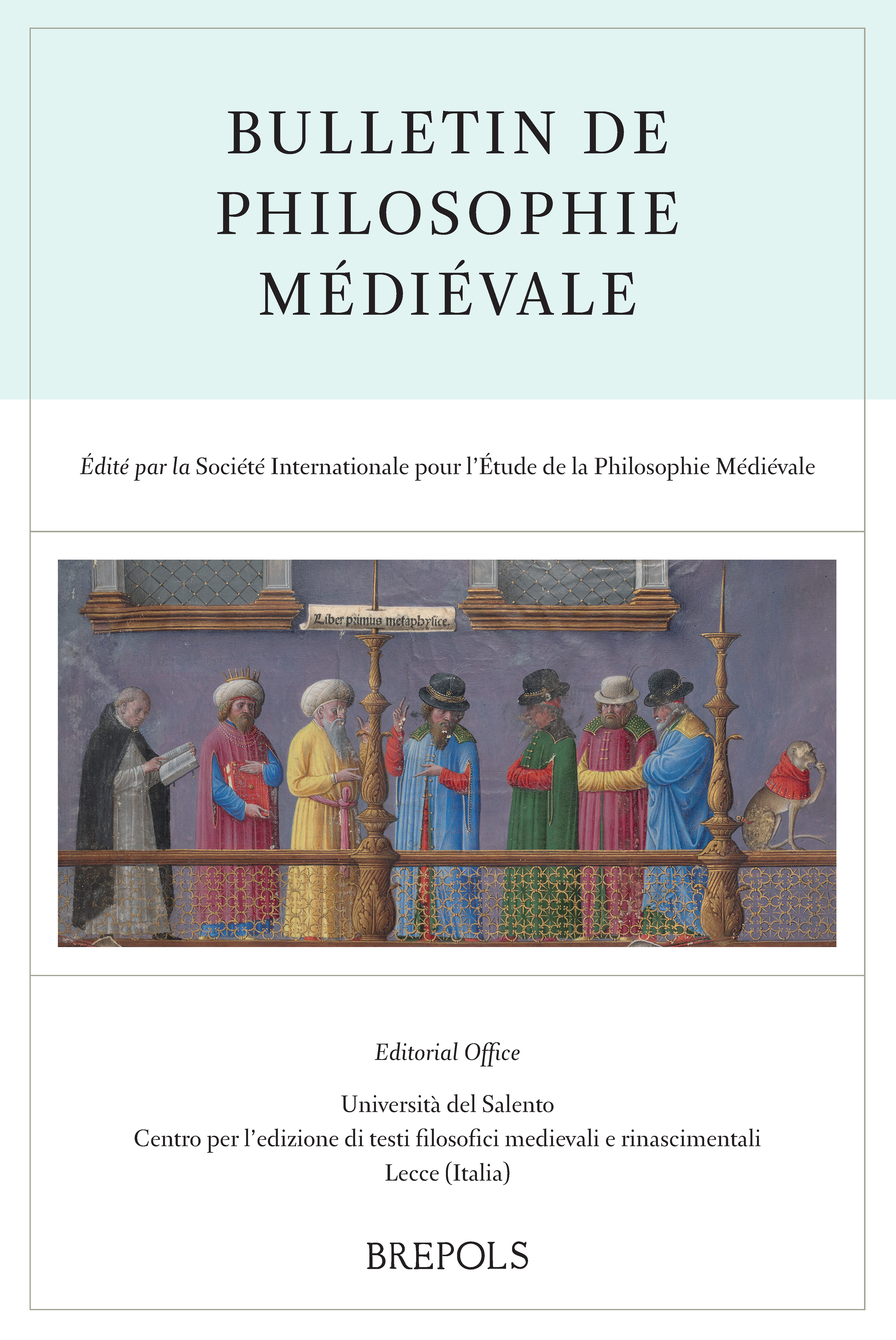
Volume 54, Issue 1, 2012
-
-
Commission II: The Latin Aristotle and Medieval Latin Commentaries on Aristotle (2007-2012)
show More to view fulltext, buy and share links for:Commission II: The Latin Aristotle and Medieval Latin Commentaries on Aristotle (2007-2012) show Less to hide fulltext, buy and share links for: Commission II: The Latin Aristotle and Medieval Latin Commentaries on Aristotle (2007-2012)Authors: Pieter De Leemans and Cecilia TrifogliAbstractThis report is divided into two main parts, devoted (1) to the Aristoteles Latinus and (2) to the Editions of Latin Commentaries on Aristotle. The report on the Aristoteles Latinus sheds light on recent research on medieval Latin translations of Aristotle’s works. Among other things, it discusses the editions published in the context of the Aristoteles Latinus (Meteorologica, translations of Aristippus and William of Moerbeke; the anonymous translation of De motu animalium; De motu animalium-De progressu animalium, translated by William of Moerbeke), and some recent studies and collective volumes on individual texts and translators. The report on Editions of Latin Commentaries on Aristotle gives information for each edition of a commentary on Aristotle that has been published in the last five years (2007-2012) and on those editions that are about to be published or are in preparation or are planned to start within the next five years.
-
-
-
Commission VII: Jewish Philosophy (2008-2012)
show More to view fulltext, buy and share links for:Commission VII: Jewish Philosophy (2008-2012) show Less to hide fulltext, buy and share links for: Commission VII: Jewish Philosophy (2008-2012)Authors: Steven Harvey and Resianne FontaineAbstractThis report of the Commission for Jewish Philosophy is based on information and personal bibliographies sent to the President of the Commission by over forty scholars in the field via the Questionnaire for SIEPM Commission Reports. Like the previous report that appeared in the Bulletin de philosophie médiévale 49 (2007), 27-44, it is thus intended to be representative and not at all exhaustive. The report features a selected bibliography, arranged alphabetically by author, of over two hundred studies in the field of medieval Jewish Philosophy, written in Western languages between the years 2008-2012. In addition, it provides a list of editions and translations in the field that have appeared during this period, as well as a list of Ph.D. dissertations in the field. The report also mentions some of the most important international conferences that have taken place, and some of the major projects. In general, the authors have tried to present a picture of the study of medieval Jewish Philosophy over the past five years, what has been its focus, what it has accomplished, and where it seems to be going. Finally, the authors address certain important issues that were raised at the meeting of the Commission for Jewish Philosophy at the 2012 SIEPM Congress in Freising.
-
-
-
Commission VIII: Byzantinische Philosophie (2007-2012)
show More to view fulltext, buy and share links for:Commission VIII: Byzantinische Philosophie (2007-2012) show Less to hide fulltext, buy and share links for: Commission VIII: Byzantinische Philosophie (2007-2012)By: Georgi KaprievAbstractThe final report of the president of the Commission (2002-2012) presents a panorama of the work of the Commission “Byzantine Philosophy,” which is one of the most active and intensively working commissions of the SIEPM, as well as of the major tendencies, results and scholars in the field over the last 10 to 15 years. The report reveals the role of the Commission in establishing the discipline during the period, and examines the transition of the discipline from its “revolutionary” phase to its status as a “normal science.” In view of the passage from the extensive to the intensive stage of the discipline, the author of the report outlines the characteristic features of the new period.
-
-
-
SIEPM Project: Report on the Repertory of Commentaries on Peter Lombard’s Sentences (2011-2012)
show More to view fulltext, buy and share links for:SIEPM Project: Report on the Repertory of Commentaries on Peter Lombard’s Sentences (2011-2012) show Less to hide fulltext, buy and share links for: SIEPM Project: Report on the Repertory of Commentaries on Peter Lombard’s Sentences (2011-2012)AbstractThis report recounts three developments during the last two years of the SIEPM Project to revise and complete the repertory of commentaries on Peter Lombard’s Sentences published by Friedrich Stegmüller in 1947. The chronological sections of the project have been established, and scholars have been assigned to lead them. A centralized administration for the Project is now located in Freiburg im Breisgau, which will co-ordinate the various sections and preserve their findings, as well as facilitate and oversee the various editorial projects on commentaries on the Sentences currently underway.
-
-
-
SIEPM Project: Scholastica colonialis. Reception and Development of Baroque Scholasticism in Latin-American Countries, 16th-18th Centuries (2010-2012)
show More to view fulltext, buy and share links for:SIEPM Project: Scholastica colonialis. Reception and Development of Baroque Scholasticism in Latin-American Countries, 16th-18th Centuries (2010-2012) show Less to hide fulltext, buy and share links for: SIEPM Project: Scholastica colonialis. Reception and Development of Baroque Scholasticism in Latin-American Countries, 16th-18th Centuries (2010-2012)Authors: Roberto H. Pich and Alfredo S. CulletonAbstractIn this report we present the summary of our experiences of visiting libraries and universities in Peru and Chile and above all make remarks on inventories and catalogues of old libraries in Peru and Chile, especially concerning collections of philosophical, theological and juridical books. We also present a bibliography of authors and works concerning Latin-American Scholasticim in the years 2010-2012, as well as M.A. and Ph.D. theses in progress treating colonial Scholasticism.
-
-
-
Ancient Physics in the Mid-Byzantine Period: The Epitome of Theodore of Smyrna, Consul of the Philosophers under Alexios I Komnenos (1081-1118)
show More to view fulltext, buy and share links for:Ancient Physics in the Mid-Byzantine Period: The Epitome of Theodore of Smyrna, Consul of the Philosophers under Alexios I Komnenos (1081-1118) show Less to hide fulltext, buy and share links for: Ancient Physics in the Mid-Byzantine Period: The Epitome of Theodore of Smyrna, Consul of the Philosophers under Alexios I Komnenos (1081-1118)By: Michele TrizioAbstractTheodore of Smyrna (11th-12th c.) is author of an epitome of natural philosophy transmitted in an incomplete form in only an early thirteenth-century manuscript (Wien ONB, cod. theol. gr. 134). Theodore was a member of the Byzantine aristocracy and head of the school of philosophy in Constantinople; in this article, Theodore’s approach to ancient physics, the contents, sources and intended audience of his work on the Physics are investigated for the first time. Finally, the author suggests that the Theodore’s epitome shows remarkable similarities with the work of other scholars from the earlier generation, a proof of the fact that the condemnation in 1082 of John Italos, Theodore’s predecessor as Consul of the Philosophers, for heterodoxy had no real impact on the way philosophy was later taught and studied in Byzantium.
-
-
-
The Influence of Thomas Aquinas on Late Byzantine Philosophical and Theological Thought: À propos of the Thomas de Aquino Byzantinus Project
show More to view fulltext, buy and share links for:The Influence of Thomas Aquinas on Late Byzantine Philosophical and Theological Thought: À propos of the Thomas de Aquino Byzantinus Project show Less to hide fulltext, buy and share links for: The Influence of Thomas Aquinas on Late Byzantine Philosophical and Theological Thought: À propos of the Thomas de Aquino Byzantinus ProjectAbstractThis article discusses the extent of influence Thomas Aquinas’ teachings exercised on Byzantine intellectuals by examining Greek translations of, and commentaries on, his writings produced between the mid-fourteenth and mid-fifteenth century. These writings provided the Byzantines with a ‘dialectical’ model of discussion, which implied a positive answer to the question of the dignitas hominis; contrary to the ‘obscurantism’ inspired by Gregory Palamas, man was seen as a being able to reach truth and attain happiness in his own terms. After Nicephoros Gregoras, Thomas’ theonymical doctrine was adopted by most Palamites and all anti-Palamites in their attempt to reconcile the notions of simplicity and multiplicity in God. Aquinas’ apologetics against Islam were also adopted by many Byzantine authors, whereas his apologetics against paganism-especially Averroism-were used by Scholarios, a fervent Aristotelian, against the fervent Platonist Plethon. Aquinas’ metaphysics and interpretation of Aristotle’s philosophy were put in the service of this objective. Finally, several specific theological issues with philosophical implications, such as God’s providence and predestination and the nature and knowledge of the angels, were treated by some Byzantines in the light of Aquinas’ ideas.
-
-
-
A Note on George Amiroutzes (c. 1400-c. 1469) and His Moral Argument against the Transmigration of Souls
show More to view fulltext, buy and share links for:A Note on George Amiroutzes (c. 1400-c. 1469) and His Moral Argument against the Transmigration of Souls show Less to hide fulltext, buy and share links for: A Note on George Amiroutzes (c. 1400-c. 1469) and His Moral Argument against the Transmigration of SoulsBy: John MonfasaniAbstractIn a recently discovered set of philosophical fragments, the late Byzantine Aristotelian George Amiroutze argues against the transmigration of souls because of necessity metempsychosis would be grounded in moral evil. If souls were of the same nature (homoeideis), then metempsychosis entails like exploiting and killing like. If one attempts to escape the moral dilemma through vegetarianism, then one falls into another moral dilemma, namely, the view that nature and the author of nature are evil since the order of nature requires that organisms exploit and devour other organisms. Amiroutzes bases much of his argument on the criterion of “common notions”; he is clearly seeking in this fragment to rebut Plotinus.
-
-
-
Les traces du Grand commentaire d’al-Fārābī à la Rhétorique d’Aristote dans la traduction arabo-latine de la Rhétorique par Hermann l’Allemand
show More to view fulltext, buy and share links for:Les traces du Grand commentaire d’al-Fārābī à la Rhétorique d’Aristote dans la traduction arabo-latine de la Rhétorique par Hermann l’Allemand show Less to hide fulltext, buy and share links for: Les traces du Grand commentaire d’al-Fārābī à la Rhétorique d’Aristote dans la traduction arabo-latine de la Rhétorique par Hermann l’AllemandAbstractThis study attempts to identify three passages in which Hermann the German, translator of the Arabic version of Aristotle’s Rhetoric into Latin, assembled extracts from Al-Fārābī’s Great Commentary on the Rhetoric, and two notes in which he mentions the Arabic philosopher by name. The criteria for isolating these passages used by W.F. Boggess in an earlier study were too general. In the article I present an edition of the five passages in question, based on the two sole manuscripts that preserve Hermann’s Arabic-Latin translation, as well as a commentary that restores each passage to its original context.
-
-
-
The Materia super libros Sententiarum Attributed to Peter Comestor: Study of the Text and Critical Edition
show More to view fulltext, buy and share links for:The Materia super libros Sententiarum Attributed to Peter Comestor: Study of the Text and Critical Edition show Less to hide fulltext, buy and share links for: The Materia super libros Sententiarum Attributed to Peter Comestor: Study of the Text and Critical EditionAbstractOne of the most significant aspects of twelfth-century theological development is the success of Peter Lombard’s Sententiarum libri quatuor. Since 1160 this text became the subject of fierce debates but also of an increasing use in the teaching activity of the Parisian masters. Peter Comestor, one of Peter Lombard’s pupils and his successor as master, composed an introitus to the Sentences whose contents were immediately seen as the proper perspective to understand Lombard’s work. The essay provides a study of Comestor’s introitus whit a critical edition of the text. A special attention is also devoted to the literary and doctrinal influence of the text, whit the edition of two texts connected with it, namely the prologue of ps.-Peter of Poitier’s Glossae and the prologue to Hugh of Saint-Cher’s commentary on the Sentences.
-
-
-
Du néoplatonisme au réalisme et retour, parcours latins du Liber de causis aux xiiie - xvie siècles
show More to view fulltext, buy and share links for:Du néoplatonisme au réalisme et retour, parcours latins du Liber de causis aux xiiie - xvie siècles show Less to hide fulltext, buy and share links for: Du néoplatonisme au réalisme et retour, parcours latins du Liber de causis aux xiiie - xvie sièclesBy: Dragos CalmaAbstractThe article presents the unknown tradition of the Latin commentaries on the Liber de causis from the thirteenth to the sixteenth century. On the basis of recent research, a new list of 56 commentaries has been established: 40 of them are unpublished, others are either lost or published in post-incunabula editions; researchers knew and cited most often only 6 commentaries (Roger Bacon Albert the Great, Siger of Brabant, Thomas Aquinas, ps.-Henry of Ghent and Giles of Rome). The new commentaries allow us to discuss certain historical hypothesis, especially the issue that the medieval authors neglected the metaphysics of Proclus. The manuscripts are held in various libraries of Europe (especially Erfurt, Krakow and Prague, but also Uppsala, Paris and Vienna) which demonstrates a wide distribution of the text. Indeed, the Liber de causis was taught not only at the Faculty of Arts in Paris around 1255, but also in the Dominican convent in the South of France in the first decades of the fourteenth century and at the Faculty of Arts in Krakow at the turn of the sixteenth century. First attributed by Latin authors to Aristotle, the Liber de causis was considered, after Thomas Aquinas’ commentary, an epitome of Proclus’ Elementatio Theologica, and has aroused great interest among the realist authors from the school of Albert the Great.
-
-
-
Notes sur un commentaire inédit au Liber de causis (Augsburg, Staats- und Stadtbibliothek, 4º Cod 68)
show More to view fulltext, buy and share links for:Notes sur un commentaire inédit au Liber de causis (Augsburg, Staats- und Stadtbibliothek, 4º Cod 68) show Less to hide fulltext, buy and share links for: Notes sur un commentaire inédit au Liber de causis (Augsburg, Staats- und Stadtbibliothek, 4º Cod 68)Authors: Alexandra Baneu and Dragos CalmaAbstractAn unpublished Latin commentary, never mentioned in the secondary literature, is in Augbsburg, Staats- und Stadtbibliothek, 4° Cod 68 ff. 272va-278ra. The same hand copies the text of the Liber de causis (which precedes it), the interlinear glosses (sometimes used in the exegesis) and the commentary. This is most likely the result of an oral teaching, as the author refers to a previous lectio. The article discusses the explicit quotations of Albert the Great, Thomas Aquinas and Proclus, and shows that the anonymous author offers an original hypothesis about the author of the Liber de causis, that he openly criticizes Thomas Aquinas’ theory of substantial forms, but he often uses Thomas to quote Proclus.
-
-
-
Guillaume de Leus, commentateur du Liber de causis
show More to view fulltext, buy and share links for:Guillaume de Leus, commentateur du Liber de causis show Less to hide fulltext, buy and share links for: Guillaume de Leus, commentateur du Liber de causisAbstractThis article presents the unedited commentary on the Liber de causis by the Dominican Guillaume de Leus, who was active beteween the end of the thirteenth and the beginning of the fourteenth century and was promoted to Master of Theology in 1309. After a reconstruction of Guillaume’s biography, the article provides a survey of his works and proposes their dates, with a special focus on his Exposicio in Librum de causis. The article contains a description of the manuscript (Città del Vaticano, BAV, Cod. Borgh. 352) that preserves the work. Finally, the article describes the commentary, its literary genre, scope, implicit and explicit sources and its prologue. An Appendix presents a list of questions that are associated with the individual propositions as well as an edition of the dedicatory letter, of the exposition of the method, and of the prologue.
-
-
-
Scholastica colonialis: Notes on Jerónimo Valera’s (1568-1625) Life, Work and Logic
show More to view fulltext, buy and share links for:Scholastica colonialis: Notes on Jerónimo Valera’s (1568-1625) Life, Work and Logic show Less to hide fulltext, buy and share links for: Scholastica colonialis: Notes on Jerónimo Valera’s (1568-1625) Life, Work and LogicAbstractJerónimo Valera (1568-1625) occupies a fundamental place in the history of colonial Latin American philosophical thought. His work Commentarii ac quaestiones in universam Aristotelis ac Subtilissimi Doctoris Ioannis Duns Scoti logicam was the first philosophical work to be printed in South America. As such it is of great value for the history of logic and philosophy of language. In this study, after discussing Valera’s career, the author highlights four aspects of Valera’s work: the novelty of a logica in via Scoti; the fact that the extant volume of Valera’s logic contains just the first part of a work divided into two parts, the latter of which has so far not been found; the presentation of representative excerpts of Valera’s Commentarii; the construction of a Table of Contents for the work.
-
-
-
Notices sur les institutions ou associations adonées specialement à l’étude de la pensée médiévale
show More to view fulltext, buy and share links for:Notices sur les institutions ou associations adonées specialement à l’étude de la pensée médiévale show Less to hide fulltext, buy and share links for: Notices sur les institutions ou associations adonées specialement à l’étude de la pensée médiévale
-
-
-
Back Matter ("Liste des ouvrages et tirés à part envoyées au secrétariat au cours de l’année 2012", "Table des manuscrits", "Table des noms d’auteurs anciens et médiévaux", " Table des noms d’auteurs modernes et contemporains", "Table des matières", "Collection « Rencontres de Philosophie Médievale »")
show More to view fulltext, buy and share links for:Back Matter ("Liste des ouvrages et tirés à part envoyées au secrétariat au cours de l’année 2012", "Table des manuscrits", "Table des noms d’auteurs anciens et médiévaux", " Table des noms d’auteurs modernes et contemporains", "Table des matières", "Collection « Rencontres de Philosophie Médievale »") show Less to hide fulltext, buy and share links for: Back Matter ("Liste des ouvrages et tirés à part envoyées au secrétariat au cours de l’année 2012", "Table des manuscrits", "Table des noms d’auteurs anciens et médiévaux", " Table des noms d’auteurs modernes et contemporains", "Table des matières", "Collection « Rencontres de Philosophie Médievale »")
-
Volumes & issues
-
Volume 66 (2024)
-
Volume 65 (2023)
-
Volume 64 (2022)
-
Volume 63 (2021)
-
Volume 62 (2020)
-
Volume 61 (2019)
-
Volume 60 (2018)
-
Volume 59 (2017)
-
Volume 58 (2016)
-
Volume 57 (2015)
-
Volume 56 (2014)
-
Volume 55 (2013)
-
Volume 54 (2012)
-
Volume 53 (2011)
-
Volume 52 (2010)
-
Volume 51 (2009)
-
Volume 50 (2008)
-
Volume 49 (2007)
-
Volume 48 (2006)
-
Volume 47 (2005)
-
Volume 46 (2004)
-
Volume 45 (2003)
-
Volume 44 (2002)
-
Volume 43 (2001)
-
Volume 42 (2000)
-
Volume 41 (1999)
-
Volume 40 (1998)
-
Volume 39 (1997)
-
Volume 38 (1996)
-
Volume 37 (1995)
-
Volume 36 (1994)
-
Volume 35 (1993)
-
Volume 34 (1992)
-
Volume 33 (1991)
-
Volume 32 (1990)
-
Volume 31 (1989)
-
Volume 30 (1988)
-
Volume 29 (1987)
-
Volume 28 (1986)
-
Volume 27 (1985)
-
Volume 26 (1984)
-
Volume 25 (1983)
-
Volume 24 (1982)
-
Volume 23 (1981)
-
Volume 22 (1980)
-
Volume 21 (1979)
-
Volume 20 (1978)
-
Volume 19 (1977)
-
Volume 18 (1976)
-
Volume 16-17 (1974)
-
Volume 15 (1973)
-
Volume 14 (1972)
-
Volume 13 (1971)
-
Volume 10-11-12 (1968)
-
Volume 8-9 (1966)
-
Volume 7 (1965)
-
Volume 6 (1964)
-
Volume 5 (1963)
-
Volume 4 (1962)
-
Volume 3 (1961)
-
Volume 2 (1960)
-
Volume 1 (1959)
Most Read This Month
