


Judaïsme Ancien / Ancient Judaism
Revue internationale d’histoire et de philologie / International Journal of History and Philology
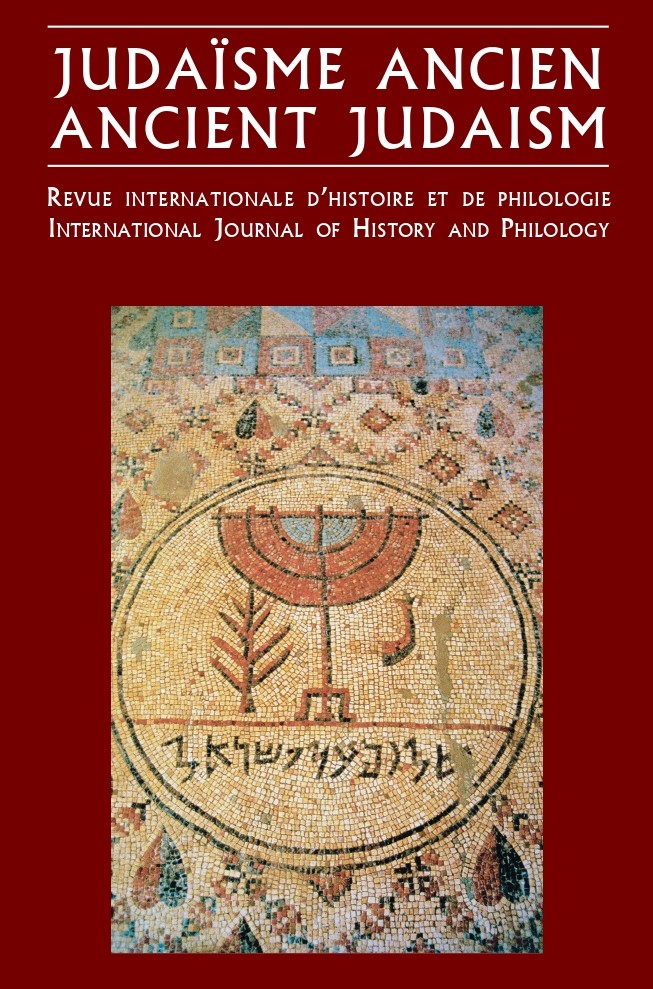
Volume 1, Issue 1, 2013
-
-
Front Matter ("Editorial Board", "Title Page", "Copyright Page", "Liminaire", "Table of Contents")
show More to view fulltext, buy and share links for:Front Matter ("Editorial Board", "Title Page", "Copyright Page", "Liminaire", "Table of Contents") show Less to hide fulltext, buy and share links for: Front Matter ("Editorial Board", "Title Page", "Copyright Page", "Liminaire", "Table of Contents")
-
-
-
Is Metatron a Converted Christian?
show More to view fulltext, buy and share links for:Is Metatron a Converted Christian? show Less to hide fulltext, buy and share links for: Is Metatron a Converted Christian?By: Daniel BoyarinAbstractDans cet article, je souhaite proposer une troisième voie de compréhension des racines et des chemins du binitarisme dans l’Antiquité tardive, y compris parmi les rabbins et dans la littérature rabbinique. Au lieu d’une vue extrême qui pose une continuité ininterrompue entre l’apocalyptique du second Temple et la littérature des Heikhalot, ou autre, récemment articulée par Peter Schäfer, selon laquelle la spéculation binitaire sur Métatron est entièrement le fruit d’une réponse au christianisme, je propose une troisième voie, à savoir qu’on a la preuve presque irréfutable d’échanges croisés entre les cercles chrétiens et juifs dans l’Antiquité tardive. Mais il existe aussi de bons indices que de telles traditions ont circulé parmi les Juifs, pendant la période rabbinique, indépendamment de tels contacts. Nous pourrions imaginer le développement de ces motifs dans la littérature des Heikhalot (et le Talmud) à travers un processus de « bricolage » déployé et redéployé dans différents contextes historiques particuliers.
AbstractIn this article, I wish to propose a third way of thinking about the roots and routes of Jewish binitarianism in Late Antiquity, including among the Rabbis and in rabbinic literature. Instead of one extreme view that posits lines of unbroken continuity between Second Temple apocalyptic and Hekhalot literature, or another, recently articulated one by Peter Schäfer, according to whom binitarian speculation about Metatron is entirely the product of a response to Christianity, I propose a third way, to wit that while there is nearly incontrovertible evidence for the interchange of Christian and Jewish circles in Late Antiquity, some of which I offer here, there is also good evidence for the circulation of such traditions among Jews through the rabbinic period independently of such contacts. We should imagine the development of these motifs in the Hekhalot literature (and the Talmud) via a process of “bricolage” deployed and redeployed in different particular historical contexts.
-
-
-
Entre judaïsme rabbinique et judaïsme synagogal : la figure du patriarche
show More to view fulltext, buy and share links for:Entre judaïsme rabbinique et judaïsme synagogal : la figure du patriarche show Less to hide fulltext, buy and share links for: Entre judaïsme rabbinique et judaïsme synagogal : la figure du patriarcheBy: José CostaAbstractThis article deals with the well-known but still problematic subject of the Jewish patriarch (nasi). It includes a clear and synthetic presentation of the sources and main interpretations, particularly in the form of tables, making it easier to compare them. It is above all based on a new hypothesis: the patriarch, who was at first the leader of the rabbinic movement, became eventually the leader of the dominant Palestinian Judaism, that is to say synagogal Judaism. The tensions between rabbis and patriarchs as well as their relation with Hellenism take on a new meaning within the framework of this hypothesis. Comparing rabbinic sources with the other ones brings a marked contrast to light: in the rabbinic sources, the patriarch essentially interacts with the rabbis, and has only few connections with the synagogue, whereas in the other sources, there is almost no mention of the rabbis, and the Theodosian Code describes the patriarch as the head leader of the whole synagogal network. Last but not least, his attempts to approach priests, which become perceptible from Rabbi Yehuda ha-nasi, appear as an important step in the process leading from rabbinic patriarch to synagogal patriarch.
AbstractLe présent article traite d’un sujet bien connu mais qui reste très problématique, celui du patriarche juif (nasi). Il comporte une présentation claire et synthétique des sources et des principales interprétations, notamment sous forme de tableaux, qui facilite le travail de comparaison. Il propose surtout une nouvelle hypothèse : le patriarche était au début le dirigeant du mouvement rabbinique et au terme de sa trajectoire historique, il est devenu le dirigeant du judaïsme palestinien majoritaire, c’est-à-dire le judaïsme synagogal. Les tensions entre rabbins et patriarches ou le rapport de ces derniers à l’hellénisme acquièrent une autre signification dans le cadre de cette hypothèse. La comparaison des sources rabbiniques et non rabbiniques fait apparaître un net contraste. Dans les premières, le patriarche est essentiellement en interaction avec les rabbins et ses liens avec la synagogue se réduisent à peu de choses. Dans les secondes, les rabbins sont presque totalement absents et le Code théodosien présente le patriarche comme le chef ultime de tout le réseau synagogal. Une orientation vers les prêtres, perceptible à partir de Rabbi Yehuda ha-nasi, a enfin constitué une des composantes du processus par lequel le patriarche rabbinique est devenu un patriarche synagogal.
-
-
-
Le procès et l’exécution des disciples de Jésus dans le Talmud de Babylone (B. Sanhédrin 43a)
show More to view fulltext, buy and share links for:Le procès et l’exécution des disciples de Jésus dans le Talmud de Babylone (B. Sanhédrin 43a) show Less to hide fulltext, buy and share links for: Le procès et l’exécution des disciples de Jésus dans le Talmud de Babylone (B. Sanhédrin 43a)By: Thierry MurciaAbstractImmediately after Jesus’ execution, the Bavli - Tractate Sanhedrin 43a in uncensored editions - relates the trial and the execution of “his five disciples”: Mattaï, Naqaï, Netser, Boni and Todah. I state that the text is a fictional story of late composition and I discuss the relevance of the various assumptions which have already been proposed by several scholars to explain these different names, the number five and the meaning of the whole document. I also show that the subtle and sophisticated dialogue between the disciples and the Sages - exchange of puns and biblical verses - reflects the discussions between Jews and Christians in later Babylonia. Last but not least, I reach the conclusion that the formula which introduces the episode: “Yeshu had five disciples”, and which is given in the Talmud as a baraita (i.e. a tannaitic dictum), is nothing but a transferring of a mishnaic formula originally related to Yohanan Ben Zakkai. Thus, the incipit gives us the tone: all this passage is a parody. On the one hand Jesus is ironically presented - in this document - as an anti-Ben Zakkai (who had five disciples). But, on the other hand and more surprisingly, he is also presented as the “new Balaam” (who had five “assessors”).
AbstractImmédiatement après avoir relaté l’exécution de Jésus, le Babli - traité Sanhédrin 43a dans les éditions non censurées - rapporte le procès et l’exécution de « ses cinq disciples »: Mattaï, Naqaï, Netser, Boni et Todah. L’auteur de cet article établit que le texte est une histoire fictive de composition tardive et discute la pertinence des diverses hypothèses savantes proposées jusqu’ici pour expliquer ces différents noms, le nombre cinq et la signification de l’ensemble du document. Il montre que le dialogue subtil et sophistiqué entre les disciples et les Sages -un échange de jeux de mots et de versets bibliques - est le reflet de discussions plus tardives qui avaient cours en Babylonie entre Juifs et chrétiens. Enfin et surtout, il parvient à la conclusion que la formule : « Yeshu avait cinq disciples », et qui est présentée dans le Talmud comme une baraïta (i.e. un dictum d’époque tannaïtique), n’est rien d’autre qu’un décalque d’une formule mishnique qui, à l’origine, se rapporte à Yohanan Ben Zakkaï. Ce faisant, l’incipit donne le ton : tout le passage est parodique. D’un côté, Jésus est ironiquement présenté, dans ce document, comme un anti-Ben Zakkaï (qui avait cinq disciples). Mais, de l’autre - et de façon plus surprenante - il y fait également figure de « nouveau Balaam » (qui avait cinq « assesseurs »).
-
-
-
Marcion the Jew
show More to view fulltext, buy and share links for:Marcion the Jew show Less to hide fulltext, buy and share links for: Marcion the JewBy: Markus VinzentAbstractMarcion de Sinope a été un des maîtres chrétiens du milieu du II e siècle à Rome. Bien qu’ Adolf von Harnack, son célèbre biographe au début du xxe siècle, le voyait issu d’une famille de Juifs prosélytes, des savants le décrivirent avec « un dégoût explicite pour le judaïsme » et « une forte attitude antisémite » (Walter Bauer). Dans cet article, sont montrées la relation complexe de Marcion au judaïsme, sa position antithétique entre le judaïsme et ce qu’il nomme « christianisme ». On insiste aussi sur le fait que ce sont des maîtres et des hérésiologues anti-marcionites qui orientèrent sa position anti-hérétique vers un christianisme anti-juif.
AbstractMarcion of Sinope was one of the Christian teachers of mid second century Rome. Although Adolf von Harnack, his famous biographer of the early 20th century, saw him derived from a family of Jewish proselytes, scholars ascribed to him “an explicit distaste for Judaism,” and “a strong anti-semitic attitude” (Walter Bauer). The following article shows Marcion’s complex relation to Judaism, his antithetical positioning between Judaism and what he calls “Christianity” and describes that only subsequently, fellow teachers and anti-Marcionite heresiologists, turned his anti-heretical position into an anti-Jewish Christianity.
-
-
-
Les religions pratiquées par les membres de la tribu de Kinda (Arabie) à la veille de l’Islam
show More to view fulltext, buy and share links for:Les religions pratiquées par les membres de la tribu de Kinda (Arabie) à la veille de l’Islam show Less to hide fulltext, buy and share links for: Les religions pratiquées par les membres de la tribu de Kinda (Arabie) à la veille de l’IslamAbstractArchaeological research carried out in the Arabian Peninsula in the last forty years confirms that in Late Antiquity Judaism had numerous followers in Yemen and the Ḥijāz. Among these Arabian Jews, a few were for sure converts and many others were probably as well. A primary issue concerns the nature of this Judaism, which appears to be different from those of rabbis (Robin, forthcoming). A second question, the topic of this contribution, is related to chronology and modes of conversion. Kinda, one of the Arab tribes in the south of the Peninsula - to be distinguished from Ḥimyaritetribes of Yemen -included numerous followers of Judaism, as Professor Michael Lecker has shown in two contributions published in 1994 and 1995, these exclusively based on Arab traditions. This tribe’s history, however, is also of much interest in that it is also known by a series of Ḥimyariteinscriptions and by a few allusions to its princes in Byzantine literature. It was therefore desirable to have a close look once more at the topic so as to draw up a comprehensive inventory of all that we know of the Kindites’ religious practices, after having precisely established this tribe’s chronology and outlined its territory and settlement. It appears that Judaism probably was the dominant religion of aristocratic lineages of the tribe of Kinda. Nevertheless this observation does not concern Kindites who placed themselves at the service of Persia or Byzantium; the religious orientation of the latter, evidently determined by political relationships, can be described as “opportunistic”. As for simple members of the tribe, if indeed they were influenced by the example of their princes, they do not appear to have converted collectively. In Pre-Islamic Arabia, religion remains a personal issue.
AbstractLes recherches archéologiques conduites dans la péninsule Arabique depuis une quarantaine d’années confirment que, dans les derniers siècles de l’Antiquité, le judaïsme a compté de nombreux adeptes au Yémen et dans le Ḥijāz. Parmi ces juifs arabiques, on peut prouver que plusieurs sont assurément des prosélytes et beaucoup probablement. Une première interrogation concerne la nature de ce judaïsme qui semble différent de celui des rabbins (Robin à paraître). Une seconde, qui fait l’objet de cette contribution, se rapporte à l’époque et aux modalités des conversions. Kinda, l’une des tribus arabes du sud de la Péninsule - à distinguer des tribus ḥimyaritesdu Yémen - a compté de nombreux adeptes du judaïsme, comme le Professeur Michael Lecker l’a mis en évidence dans deux contributions publiées en 1994 et 1995, qui se fondaient exclusivement sur les traditions arabes. L’histoire de cette tribu présente l’intérêt d’être également connue par toute une série d’inscriptions ḥimyarites et par quelques allusions à ses princes dans des ouvrages byzantins. Il était donc souhaitable de reprendre l’ensemble du dossier afin de dresser un inventaire exhaustif de tout ce que nous savons des pratiques religieuses des Kindites, après avoir précisé la chronologie et l’habitat de leur tribu. Il apparaît que le judaïsme a probablement été la religion dominante dans l’aristocratie kindite du Yémen à la veille de l’Islam. Mais cette observation ne concerne pas les Kindites qui se sont mis au service de la Perse ou de Byzance. Quant aux simples membres de la tribu, s’ils ont sans doute été influencés par l’exemple de leurs princes, il ne semble pas qu’ils se soient convertis collectivement. Dans l’Arabie préislamique, la religion reste une affaire personnelle.
-
-
-
Le judaïsme chrétien ancien : quelques remarques et réflexions sur un problème débattu et rebattu
show More to view fulltext, buy and share links for:Le judaïsme chrétien ancien : quelques remarques et réflexions sur un problème débattu et rebattu show Less to hide fulltext, buy and share links for: Le judaïsme chrétien ancien : quelques remarques et réflexions sur un problème débattu et rebattuBy: Simon C. MimouniAbstractIn this contribution, I would like to return to the definition of the phenomenon that I addressed twenty years ago in an article published in New Testament Studies. I will take into account researches published since then, particularly those on the study of ancient Judaism and I will propose new parameters.
AbstractDans cette contribution, je voudrais revenir sur la définition d’un phénomène que j’avais élaborée il y a vingt ans dans un article publié dans les New Testament Studies. Je voudrais prendre en compte les recherches publiées depuis, en particulier celles sur l’étude du judaïsme ancien et proposer de nouveaux paramètres.
-
-
-
Jan Dušek, Les manuscrits araméens du Wadi Daliyeh et la Samarie vers 450-332 av. J.-C., Leyde-Boston, Brill, 2007
show More to view fulltext, buy and share links for:Jan Dušek, Les manuscrits araméens du Wadi Daliyeh et la Samarie vers 450-332 av. J.-C., Leyde-Boston, Brill, 2007 show Less to hide fulltext, buy and share links for: Jan Dušek, Les manuscrits araméens du Wadi Daliyeh et la Samarie vers 450-332 av. J.-C., Leyde-Boston, Brill, 2007By: David Hamidović
-
-
-
Daniel R. Schwartz – Zeev Weiss (éd.), Was 70 CE a Watershed in Jewish History ? On Jews and Judaism before and after the Destruction of the Second Temple, Leyde-Boston, Brill, 2012
show More to view fulltext, buy and share links for:Daniel R. Schwartz – Zeev Weiss (éd.), Was 70 CE a Watershed in Jewish History ? On Jews and Judaism before and after the Destruction of the Second Temple, Leyde-Boston, Brill, 2012 show Less to hide fulltext, buy and share links for: Daniel R. Schwartz – Zeev Weiss (éd.), Was 70 CE a Watershed in Jewish History ? On Jews and Judaism before and after the Destruction of the Second Temple, Leyde-Boston, Brill, 2012By: Régis Burnet
-
-
-
Daniel Boyarin, The Jewish Gospels: The Story of the Jewish Christ (avec une préface de Jack Miles), New York, The New Press, 2012
show More to view fulltext, buy and share links for:Daniel Boyarin, The Jewish Gospels: The Story of the Jewish Christ (avec une préface de Jack Miles), New York, The New Press, 2012 show Less to hide fulltext, buy and share links for: Daniel Boyarin, The Jewish Gospels: The Story of the Jewish Christ (avec une préface de Jack Miles), New York, The New Press, 2012
-
-
-
Denise Kimber Buell, Pourquoi cette race nouvelle ? Le raisonnement ethnique dans le christianisme des premiers siècles, Paris, Éditions du Cerf, 2012
show More to view fulltext, buy and share links for:Denise Kimber Buell, Pourquoi cette race nouvelle ? Le raisonnement ethnique dans le christianisme des premiers siècles, Paris, Éditions du Cerf, 2012 show Less to hide fulltext, buy and share links for: Denise Kimber Buell, Pourquoi cette race nouvelle ? Le raisonnement ethnique dans le christianisme des premiers siècles, Paris, Éditions du Cerf, 2012By: Simon C. Mimouni
-
-
-
Tilman Nagel, Mahomet. Histoire d’un Arabe – Invention d’un prophète, Genève, Labor et Fides, 2012. Livres reçus à la Rédaction
show More to view fulltext, buy and share links for:Tilman Nagel, Mahomet. Histoire d’un Arabe – Invention d’un prophète, Genève, Labor et Fides, 2012. Livres reçus à la Rédaction show Less to hide fulltext, buy and share links for: Tilman Nagel, Mahomet. Histoire d’un Arabe – Invention d’un prophète, Genève, Labor et Fides, 2012. Livres reçus à la RédactionBy: Mathieu Terrier
-
-
-
Bulletin
show More to view fulltext, buy and share links for:Bulletin show Less to hide fulltext, buy and share links for: BulletinAbstractInformations sur les thèses et habilitations à diriger des recherches, 303
- Thèse de Daniel Barbu, 303
- Thèse de Thierry Murcia, 306
Informations sur les projets,310
- La question de la sacerdotalisation du judaïsme chrétien et du judaïsme synagogal 310
Informations sur les colloques, 312
- La mémoire des persécutions, Paris 2012, par Simon C. Mimouni, 312
- Aux origines du messianisme juif, Lausanne 2012, par David Hamidović, 319
- Les judaïsmes dans tous leurs états aux Ier-IIe siècles (les Judéens des synagogues, les chrétiens et les rabbins), Lausanne 2012, par Simon C. Mimouni, 321
- Jews and Christians in Antiquity: a regional perspective, Leuven 2013, par Pierluigi Lanfranchi, 324
-
Most Read This Month
