


Peritia
Journal of the Medieval Academy of Ireland
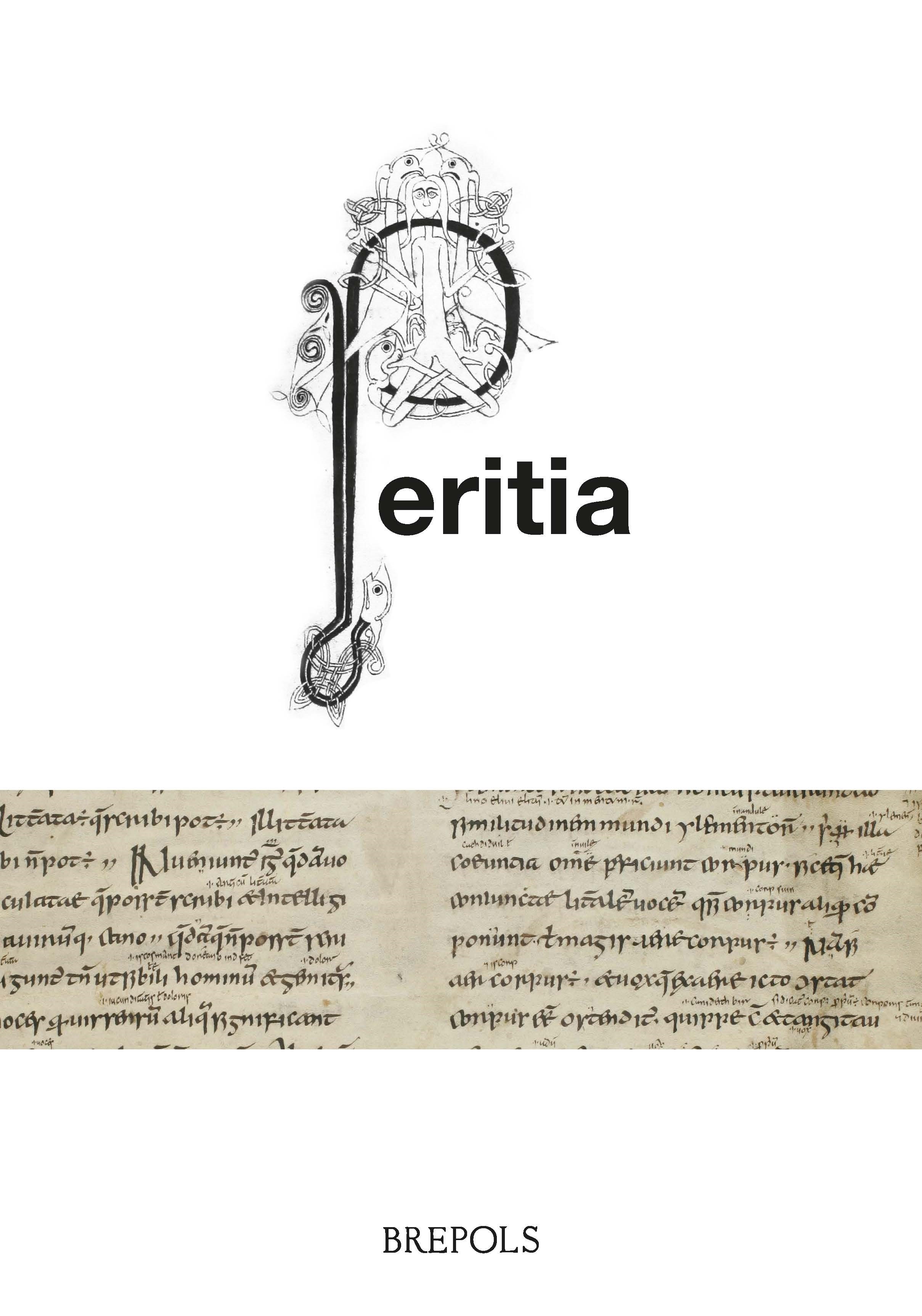
Volume 13, Issue 1, 1999
-
-
Front Matter (Title Page, Copyright Page, Table of Contents, Abbreviations)
show More to view fulltext, buy and share links for:Front Matter (Title Page, Copyright Page, Table of Contents, Abbreviations) show Less to hide fulltext, buy and share links for: Front Matter (Title Page, Copyright Page, Table of Contents, Abbreviations)
-
-
-
The Eusebian apparatus in some Vulgate gospel books
show More to view fulltext, buy and share links for:The Eusebian apparatus in some Vulgate gospel books show Less to hide fulltext, buy and share links for: The Eusebian apparatus in some Vulgate gospel booksAbstractIn certain Vulgate gospel books there is a full cross-referencing system that is based on the work of Eusebius of Caesarea. A study of this apparatus may tell us a great deal about the textual tradition and inter-relationships of gospel books, as well as providing information for the history of gospel exegesis. An edition, as a starting point for further comparisons, of this apparatus from St Gallen 1395 (oldest Vulgate codex) and the Book of Durrow is provided.
-
-
-
Medius as ‘middle’ and ‘mean’
show More to view fulltext, buy and share links for:Medius as ‘middle’ and ‘mean’ show Less to hide fulltext, buy and share links for: Medius as ‘middle’ and ‘mean’By: David HowlettAbstractA survey of evidence of an Insular Latin tradition of composition from the fifth century to the fifteenth, in which writers make words exhibit by their position varied mathematical meanings. These writers and texts include Adelard of Bath, Aediluulf, Ailerán, Aldhelm, Asser, Bede, Boethius, Boniface, Columban, Cummian, Dicuill, Geoffrey of Monmouth, Gildas, Giraldus Cambrensis, Henry of Huntingdon, Israel Grammaticus, Jocelin of Furness, John of Kelso, John of Salisbury, Moucan, Osbern of Gloucester, Patrick, Pelagius, Peter of Cornwall, Robertus de Hopprew, Theodore of Canterbury, Turgot of Durham, Virgilius Maro Grammaticus, William of Malmesbury, Ciues celestis patrie, De situ Albanie, Encomium Emmae, Jeu d’Adam, Nauigatio S. Brendani, Synodus episcoporum, St Margaret’s Gospel Book, Vita S. Conwoionis, Vita S. Iltuti.
-
-
-
Dicuill on the islands of the north
show More to view fulltext, buy and share links for:Dicuill on the islands of the north show Less to hide fulltext, buy and share links for: Dicuill on the islands of the northBy: David HowlettAbstractAn edition, translation, and analysis of Dicuill’s Liber de mensura orbis terrae, vii 6–15 in which verbal and arithmetic features enable the reader to authenticate the text internally, to understand the basis of his correction of the accounts of ancient geographers, and to ascertain possible dates of an expedition by Irish clerics who observed the summer solstice in Iceland and sailed to the polar icecap.
-
-
-
More Israelite learning in Insular Latin
show More to view fulltext, buy and share links for:More Israelite learning in Insular Latin show Less to hide fulltext, buy and share links for: More Israelite learning in Insular LatinBy: David HowlettAbstractFurther evidence for a knowledge of Hebrew and Aramaic amongst the learned in the British Isles in the Roman period, and in the early and later middle ages.
-
-
-
The shape of the Durrow cross
show More to view fulltext, buy and share links for:The shape of the Durrow cross show Less to hide fulltext, buy and share links for: The shape of the Durrow crossAbstractThe shape of the Durrow Cross is made up of lines with measures and distances answerable entirely to ratios incorporating only 1, 2, and φ (the golden section). This paper gives a practical method for its construction, and discusses the scheme of its proportions.
-
-
-
Spoliation of the past: the destruction of monuments and treasure-hunting in nineteenth-century Ireland
show More to view fulltext, buy and share links for:Spoliation of the past: the destruction of monuments and treasure-hunting in nineteenth-century Ireland show Less to hide fulltext, buy and share links for: Spoliation of the past: the destruction of monuments and treasure-hunting in nineteenth-century IrelandBy: Gillian M. SmithAbstractThis article discusses the destruction of archaeological sites and field monuments in the early nineteenth-century and the fate of material remains that were uncovered in the process. Ordnance Survey records of the 1820s and 1830s show that very much of Ireland’s medieval inheritance survived the ravages of war and conquest but began to disappear in the decades before the Great Famine.
-
-
-
The Turin glosses on Mark: towards a cultural profile of the glossator
show More to view fulltext, buy and share links for:The Turin glosses on Mark: towards a cultural profile of the glossator show Less to hide fulltext, buy and share links for: The Turin glosses on Mark: towards a cultural profile of the glossatorBy: Michael CahillAbstractThe Turin, Biblioteca Nazionale Universitaria, F. IV.1, fasc. 7, Old-Irish glosses on a commentary on Mark are described in regard to nature and content, and especially errors and anomalies, and the Glossator’s sources and possible knowledge of Greek. Allowance is made for the Glossator’s originality. An analysis of the data is then presented, dealing with the identity of the Glossator and his cultural profile. Auxerre in the latter half of the ninth century is proposed as a plausible setting.
-
-
-
Ulysses and the judge of truth: sources and meanings in the Irish Odyssey
show More to view fulltext, buy and share links for:Ulysses and the judge of truth: sources and meanings in the Irish Odyssey show Less to hide fulltext, buy and share links for: Ulysses and the judge of truth: sources and meanings in the Irish OdysseyBy: Barbara HillersAbstractThe medieval Merugud Uilixis meic Leirtis is a highly original adaptation of the Odyssey. Evidence for Ireland’s indebtedness to classical learning, it is also a showcase for the interaction between oral and written tradition in medieval Ireland: the Odyssean framework has been skilfully combined with an international folktale still popular in Ireland. This article explores the story’s classical background and its folktale component. Finally, it directs attention to the anonymous author, his use of sources and the meaning he gave the tale.
-
-
-
Omens, ordeals and oracles: on demons and weapons in early Irish texts
show More to view fulltext, buy and share links for:Omens, ordeals and oracles: on demons and weapons in early Irish texts show Less to hide fulltext, buy and share links for: Omens, ordeals and oracles: on demons and weapons in early Irish textsAbstractThe account of a sword ritual in Serglige Con Culainn involves references to two different kinds of divination, reflected in two consecutive sentences in the text: the first describes the ritual as an ordeal, the second as an oracle. The supernatural source of the oracle is identified as ‘demons’ by the text. It is here argued that the religious and literary background of these demons is formed by certain types of supernatural battle creature, especially the Irish war goddesses.
-
-
-
Tánaise ríg: the earliest evidence
show More to view fulltext, buy and share links for:Tánaise ríg: the earliest evidence show Less to hide fulltext, buy and share links for: Tánaise ríg: the earliest evidenceBy: Marilyn DunnAbstractThe Rule of the master shows numerous signs of Irish influence, as well as instances of Lombard-Latin vocabulary, suggesting that it was composed, not before Benedict, but at the Columbanian monastery of Bobbio in northern Italy in the seventh century. It also uses the term secundarius to mean a designated successor, a usage familiar from the Life of Alfred and comparable to the Irish tánaise ríg, confirming the antiquity of the concept and even suggesting that it may have been known as early as the time of Columbanus (†615).
-
-
-
The so-called omission of the baptismal formula in the order of baptism in the Stowe Missal
show More to view fulltext, buy and share links for:The so-called omission of the baptismal formula in the order of baptism in the Stowe Missal show Less to hide fulltext, buy and share links for: The so-called omission of the baptismal formula in the order of baptism in the Stowe MissalBy: Victor de WaalAbstractA discussion of the ordo baptismi in the early medieval Irish church, leading to the conclusion that its baptism represented the survival of Early Christian usages.
-
-
-
Reiclés in the Irish annals to ad 1200
show More to view fulltext, buy and share links for:Reiclés in the Irish annals to ad 1200 show Less to hide fulltext, buy and share links for: Reiclés in the Irish annals to ad 1200By: Aidan MacdonaldAbstractThis paper offers a detailed discussion of the annalistic evidence for the Early Medieval church type, reiclés, in an attempt to establish its true nature and its role in the Irish church in the twelfth century and before.
-
-
-
Church and state in Angevin Ireland
show More to view fulltext, buy and share links for:Church and state in Angevin Ireland show Less to hide fulltext, buy and share links for: Church and state in Angevin IrelandBy: W. L. WarrenAbstractAn examination of the ecclesiastical policy of the first Angevin kings in Ireland suggests that the period 1171-1216 constitutes a distinct phase in Irish history characterised by a desire on the part of Henry II and king John to pursue a policy of peaceful co-existence between Irish and Anglo-Norman, rather than division and competition; a more colonial attitude becomes apparent during the minority of Henry III.
-
-
-
Waiting for the registrar: appeal at the metropolitan court of Armagh
show More to view fulltext, buy and share links for:Waiting for the registrar: appeal at the metropolitan court of Armagh show Less to hide fulltext, buy and share links for: Waiting for the registrar: appeal at the metropolitan court of ArmaghBy: M. A. SughiAbstractThe presentation of an appeal to a metropolitan court is an important aspect of medieval ecclesiastical law. Here it is treated in three stages with reference to the Armagh registers: (i) the recipient of the appeal in canon law; (ii) the degree to which the principles of universal canon law, ius commune, were observed at Armagh; and (iii) the preliminaries of a case of appeal (up to its presentation) as reconstructed from the Armagh registers in the metropolitan court of Armagh. Though technical, the matters throws vivid new light on aspects of Irish life at the end of the middle age.
-
-
-
Toby Barnard, Dáibhí Ó Cróinín & Katharine Simms (ed), A miracle of learning: studies in manuscripts and Irish learning: essays in honour of William O’Sullivan
show More to view fulltext, buy and share links for:Toby Barnard, Dáibhí Ó Cróinín & Katharine Simms (ed), A miracle of learning: studies in manuscripts and Irish learning: essays in honour of William O’Sullivan show Less to hide fulltext, buy and share links for: Toby Barnard, Dáibhí Ó Cróinín & Katharine Simms (ed), A miracle of learning: studies in manuscripts and Irish learning: essays in honour of William O’Sullivan
-
Volumes & issues
-
Volume 35 (2024)
-
Volume 34 (2023)
-
Volume 33 (2022)
-
Volume 32 (2021)
-
Volume 31 (2020)
-
Volume 30 (2019)
-
Volume 29 (2018)
-
Volume 28 (2017)
-
Volume 27 (2016)
-
Volume 26 (2015)
-
Volume 24-25 (2014)
-
Volume 22-23 (2011)
-
Volume 21 (2010)
-
Volume 20 (2008)
-
Volume 19 (2005)
-
Volume 17-18 (2003)
-
Volume 16 (2002)
-
Volume 15 (2001)
-
Volume 14 (2000)
-
Volume 13 (1999)
-
Volume 12 (1998)
-
Volume 11 (1997)
-
Volume 10 (1996)
-
Volume 9 (1995)
-
Volume 8 (1994)
-
Volume 6-7 (1987)
-
Volume 5 (1986)
-
Volume 4 (1985)
-
Volume 3 (1984)
-
Volume 2 (1983)
-
Volume 1 (1982)
Most Read This Month
