


Peritia
Journal of the Medieval Academy of Ireland
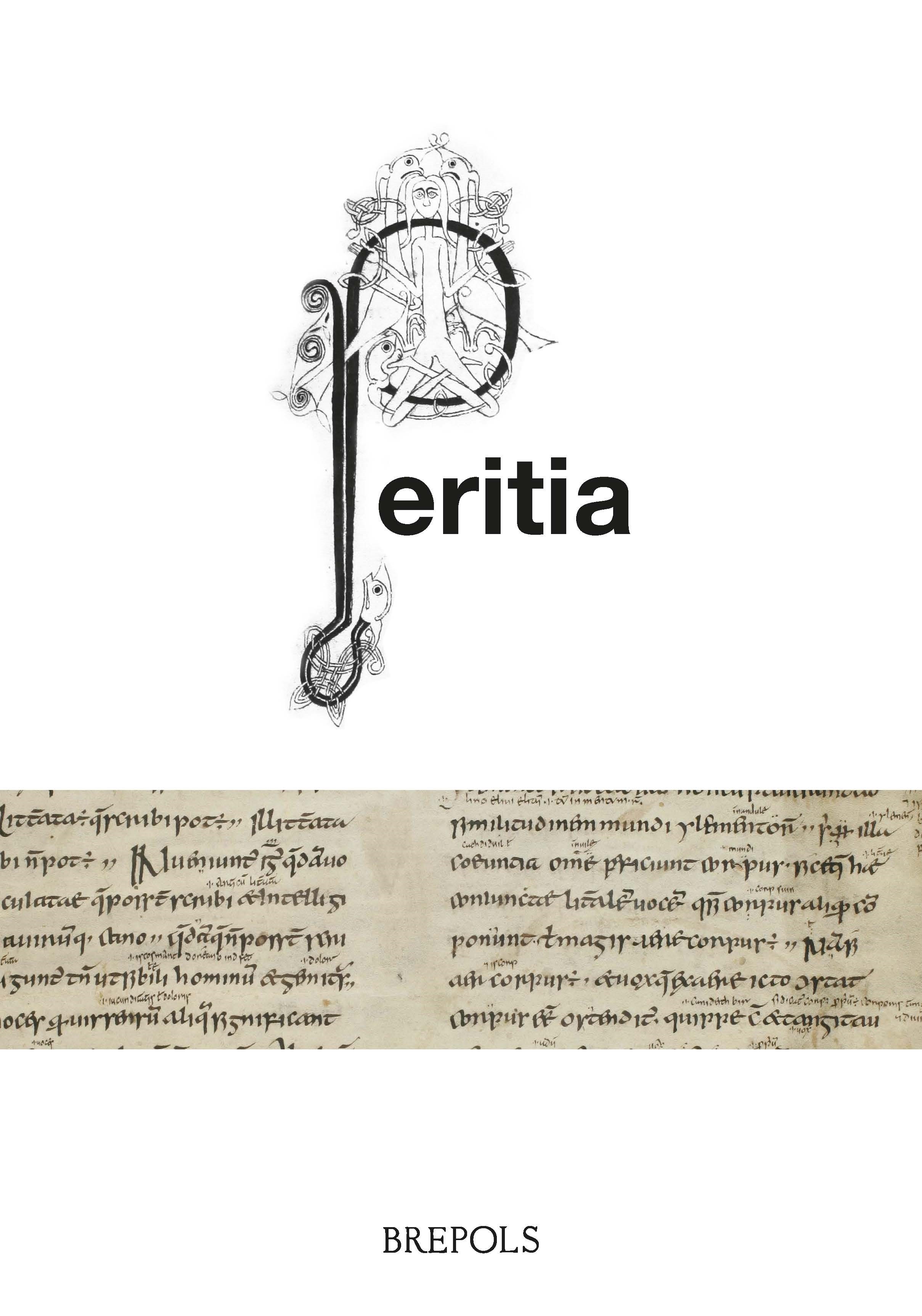
Volume 17-18, Issue 1, 2003
-
-
Front Matter (Title Page, Copyright Page, Table of Contents, Abbreviations)
show More to view fulltext, buy and share links for:Front Matter (Title Page, Copyright Page, Table of Contents, Abbreviations) show Less to hide fulltext, buy and share links for: Front Matter (Title Page, Copyright Page, Table of Contents, Abbreviations)
-
-
-
The date and origin of Liber de ordine creaturarum
show More to view fulltext, buy and share links for:The date and origin of Liber de ordine creaturarum show Less to hide fulltext, buy and share links for: The date and origin of Liber de ordine creaturarumBy: Marina SmythAbstractA survey of recent scholarly views on various aspects of Liber de ordine creaturarum is followed by a demonstration that the treatise was written in Ireland between 655 ad 680.
-
-
-
The obscurantists and the sea-monster: reflections on the Hisperica famina
show More to view fulltext, buy and share links for:The obscurantists and the sea-monster: reflections on the Hisperica famina show Less to hide fulltext, buy and share links for: The obscurantists and the sea-monster: reflections on the Hisperica faminaBy: John CareyAbstractCorrespondences in vocabulary, together with divergence in plot, indicate that the authors of the adventure stories in the A and B versions of the Hisperica famina worked from a shared word list rather than from a textual model. They appear to have derived their themes from Irish oral narrative, for which the Hisperica famina may accordingly be our earliest witness.
-
-
-
Early Insular Latin poetry
show More to view fulltext, buy and share links for:Early Insular Latin poetry show Less to hide fulltext, buy and share links for: Early Insular Latin poetryBy: David HowlettAbstractThe essay considers some aspects, chronological, contextual, formal, structural, and generic, of the development of Cambro-, Hiberno-, and Anglo-Latin poetry from Romano-British times to the Norman Conquest.
-
-
-
Searching for St Benedict in the legacy of St Gregory the Great
show More to view fulltext, buy and share links for:Searching for St Benedict in the legacy of St Gregory the Great show Less to hide fulltext, buy and share links for: Searching for St Benedict in the legacy of St Gregory the GreatBy: Francis ClarkAbstractThe controversy concerning the authenticity of Gregory the Great’s Dialogues, rekindled by the publication in 1987 of The Pseudo-Gregorian dialogues, has continued for almost 20 years. In this essay, the state of the question is reviewed, and the main arguments presented for inauthenticity are summarised.
-
-
-
The making of the Canons of Theodore
show More to view fulltext, buy and share links for:The making of the Canons of Theodore show Less to hide fulltext, buy and share links for: The making of the Canons of TheodoreBy: Roy FlechnerAbstractThe present paper examines the evolution of archbishop Theodore’s canonical and penitential teachings from oral sayings to popular written texts. In the course of the investigation, two previously unidentified fragments of Theodoran material are introduced, a new source for his teachings is brought to light, and a date for some Theodoran texts is proposed. The evidence sheds new light on the making of an early medieval canon law authority.
-
-
-
The prologue to the Collectio canonum hibernensis
show More to view fulltext, buy and share links for:The prologue to the Collectio canonum hibernensis show Less to hide fulltext, buy and share links for: The prologue to the Collectio canonum hibernensisBy: David HowlettAbstractAn edition, translation, and analysis of the Prologue to the Collectio canonum hibernensis, compiled by Ruben of Dairinis and Cú Chuimne of Iona. Publication by Cú Chuimne in 735–36 is suggested.
-
-
-
Numerical punctilio in Patrick’s Confessio
show More to view fulltext, buy and share links for:Numerical punctilio in Patrick’s Confessio show Less to hide fulltext, buy and share links for: Numerical punctilio in Patrick’s ConfessioBy: David HowlettAbstractThis note considers in Patrick’s Confessio validation of words for numbers by their positions.
-
-
-
The composition of Adomnán’s Vita Columbae
show More to view fulltext, buy and share links for:The composition of Adomnán’s Vita Columbae show Less to hide fulltext, buy and share links for: The composition of Adomnán’s Vita ColumbaeBy: Mark StansburyAbstractAn examination of the manuscripts of Adomnán’s Vita Columbae reveals the various stages in the composition of the work and argues that Adomnán died before he completed revising the text.
-
-
-
Adomnán, Cumméne Ailbe, and the Picts
show More to view fulltext, buy and share links for:Adomnán, Cumméne Ailbe, and the Picts show Less to hide fulltext, buy and share links for: Adomnán, Cumméne Ailbe, and the PictsBy: James E. FraserAbstractThe treatment of Pictish subjects in Adomnán’s Vita sancti Columbae is more complex than has hitherto been appreciated. In regard to the significance of Columba for Pictish ecclesiastical history, it is possible to isolate a stream of thought within the text attributable to Cumméne Ailbe’s Liber de uirtutibus sancti Columbae, and to demonstrate that Adomnán’s own view was rather different.
-
-
-
Iona and the kingship of Dál Riata in Adomnán’s Vita Columbae
show More to view fulltext, buy and share links for:Iona and the kingship of Dál Riata in Adomnán’s Vita Columbae show Less to hide fulltext, buy and share links for: Iona and the kingship of Dál Riata in Adomnán’s Vita ColumbaeBy: Miho TanakaAbstractIn Adomnán’s Vita Columbae (VC) three kings are said to ordained by God: Diarmait mac Cerbaill, Oswald of Northumbria, and Áedán mac Gabráin, king of Dál Riata. Áedán alone is ordained at the command of an angel (VC 3.5). The same chapter includes text by Cumméne, who wrote the Liber de uirtutibus sancti Columbae about the middle of the seventh century. Some chapters of VC tell of the relationship between Iona and the kingship of Dál Riata from Columba’s time to Adomnán’s. This paper considers why Adomnán wrote about the royal ordination of Áedán, examines Áedán as a historical person, and considers the relationship between Columba and Dál Riata in its possible political context.
-
-
-
Diarmait sapientissimus: the career of Diarmait, dalta Daigre, abbot of Iona
show More to view fulltext, buy and share links for:Diarmait sapientissimus: the career of Diarmait, dalta Daigre, abbot of Iona show Less to hide fulltext, buy and share links for: Diarmait sapientissimus: the career of Diarmait, dalta Daigre, abbot of IonaAbstractDiarmait, dalta Daigre, abbot of Iona (814/831×849), has been neglected in the historiography for partly accidental reasons. His career reveals both his own involvement in setting a new political and ecclesiastical agenda for the Columban familia in the early ninth century—particularly in relation to the monastic profession—and also the wider issues facing the Columban familia, such as Viking raids, newly aggressive royal power, and church reform. Suggestions are made about several aspects of his background, his eventual fate, and his connection with two works associated with Iona on the continent in the ninth century, namely, the poem on the death of Blathmac by Walahfrid Strabo, and the Schaffhausen ms of the Vita Columbae, which was in use in St Gall about this time. Further speculation on the Milan glosses is ventured.
-
-
-
The Vikings in Southern Uí Néill until 1014
show More to view fulltext, buy and share links for:The Vikings in Southern Uí Néill until 1014 show Less to hide fulltext, buy and share links for: The Vikings in Southern Uí Néill until 1014By: Claire DownhamAbstractThis paper provides a brief survey of Viking influence in Southern Uí Néill to 1014. The evidence highlights the resilience of both churches and polities in the face of Viking attacks, compared to the Vikings’ impact in England. Viking settlement and territorial power was limited to areas near the Irish Sea coast, and various strategies were employed to limit the impact of Viking attacks. Nevertheless, Vikings exercised a strong impact on the political and economic history of the region. Prior to the battle of Clontarf, Brian Boru and Mael Sechnaill overking of Uí Néill vied for control over the resources of Dublin. This competition was reflected both in events and in political propaganda.
-
-
-
Vikings and saints—encounters vestan um haf
show More to view fulltext, buy and share links for:Vikings and saints—encounters vestan um haf show Less to hide fulltext, buy and share links for: Vikings and saints—encounters vestan um hafBy: Jan Erik RekdalAbstractThis study discusses whether there are reasons to believe that saints’ legends in Ireland and Britain contributed to the import and formation of legends in Norway and Iceland. Church dedications near or within settlement-areas are pointed out, in Orkney/Caithness, the Hebrides, Ireland, Man and Cumbria. In many of these Norse-speaking people had their first encounters with christianity long before it was introduced in Norway by the christian lords and their English missionaries. The point of departure for this survey is the legend of St Sunniva, the earliest saint we know of in the Norwegian and Icelandic tradition of saints. This is the only legend extant of a saint from the colonies in the West. Three of the main features constituting Sunniva’s legend are represented by the legends of Triduana (Tredwell, Trollhøna), Donnán, Mo Nenna, and Bega.
-
-
-
The expulsion of the Ostmen, 1169–71: the documentary evidence
show More to view fulltext, buy and share links for:The expulsion of the Ostmen, 1169–71: the documentary evidence show Less to hide fulltext, buy and share links for: The expulsion of the Ostmen, 1169–71: the documentary evidenceBy: Emer PurcellAbstractTradition holds that the Anglo-Normans, when they took Dublin, expelled the Hiberno-Norse or Ostmen to the north bank of the Liffey where they formed a distinct settlement, Oxmantown. Close reading of the primary sources does not support this interpretation. A fourteenth-century account of the settling of Waterford has too much influenced our understanding of the settlement of Oxmantown, and of the treatment of the Ostmen in Anglo-Norman Ireland.
-
-
-
The genealogical section of the Psalter of Cashel
show More to view fulltext, buy and share links for:The genealogical section of the Psalter of Cashel show Less to hide fulltext, buy and share links for: The genealogical section of the Psalter of CashelBy: Bart JaskiAbstractThe genealogical section of the Psalter of Cashel was probably drafted c.900 by Cormac mac Cuilennáin, the bishop-king of Cashel. For Munster it draws mainly on records compiled c.740. The Psalter was updated c.1000. After a limited update c.1015 the Psalter was further edited by northern scholars in the eleventh century. Copies reached Leinster in the twelfth, and were included in Rawlinson B.502 and the Book of Leinster. The main stages of compilation are reflected in changes in genealogical doctrines, as the secular genealogies and the genealogies of the saints of Munster show. This section of the Psalter probably contained narrative material as well.
-
-
-
Co nómad n-ó: an early Irish socio-legal timescale
show More to view fulltext, buy and share links for:Co nómad n-ó: an early Irish socio-legal timescale show Less to hide fulltext, buy and share links for: Co nómad n-ó: an early Irish socio-legal timescaleBy: Rolf BaumgartenAbstractDiscussion of the origins of the phrase co nómad n-ó and of its application in (1) Críth gablach and Cóic conara fugill; (2) Audacht Moraind and the Rule of Mochuta; and (3) Ces Noínden and the metrical Dindshenchas.
-
-
-
Royal succession in earlier medieval Ireland: the fiction of tanistry
show More to view fulltext, buy and share links for:Royal succession in earlier medieval Ireland: the fiction of tanistry show Less to hide fulltext, buy and share links for: Royal succession in earlier medieval Ireland: the fiction of tanistryBy: Megan McGowanAbstractA review of previous hypotheses on the meaning of tánaise ríg and a new interpretation of the term. Tánaise (ríg) in the law tracts, narrative literature and indigenous chronicles is analysed to disprove the standard interpretation as ‘tanist’, that is, an heir designate selected during the lifetime of a reigning king, and to argue instead that tánaise ríg in earlier medieval Ireland is the representative of a king or his second in command. This analysis also establishes that tanistry began to be practised in Ireland—and then not widely—only in the later middle ages, although it existed as an ideal in the earlier middle ages.
-
-
-
The marriage of Childeric II and Bilichild in the context of the Grimoald coup
show More to view fulltext, buy and share links for:The marriage of Childeric II and Bilichild in the context of the Grimoald coup show Less to hide fulltext, buy and share links for: The marriage of Childeric II and Bilichild in the context of the Grimoald coupBy: Julia HofmanAbstractThe marriage of the Neustrian prince Childeric II to his Austrasian first cousin Bilichild, consummated in 662, is the only known union between blood-related members of the Merovingian ruling houses. It is not, however, as unique in its contravention of custom and canon law as it may first appear, but is merely one of several instances in which a Merovingian ruler made use of controversial marital politics in order to respond to sudden shifts in the power currents of the Frankish regna. Given that Childeric and Bilichild’s common ancestry lends an extra dimension to a comparison with earlier incestuous marriages within the Merovingian family, it seems likely that their union was conceived in response to a hitherto unprecedented challenge to Merovingian authority. Rooted in the unusual circumstances of the late 650s, it may therefore have been directly connected with the Merovingian need to re-establish control over Austrasia in the wake of the so-called Grimoald coup.
-
-
-
The alternation of the kingship of Tara 734–944
show More to view fulltext, buy and share links for:The alternation of the kingship of Tara 734–944 show Less to hide fulltext, buy and share links for: The alternation of the kingship of Tara 734–944By: Immo WarntjesAbstractThe kingship of Tara alternated strictly between two Uí Néill dynasties, Cenél nEógain and Clann Cholmáin, between 734 and 944. This is an examination of how it was possible to exclude the other two main Uí Néill dynasties, Cenél Conaill and Síl nÁedo Sláine, from this kingship, how this alternation came into being, and how it was maintained. The main question is whether this strict alternation was at any time confirmed by treaties or whether it was merely the result of the power-politics of the day.
-
Volumes & issues
-
Volume 35 (2024)
-
Volume 34 (2023)
-
Volume 33 (2022)
-
Volume 32 (2021)
-
Volume 31 (2020)
-
Volume 30 (2019)
-
Volume 29 (2018)
-
Volume 28 (2017)
-
Volume 27 (2016)
-
Volume 26 (2015)
-
Volume 24-25 (2014)
-
Volume 22-23 (2011)
-
Volume 21 (2010)
-
Volume 20 (2008)
-
Volume 19 (2005)
-
Volume 17-18 (2003)
-
Volume 16 (2002)
-
Volume 15 (2001)
-
Volume 14 (2000)
-
Volume 13 (1999)
-
Volume 12 (1998)
-
Volume 11 (1997)
-
Volume 10 (1996)
-
Volume 9 (1995)
-
Volume 8 (1994)
-
Volume 6-7 (1987)
-
Volume 5 (1986)
-
Volume 4 (1985)
-
Volume 3 (1984)
-
Volume 2 (1983)
-
Volume 1 (1982)
Most Read This Month
