
Full text loading...



Epigenesis and Generative Power in Descartes’ Late Scholastic Sources, Page 1 of 1
< Previous page | Next page > /docserver/preview/fulltext/10.1484/M.DESCARTES-EB.5.123382/M.DESCARTES-EB.5.132884-1.gif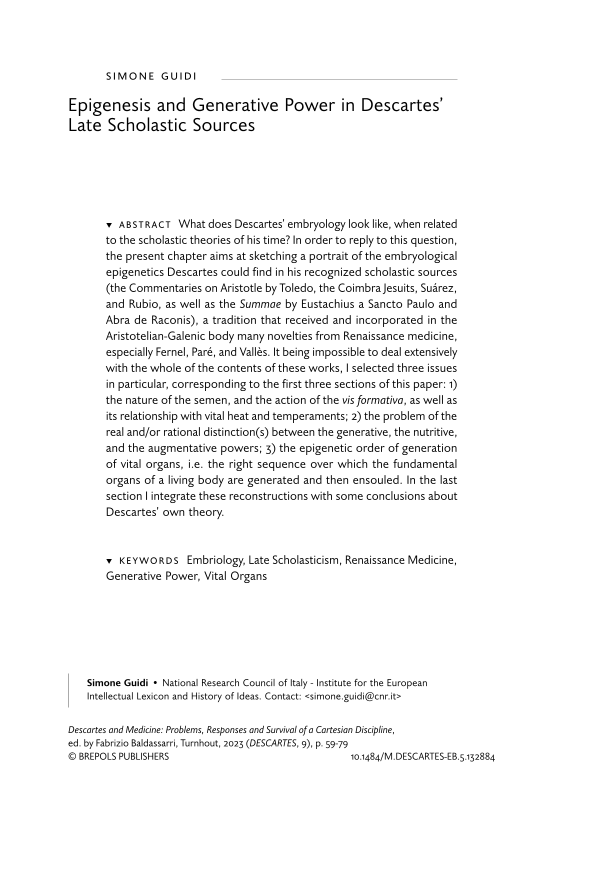
What does Descartes’ embryology look like, when related to the scholastic theories of his time? In order to reply to this question, the present chapter aims at sketching a portrait of the embryological epigenetics Descartes could find in his recognized scholastic sources (the Commentaries on Aristotle by Toledo, the Coimbra Jesuits, Suárez, and Rubio, as well as the Summae by Eustachius a Sancto Paulo and Abra de Raconis), a tradition that received and incorporated in the Aristotelian-Galenic body many novelties from Renaissance medicine, especially Fernel, Paré, and Vallès. It being impossible to deal extensively with the whole of the contents of these works, I selected three issues in particular, corresponding to the first three sections of this paper: 1) the nature of the semen, and the action of the vis formativa, as well as its relationship with vital heat and temperaments; 2) the problem of the real and/or rational distinction(s) between the generative, the nutritive, and the augmentative powers; 3) the epigenetic order of generation of vital organs, i.e. the right sequence over which the fundamental organs of a living body are generated and then ensouled. In the last section I integrate these reconstructions with some conclusions about Descartes’ own theory.
Full text loading...