


Vera philosophia
Studies in Late Antique medieval and Renaissance Christian Thought
Abstract
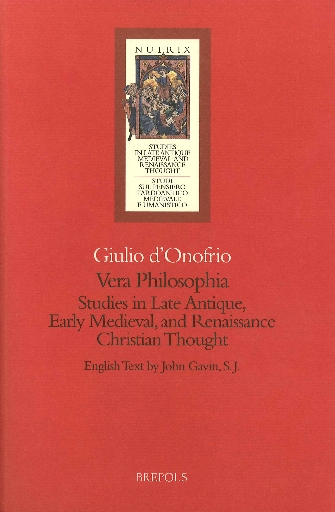
This volume includes a collection of reworked articles which the author, during the last twenty years, dedicated to the origins and conditions constitutive of Christian philosophical-theological thought. From the earliest centuries of the Christian era, human reason was submitted to a particular formal conditioning, in so far as it was necessarily obliged to confront the contents of a divine revelation recognized as necessarily ‘true’. The medieval Latin scholar was induced by the social and cultural peculiarities of his time to confront a model of thought which imposes a decisive subordination of natural knowledge - demonstrated to be imperfect and inconclusive - to the certainties assured by the faith. The production of this model of philosophia, significantly different from the dominant paradigms in the classical period, rooted itself in the critical redimensioning of reason which Cicerointroduced into the West. Departing from the observation of the failure of the philosophical aspirations of antiquity, the Christian intellectuals effected an operative ‘overturning’ of the conditions of veridical knowledge.
The new wisdom was not entirely the result of religion interfering in the field of rational science, but it was shaped by a conscious ‘conversion’ of the philosophers and reached fulfillment under two principles: faith, which requires earthly knowledge in order to defend itself from misunderstandings and heresies; and reason, which allows itself to draw upon supernatural revelation for the possession of regulatory principles which guide it in the study of natural things.
This book investigates the development of this approach during the course of the centuries which in the West precede the rediscovery of Aristotelian epistemology: from Augustine to Boethius, from John Scottus Eriugena to Anselm of Aosta. It concludes by describing the return of this methodological approach, at the end of the Medieval Scholastic period, in the results of the anti-Aristotelian critique carried out by the men of the Renaissance through the recovery of a model of thought which had dominated in the Patristic and Early Medieval periods.
