


Brepols
Brepols is an international academic publisher of works in the humanities, with a particular focus in history, archaeology, history of the arts, language and literature, and critical editions of source works.2961 - 2980 of 3194 results
-
-
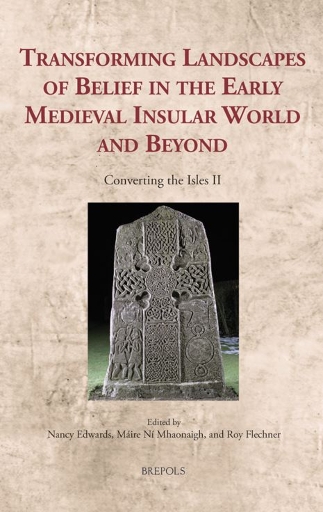
Transforming Landscapes of Belief in the Early Medieval Insular World and Beyond
Converting the Isles II
show More to view fulltext, buy and share links for:Transforming Landscapes of Belief in the Early Medieval Insular World and Beyond show Less to hide fulltext, buy and share links for: Transforming Landscapes of Belief in the Early Medieval Insular World and BeyondConversion to Christianity is arguably the most revolutionary social and cultural change that Europe experienced throughout Late Antiquity and the early Middle Ages. Christianization affected all strata of society and transformed not only religious beliefs and practices, but also the nature of government, the priorities of the economy, the character of kinship, and gender relations. It is against this backdrop that an international array of leading medievalists gathered under the auspices of the Converting the Isles Research Network (funded by the Leverhulme Trust) to investigate social, economic, and cultural aspects of conversion in the early medieval Insular world, covering different parts of Britain, Ireland, Scandinavia, and Iceland.
This volume analyses the effects of religious conversion on landscapes of cult and on religious practice in Europe, focusing in particular on Britain and Ireland. Adopting an interdisciplinary and comparative approach, the volume investigates the interaction between different forms of belief, their coexistence and competition. It discusses the coming of writing, the power of the word, landscapes of ritual, and converting communities. The contributors include leading historians, archaeologists, linguists, and literary scholars. This is the second volume to emerge from research undertaken by contributors to the Converting the Isles Research Network and forms a companion volume to The Introduction of Christianity into the Early Medieval Insular World.
See the companion volume at: http://www.brepols.net/Pages/ShowProduct.aspx?prod_id=IS-9782503554624-1
-
-
-
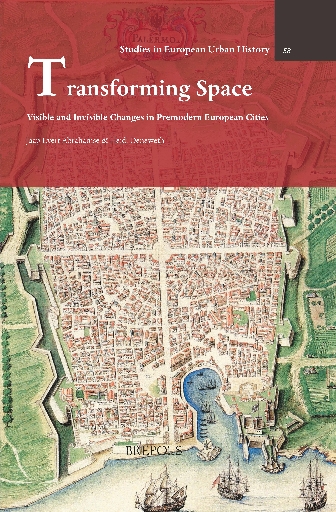
Transforming space
Visible and invisible changes in premodern European cities
show More to view fulltext, buy and share links for:Transforming space show Less to hide fulltext, buy and share links for: Transforming spaceTransforming Space deals with visible and invisible changes in premodern cities, their causes and the way in which they were perceived and received. The chapters in this book analyse the development and management of urban space, combining case studies and insights from a range of cities from all over Europe. Several contributions deal with the impact of major events on the urban tissue: geopolitics; disasters such as fires or wars; expropriation or redevelopment projects directed by urban governments; religious change such as the Dissolution in England, and the Reformation and Counter-Reformation on the continent. On closer scrutiny, however, some of these major events were only an accelerator of already ongoing processes of change. By shifting the perspective from the city as a whole, to neighbourhoods, urban blocks or even plots of land, other chapters reveal how functional change or real estate dynamics changed the urban landscape almost imperceptibly. This book is written from a comparative perspective that takes into account path-dependency. Pre-existing power relations, ideology and mentality, the resilience of property structures, the impact of building regulations, subsidies, or the effects of real estate markets are shown to have had different outcomes for different social groups and the evolution of neighbourhoods.
-
-
-
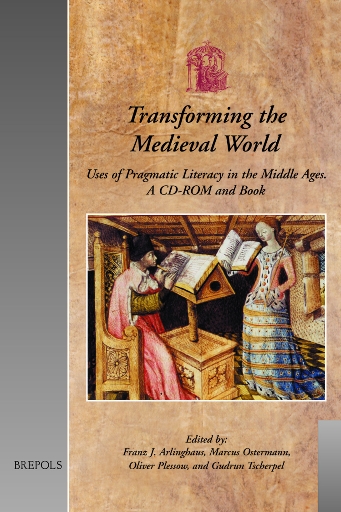
Transforming the Medieval World
Uses of Pragmatic Literacy in the Middle Ages. A CD-ROM and Book
show More to view fulltext, buy and share links for:Transforming the Medieval World show Less to hide fulltext, buy and share links for: Transforming the Medieval WorldWhen viewed retrospectively, the period between the eleventh and the fifteenth centuries was a phase of European history that was characterized by a radical and fundamental media transformation. Before this time, the vast majority of the population had never encountered the written word in their day-to-day activities. From the beginning of the second millennium, however, texts began to appear in, and influence, almost every sphere of human life. Medieval written texts were subject to revision, copying, embellishments, and deletions; they were read silently and aloud, and they were recited in a variety of contexts. The multimedia environment offered on the CD visualizes these textual transformations and illustrates the adaptability and dynamism of writing and its reception. The uses of writing in this early phase of intensive European literacy are analysed in eleven separate multimedia presentations, which are almost all based on research carried out by the Special Research Unit (SFB) between 1986 and 1999. The CD also contains an anthology of important essays, which provide the user with further reading materials, as well as a general bibliography. The book which accompanies the CD-ROM facilitates the use of the CD itself, and provides the various multimedia presentations in written format. As such, Transforming the Medieval World will be invaluable to both scholars and students interested in medieval literacy.
-
-
-
Transitions
A Historian’s Memoir
show More to view fulltext, buy and share links for:Transitions show Less to hide fulltext, buy and share links for: TransitionsThe transitions of the title are those in the life and intellectual development of one of the leading historians of late antiquity and Byzantium. Averil Cameron recounts her working-class origins in North Staffordshire and how she came to read Classics at Oxford and start her research at Glasgow University before moving to London and teaching at King’s College London. Later she was the head of Keble College Oxford at a time of change in the University and its colleges. She played a leading role in projects and organisations even as the flow of books and articles continued, in an array of publications that have been fundamental in shaping the disciplines of late antiquity and Byzantine studies in the twentieth and twenty-first centuries.
-
-
-
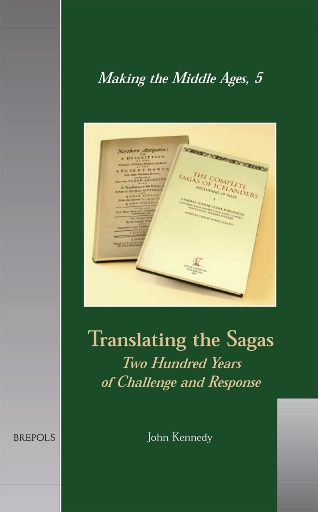
Translating the Sagas
Two Hundred Years of Challenge and Response
show More to view fulltext, buy and share links for:Translating the Sagas show Less to hide fulltext, buy and share links for: Translating the SagasFew speakers of English have ever been able to read the Icelandic sagas in the original language, and published saga translations have played a major role in shaping attitudes towards Viking Age Scandinavia and the great literary achievements of medieval Iceland in the English-speaking world. This book is the first publication to provide an extended examination of the history and development of Icelandic saga translations into English from their beginnings in the eighteenth century to today. It explores reasons for undertaking saga translation, and the challenges confronting translators. Chapters are devoted to the pioneering saga translations, the later Victorian and Edwardian eras, the often-neglected period of the two World Wars and their aftermath, and the upsurge of saga translation in the second half of the twentieth century. The contributions of individual translators and teams are reviewed, from James Johnstone in the 1780s through major Victorians such as Samuel Laing, George Webbe Dasent, and William Morris, distinguished twentieth century figures such as Lee M. Hollander, Gwyn Jones, Magnus Magnusson and Hermann Pálsson, and George Johnston, and the great co-operative project which produced The Complete Sagas of Icelanders at the century’s end. The book concludes with saga translation facing interesting new possibilities and challenges, not least those generated by information technology.
-
-
-
Translation Automatisms in the Vernacular Texts of the Middle Ages and Early Modern Period
show More to view fulltext, buy and share links for:Translation Automatisms in the Vernacular Texts of the Middle Ages and Early Modern Period show Less to hide fulltext, buy and share links for: Translation Automatisms in the Vernacular Texts of the Middle Ages and Early Modern PeriodThe volume deals with the issue of translation automatisms in early vernacular texts predating 1650. It introduces the novel concept of ‘translation clusters’, first defined in machine translation theory, but equally considering a wider array of situations that involve ‘translation units’, ‘language automatisms’, ‘culturemes’, and ‘formulaic borrowings’ in vernacular texts. Contrary to contemporary languages, where translation units, clusters, and automatisms appear frequently due to the influence of standard language varieties or dialects, the vernacular idioms of the Middle Ages and Early Modern period are often pluricentric. Consequently, automatisms are limited to specific cases where diachronic, diatopic, diastratic, and diaphasic variants align similarly in two otherwise different translations. This is a crucial topic for philology, as it can explain accidents that ecdotic methods tend to mistake for variant readings of a single ‘redactio’. The volume aims to determine the organic interplay between three primary situations in which common coincidences between translations or texts occur. Firstly the volume explores the shared elements resulting from the transfer of textual units between multiple translations or adaptations (quotations, corrections, formulas). Secondly chapters study the shared elements arising from the existence of a common source text (translation clusters, based on translation units); and lastly, the volume questions the fixed, inherent, and unchangeable aspects of the target language (language automatisms, often coinciding with translation units). The chapters of this volume focus on numerous vernacular languages and a multitude of case studies, with a particular emphasis on biblical translation—a cornerstone of contemporary translation studies. The chapter format encourages diverse perspectives to push the boundaries of philology, translation studies, and “vernacular theologies”.
-
-
-
Translation and Authority - Authorities in Translation
show More to view fulltext, buy and share links for:Translation and Authority - Authorities in Translation show Less to hide fulltext, buy and share links for: Translation and Authority - Authorities in TranslationThe question about the relation between medieval translation practices and authority is a complex and multifaceted one. Depending on one’s decision to focus on the authority of the source-text or of the translated text itself, on the author of the original text, on the translator, or on the user of the translation, it falls apart in several topics to be tackled, such as, just to name a few: To what extent does the authority of the text to be translated affect translational choices? How do translators impose authority on their text? By lending their name to a translation, do they contribute to its authoritative status?
After two introductory essays that set the scene for the volume, addressing the above questions from the perspective of translations of authoritative texts into Dutch and French, the focus of the volume shifts to the translators themselves as authorities. A next section deals with the choices of texts to be translated, and the impact these choices have on the translation method. A third part is dedicated to papers that examine the role of the users of the translations.
The selection of papers in the present volume gives a good indication of the issues mentioned above, embedded in a field of tension between translations made from a learned language to a vernacular language, translations from one vernacular to another, or even from a vernacular to the Latin language.
-
-
-
Transmission of Knowledge in the Late Middle Ages and the Renaissance
show More to view fulltext, buy and share links for:Transmission of Knowledge in the Late Middle Ages and the Renaissance show Less to hide fulltext, buy and share links for: Transmission of Knowledge in the Late Middle Ages and the RenaissanceThe nineteenth century saw the rapid development of textual criticism for establishing the “best” and “most authentic” forms of both Ancient and Mediaeval texts thanks to the method perfected by Karl Lachmann, who based himself on the insights gained during the eighteenth century. Lachmann’s method has been further refined by later philologists, with, most interestingly, the use of computers in establishing the mutual relations of manuscript witnesses since the last decades of the twentieth century. However, the interest in what form the texts, both Ancient and Mediaeval, were actually circulating in the Late Middle Ages and in the Renaissance, has been slow to emerge as an area of scholarly interest. In other words: what did the readers actually get in front of their eyes, and acted upon as, say, doctors, historians, theologians between the thirteenth and sixteenth centuries?
This volume explores the Late Medieval and Renaissance transmission of texts of different genres, languages and periods from the book historical point of view, taking into consideration not only the textual but also the material aspect of the traditions.
The authors include eminent specialists as well as mid- and early career scholars.
-
-
-
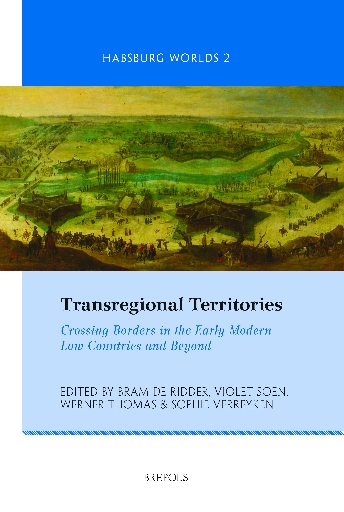
Transregional Territories
Crossing Borders in the Early Modern Low Countries and Beyond
show More to view fulltext, buy and share links for:Transregional Territories show Less to hide fulltext, buy and share links for: Transregional TerritoriesThe early modern world was one of movement, contact, and exchange. Yet, this does not mean that it was borderless. On the contrary, connection existed only when people moved along and across the separations between polities, religions, and mentalities. So in order to understand early modern connections, one also needs to analyse the boundaries that accompanied them.In Transregional Territories, the early modern Low Countries are chosen as a ‘laboratory’ for studying border formation and border management through the lens of transregional history. Eight different cases highlight the impact of boundaries on the actions and strategies of individuals and governments. Crossing borders in early modern times was not merely an act of negating a territorial division, but rather a moment of intimate interaction with the separation itself. As such, this volume illustrates how borders forced historical actors to adapt their behaviour, and how historians can use a transregional vantage point to better understand these changes.The cases are presented by leading border specialists and scholars of the early modern Low Countries: Fernando Chavarría Múgica, Victor Enthoven, Raingard Esser, Yves Junot, Marie Kervyn, Christel Annemieke Romein, and Patricia Subirade.Bram De Ridder, Violet Soen, Werner Thomas, and Sophie Verreyken are all members of the Early Modern History Research Group of the KU Leuven. Together, they have published extensively on transregional history and the history of the early modern Low Countries, grouped under the label of transregionalhistory.eu.
-
-
-

Traumas of 1066 in the Literatures of England, Normandy, and Scandinavia
show More to view fulltext, buy and share links for:Traumas of 1066 in the Literatures of England, Normandy, and Scandinavia show Less to hide fulltext, buy and share links for: Traumas of 1066 in the Literatures of England, Normandy, and Scandinavia1066 is one of the most well-known dates in English history: but how far do we understand the mental and emotional lives of those who experienced it? In just over a month, England was rocked by two separate invasions, multiple pitched battles, and the deaths of thousands. The repercussions of these traumatic events would echo through the history and literature of northern Europe for centuries to come.
Drawing on studies of trauma and cultural memory, this book examines the cultural repercussions of the year 1066 in medieval England, Normandy, and Scandinavia. It explores how writers in all three regions celebrated their common heritage and mourned the wars that brought them into conflict. Bringing together texts from an array of languages, genres, and cultural traditions, this study examines the strategies medieval authors employed to work through the traumas of 1066, narrating its events and experiences in different forms. It explores the ways in which history and memory interacted through multiple generations of writers and readers, and reveals how the field of trauma studies can help us better understand the mental and emotional lives of medieval people.
-
-
-

Travelling Matters across the Mediterranean
Rereading, Reshaping, Reusing Objects (10th–20th centuries)
show More to view fulltext, buy and share links for:Travelling Matters across the Mediterranean show Less to hide fulltext, buy and share links for: Travelling Matters across the MediterraneanIn the last two decades, objects have become increasingly relevant to historical studies as the primary focus of research discussing cross-cultural relations. Objects are produced, used, modified, preserved, and destroyed according to historically specific political and cultural settings, thus providing researchers with information and insights about their original background. However, they can also throw light on a large array of cross-cultural encounters when their mobility is put to the fore. Objects can move by being bought, gifted, bartered, and sold, borrowed or stolen, collected and dispersed, just as they can be modified, repaired, reshaped, repurposed, and destroyed in the process.
The Mediterranean, as a barrier and as a meeting place for different polities and communities, and as the setting of conflicted experiences of cultural, political, economic, and social transformation, easily lends itself to this kind of historical analysis. Featuring articles on Byzantine imperial silks and bronze doors from southern Italy, eastern luxuries in Istanbul and African bolsas from the Canary Islands, Arabic geographies and Hebrew religious texts travelling from shore to shore and from manuscript to the press, and the ‘dead’ bodies of holy women and men, this volume intends to tackle objects as sources and subjects of the history of cross-cultural encounters in innovative ways: focusing on the ‘second-handedness’ of displaced objects across the Mediterranean, the volume intersects different chronologies — from antiquity to the present-day — and varying scales, from the individual objects to the much larger one of the histories of their reinterpretation and repurposing.
-
-
-
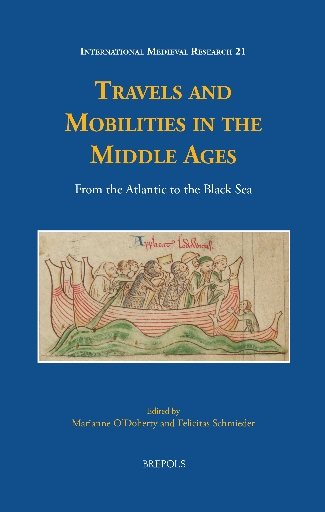
Travels and Mobilities in the Middle Ages
From the Atlantic to the Black Sea
show More to view fulltext, buy and share links for:Travels and Mobilities in the Middle Ages show Less to hide fulltext, buy and share links for: Travels and Mobilities in the Middle AgesThis collection of research, which brings together contributions from scholars around the world, reflects the range and variety of work that is currently being undertaken in the field of travel and mobility in the European Middle Ages. The essays draw on diverse methodological approaches, from the archival and literary to the art historical and archaeological. The collection focuses not just on key medieval modes of travel and mobility, but also on themes whose relevance continues to resonate in the modern world. Topics touched upon include religious and diplomatic journeys, migration, mobility and governance, gendered mobilities, material culture and mobility, mobility and disability, travel and status, and notions of home and abroad. Broad themes are approached through case studies of individuals, families, and groups, ranging from kings, queens, and nobles to friars, exiles, and students. The geographical reach of the collection is particularly broad, encompassing travellers from Southern, Western, Northern, Central and Eastern Europe and journeys to destinations as diverse as Scandinavia, the Black Sea, the Mediterranean, and the Indian Ocean. A wide-ranging and detailed introduction situates the collection in its scholarly context.
-
-
-
Tre pellegrinaggi in Terrasanta
show More to view fulltext, buy and share links for:Tre pellegrinaggi in Terrasanta show Less to hide fulltext, buy and share links for: Tre pellegrinaggi in TerrasantaLe tre descrizioni della Terrasanta crociata riunite in questo volume furono prodotte tra l’inizio del XII secolo - qualche anno dopo la presa europea della Palestina - e il 1170 circa - poco prima della riconquista musulmana di Gerusalemme. La prima, quella dell’inglese Saewulf, è un vero e proprio resoconto di pellegrinaggio dalla forte impronta personale, che con un linguaggio letterariamente spoglio ricorda le vicissitudini sperimentate dall’autore nel suo viaggio per mare e per terra, dalla Puglia a Gerusalemme e fin quasi a Constantinopoli. Quelle di Giovanni di Würzburg e di Teodorico sono invece due guide della città santa e di buona parte della Palestina, parzialmente sovrapponibili in quanto in gran parte derivate dal celebre trattatello di topografia sacra composto qualche decennio prima dal chierico nazareno Rorgo Fretello. Entrambi gli autori, e soprattutto il più raffinato Teodorico, si impegnano tuttavia in un processo di rielaborazione e amplificazione del loro modello, che viene ad arricchirsi di informazioni originali accumulate nel corso di una reale esperienza di pellegrinaggio, testimone dei rinnovati fasti architettonici e urbanistici del regno latino di Gerusalemme.
La versione latina originale dei testi qui tradotti è pubblicata nella collana Corpus Christianorum Continuatio Mediaeualis con il titolo Peregrinationes tres. Saewulf, John of Würzburg, Theodericus (CC CM, 139), a cura di R.B.C. Huygens (1994). I rimandi alle pagine corrispondenti dell’edizione sono forniti a margine di questa traduzione.
-
-
-
Treasury
show More to view fulltext, buy and share links for:Treasury show Less to hide fulltext, buy and share links for: TreasuryDiscovered by the French scholar, Marcel Richard, on one of his photographic expeditions to the monastic libraries of Mount Athos, the Thesaurus was entrusted to a young scholar, Joseph Munitiz, who prepared the editio princeps for his doctoral thesis, defended at the Sorbonne in 1976. The work was shown to have been composed by a little-known spiritual author, thought to have been active in the fourteenth century, but placed, thanks to a passing reference in his Treasury, in the middle of the thirteenth century. This semi-encyclopaedic work was intended to provide an overview of the sort of knowledge considered essential for a young prince, as one chapter is an exhortation to a future emperor. Thus it contains a summary of the Old Testament, with curious reflections (e.g. on female wickedness and the ingenuity of Solomon), and chapters on dogmatic questions: the divinity of Christ; the value of Holy Scripture; the sacraments, icons, the Theotokos, and the key role of the Ecumenical Councils. A large part is made up of moral exhortations attributed partly to Amphilochios and backed by pious stories. There are also florilegia, so popular in Byzantine spiritual writings, focused around the eucharist, the priesthood, sexual morality and confession. At the end, some questions-and-answers (another popular Byzantine genre) deal with items of general knowledge (ranging from theology, through astronomy, to alms-giving). In general, the work opens a window into the mind of the ordinary believer in mediaeval Constantinople.
The source text of this volume appeared with the title Theognosti Thesaurus as volume 5 in Corpus Christianorum Series graeca, in 1979. References to the corresponding pages of the edition are provided in the margin of this translation, along with a list of corrections of the Greek.
-
-
-
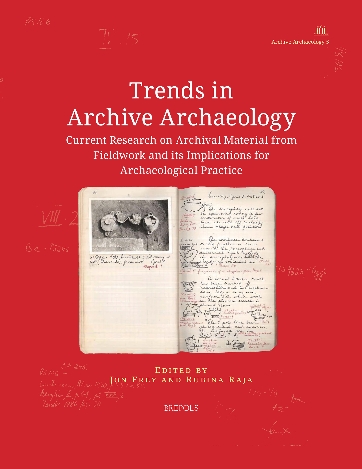
Trends in Archive Archaeology
Current Research on Archival Material from Fieldwork and its Implications for Archaeological Practice
show More to view fulltext, buy and share links for:Trends in Archive Archaeology show Less to hide fulltext, buy and share links for: Trends in Archive ArchaeologyArchive archaeology has, in recent years, become increasingly acknowledged as an important component of archaeological research. However, the vast amounts of empirical data contained in such archives — among them fieldwork diaries, working notebooks, finds sheets, and photographs — together with a sense that the field is often skewed towards ‘one’s own data’, have made it difficult to develop a clear methodological approach that fits all eventualities. The result is that archive archaeology is still not always recognized for what it can bring to the discipline of archaeology, as a field of study that focuses on the contexts within which humanity developed.
This volume draws together contributions from scholars who work with archives in a variety of capacities: as fieldwork directors of decades-long excavations; as archivists interested in the history of collections; as specialists focusing on certain object groups or regions; and as researchers broadly interested in what archival material brings to the table in terms of new knowledge about archaeological situations. In showcasing contributions of work in progress, the chapters published here bring to the fore knowledge about archives that has long been overlooked, and examine how archival archaeology should be shaped in the future so that it can become more firmly integrated within archaeological practice.
-
-
-
Trent and Beyond. The Council, Other Powers, Other Cultures
show More to view fulltext, buy and share links for:Trent and Beyond. The Council, Other Powers, Other Cultures show Less to hide fulltext, buy and share links for: Trent and Beyond. The Council, Other Powers, Other CulturesFor centuries, the Council of Trent has been studied as a fundamental episode in European history wherein doctrinal and institutional unity was lost. Although the Council decrees nowhere refer to the contexts of the peoples met by Christopher Columbus, nor to the Cathay regions rediscovered by missionaries, nor to their religions, their superstitions or their political systems, the Council was nonetheless a global event. The Roman Church, which lost doctrinal control of the considerable part of Europe captured by different forms of Protestantism, imposed itself upon its followers through the application of conciliar decrees. Freed of its exclusively European perspective it opened up to cultures of the rest of the world. The customs and traditions thus encountered, the relationships with political authorities, possibilities for the construction of a new Christianity offered by New Worlds, disclosing spaces and contexts to the Tridentine Church, with accommodations and cross-fertilizations, with a return to origins and tradition, obliged that it begin to think of itself, perhaps for the first time, as a universal Church.
The Council and Beyond suggests not only reconsideration of Europe through the prism of the Tridentine decrees and the long processes of their dissemination, but also through an intercontinental consideration, a spatial perspective that would become universal to the Church and to the normative texts that had been elaborated at Trent.
-
-
-

Tributes to Paul Binski
Medieval Gothic: Art, Architecture and Ideas
show More to view fulltext, buy and share links for:Tributes to Paul Binski show Less to hide fulltext, buy and share links for: Tributes to Paul BinskiThis volume is published in honour of Paul Binski, whose scholarship and teaching have done so much to illuminate the material and intellectual worlds of Gothic art and architecture. Remarkable for its material scope and philosophical depth, Paul’s work has had a powerful influence on the current state of the field: this is reflected here in thirty-four essays on buildings, works of art and ideas in a wide range of historical and geographical contexts, from Iberia to Scandinavia and Italy to Ireland. Consistently fresh in their scholarship, these essays combine to make an important contribution to medieval art history. In doing so they reflect the admiration and affection which Paul inspires in his students and colleagues. With contributions by: Gabriel Byng, Meredith Cohen, Emily Guerry, James Hillson, Ethan Matt Kavaler, Tom Nickson, Zoë Opačić, Claudia Bolgia, Jean-Marie Guillouët, Justin E. A. Kroesen, Julian Luxford, Robert Mills, John Munns, Matthew M. Reeve, Laura Slater, Beth Williamson, Jessica Berenbeim, Spike Bucklow, Marcia Kupfer, Jean-Pascal Pouzet, Miri Rubin, Kathryn M. Rudy, Rocío Sánchez Ameijeiras, Lucy Wrapson, Patrick Zutshi, Mary Carruthers, Jill Caskey, Lucy Donkin, Kate Heard, Robert Maniura, Alexander Marr, M. A. Michael, Conrad Rudolph, Betsy Sears.
-
-
-

Trilingual Learning
The Study of Greek and Hebrew in a Latin World (1000-1700)
show More to view fulltext, buy and share links for:Trilingual Learning show Less to hide fulltext, buy and share links for: Trilingual LearningIn 1517, the Brabant city of Louvain witnessed the foundation of the Collegium Trilingue (Three Language College). Funded by means of the legacy of the humanist and diplomat Jerome of Busleyden (d. 1517) and steered by guiding spirit Erasmus of Rotterdam, this institute offered courses in the three so-called sacred languages Hebrew, Greek, and Latin, which students could attend for free. However, this kind of initiative was not unique to Louvain in the early 16th century. In a time span of barely twenty years, Greek and Hebrew were also offered in Alcalá de Henares (near Madrid), Wittenberg, and Paris, among other places. It would not take long before these ‘sacred’ languages were also on the educational agenda at universities throughout the whole of Europe.
The present volume examines the general context in which such polyglot institutes emerged and thrived, as well as the learning and teaching practices observed in these institutes and universities. Devoting special attention to the study of the continuity, or rather the discontinuity, between the 16th-century establishment of language chairs and the late medieval interest in these languages, it brings together fifteen selected papers exploring various aspects of these multilingual undertakings, focusing on their pedagogical and scholarly dimensions. Most of the contributions were presented at the 2017 LECTIO conference The Impact of Learning Greek, Hebrew, and ‘Oriental’ Languages on Scholarship, Science, and Society in the Middle Ages and the Renaissance, which was organized at the occasion of the 500th anniversary of the foundation of the Louvain Collegium Trilingue.
-
-
-

Trinity and Creation
A Selection of Works of Hugh, Richard, and Adam of St Victor
show More to view fulltext, buy and share links for:Trinity and Creation show Less to hide fulltext, buy and share links for: Trinity and CreationThe Trinity and Creation are central themes in the theology of the Augustinian Canons of the Abbey of St Victor during its time of greatest flourishing in the twelfth century. In this volume, three of the most important Victorine theological works are introduced and completely translated into English for the first time: On the Three Days, by Hugh of St. Victor (d. 1141), a lyrical yet philosophical study of how the power, wisdom, and goodness of God can be known from the things God has made; Hugh’s Sentences on Divinity, lecture notes which show how the divine ideas (“primordial causes”) serve God in creation; and On the Trinity, by Richard of St. Victor (d. 1173), one of the enduring classics of Christian theology, which analyzes the Trinity in terms of love. Also included are two of Adam of St. Victor’s sequences in praise of the Trinity.
This volume is edited by Boyd Taylor Coolman (PhD, Notre Dame University; Theology Dept. Boston College), author of The Theology of Hugh of St. Victor: An Interpretation (2010), and Dale M. Coulter (DPhil, Oxford; School of Divinity, Regent University), author of Per Visibilia ad Invisibilia: Theological Method in Richard of St. Victor (d. 1173) (2006).
-
-
-
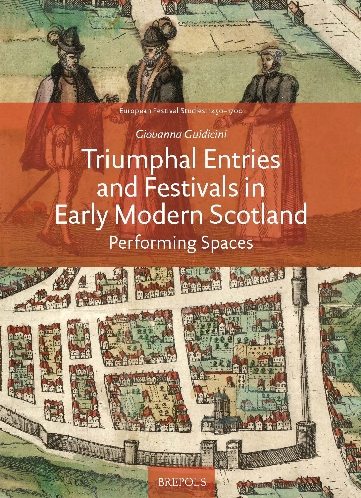
Triumphal Entries and Festivals in Early Modern Scotland
Performing Spaces
show More to view fulltext, buy and share links for:Triumphal Entries and Festivals in Early Modern Scotland show Less to hide fulltext, buy and share links for: Triumphal Entries and Festivals in Early Modern ScotlandThis book offers unprecedented insights into the richness of Scottish culture in the early modern period, studying triumphal entries — that is, processional civic welcomes offered to royal guests — staged in Edinburgh in the period between 1500 and the Wars of the Three Kingdoms. Based on a comprehensive and imaginative analysis of the written and archival sources available for these events, it also brings renewed attention to the country’s artistic, architectural, and literary traditions. The analysis of comparable events staged in England and continental Europe — in France, the Italian peninsula, and the Low Countries — helps frame Scotland’s distinctiveness within a network of international connections. The book explores how the urban space of early modern Edinburgh was employed with changing fortunes to address potentially explosive power dynamics, expressed by civic and royal, secular and religious (pre and post Reformation), Scottish and post-1603 pan-British worldviews. Scottish triumphal culture is presented as profoundly embedded in the urban context within which it is set, rich in politicised rituals of negotiation and mutual acknowledgement, and visually vibrant through temporary structures, decorations, pageants, and costumed performers. This book offers a well-rounded answer to the still relevant question of Scottish identity, and how identity and power — individual, communal, national, royal — can be performed through active engagement with civic space.
-