Brepols
Brepols is an international academic publisher of works in the humanities, with a particular focus in history, archaeology, history of the arts, language and literature, and critical editions of source works.2981 - 3000 of 3194 results
-
-
Troianalexandrina
Anuario sobre literatura medieval de materia clásica / Yearbook of Classical Material in Medieval Literature
show More to view fulltext, buy and share links for:Troianalexandrina show Less to hide fulltext, buy and share links for: TroianalexandrinaTroianalexandrina features articles on medieval European works on the matter of Antiquity (Trojan matter, Alexander the Great, Greek and Latin literatures and mythology) and, more generally, the survival of classical culture in the Middle Ages. Interdisciplinary contributions focusing on the study of images and iconographic tradition or exploring elements of medieval visual culture related to classical themes and motifs are also welcome.
More information about this journal on Brepols.net
-
-
-

True Warriors? Negotiating Dissent in the Intellectual Debate (c. 1100–1700)
show More to view fulltext, buy and share links for:True Warriors? Negotiating Dissent in the Intellectual Debate (c. 1100–1700) show Less to hide fulltext, buy and share links for: True Warriors? Negotiating Dissent in the Intellectual Debate (c. 1100–1700)Dissent, polemics and rivalry have always been at the centre of intellectual development. The scholarly Streitkultur was given a fresh impetus by the newly founded universities in the High Middle Ages and later turned into a quintessential part of early modern intellectual life, with the emergence of the Protestant Reformation creating a new momentum. It was not only mirrored in various well-known intellectual disputations and controversies, but also embodied in numerous literary genres and non-literary modes of expression, as well as discursive or political strategies. Moreover, the harsh debates notwithstanding, consensus was also actively searched for, both within particular disciplines and within society as a whole.
This volume collects thirteen contributions offering a very rich variety of topics with regard to the negotiation of disagreements from the twelfth till the eighteenth centuries. They reflect inter alia upon the rules and conventions of the intellectual debate, upon the media used to negotiate dissent, as well as upon the role of formal institutions created to judge and decide in cases of dissent. The contributions are offered by scholars from fields as diverse as history of literature, political history, history of philosophy, history of Church and theology, and legal history.
-
-
-
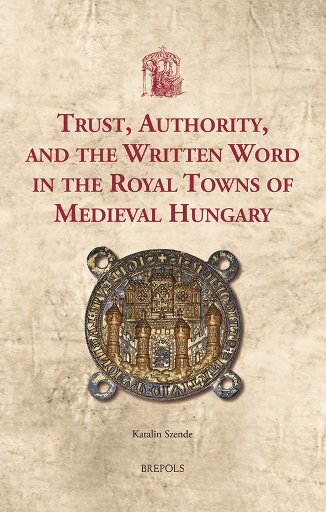
Trust, Authority, and the Written Word in the Royal Towns of Medieval Hungary
show More to view fulltext, buy and share links for:Trust, Authority, and the Written Word in the Royal Towns of Medieval Hungary show Less to hide fulltext, buy and share links for: Trust, Authority, and the Written Word in the Royal Towns of Medieval HungaryThis book is the first comprehensive overview of how written administration was established in the royal towns of medieval Hungary. Using the conceptual framework of trust and authority, the volume sheds light on the growing complexity of urban society and the impact that the various uses of writing had on managing this society, both by the king and by the local magistrates. The present survey and analysis of a broad range of surviving sources reveals that trust in administrative literacy was built up gradually, through a series of decisive and chronologically distinct steps. These included the acquisition of an authentic seal; the appointment of a clerk or notary; setting up a writing office; drawing up town books; and, finally, establishing an archive from the assemblage of collected documents.
Although the development of literacy in Hungarian towns has its own history, the questions posed by the study are not unlike those raised for other towns of medieval Europe. For instance, both the gradually increasing use of various vernaculars and the controversial role of writing in Jewish-Christian contacts can be meaningfully compared with similar processes elsewhere. The study of Central European towns can therefore be used both to broaden seemingly disparate research frameworks and to contribute to studies that take a more general approach to Europe and beyond.
-
-
-
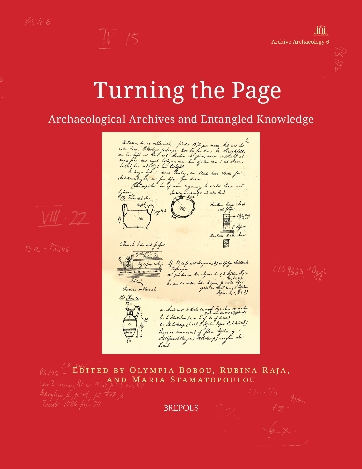
Turning the Page
Archaeological Archives and Entangled Knowledge
show More to view fulltext, buy and share links for:Turning the Page show Less to hide fulltext, buy and share links for: Turning the PageThroughout the nineteenth, and for much of the twentieth century, archives were considered to be containers of knowledge, holding material that was deemed to be objective and unbiased. In more recent years, however, as scholars have begun to engage more with archival material, this perception has changed, and archives have increasingly been recognized as sites of contention, holding curated historical documents — a re-evaluation that, in turn, has led to a new understanding of the role and significance of both archives and archiving practices, as well as to revived interest in their contents.
Taking renewed scholarly interest in archives as its starting point, this volume highlights the importance of archival material both as a source of study, and as a way of unleashing hitherto ‘lost’ knowledge. The chapters gathered here present previously unpublished material for the first time, as well as offer new insights into archival and curatorial practices. Through this approach, the authors not only reveal unknown aspects and histories of both past and ongoing excavations, but also shed light on the creation processes of an archive, an element that is typically lost by the time the material is designated as an archive by those who study it. The result is a volume that can shape best archival practices and approaches for the future.
-
-
-
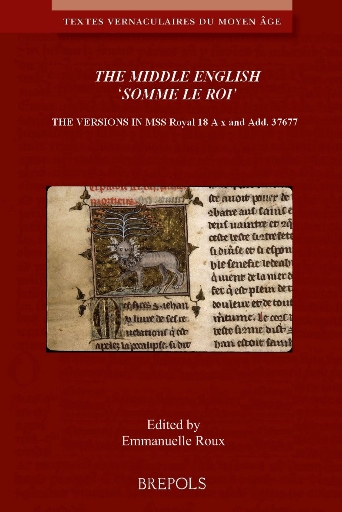
Two Middle English Translations of Friar Laurent's 'Somme le roi': critical edition
show More to view fulltext, buy and share links for:Two Middle English Translations of Friar Laurent's 'Somme le roi': critical edition show Less to hide fulltext, buy and share links for: Two Middle English Translations of Friar Laurent's 'Somme le roi': critical editionThis is the first volume of a two-volume project whose aim is to publish all the known Middle English manuscript translations of the French Somme le roi, a thirteenth-century manual of religious instruction offering teaching on the Decalogue, the seven deadly sins and their remedies, compiled by the Dominican friar Laurent of Orleans. The project extends and deepens our knowledge of the influence of this popular French text, known today only from the versions entitled The Ayenbite of Inwit and The Book of Vices and Virtues, published in 1866 and 1942, respectively.
This volume presents the versions extant in BL MSS Royal 18. A. x and Add. 37677; the second will cover the versions in Cambridge, Corpus Christi College, MS 494, Oxford, Bodleian Library, MS Ashmole 1286, and Oxford, Bodleian Library, MS e Musaeo 23. The texts of both volumes have been prepared with the help of the recently-published edition of the French text (2008), a circumstance from which the earlier English editions were unable to benefit. It is likely that the versions edited here for the first time will make a considerable contribution to our understanding of the processes of textual transmission and to that of translation itself in English literary circles of the fifteenth century.
-
-
-
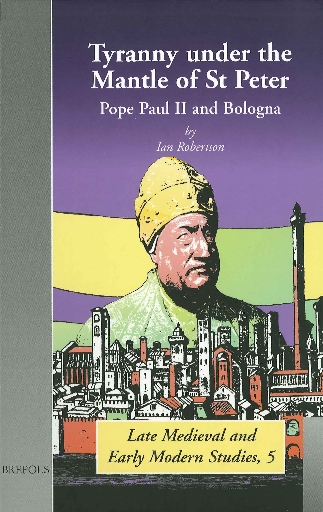
Tyranny under the Mantle of St Peter
Pope Paul II and Bologna
show More to view fulltext, buy and share links for:Tyranny under the Mantle of St Peter show Less to hide fulltext, buy and share links for: Tyranny under the Mantle of St PeterThe clash between Pope Paul II ( 1464-1471) and Bologna was one of two opposed concepts of government and 'state'. Paul II held to a high concept of princely sovereignty, and to a vision of the papal temporal dominions as a genuinely co-ordinated territorial state, an enduring public; entity. Inevitably he clashed with the Commune of Bologna, second city of the Papal State, over which he aspired to more jurisdiction. The political vision of the Bolognese regime had a. local focus which precluded the sacrifice of independence in favour of integration into a wider entity, and sprang from a view of government as rightfully the private preserve of a restricted oligarchic group, from the 1440s consolidated in the magistracy of the 'Sixteen Reformers of the Regime of Liberty'. Paul II regarded the regime of the Sixteen as a 'tyranny', and declared that no such ty rannies should flourish 'under the mantle of St Peter'. But his intervention failed and, instead, Paul modified the constitution which gave the long-developing predominance of the Bentivoglio family an institutional basis. This 'signorial' regime aggravated the tension between collegiality and despotism and paved the way for the eventual destruction of the Bentivoglio dominance and later the fuller incorporation in the sixteenth century of Bologna into the Papal State.
-
-
-

Ugo di San Vittore, Sull’inanità delle cose mondane e Dialogo sulla creazione del mondo
Introduzione, traduzione e note
show More to view fulltext, buy and share links for:Ugo di San Vittore, Sull’inanità delle cose mondane e Dialogo sulla creazione del mondo show Less to hide fulltext, buy and share links for: Ugo di San Vittore, Sull’inanità delle cose mondane e Dialogo sulla creazione del mondoIl De vanitate rerum mundanarum e il Dialogus de creatione mundi sono due opere fortemente legate l’una all’altra: in un primo momento unite e poi separate, testimoniano il gusto ugoniano per la pratica della riscrittura, segno di un pensiero in continuo movimento, che progredisce e si evolve tornando su sé stesso. Il De vanitate si presenta come un dialogo tra due personaggi, Anima e Ratio, volto a dimostrare come chi ripone tutte le proprie aspettative e speranze nel mondo, senza guardare a quello che è il vero bene e fine ultimo di ogni esistenza, Dio, sia destinato a vivere un’esistenza di frustrazione e infelicità. Il Dialogus, che invece vede come protagonisti un Discipulus e un Magister, dopo un dettagliato racconto della creazione del mondo si concentra sulla trattazione della natura dell’uomo, del peccato, della redenzione e dei sacramenti. Questa è la prima traduzione del testo criticamente curato da Cédric Giraud (CC CM, 269).
-
-
-

Uist Unearthed
5000 Years of Prehistory and History Told through the Interactive Exploration of Five Archaeological Sites
show More to view fulltext, buy and share links for:Uist Unearthed show Less to hide fulltext, buy and share links for: Uist UnearthedPeople have been living in Uist’s island landscapes for millennia; shaping and shaped by the unique environments of machair and moorland we see today. Uist Unearthed tells the story of 5000 years of the islands’ prehistory and history through five key archaeological sites.
Based on the award-winning Uist Virtual Archaeology Project, this interactive book brings Uist’s past to life. Readers are invited to dig deeper and discover Uist’s unique archaeology through colourful and creative mixed media including illustrations, infographics, and photography, enhanced with state-of-the-art augmented reality.
This book provides an excellent introduction to Uist’s archaeology for novices and professionals alike. It discusses the importance of Gaelic language and culture in our interpretation and understanding of archaeological landscapes. It is for all those interested in exploring alternative ways of reimagining, interpreting, and presenting the past through digital storytelling.
-
-
-
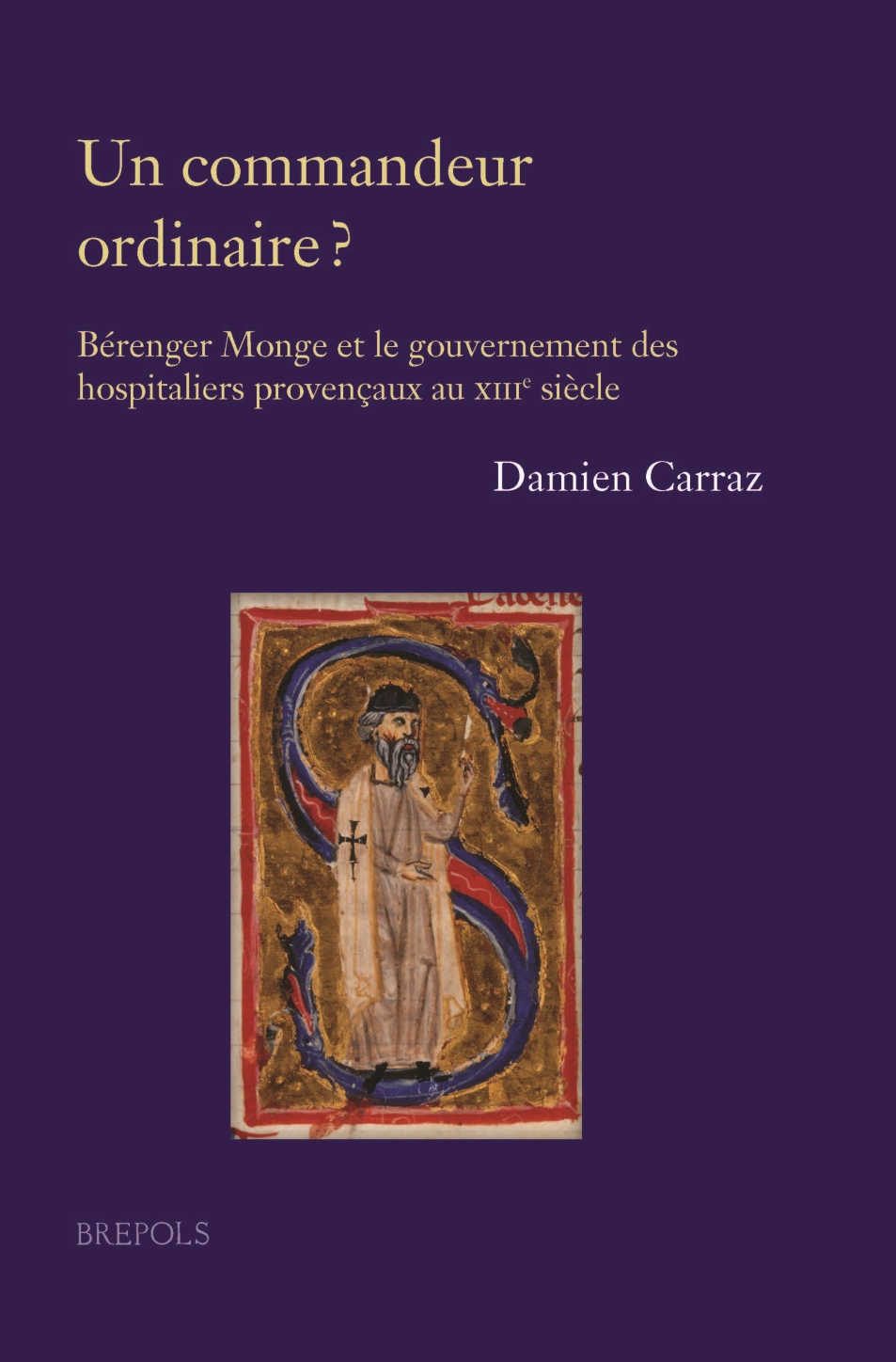
Un commandeur ordinaire ?
Bérenger Monge et le gouvernement des hospitaliers provençaux au xiiie siècle
show More to view fulltext, buy and share links for:Un commandeur ordinaire ? show Less to hide fulltext, buy and share links for: Un commandeur ordinaire ?Bérenger Monge fut commandeur des maisons de l’Hôpital d’Aix et de Manosque pendant toute la seconde moitié du XIIIe siècle. Chef respecté de ces deux importantes communautés régulières élargies à la familia, seigneur de l’une des principales villes de Haute-Provence, maître d’ouvrage de deux constructions majeures, lieutenant du prieur de Saint-Gilles, ce dignitaire bénéficia d’un rayonnement dont témoigne le corpus documentaire rassemblé autour de sa personne. Exceptionnel par sa personnalité comme par sa longévité, ce commandeur n’en fut-il pas moins ordinaire dans sa fonction statutaire ? Se pose, en effet, la question de la représentativité, non seulement de cet acteur principal mais encore de toute une galerie de personnages et de statuts auxquels celui-ci s’est trouvé lié : prieurs de Saint-Gilles, bayles de Manosque, experts en droit et en écritures, entourages princiers… De fait, loin de s’enfermer dans un récit de vie linéaire, l’approche par le singulier est susceptible de dévoiler des techniques de gouvernement, des configurations sociales, des stratégies de carrière ou encore des affinités personnelles ou spirituelles. En définitive, la mise en intrigue autour de Bérenger Monge et des différents cercles de son entourage - du lignage à l’institution en passant par les autorités politiques du temps - offre un éclairage inédit sur « une vie de commanderie », c’est-à-dire la cellule de base d’un ordre militaire envisagée comme une institution totale. L’échelle de la vie humaine permet finalement d’articuler le cycle intermédiaire de la génération à des temporalités propres aux différentes mémoires sociales - dont la mémoire des archives appréhendées dans leur dimension processuelle.
-
-
-
Un commentaire vercellien du Cantique des cantiques: "Deiformis anime gemitus"
show More to view fulltext, buy and share links for:Un commentaire vercellien du Cantique des cantiques: "Deiformis anime gemitus" show Less to hide fulltext, buy and share links for: Un commentaire vercellien du Cantique des cantiques: "Deiformis anime gemitus"Le Moyen Âge a inlassablement commenté le Cantique des cantiques comme dialogue spirituel entre l'âme et son Époux divin. Superposer à cette mystique nuptiale la mystique métaphysique du Pseudo-Denys fut une initiative du victorin Thomas Gallus, promise à une grande faveur dans le monde cartusien. Le présent commentaire du Cantique («Deiformis animae gemitus»), s'inscrit dans cette tradition, en y ajoutant l'expression d'une dévotion au Christ crucifié aux accents franciscains. Un temps attribué à Thomas Gallus lui-même, l'ouvrage doit probablement être restitué à un autre religieux de son abbaye, un «Vercellensis» dont nous ne saurons peut-être jamais le nom complet. L'édition princeps jadis procurée par Jeanne Barbet a été revue et remaniée grâce à un nouveau recours aux manuscrits et assortie d'une traduction française due au P. Francis Ruello.
-
-
-
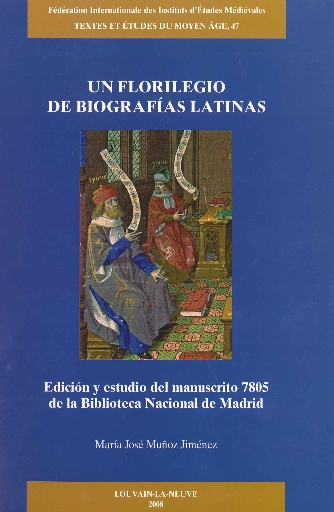
Un florilegio de biografías latinas
Edición y estudio del manuscrito 7805 de la Biblioteca Nacional de Madrid
show More to view fulltext, buy and share links for:Un florilegio de biografías latinas show Less to hide fulltext, buy and share links for: Un florilegio de biografías latinasEl manuscrito 7805 de la Biblioteca Nacional de Madrid contiene un florilegio de biografías latinas que ofrece excerpta de Quinto Curcio, del De vita Caesarum de Suetonio, de la Historia Augusta y del Ab urbe condita de Tito Livio. Esta selección de obras de la Antigüedad se acompaña con extractos del De vita et moribus philosophorum erróneamente atribuido a Walter de Burley y de la versión latina realizada por A. Travesari del De vita philosophorum de Diógenes Laercio.
Varias razones aconsejan el estudio de este manuscrito: por una parte, es un autógrafo realizado por una mano hispana en el siglo XV del que no se conocen otras copias; por otra, presenta una producción de un género típicamente medieval como es el del florilegio, y, a la vez, acoge una semblanza de biografías, género recuperado en el Renacimiento. La obra contenida en el ms. 7805 se muestra, pues, como un producto propio de esa época tan discutida de ‘transición’ del Medievo al Renacimiento en la España cuatrocentista.
María José Muñoz Jiménez es Catedrática de Filología Latina en la Universidad Complutense de Madrid. Desde su Tesis Doctoral ha trabajado sobre los manuscritos latinos conservados en España. Es autora, además, de diversos trabajos de Literatura Latina y Tradición Clásica así como de Lexicografía Latina Medieval.
En la actualidad es directora de un Grupo de Investigación de la Universidad Complutense dedicado al estudio de los florilegios latinos conservados en las bibliotecas españolas.
-
-
-
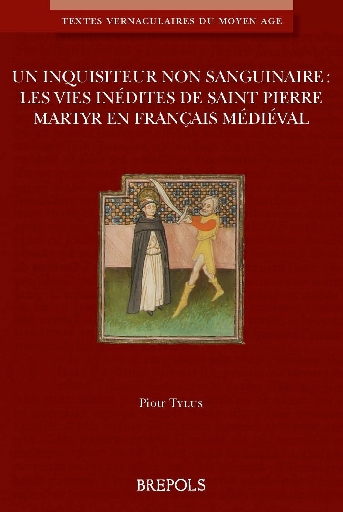
Un inquisiteur non sanguinaire : les vies inédites de saint Pierre Martyr en français médiéval
show More to view fulltext, buy and share links for:Un inquisiteur non sanguinaire : les vies inédites de saint Pierre Martyr en français médiéval show Less to hide fulltext, buy and share links for: Un inquisiteur non sanguinaire : les vies inédites de saint Pierre Martyr en français médiévalPierre naît à Vérone, au tournant du XIIe et du XIIIe siècle, d’une famille cathare. Il est dit « de Vérone » ou « Martyr ». Il étudie à Bologne, où il rencontre les frères prêcheurs et entre dans l’ordre, en recevant l’habit probablement des mains de saint Dominique lui-même, vers 1220 ou 1221. Son activité essentielle est celle de prédicateur itinérant. Il prêche à Rome, à Florence, dans la Romagne et la Marche d’Ancône, à Venise et en Toscane, et peut-être même à Paris. En juin 1251, Innocent IV le charge d’une mission contre les hérétiques de Crémone. Quelques mois plus tard, en septembre 1251, il devient inquisiteur pontifical à Milan, à Côme et dans leurs districts. Il assume cette tâche pendant les derniers mois de sa vie. Le 6 avril 1252, il est tué sur le chemin de Côme à Milan par un tueur à gages, loué par les hérétiques. Pierre est canonisé le 9 mars 1253.
Le présent livre contient neuf versions de sa légende, rédigées en français ancien (XIIIe-XVe siècles) par des auteurs anonymes. Les textes, qui procèdent du chapitre 61 de la Légenda aurea de Jacques de Voragine, n’ont jusqu’à présent jamais été édités. Dans la majorité des cas, on a affaire à des adaptations libres, parfois très libres, de la vita contenue dans la Legenda aurea, pour lesquelles celle-ci n’est qu’un point de départ. Il s’agit de textes autonomes : chacun des auteurs a exploité sa source à sa propre façon ; ce sont des jeux de la variante, tellement caractéristiques de la littérature médiévale.
-
-
-
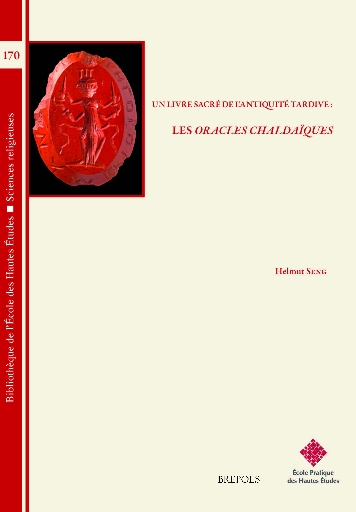
Un livre sacré de l'Antiquité tardive : les Oracles Chaldaïques
show More to view fulltext, buy and share links for:Un livre sacré de l'Antiquité tardive : les Oracles Chaldaïques show Less to hide fulltext, buy and share links for: Un livre sacré de l'Antiquité tardive : les Oracles ChaldaïquesLa définition devenue classique des Oracles Chaldaïques comme « une sorte de bible des derniers néo-platoniciens » résume la signification de ce texte médio-platonicien, qui n’a été conservé que sous forme de fragments et n’en est que plus difficile à comprendre. La tâche est compliquée par le fait que son langage poétique regorge d'images et de métaphores, et que ses exégètes antiques, ainsi que ses principaux témoins, en ont fait un usage créatif. Le présent volume offre une synthèse de la tradition, de la réception et de l’histoire de la recherche, ainsi que l’interprétation de la plupart des fragments et de nombreux témoignages dans le cadre d’une reconstruction systématique des conceptions philosophiques proposées dans les Oracles Chaldaïques. L’un des principaux thèmes abordés sera celui des idées cosmologiques liées à une hiérarchie des êtres résumée par la formule « âme-homme-salut », cela, à la lumière des informations glanées sur la pratique rituelle théurgique.
-
-
-
Un platonisme original au XIIe siècle
Métaphysique pluraliste et théologie trinitaire dans le De unitate et pluralitate creaturarum d’Achard de Saint-Victor
show More to view fulltext, buy and share links for:Un platonisme original au XIIe siècle show Less to hide fulltext, buy and share links for: Un platonisme original au XIIe siècleAchard de Saint-Victor (†1171) est un représentant moins connu de l’école de Saint-Victor, élève d’Hugues, chanoine régulier, maître, abbé de Saint-Victor à Paris (1155-1161), évêque d’Avranches (1161-1171). Son œuvre principal, le De unitate et pluralitate creaturarum, consiste en deux parties qui portent sur la doctrine trinitaire et sur la doctrine de la pluralité des raisons éternelles dans le Verbe de Dieu.
Cette recherche entend rétablir les thèses principales exposées par Achard de Saint-Victor dans son livre De unitate et pluralitate creaturarum pour montrer que les capacités métaphysiques de ce penseur ne le cèdent pas aux philosophes plus connus de son époque. Notamment, l’autrice étudie la façon dont le De unitate recourt aux doctrines médio et néoplatoniciennes pour résoudre la question d’une coexistence de l’unité et de la pluralité en Dieu et dans les créatures. L’enjeu est de mieux comprendre la place de la métaphysique platonicienne dans l’école de Saint-Victor, et ce malgré la rareté des sources au XIIe siècle, en particulier des œuvres de Platon ou de ses disciples grecs.
Le présent ouvrage contribue à résoudre deux problèmes de l’histoire de la philosophie : quels éléments et sources platoniciens ont été reçus au XIIe siècle et quelle place la pensée victorine fait à l’héritage platonicien. Les problèmes philosophiques soulevés sont la multiplication des objets intelligibles et sensibles, la définition de la chose et l’identité des êtres.
-
-
-

Un âge d’or des chapitres nobles de chanoinesses en Europe au xviii e siècle
Le cas de la Franche-Comté
show More to view fulltext, buy and share links for:Un âge d’or des chapitres nobles de chanoinesses en Europe au xviii e siècle show Less to hide fulltext, buy and share links for: Un âge d’or des chapitres nobles de chanoinesses en Europe au xviii e siècleS’il est difficile d’ignorer les chapitres nobles lorsqu’on aborde l’histoire des noblesses européennes au xviii e siècle, notamment dans les rapports qu’elles entretenaient avec l’Église, ces instituts restent toutefois peu étudiés. Plus marqué que pour les chapitres nobles masculins, le dynamisme de ceux de femmes intrigue. Le cas des chapitres nobles de chanoinesses de Franche-Comté, demeurés réguliers en un siècle qui ne passe pas pour avoir été favorable à l’Église régulière, comme le confirme la sécularisation d’un certain nombre de ces compagnies, est très éclairant sur les raisons de leur faveur. Celle-ci ne réside pas dans cette fonction d’asile et de secours matériel à destination d’une ancienne noblesse paupérisée que décrivaient leurs contemporains, mais dans leurs réponses précoces aux attentes de reconnaissance d’un groupe social convaincu de son déclin ainsi que dans leur aptitude à contenter une spiritualité en phase avec celle des Lumières et adaptable à la personnalité de chaque dame noble. L’effort accompli par les chapitres de chanoinesses, à l’apogée de la Réforme post-tridentine, pour conserver et développer leur spécificité en dépit de l’hostilité du clergé nous conduit par ailleurs à relativiser le concept de « Dorsale catholique » toujours très débattu chez les historiens, la plupart de ces établissements étant pourtant implantés dans ce front de catholicité identifié par René Taveneaux, reliant les anciens Pays-Bas à l’Italie du Nord.
-
-
-
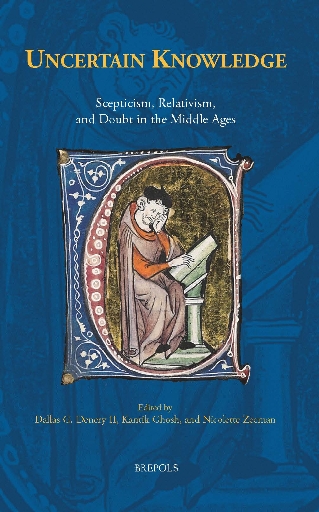
Uncertain Knowledge
Scepticism, Relativism, and Doubt in the Middle Ages
show More to view fulltext, buy and share links for:Uncertain Knowledge show Less to hide fulltext, buy and share links for: Uncertain KnowledgeWhat are the forms in which later medieval thinkers articulate epistemological scepticism, relativism, and doubt? Is it possible to voice different forms of uncertainty in different institutional contexts and languages? Bringing together specialists in philosophy, theology, history, and literature, this book undertakes an interdisciplinary investigation of some of the ways in which the problem of knowledge was explored in the Middle Ages. This is a topic of central intellectual importance and has large cultural consequences. The Middle Ages are often still treated by non-medievalists as a time of naive epistemological self-confidence, and we hope that ultimately this revisionist project will have impact beyond medieval studies, illustrating the extent to which this was a period in which many thinkers were intrigued by, and comfortable with, uncertainty.
-
-
-
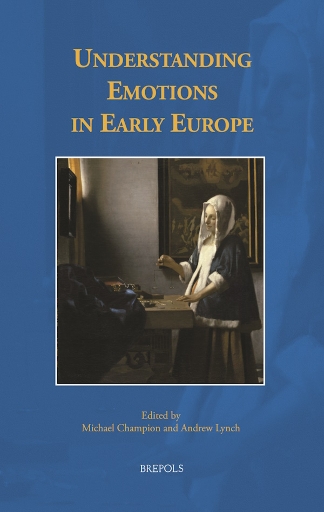
Understanding Emotions in Early Europe
show More to view fulltext, buy and share links for:Understanding Emotions in Early Europe show Less to hide fulltext, buy and share links for: Understanding Emotions in Early EuropeThis book investigates how medieval and early modern Europeans constructed, understood, and articulated emotions. The essays trace concurrent lines of influence that shaped post-Classical understandings of emotions, through overlapping philosophical, rhetorical, and theological discourses. They show the effects of developments in genre and literary, aesthetic, and cognitive theories on depictions of psychological and embodied emotion in literature. They map the deeply embedded emotive content inherent in rituals, formal documents, daily conversation, communal practice, and cultural memory. The contributors focus on the mediation and interpretation of pre-modern emotional experience in cultural structures and institutions - customs, laws, courts, religious foundations - as well as in philosophical, literary, and aesthetic traditions.
The volume thus represents a conspectus of contemporary interpretative strategies, displaying close connections between disciplinary and interdisciplinary critical practices drawn from historical studies, literature, anthropology and archaeology, philosophy and theology, cognitive science, psychology, religious studies, and gender studies. The essays stretch from classical and indigenous cultures to the contemporary West, embracing numerous national and linguistic groups. They illuminate the complex potential of medieval and early modern emotions in situ, analysing their involvement in subjects as diverse as philosophical theories, imaginative and scholarly writing, concepts of individual and communal identity, social and political practices, and the manifold business of everyday life.
-
-
-
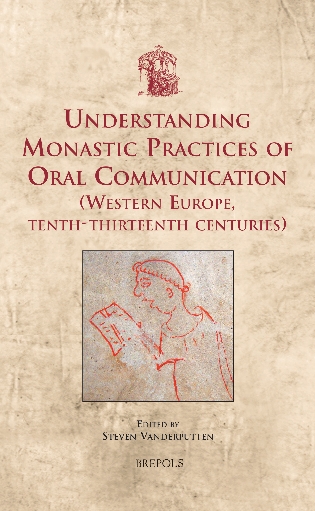
Understanding Monastic Practices of Oral Communication
(Western Europe, tenth-thirteenth centuries)
show More to view fulltext, buy and share links for:Understanding Monastic Practices of Oral Communication show Less to hide fulltext, buy and share links for: Understanding Monastic Practices of Oral CommunicationAlthough traditionally defined as a literate environment, Western monastic culture depended on a range of communicative practices which was just as large, and in some ways more sophisticated in its diversity, than that of other groups of society. Monks and nuns exchanged considerable amounts of information for which no written media were deemed necessary or which did not make a complete or immediate transition into written sources. Grouped in five thematic chapters, the papers in this volume aim to provide inroads into a useable interpretation of the various contexts in which monks and nuns in the central Middle Ages considered the spoken word as a vital complementary medium to other forms of communication.
-
-
-
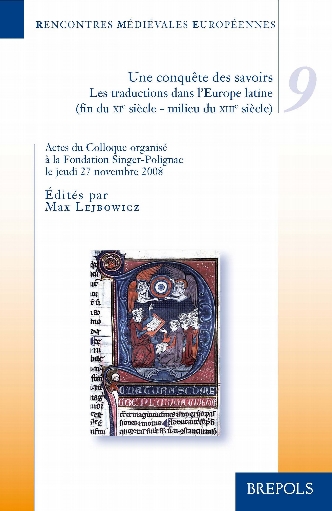
Une conquête des savoirs
Les traductions dans l’Europe latine (fin XIe siècle - milieu XIIIe siècle)
show More to view fulltext, buy and share links for:Une conquête des savoirs show Less to hide fulltext, buy and share links for: Une conquête des savoirsLes nouveautés culturelles qui se répandent en Europe latine aux xii e et xiii e siècles sont les expressions les plus hautes d’une longue période de croissance. Bien que déjà largement documentée, cette expansion pluriséculaire mérite d’être reprise et précisée.
Un cercle vertueux s’est enclenché aux alentours de l’an mil dans l’Europe latine, sans qu’il y ait simultanéité de dates et de rythmes sur tout le territoire. Pour être multiples, les composantes de cet essor se réduisent à un même thème: ce sont autant de triomphes de l’homme européen sur son environnement et sur lui-même: amélioration de l’outillage et des techniques agricoles, poussée démographique, défrichements, nouveaux sites de peuplement, renouveau urbain, renforcement de l’artisanat, essor de l’économie monétaire, développement et diffusion de l’écrit, promotion des langues vernaculaires.
Véhicule déterminant du nouveau savoir, les traductions surviennent dans un monde latin à l’essor multiforme. Elles l’accompagnent et le transfigurent. Elles en décuplent les possibilités. Elles expriment un engouement dévorant pour l’étude, dont en retour elles accroissent l’intensité et rehaussent le niveau. Les clercs sont aspirés par cette spirale, dont le terme marque la fin du Moyen Âge. Les acquis des siècles précédents servent aux hommes du xv e à renouer directement avec l’hellénisme et avec le classicisme latin, tout en franchissant les océans d’une terre maintenant centrée sur le soleil.
La polysémie du mot «monde» rend compte de la totalité des nouveautés qui, apparues au cours du xii e siècle de Europe latine, transforment en quelques cent ans le continent: le xii e siècle latin s’est transfiguré en véritable Nouveau Monde.
-