Brepols
Brepols is an international academic publisher of works in the humanities, with a particular focus in history, archaeology, history of the arts, language and literature, and critical editions of source works.2101 - 2200 of 3194 results
-
-
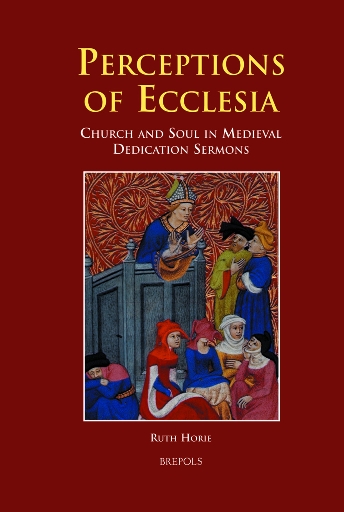
Perceptions of Ecclesia
Church and Soul in Medieval Dedication Sermons
show More to view fulltext, buy and share links for:Perceptions of Ecclesia show Less to hide fulltext, buy and share links for: Perceptions of EcclesiaThe medieval laity’s understanding of the church and their own role within it was largely shaped by preaching. How did preachers actually define the word 'church', and what was the essence of their ecclesiological teachings? Sermons for the dedication of a church reveal that the term
ecclesia had numerous connotations. Three key ideas recur with particular frequency: the material church, the Christian community, and the church of the soul. The physical church building held an important place in medieval society as a tangible connecting link between ordinary people on the one hand and saints, angels and the divine presence on the other. Yet perhaps more significantly, it stood as a symbol for the human soul. Preachers treat the dedication of the physical church as an elaborate metaphor for the spiritual consecration of the soul. The prominent interest in the concept of the soul as church, which is reflected in sermons, suggests a much more individual, less community-oriented focus in medieval spirituality than has been generally assumed.
-
-
-
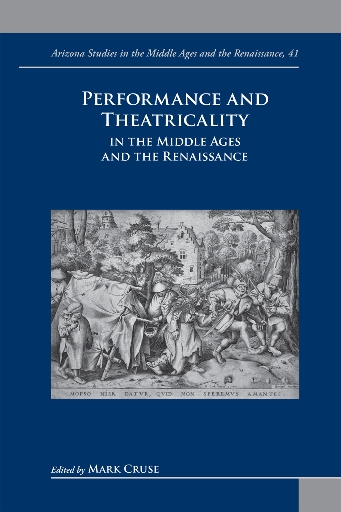
Performance and Theatricality in the Middle Ages and the Renaissance
show More to view fulltext, buy and share links for:Performance and Theatricality in the Middle Ages and the Renaissance show Less to hide fulltext, buy and share links for: Performance and Theatricality in the Middle Ages and the RenaissanceThis volume is a contribution to the cross-cultural study of theater and performance in the Middle Ages and the Renaissance. The studies gathered here examine material from Austria, England, France, Germany, Italy, the Netherlands, Russia, and Spain from the thirteenth to the eighteenth century. Underlying all of these essays is the understanding that performance shapes reality - that in all of the cultural contexts included here, performance opened a space in which patrons, rulers, writers, painters, spectators, and readers could see themselves or their societies differently, and thereby could assume different identities or construct alternative communities. Addressing confession and private devotion, urban theater and pageantry, royal legitimacy and religious debate, and a wide range of genres and media, this volume offers a panoramic mosaic of theater’s world-making role in medieval and early modern European societies.
-
-
-
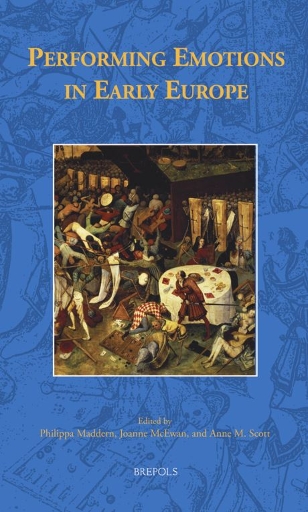
Performing Emotions in Early Europe
show More to view fulltext, buy and share links for:Performing Emotions in Early Europe show Less to hide fulltext, buy and share links for: Performing Emotions in Early EuropeDrawing on a range of interdisciplinary approaches and innovative methodologies, this collection contributes ground-breaking new scholarship in the burgeoning field of emotions studies by examining how medieval and early modern Europeans communicated and ‘performed’ their emotions. Rejecting the notion that emotions are ‘essential’ or ‘natural’, this volume seeks to pay particular attention to cultural understandings of emotion by examining how they were expressed and conveyed in a wide range of historical situations. The contributors investigate the performance and reception of pre-modern emotions in a variety of contexts — in literature, art, and music, as well as through various social and religious performances — and in a variety of time periods ranging from the twelfth to the eighteenth centuries. These studies provide both case-studies of particular emotions and emotional negotiations, and examinations of how their categorisation, interpretation, and meaning has changed over time.
The contributors provide new insights into the expression and performance of pre-modern emotions from a wide range of disciplinary fields, including historical studies, literature, art history, musicology, gender studies, religious studies, and philosophy. Collectively, they theorise the performativity of medieval and early modern emotions and outline a new approach that takes fuller account of the historical specificity and cultural meanings of emotions at particular points in time.
This volume forms a companion to Understanding Emotions in Early Europe, edited by Michael Champion and Andrew Lynch (2015); http://www.brepols.net/Pages/ShowProduct.aspx?prod_id=IS-9782503552644-1
-
-
-
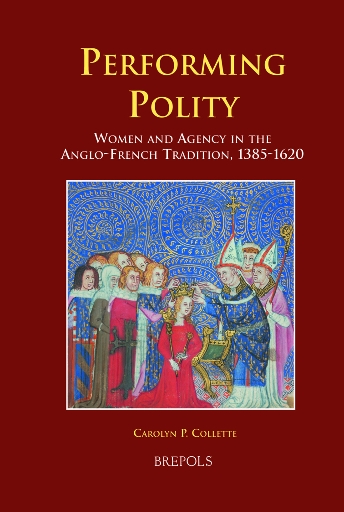
Performing Polity
Women and Agency in the Anglo-French Tradition, 1385-1620
show More to view fulltext, buy and share links for:Performing Polity show Less to hide fulltext, buy and share links for: Performing PolityReading a variety of texts centred in the power and agency of women during the period 1385 to 1620, this book examines changing ideals of gender within the context of changing ideologies of governance and polity. Together the essays that comprise this book lay out three lines of thinking about women and polity: that the ideology of late medieval gender roles articulated in Anglo-French texts of the late fourteenth and early fifteenth centuries outlined important roles for women’s voice and agency in supporting the larger polity as well as the smaller household; that the acceptance and the value of those roles diminished as models of polity in both Church and State in England changed in the early modern period; that to see this change merely in terms of change in expectations of gender roles is to miss the vital link between the status of women and the political construction of individual relationship to authority. Woman is the site on which society delineates the degree of freedom and independence it will tolerate in the political subject. The attention directed to women’s roles in the plethora of woman-centred stories, courtesy books, prayer books, sermons and tracts in the period 1385-1620 is an index to shifting alignments of power that replaced medieval models of partnership and co-operation with models of obedience.
-
-
-
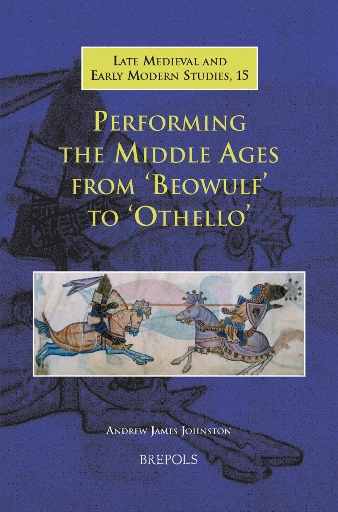
Performing the Middle Ages from 'Beowulf' to 'Othello'
show More to view fulltext, buy and share links for:Performing the Middle Ages from 'Beowulf' to 'Othello' show Less to hide fulltext, buy and share links for: Performing the Middle Ages from 'Beowulf' to 'Othello'Performing the Middle Ages from ‘Beowulf’ to ‘Othello’ traces the dialogic nature of the relationship between the Middle Ages and modernity. Arguing that modern beliefs in the alterity of the Middle Ages stem from the Middle Ages’ own processes of self-representation, Johnston explores varieties of nostalgia through a wide selection of texts. This volume spans an extensive chronological period with a view to demonstrating how our notions of the medieval have been crucially informed by the past itself. The study is focused on works which stage that popular literary archetype - the nostalgic figure of the aristocratic warrior - and argues that it is this image that provides a structural model for so many modern perspectives on the Middle Ages. And yet, in the Middle Ages this model was being deconstructed as it was also being generated. By moving from the self-consciously archaic heroism of Beowulf to the scathing comment on chivalric narrative presented in Chaucer’s ‘Knight’s Tale’, Johnston’s analysis offers an intriguing insight into the way medieval texts engage in a continual aesthetic and ideological critique of their own cultural moment. Using Sir Gawain and the Green Knight and the Alliterative Morte Arthure as examples of an incisive critique of the cult of subjectivity and of a highly self-conscious desire for tradition, Johnston extends his analysis to the early seventeenth century, and explores the ways in which Shakespeare’s Othello brilliantly deconstructs the very concept of ‘Renaissance Man’. With its interest in issues of subjectivity, textual performance, and the ideological self-awareness of medieval culture, Performing the Middle Ages provides a scholarly and compelling investigation into the Middle Ages’ ability both to understand itself and to shape (post)modern notions of the medieval.
-
-
-
Peritia
Journal of the Medieval Academy of Ireland
show More to view fulltext, buy and share links for:Peritia show Less to hide fulltext, buy and share links for: PeritiaPeritia is devoted to the advancement of medieval studies in the broadest sense of that term (albeit from an insular perspective), including history, languages, law (canon and secular), archaeology and the ancillary disciplines. It is especially strong on Insular Latin, computistics, and paleography, and it has carried notable contributions on hagiography, art history and archaeology, literature, Irish vernacular law, and the history of the later Middle Ages. It also has a lively and wide-ranging review section.
More information about this journal on Brepols.net
-
-
-
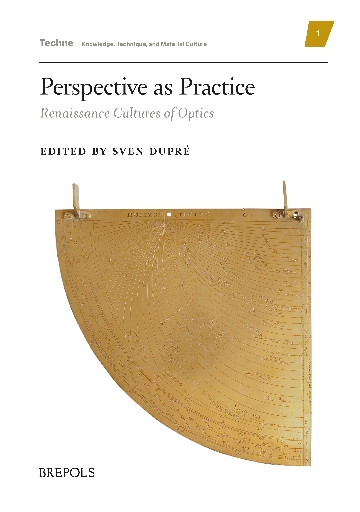
Perspective as Practice
Renaissance Cultures of Optics
show More to view fulltext, buy and share links for:Perspective as Practice show Less to hide fulltext, buy and share links for: Perspective as PracticeThis book is about the development of optics and perspective between the fifteenth and seventeenth centuries. The point of departure of this book is the recognition of the polysemy of perspective, that is, the plurality of meanings of perspective. To bring forward the polysemy of perspective, this book explores the history of perspectiva in terms of practices, a conglomerate of material, social, literary and reproductive practices, through which knowledge claims in perspective were produced, promoted, legitimated and circulated in and through a variety of sites and institutions. The ways optical knowledge was used by different groups in different places (such as the university classroom, the anatomist's dissection table, the goldsmith's workshop, and the astronomer's observatory) defined the meanings of Renaissance perspective. As this period was characterized by widespread 'optical literacy', perspective was defined in different ways in different places and sites by various groups of practitioners. Most interestingly, sites such as the theatre, the instrument maker's workshop and the courtly garden were home to practices of perspective which have remained on the margin, or even completely invisible, in the historiographies of optics and perspective. The book also brings out the differences between codifications of perspectiva and practice. There were a variety of non-Albertian constructions to create the illusion of space, and other types of optical knowledge were as important to artists as the geometry of perspective.
-
-
-
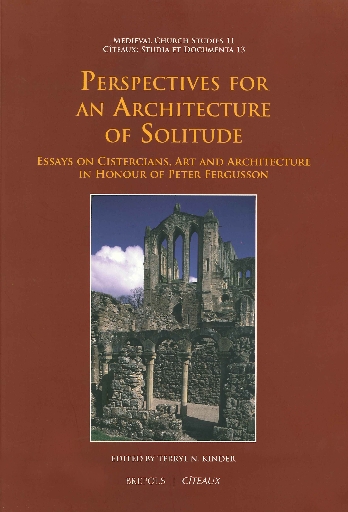
Perspectives for an Architecture of Solitude
Essays on Cistercians, Art and Architecture in Honour of Peter Fergusson
show More to view fulltext, buy and share links for:Perspectives for an Architecture of Solitude show Less to hide fulltext, buy and share links for: Perspectives for an Architecture of SolitudeWhat was it that gave medieval art and architecture its form and style? What is it that attracts people to medieval art and architecture, especially that of the Cistercians? What shaped medieval buildings and determined their embellishments - and what now determines the way we look at them?
Some of the most intriguing questions in monastic and ecclesiastical architecture and archaeology are discussed in this tribute to Peter Fergusson and his lifetime of scholarship as an historian of medieval art and architecture, especially of the Cistercians.
These thirty-four essays range from a discussion of the earliest Christian legislation on art (fourth century) to an account of a garden project of 1811 designed to efface all previous monastic habitation. Between these chronological signposts are studies on the design, siting, building, and archaeology of churches, infirmaries, abbots’ lodgings, gatehouses, private chambers, grange chapels, and the life lived within and around them. Geographically, the papers range from the British Isles through Spain, France, Flanders, and Germany to the centre of the medieval world: Jerusalem.
They treat of the complexities of building and re-building; of architectural and artistic adaptations to place, period, and political upheaval; of the interrelationship of text and structure; and of the form, iconography, and influence of some of the great churches and cathedrals of the Middle Ages. This is a wide-ranging and authoritative collection of studies which is essential reading for any historian of medieval art and architecture.
-
-
-
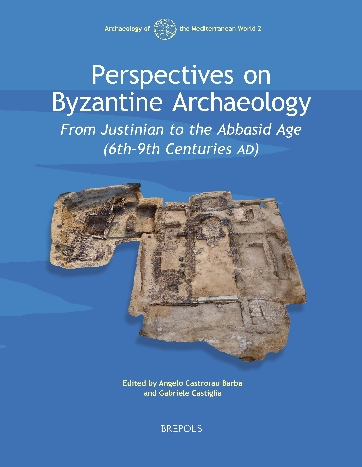
Perspectives on Byzantine Archaeology
From Justinian to the Abbasid Age (6th–9th Centuries)
show More to view fulltext, buy and share links for:Perspectives on Byzantine Archaeology show Less to hide fulltext, buy and share links for: Perspectives on Byzantine ArchaeologyFrom the rule of Justinian (AD 527-AD 565) up to the Islamic conquests in the Byzantine Empire, the lands of the Mediterranean basin underwent significant change from the sixth to the ninth centuries AD. Urban and rural areas were transformed, landscapes altered, and material cultures saw a fundamental shift. But such changes were by no means uniform across the region. From Jordan, Greece, and the Danube, to the Italian peninsula, Sicily, Spain, and the Horn of Africa, the contributions gathered together in this volume explore new advances and perspectives from the field of ‘Byzantine’ archaeology over the longue durée in order to shed new light on this period.
What was the impact of the reconquest of Justinian? What was the impact of Byzantium in archaeological record? What are the archaeological indicators of urban and rural transformations from the sixth to the ninth centuries? Did architecture represent a marker of socio-economic and cultural change within the Byzantine world? By engaging with such key questions, and by drawing on new data from surveys, excavations, material culture, and historical sources, this volume offers new insights into archaeological perspectives on the broader Byzantine world.
-
-
-
Pestes, incendies, naufrages.
Écritures du désastre au dix-septième siècle
show More to view fulltext, buy and share links for:Pestes, incendies, naufrages. show Less to hide fulltext, buy and share links for: Pestes, incendies, naufrages.La peste de Milan, l’éruption du Vésuve, l’incendie de Londres : ces faits n’ont pas subsisté dans la mémoire collective à cause de leur impact ou de leur singularité, mais en raison des discours qu’ils ont produits et qui les ont produits, en tant qu’événements. Bien avant le désastre de Lisbonne, les catastrophes naturelles, au dix-septième siècle, deviennent des phénomènes éditoriaux, suscitant une très grande quantité de récits, de témoignages, de traités, de sermons, de lettres, de poèmes. Des « colonnes de la peste » s’élèvent sur les places des villes. À la même époque, les catastrophes naturelles font aussi leur apparition dans des oeuvres de fiction.
L’objet du présent ouvrage est d’interroger quelques-unes des manifestations de cette approche nouvelle de ce que l’on n’appelle pas encore, ou pas souvent, des « catastrophes » : les modalités de leur mise en récit, l’inscription d’un point de vue, ou encore la visée esthétique revendiquée par des auteurs qui ne sont pas tous des professionnels de l’écriture, et presque aucun des écrivains de renom. Quels moyens rhétoriques, poétiques, ou même dramatiques ont-ils mis en oeuvre afin de rendre compte de la peur, de l’horreur et du deuil ? Quels systèmes de causalité, quels modèles de compréhension et de comportement ont-ils pour cela mobilisé ? Comment les conflits d’interprétation ont-ils contribué à leur prise de parole et informé leur représentation des faits ? Que dit, enfin, celui qui a survécu à la peste ou au naufrage ?
La réponse à ces questions ne peut se trouver que dans la forme et l’écriture de ces textes, dont certains sont exceptionnels par leur force évocatoire ou l’intelligence de leurs enjeux esthétiques et moraux. C’est pourquoi les auteurs de ce livre ont choisi de les commenter, de les présenter et d’en donner à lire de larges extraits, en langue originale et en traduction.
Françoise Lavocat est professeur en littérature comparée à l’Université Paris 3-Sorbonne nouvelle.
Giancarlo Alfano est professeur associé à l’Universita Seconda de Naples. Anne Duprat est maître de conférences habilitée en littérature comparée à l’Université Paris 4-Sorbonne ; Jochen Hoock est professeur d’histoire émérite à l’Université Paris 7-Denis Diderot ; Pierre Kapitaniak est maître de conférences en anglais à l’Université Paris 8-Saint-Denis ; Chantal Liaroutzos est maître de conférences habilitée en littérature française du seizième siècle à l’Université Paris 7-Denis Diderot ; Gérard Marino est traducteur ; Louis Picard est docteur en littérature comparée et professeur en classes préparatoires (Versailles) ; Christian Zonza est maître de conférences en littérature française du dix-septième siècle à l’Université de Nantes.
-
-
-
Peter Abelard, Know Yourself (Scito te ipsum)
show More to view fulltext, buy and share links for:Peter Abelard, Know Yourself (Scito te ipsum) show Less to hide fulltext, buy and share links for: Peter Abelard, Know Yourself (Scito te ipsum)Peter Abelard (1079-1142), famous for his unhappy love story with Heloise, which he wrote down in his autobiographical work Historia calamitatum, was among the most respected scholars of his time. Brilliant as a philosopher and theologian, he was one of the co-founders of scholasticism, seeking to elucidate theological facts through logic.Scito te ipsum is one of the most important texts of the twelfth century. Only in the later phase of his life and work did Abelard decide to separate moral themes from his overall theological schema, and to dedicate a monograph to them under the guiding concepts of "sin" (First Book) and "obedience before God" (Second Book, unfinished). As Ethica nostra it was intended to provide a Christian conception alongside a philosophical ethics, and to summarise the results of his previous studies.
Along with Abelard’s entire theology, this treatise was also condemned as heretical by Pope Innocent II, and was long considered lost. Since its rediscovery in the 18th century, it has met with lively interest both from a theological and also from a philosophical point of view. The historical aspects of the work and its integration into Abelard’s complete works receive special attention in the introduction to this volume, which presents the Latin text from the Corpus Christianorum (CC CM 190) with a new English translation.
-
-
-

Peter of Ireland, Writings on Natural Philosophy
Commentary on Aristotle’s On Length and Shortness of Life and the Determinatio Magistralis
show More to view fulltext, buy and share links for:Peter of Ireland, Writings on Natural Philosophy show Less to hide fulltext, buy and share links for: Peter of Ireland, Writings on Natural PhilosophyPeter of Ireland (Petrus de Ybernia) was born sometime around the beginning of the thirteenth century in Ireland, probably of a Norman family. He probably left Ireland aged around age 15 to pursue his studies abroad. His interest in medical and scientific questions would suggest a stay at Oxford, whereas his approach to logic would suggest a Parisian influence. By the middle of the century he was Professor of Logic and Natural Philosophy at the University at Naples. Peter is perhaps one of the best known of medieval Irish thinkers on the continent owing to the fact that he was held to be the teacher of the young Thomas Aquinas at Naples University from 1239-44. As such, it would be he who, in all likelihood, first introduced Thomas to the study of Aristotle and perhaps also to the commentaries of Avicenna and Averroes. The works presented here date from at least a decade later, and relate to lectures given at Naples in the 1250s and 1260s. The extent to which he was held in respect by his contemporaries is to be seen in his solution (determinatio) to the disputed question on the origin of the design of an animal’s body which was held before King Manfred around 1260. It was, perhaps the culmination of a famous scholarly career.
-
-
-
Peter of Spain on Composition and Negation
Text, translation, commentary
-
-
-
Petit manuel pour le dévot moderne. Tractatulus devotus
show More to view fulltext, buy and share links for:Petit manuel pour le dévot moderne. Tractatulus devotus show Less to hide fulltext, buy and share links for: Petit manuel pour le dévot moderne. Tractatulus devotusLe mouvement spirituel du XIVe siècle connu sous le nom de Devotio moderna, a reçu outre l'impulsion de Gérard Grote († 1384) son organisation et son soutien de Florent Radewijns, qui à côté de Gérard Zerbolt et à une place que son zèle de disciple privilégié ne déclarerait pas mineure, doit être considéré comme un cofondateur. Rédacteur d'un rapiarium, anthologie spirituelle à usage personnel ou communautaire des Frères de la Vie commune, Florent a mis en œuvre le matériau ainsi rassemblé, dans un ouvrage où paraît le génie didactique de la Devotio moderna, aiguisé par ses premières tâches pédagogiques: le Tractatulus devotus est un véritable Petit manuel pour le dévot moderne, d'une tonalité plus souriante que les écrits plus élaborés de son secrétaire, Gérard Zerbolt.
La découverte du rapiarium comme source première du Petit manuel a permis d'en restituer le texte dans les meilleures conditions, malgré la disparition en mai 1940 de l'unique manuscrit d'une œuvre à circulation interne, représentant une forme de «littérature domestique».
Avec le précédent volume sur Gérard Grote, paru dans la même collection, c'est la seconde personnalité de la Devotio moderna qui est maintenant mise en lumière. L'Introduction de Thom Mertens reconstitue ce milieu où s'unissent activité de prière, activité pédagogique et activité littéraire, où la lecture est source de l'écriture.
-
-
-
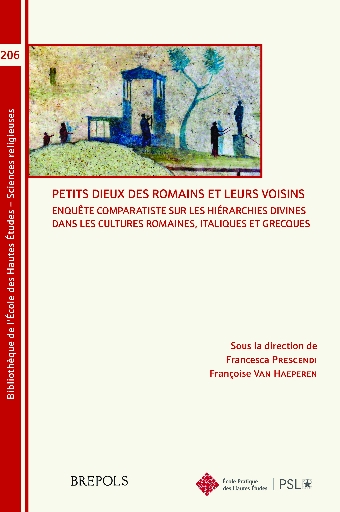
Petits dieux des Romains et leurs voisins
Enquête comparatiste sur les hiérarchies divines dans les cultures romaines, italiques et grecques
show More to view fulltext, buy and share links for:Petits dieux des Romains et leurs voisins show Less to hide fulltext, buy and share links for: Petits dieux des Romains et leurs voisinsLa formule « petites divinités », qui désigne dans ce volume toutes les puissances revêtant des pouvoirs limités ou une position inférieure dans une configuration divine donnée, est utilisée ici comme un concept exploratoire dont le caractère opérationnel est testé collectivement, en l’appliquant au monde romain et en le comparant aux cultures voisines, grecques et italiques. Si l’étiquette « petites divinités » peut étonner, elle repose cependant sur des catégories antiques. Dans quelques textes latins, en effet, les dieux se définissent eux-mêmes – ou sont définis – comme inférieurs aux autres. Le concept de petites divinités est donc éminemment relationnel mais également contextuel. Les articles réunis dans ce volume abordent ainsi la question des classifications et des hiérarchies divines à partir de sources et de contextes spécifiques, plus ou moins larges, mettant en jeu des panthéons, configurations ou réseaux divins, plus ou moins structurels ou conjoncturels. Si dans le contexte romain, la hiérarchie est une clé pour organiser les groupes des dieux, en se déplaçant vers d’autres contextes culturels, au contraire, les rapports entre divinités semblent plutôt fondés sur des liens de complémentarités entre les dieux.
-
-
-
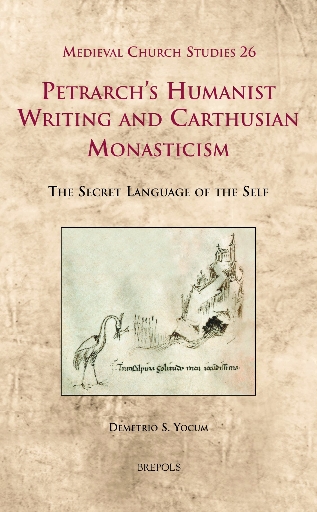
Petrarch's Humanist Writing and Carthusian Monasticism
The Secret Language of the Self
show More to view fulltext, buy and share links for:Petrarch's Humanist Writing and Carthusian Monasticism show Less to hide fulltext, buy and share links for: Petrarch's Humanist Writing and Carthusian MonasticismThe fourteenth century saw an exponential rise in charterhouses across Europe. During this period of growth, the cloister walls protecting the silence and solitude of the relatively small and isolated semi-eremitical Carthusian houses became more porous, pliable, and open to the outer world. Although still considered at the forefront of Christian piety and asceticism, the Carthusians began to be more clearly identified with their newly acquired taste for the arts, literature, and architecture. Gradually, charterhouses became major humanist centres attracting sophisticated patrons, artists, and scholars.
Of the long line of renowned anti-scholastic intellectuals who were attracted to Carthusian circles, Petrarch was undoubtedly the first. By revealing the Carthusian imprint on Petrarch’s thought as well as elements of Carthusian spirituality present in his texts, this book argues that Carthusianism was an essential component of Petrarch’s Christian humanism and hermeneutics of the self. An interdisciplinary approach, involving parallel readings of Petrarchan texts, early monastic and Carthusian primary sources, together with more recent theological reflections, offers new insights into the role of Carthusianism in the intellectual debate on spirituality and the position of the individual within this order. Through Petrarch and his literary works, the Carthusian milieu ultimately shaped not only Renaissance humanism but also our understanding of the relationship between ‘self’, God, and others.
-
-
-
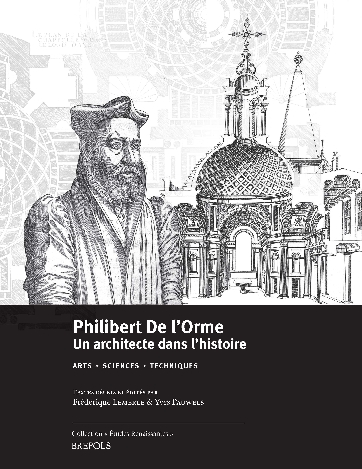
Philibert De l'Orme. Un architecte dans l'histoire
Arts - Sciences - Techniques
show More to view fulltext, buy and share links for:Philibert De l'Orme. Un architecte dans l'histoire show Less to hide fulltext, buy and share links for: Philibert De l'Orme. Un architecte dans l'histoireEntre Pierre Lescot et Jean Bullant, Jean Goujon et Jacques Androuet du Cerceau, Philibert De l’Orme est l’étoile majeure d’une constellation d’architectes qui, à l’instar de la Pléiade des poètes, a donné au XVIe siècle français une aura comparable à celle de l’Italie. Au service du cardinal Jean du Bellay, de Diane de Poitiers, de Henri II et de Catherine de Médicis, constructeur et théoricien, il laisse une œuvre aussi passionnante que problématique. Héritier du Moyen-Âge et grand connaisseur de l’antiquité romaine, praticien expert doublé d’un humaniste savant, il réalise une synthèse fascinante des tendances diverses mais convergentes de la Renaissance, qui lui fait incarner le renouveau artistique de la France de son temps. Quoique sa fortune ait souffert des vicissitudes de l’histoire, de l’évolution du goût et sans doute aussi du caractère protéiforme de son génie, sa puissance créatrice, égale à celle d’un Rabelais ou d’un Ronsard, en fait le Michel-Ange français.
À l’occasion du cinq-centième anniversaire de sa naissance, le LVIIe colloque international d’études humanistes du Centre d’études supérieures de la Renaissance à Tours, organisé par Frédérique Lemerle, directrice de recherche au Cnrs (Tours, CESR, UMR 7323) et Yves Pauwels professeur des universités (Tours, CESR/Université François-Rabelais) a rendu hommage à celui qui fut l’un des plus grands artistes de la Renaissance. Les essais réunis s’attachent à explorer quelques zones d’ombre laissées encore obscures par les monographies précédemment consacrées à l’architecte en inscrivant la problématique dans la perspective pluridisciplinaire qui est celle du CESR.
-
-
-
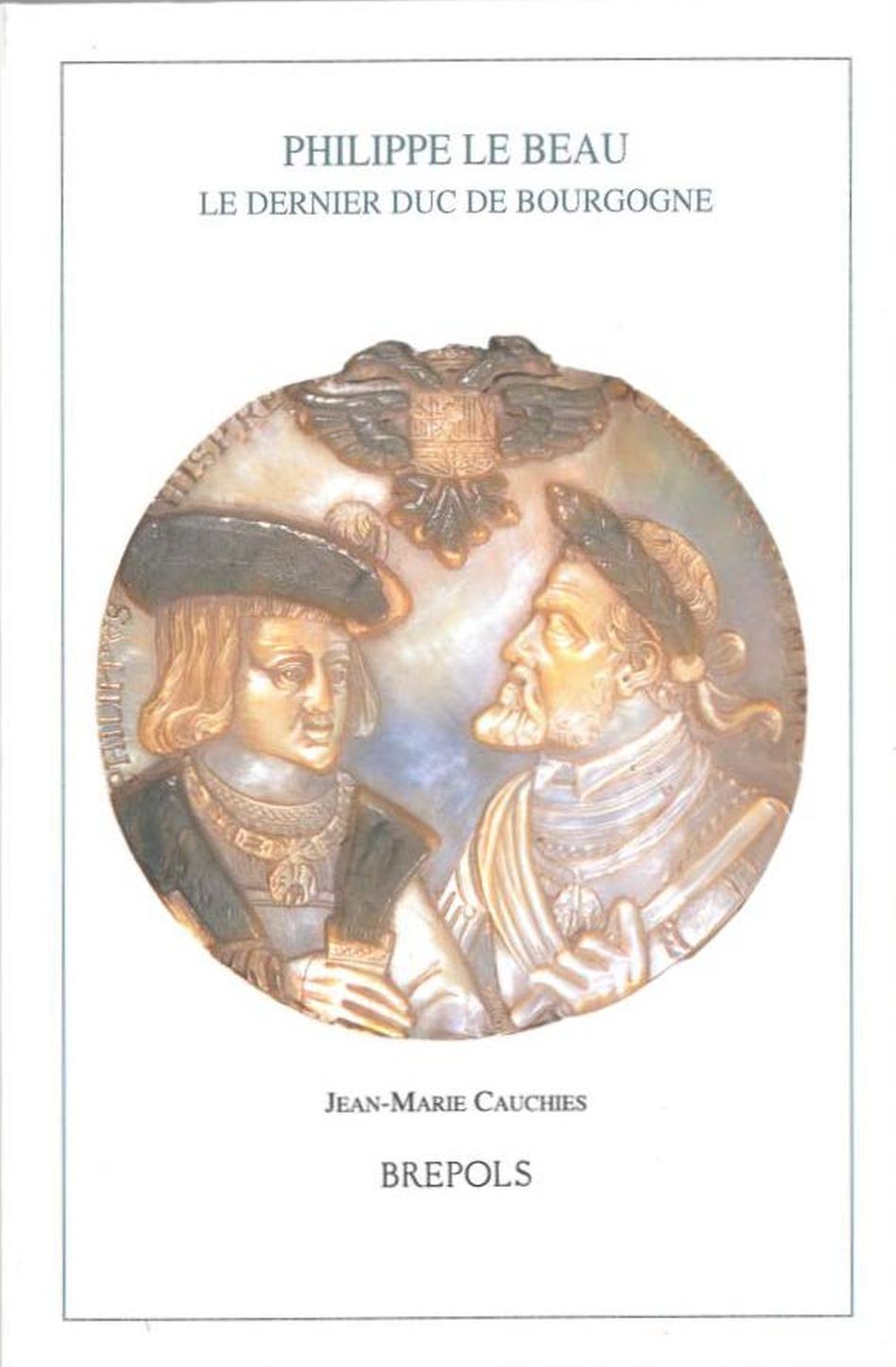
Philippe le Beau. Le dernier duc de Bourgogne
show More to view fulltext, buy and share links for:Philippe le Beau. Le dernier duc de Bourgogne show Less to hide fulltext, buy and share links for: Philippe le Beau. Le dernier duc de BourgognePhilippe de Habsbourg-Bourgogne, dit le Beau, archiduc d'Autriche, prince "naturel" dans les Pays-Bas, éphémère roi de Castille, fait trop souvent d' " oublié de l'Histoire ". Mort jeune encore, en pleine ascension politique, " victime " de la notoriété de ses parents, Maximilien et Marie, et davantage encore de son fils aîné Charles Quint, éclipsé dans la mémoire par son épouse Jeanne, dite la Folle, il trouve mal sa place dans l'historiographie, aux confins du moyen âge et de la Renaissance, de la féodalité des grands princes et du temps d'expansion de l' " Etat moderne " en occident. Né à Bruges en 1478, mort à Burgos en 1506, il est pourtant un maillon essentiel. Sa biographie morale et politique entraîne le lecteur à la découverte du pouvoir et de ses instruments, de la diplomatie et de ses intrigues, de Malines à Madrid, de Windsor à Innsbruck. Européen par la force des choses, Philippe le Beau, très entouré de " ministres " aux vues ambitieuses et divergentes, n'est pas encore le dépositaire d'une aspiration à la monarchie universelle vers laquelle tendra son successeur. Il demeure avant tout un duc de Bourgogne, l'héritier et le continuateur d'une lignée. Les choix politiques qu'il assume à ce titre, face à son père l'empereur élu du Saint Empire, à ses beaux-parents les Rois catholiques, au roi de France, ont pu faire de lui un " enfant terrible " de la politique internationale.
-
-
-
Philippe le Chancelier prédicateur, théologien et poète parisien du début du xiii e siècle
show More to view fulltext, buy and share links for:Philippe le Chancelier prédicateur, théologien et poète parisien du début du xiii e siècle show Less to hide fulltext, buy and share links for: Philippe le Chancelier prédicateur, théologien et poète parisien du début du xiii e siècleHomme de savoir et de pouvoir, Philippe le Chancelier (mort en 1236) se distingue par une production de qualité dans des domaines aussi divers que la théologie, la prédication ou encore la poésie lyrique. Sa charge de chancelier de Notre-Dame de 1217 à 1236 le place au cœur des événements qui rythment la vie ecclésiastique parisienne. Il prend part aux grandes querelles de son temps, notamment celles qui entourent l’émergence de l’université. Il est l’auteur de l’une des premières sommes préscolastiques, la Summa de bono, qui exerce une influence notable sur plusieurs générations de théologiens. D’autre part, il est un prédicateur très apprécié dont les sources conservent une trace abondante. Sa production lyrique occupe une place importante dans l’histoire littéraire et musicale.
Encore mal connue, cette figure complexe et prolixe mérite donc qu’on lui consacre des études croisées, permettant l’éclairage de différents champs disciplinaires. Les études ici assemblées ont pour ambition d’aborder chacun des domaines dans lesquels Philippe le Chancelier s’est illustré, dans le but de faire dialoguer ces corpus et de faire apparaître des zones de cohérence ou des registres intertextuels encore peu explorés.
-
-
-
Philippine Duchesne, pionnière à la frontière américaine
Oeuvres complètes (1769-1852)
show More to view fulltext, buy and share links for:Philippine Duchesne, pionnière à la frontière américaine show Less to hide fulltext, buy and share links for: Philippine Duchesne, pionnière à la frontière américaineEn 1818, Mère Rose Philippine Duchesne, de la Société du Sacré-Cœur de Jésus récemment fondée, quitte la France pour participer à l’expansion missionnaire de l’Église catholique au Nouveau Monde, à la demande de Mgr Louis Guillaume Dubourg, nommé évêque de « la Louisiane ». Cette vaste région, acquise par les États-Unis à la France en 1803, s’étend sur un territoire de 2 144 500 km2 allant de la Nouvelle-Orléans au Canada et recouvrant les terres drainées par le vaste système fluvial du Mississippi et du Missouri, futur Midwest des États-Unis. La navigation y est parfois difficile et la transmission du courrier postal s’en trouve perturbée.
Les écrits de sainte Philippine - 656 lettres, cinq annales et quelques textes plus courts, tous en français (sauf une lettre en anglais) - représentent une belle source d’informations concernant son appel missionnaire et les sacrifices qu’il a entraînés, la vie primitive des premières années à la frontière du Missouri, le développement de l’Église catholique et de la Société du Sacré-Cœur en Amérique du Nord pendant trente-quatre ans. Ils décrivent sa vie héroïque reconnue par un bon nombre de sociétés historiques américaines, révèlent sa sainteté proclamée par l’Église catholique en 1988. Jusqu’à présent, tous ses écrits n’avaient pas été mis à la disposition des lecteurs et des chercheurs. Cette édition annotée les rassemble.
-
-
-
Philologie, herméneutique et histoire des textes entre Orient et Occident
Mélanges en hommage à Sever J. Voicu
show More to view fulltext, buy and share links for:Philologie, herméneutique et histoire des textes entre Orient et Occident show Less to hide fulltext, buy and share links for: Philologie, herméneutique et histoire des textes entre Orient et OccidentCe volume en hommage à Sever Voicu, ancien Scriptor Graecus à la Bibliothèque Vaticane et professeur à l’Istituto Patristico «Augustinianum» à Rome, rassemble des contributions sur la patristique, les christianismes orientaux, les apocryphes de l’Ancien et du Nouveau Testament, la paléographie et la codicologie.
La première section accueille des études codicologiques sur la circulation de manuscrits et de textes entre le XIVe et le XVIe siècle. La deuxième section est dédiée aux traductions anciennes (en latin, en copte, en arménien, en éthiopien), ainsi qu’à l’édition de textes fragmentaires (grecs, coptes). Les contributions de la troisième section cherchent à éclairer des questions exégétiques ou discutent le contexte de production d’un texte, son auteur, son destinataire. Suivent des études sur des textes pseudépigraphes grecs ainsi que sur les apocryphes de l’Ancien et du Nouveau Testament en grec, en latin, en arménien, en géorgien, en roumain. Le volume se termine par une section consacrée à des textes de Jean Chrysostome ou qui lui sont attribués, en grec et dans des traductions syriaques, arméniennes, géorgiennes et slavonnes. Le livre contient plusieurs éditions de textes inédits, ainsi que des descriptions de manuscrits pas ou peu connus.
-
-
-

Philon d'Alexandrie. Un penseur à l'intersection des cultures gréco-romaine, orientale, juive et chrétienne
show More to view fulltext, buy and share links for:Philon d'Alexandrie. Un penseur à l'intersection des cultures gréco-romaine, orientale, juive et chrétienne show Less to hide fulltext, buy and share links for: Philon d'Alexandrie. Un penseur à l'intersection des cultures gréco-romaine, orientale, juive et chrétiennePhilon fut un penseur longtemps négligé, voire rejeté par les principales traditions à l’intersection desquelles il a déployé une pensée originale et féconde. Le judaïsme, tout d’abord, qui ignora ou fit mine d’ignorer un philosophe qui avait séduit les chrétiens; le christianisme, dont la dette à son égard est considérable, mais fut rarement reconnue de manière explicite. Quant aux admirateurs de l’hellénisme, ils n’ont vu trop longtemps dans ses écrits qu’une pensée abâtardie et dépourvue d’intérêt. C’est sans doute au vingtième siècle que l’Alexandrin - appellation qui s’est imposée, se substituant à « Philon le Juif » - sortit de son ’purgatoire’ pour susciter l’intérêt des chercheurs. La valorisation de la pluridisciplinarité et de la transdisciplinarité fut assurément une des causes qui favorisa la relecture de son œuvre. Considéré jusqu’au début du vingtième siècle comme un auteur aux marges de l’antiquité, du judaïsme et du christianisme, Philon a quitté le limes de l’empire officiel des idées pour gagner le cœur scientifique, et parfois idéologique, de certaines recherches. Il demeure cependant encore trop souvent prisonnier de l’archaïsme de certaines catégories épistémologiques, culturelles et religieuses dans la recherche moderne, qui masquent le caractère multiple de sa pensée. Il semble donc nécessaire de poursuivre les efforts entrepris au cours du siècle passé afin d’envisager le travail de Philon dans toute sa complexité. Ni seulement grec, ni seulement juif, Philon appartenait à un monde éminemment multiculturel et, à ce titre, il est, plus que beaucoup d’autres, infiniment proche de la réalité que nous vivons. C’est pourquoi notre colloque international s’assigne pour tâche l’étude de l’oeuvre de Philon dans la totalité de ses aspects, ce qu’exprime le thème que nous avons choisi: « Philon d’Alexandrie: un penseur à l’intersection des cultures gréco-romaine, orientale, juive, et chrétienne ». Il apparaît, en effet, aujourd’hui, après un siècle de recherche, que seule une approche plurielle de son œuvre permet de cerner de façon adéquate une pensée qui puisa aux sources des différentes traditions de l’Antiquité pour parfois les nourrir à son tour.
-
-
-
Philosopher-monks, episcopal authority, and the care of the self
The Apophthegmata Patrum in fifth-century Palestine
show More to view fulltext, buy and share links for:Philosopher-monks, episcopal authority, and the care of the self show Less to hide fulltext, buy and share links for: Philosopher-monks, episcopal authority, and the care of the selfThis volume explores the Apophthegmata Patrum in the context of church-monastery dynamics in fifth-century Palestine. Positing that the Apophthegmata Patrum was compiled in response to perceived external interference, Zachary B. Smith provides the first examination of the Apophthegmata Patrum in its Palestinian context, illuminating monastic strategies for resisting episcopal control. Engaging literary and historical methods, this volume weaves a narrative that places the Apophthegmata Patrum squarely in the political and philosophical worlds of the eastern Mediterranean in late antiquity. The Apophthegmata Patrum’s compiler carefully selects stories to highlight problematic interactions between monks and ecclesiastics. He then appeals to classical and late antique philosophical categories of self-care to assert monastic autonomy, making the monks the new philosophers. In the context of contentious theological debates during the fourth and fifth centuries, these selected interactions and assertions tacitly advocate a path of monastic autonomy.
-
-
-
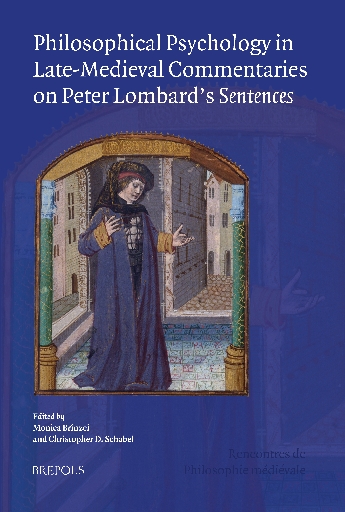
Philosophical Psychology in Late-Medieval Commentaries on Peter Lombard’s Sentences
Acts of the XIVth Annual Colloquium of the Société Internationale pour l’Étude de la Philosophie Médiévale, Radboud Universiteit, 28-30 October 2009
show More to view fulltext, buy and share links for:Philosophical Psychology in Late-Medieval Commentaries on Peter Lombard’s Sentences show Less to hide fulltext, buy and share links for: Philosophical Psychology in Late-Medieval Commentaries on Peter Lombard’s SentencesThe proceedings of the SIEPM Colloquium at Nijmegen published in this volume bring together new evidence for how the corpus of late-medieval commentaries on the Sentences, especially from the second half of the fourteenth century, contributed to the development of philosophical psychology within the discipline of theology. The relation among the faculties of the soul, the limits of knowledge, hylomorphism and the union of soul and body, intuitive and abstractive cognition, the immortality of the soul, the experience of the beatific vision, divine foreknowledge and the knowability of species are some of the topics involving psychological issues that are examined in this volume. The wealth of new information presented in this volume results from the interpretation of previously unexplored sources. The essays in this volume demonstrate that the various parts and Books of Peter Lombard’s Sentences,the standard textbook of theology in the Middle Ages, provided lecturers and commentators with a variety of loci for the discussion of philosophical topics, from the principia (Denys of Montina), the Prologue (Alfonsus Vargas of Toledo, Hugolino of Orvieto, John Regis, Francis Toti of Perugia), Book I (Gregory of Rimini, John of Mirecourt, Pierre Ceffons, Hugolino of Orvieto, Pierre d’Ailly, Peter of Candia, the Vienna Group, John Capreolus, Henry of Gorkum, Denys the Carthusian), Book II (Pierre Ceffons, Peter of Candia, Guillaume de Vaurouillon, Gabriel Biel, Denys the Carthusian), and Book III (Heymericus de Campo). This diversity, within large works on theology conceived broadly, constitutes a tradition parallel to that found in commentaries on Aristotle’s De anima in the late Middle Ages.
-
-
-

Philosophy and Theology in the 'Studia' of the Religious Orders and at Papal and Royal Courts
Acts of the XVth Annual Colloquium of the Société Internationale pour l’Étude de la Philosophie Médiévale, University of Notre Dame, 8-10 October 2008
show More to view fulltext, buy and share links for:Philosophy and Theology in the 'Studia' of the Religious Orders and at Papal and Royal Courts show Less to hide fulltext, buy and share links for: Philosophy and Theology in the 'Studia' of the Religious Orders and at Papal and Royal CourtsMost scholars know that the great universities were the institutional setting of Scholastic philosophical and theological activity in the later Middle Ages. Fewer realize, however, that perhaps far more Scholastic learning in the liberal arts and theology took place in the studia or study-houses of the religious orders, which out-numbered the universities and were more widely distributed across Europe. Indeed, most members of the mendicant orders received most or all of their learning in the liberal arts and theology in the studia of their order, and the most famous members of the orders (e.g., Albert the Great, Thomas Aquinas and John Duns Scotus) spent more time teaching in the studia than they did serving as Regent Masters in the university proper. As a consequence, the greater part of later medieval Scholastic literature was produced in the institutional context of the studia of the religious orders. Moreover, there were other significant institutional loci for Scholastic learning and discourse in the later Middle Ages besides the universities and the study-houses, namely the Papal Court—notably the Sacred Palace at Avignon—and several royal courts, for example, the courts of Robert the Wise in Naples and of the Emperor Lewis IV in Munich. It is not surprising, therefore, that many of the greatest Scholastic masters at different times taught in, or were associated with, all of these venues. This volume, which originated at the XVth annual Colloquium of the Société Internationale pour l’Étude de la Philosophie Médiévale held at the University of Notre Dame (USA) in October 2008, contains essays concerning the study and teaching of philosophy and theology in the studia of the Dominicans, Franciscans, Augustinian Hermits, Carmelites, Benedictines and Cistercians, as well as the intellectual activity at the Papal Court in Rome and Avignon and at various royal courts (London, Naples, Munich).Contributions by: Fabrizio Amerini, Luca Bianchi, Alain Boureau, Stephen F. Brown, Amos Corbini, William O. Duba, Russell L. Friedman, Hester G. Gelber, Joseph Goering, Wouter Goris, Guy Guldentops, Jacqueline Hamesse, Maarten J.F.M. Hoenen, Roberto Lambertini, Alfonso Maierù, Michèle Mulchahey, Patrick Nold, Adriano Oliva, OP, Alessandro Palazzo, Giorgio Pini, Sylvain Piron, François-Xavier Putallaz, Christopher D. Schabel and Garrett R. Smith, Neslihan ?enocak, Thomas Sullivan, OSB, Christian Trottmann, with an introduction by Kent Emery, Jr. and an epilogue by William J. Courtenay.
-
-
-
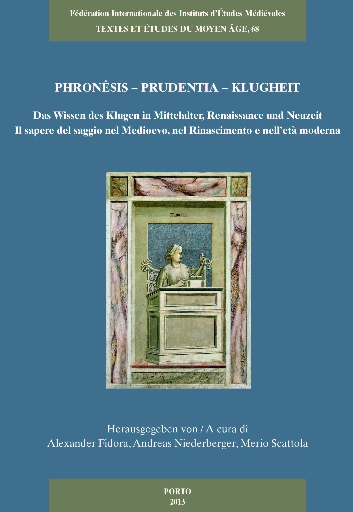
Phronêsis - Prudentia - Klugheit
Das Wissen des Klugen in Mittelalter, Renaissance und Neuzeit - Il sapere del saggio nel Medioevo, nel Rinascimento e nell'età moderna
show More to view fulltext, buy and share links for:Phronêsis - Prudentia - Klugheit show Less to hide fulltext, buy and share links for: Phronêsis - Prudentia - KlugheitKlugheit, heute oftmals missverstanden als Cleverness oder Gerissenheit, gehört bis in die Frühe Neuzeit zu den Schlüsselbegriffen der praktischen Philosophie.
Die in diesem Band versammelten Beiträge untersuchen den Begriff der Klugheit in historisch vergleichender Perspektive von seinen Ursprüngen in der griechischen Antike über die islamische Philosophie bis in das lateinische Mittelalter, das eine systematisch komplexe und stark differenzierte Klugheitslehre entwickelt. Ein Ausblick auf frühneuzeitliche und moderne Entwicklungen beleuchtet das weitere Geschick der Klugheit in der europäischen Tradition und macht dabei auf Kontinuitäten und Neuaufbrüche zwischen Mittelalter und Früher Neuzeit aufmerksam.
-
-
-
Physiology of the Soul
Mind, Body and Matter in the Galenic Tradition of the Late Renaissance (1550-1630)
show More to view fulltext, buy and share links for:Physiology of the Soul show Less to hide fulltext, buy and share links for: Physiology of the SoulThis study looks at the ways in which physicians and philosophers developed Galen's philosophical legacy at the end of the Renaissance, and shows how their reading of classical medical texts moved beyond accepted patterns and conventions.
By challenging a traditional historiographical account that described Renaissance Galenism in terms of decline and fall, this study argues for a new assessment of Galen's legacy, also read through the lens of those who opposed or reacted critically to it and thus contributed to the shaping of important aspects of the early modern debate on anthropology, ethics, psychology and even quantified experimentation. Among these many innovations and transformations, the notion of 'ingenuity' (ingenium) deserves particular attention. Hidden within this corporeal, inherent and heritable inclination, two major themes that side disquietingly with the development of modern subjectivity can be identified: the 'corporeality of the body', and the common destiny of humans and animals.
More generally, this study offers a contribution to the ongoing debate on the role and value of medical history, arguing in favour of the concept of 'historical translatability' in balancing the longue durée of traditions with the chaotic interactions of individual thinkers.
-
-
-
Picatrix
Un traité de magie médiéval
show More to view fulltext, buy and share links for:Picatrix show Less to hide fulltext, buy and share links for: PicatrixTémoignage des contacts de culture dans l'Espagne d' Alphonse le Savant, le Picatrix se présente comme une traduction d'un originai arabe (le Ghâyat AlHakîm), auquelle ou les t raducteurs ont beaucoup retranché ou ajouté.
L'ouvrage expose les connaissances de toute nature indispensables à qui veut agir sur le m onde et l es hommes : fabrication des talismans, exploitation de tous les règnes - minéral, animai et végétal - , prières aux planètes, données astrologiques, physiques et philosophiques. La pratique magique s'inscrit ainsi dans un cadre philosophico-religieux très particulier où l'hermétisme et le néoplatonisme sont associés à l'orthodoxie religieuse. Le Picatrix illustre parfaitement l'idée selon laquelle la magie n'est pas seulement un reflet de la science, mais se présente aussi comme un système complet, une méthode de pensée, de croyance et de savoir. Il a exercé une profonde et durable influence au Moyen Age et à la Renaissance.
-
-
-
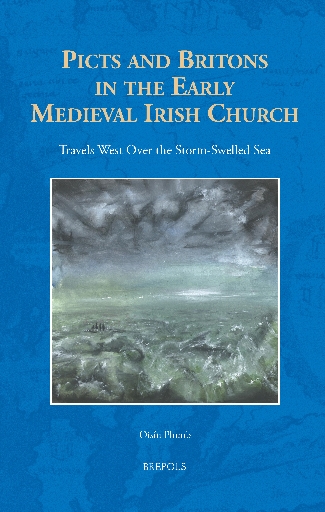
Picts and Britons in the Early Medieval Irish Church
Travels West Over the Storm-Swelled Sea
show More to view fulltext, buy and share links for:Picts and Britons in the Early Medieval Irish Church show Less to hide fulltext, buy and share links for: Picts and Britons in the Early Medieval Irish ChurchBetween the fifth and ninth centuries AD, the peoples of Britain, Ireland, and their surrounding islands were constantly interacting - sharing cultures and ideas that shaped and reshaped their communities and the way they lived. The influence of religious figures from Ireland on the development of the Church in Britain was profound, and the fame of monasteries such as Iona, which they established, remains to this day. Yet with the exception of St Patrick, far less attention has been paid to the role of the Britons and Picts who travelled west into Ireland, despite their equally significant impact.This book aims to redress the balance by offering a detailed exploration of the evidence for British and Pictish men and women in the early medieval Irish Church, and asking what we can piece together of their lives from the often fragmentary sources. It also considers the ways in which writers of later ages viewed these migrants, and examines how the shaping of the ‘migration narrative’ throughout the centuries had a major effect on the way that the earliest centuries of the church came to be viewed in later years in both Scotland and Ireland. In doing so, this volume offers important new insights into our understanding of the relationships between Britain and Ireland in this period.
-
-
-
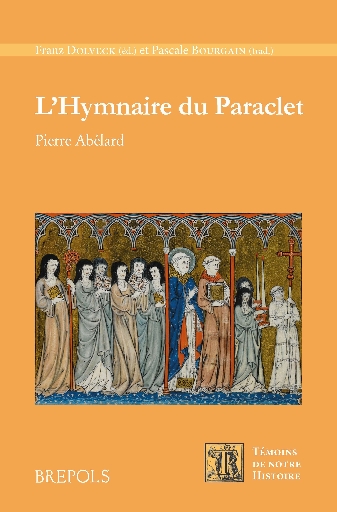
Pierre Abélard, L’Hymnaire du Paraclet
show More to view fulltext, buy and share links for:Pierre Abélard, L’Hymnaire du Paraclet show Less to hide fulltext, buy and share links for: Pierre Abélard, L’Hymnaire du ParacletLes œuvres en vers les plus célèbres d’Abélard sont ces poèmes d’amour composés pour Héloïse au temps qu’il la séduisait ; mais ils sont perdus, et c’est en vain qu’on les cherche. La célébrité de ces textes inconnus a laissé dans l’ombre d’autres poèmes qui, eux, sont bien parvenus jusqu’à nous. Eux aussi ont été composés pour Héloïse, d’une certaine manière ; eux aussi sont, d’une certaine manière, des produits de l’amour, et même des poèmes d’amour. Il s’agit des hymnes que, dans les années 1130, Abélard composa pour le monastère dont Héloïse était la supérieure, le Paraclet. Leur série, presque complète, constitue au fil de l’année liturgique un itinéraire spirituel et intellectuel d’une cohérence inégalée. Ces hymnes ne sont pas seulement des témoins d’une tentative quasiment inouïe dans l’histoire du christianisme de réformer la totalité de la liturgie : ils sont aussi la pensée d’un théologien exceptionnel coulée dans les vers d’un poète génial. L’Hymnaire du Paraclet mérite bien ainsi, à de multiples titres, d'être appelé un monument de la culture occidentale. Ce volume offre à la fois le texte latin original, entièrement établi et contrôlé sur les manuscrits, et, en regard, l'une des premières traductions complètes de l'Hymnaire, et la première en français.
-
-
-
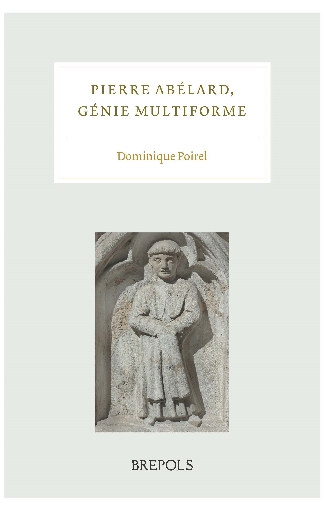
Pierre Abélard, génie multiforme
Actes du colloque international, organisé par l’Institut d’Études Médiévales et tenu à l’Institut Catholique de Paris les 29-30 novembre 2018
show More to view fulltext, buy and share links for:Pierre Abélard, génie multiforme show Less to hide fulltext, buy and share links for: Pierre Abélard, génie multiformeÉtudiant terrible et maître illustre, amant légendaire et logicien virtuose, moine instable et abbé réformateur, poète de génie et philosophe précurseur, théologien prestigieux et deux fois condamné pour hérésie, auteur entre autres de commentaires sur Porphyre et sur la Bible, de traités sur la dialectique et sur la Trinité, de poèmes amoureux et liturgiques, et encore - dans le même dossier - d’une autobiographie controversée, d’une correspondance passionnée et d’une règle religieuse, Pierre Abélard n’est pas seulement une des figures les plus célèbres de tout le Moyen Âge, il en est aussi, comme homme, comme écrivain et comme penseur, une des plus riches, des plus complexes et des plus insaisissables. Aussi a-t-il semblé utile de rassembler autour de sa personne - il en aurait sûrement été ravi - quelques spécialistes parmi les meilleurs de l’histoire, de la logique, de l’éthique, de la théologie, du droit, de la littérature et de l’historiographie du Moyen Âge.
-
-
-

Pierre Bayle historien, critique et moraliste
show More to view fulltext, buy and share links for:Pierre Bayle historien, critique et moraliste show Less to hide fulltext, buy and share links for: Pierre Bayle historien, critique et moralisteOn ne peut que se réjouir de constater que l'œuvre de Pierre Bayle (1647-1706), aussi foisonnante et complexe soit-elle, fait aujourd'hui l'objet d'un regain d'intérêt. Même s'ils ont sollicité la pensée du philosophe de Rotterdam en lui faisant parfois endosser des thèses qui n'étaient pas les siennes, les écrivains des Lumières ne s'y étaient pas trompés, qui reconnaissaient en lui l'un de leurs principaux devanciers - et donc un fondateur de la «modernité» dont nous avons hérité. Mais Bayle n'est pas qu'un «philosophe» au sens courant et un peu scolaire que ce terme a revêtu. S'il défend résolument le périmètre d'une raison émancipée de la tutelle théologique, s'il plonge avec délices dans les arcanes de la métaphysique et se passionne pour les concepts, il est trop curieux de tout pour confiner sa réflexion au seul champ de cette discipline. Bayle est aussi un amateur d'histoire, antique ou moderne, soucieux de comprendre l'humanité à travers ce qu'elle accomplit, son organisation socio-politique, ses représentations et ses systèmes de croyance. Journaliste, il se veut passeur d'idées et chroniqueur de son temps. Porté par tempérament à la critique, il se montre sans cesse à l'affût des failles logiques des systèmes de pensée et de conviction, attentif aux contradictions entre le discours et l'action. Révolté par l'injustice et révulsé par l'hypocrisie, il dénonce les accommodements de ceux qui prétendent adapter ou soumettre les exigences morales - notamment celles de l'évangile chrétien - à leurs intérêts présents.
L'ensemble des études réunies ici rend compte de certains aspects de cette pensée qui préfère toujours les questions aux réponses. On y trouvera des enquêtes qui soulignent l'importance qu'ont eu ses œuvres de jeunesse pour l'élaboration de sa pensée ; le rôle d'animateur de la République des Lettres qu'il a joué au Refuge huguenot ; le poids de ses convictions politiques dans son positionnement face à la révocation de l'édit de Nantes ou à la Glorieuse Révolution ; et quelques-unes des convictions fondamentales en faveur desquelles il s'est battu toute sa vie, comme la liberté de conscience, de pensée et d'expression. Sa pensée est toujours en prise avec les défis de son époque : défis éthiques et civiques en particulier, qui, faute d'être relevés, condamnent les peuples à être les marionnettes des clercs ou des puissants. Les hommes étant portés à se conformer aux injonctions de ceux qui crient le plus fort, il faut leur apprendre à s'émanciper des tutelles qui les empêchent d'examiner les faits ou les discours par eux-mêmes. Nul doute que cet effort, auquel Bayle ne cesse d'appeler ses contemporains et ses lecteurs, mobilisa son énergie jusqu'à son dernier souffle. En un temps où la question théologico-politique se pose avec une acuité renouvelée et à l'échelle mondiale, il vaut la peine de le relire et de découvrir la surprenante actualité de ses réflexions.
-
-
-
Pierre Gassendi (1592-1655). Introduction à la vie savante
show More to view fulltext, buy and share links for:Pierre Gassendi (1592-1655). Introduction à la vie savante show Less to hide fulltext, buy and share links for: Pierre Gassendi (1592-1655). Introduction à la vie savanteGassendi est un personnage paradoxal : son nom est célèbre, comme celui d’un adversaire de Descartes, parfois d’un astronome, mais son œuvre reste largement méconnue, faute d’éditions récentes. La présente édition a pour objet de faire mieux connaître l’homme, c’est-à-dire le savant, le penseur, l’homme d’Église et l’homme plus quotidien en éclairant son évolution intellectuelle et ses rapports avec les différentes doctrines de son temps.
Un premier volume Introduction à la vie savante se présente comme un essai, à mi chemin entre la biographie et l’histoire de la pensée ; il introduit au volume qu’il accompagne - la traduction annotée des Lettres latines de Gassendi dont c’est la première édition depuis 1658 ; mais il forme aussi une unité en soi, articulant des faits et des interprétations. S’appuyant sur la riche moisson des lettres, il décrit les particularités des correspondances savantes, met en évidence la culture commune de ceux qui la constituent, présente les grandes questions de la science de l’époque ; l’analyse plus précise de la philosophie de Gassendi ouvre des perspectives sur son épicurisme et l’importance de l’articulation originale qu’il propose dans l’invention de la modernité ; l’intérêt qu’il manifeste pour l’histoire de son temps introduit tout naturellement à la seconde partie du volume, un ensemble de notices biographiques qui recensent toutes les personnes que les lettres évoque. Une bibliographie complète le volume ; elle vaut aussi pour l’édition des lettres.
Car cette Introduction donne quelques notions permettant d’entrer plus facilement dans le monde des les Lettres latines de Gassendi qui suivent toute la carrière de l’homme mûr toujours en quête de la vérité. Le parcours de Gassendi rend compte des conditions d’élaboration de la pensée philosophique et scientifique dans la première moitié du dix-septième siècle : sa carrière et son état d’esprit reflètent la transition entre la Renaissance et l’âge classique, entre humanisme et rationalité. Philosophie et astronomie sont les deux champs de recherche auxquels il se consacre principalement, entre la recherche de démonstrations convaincantes, fondées sur les méthodes de la Nouvelle science, pour appuyer la thèse copernicienne, et la redécouverte d’Épicure, qu’il édite et commente, avant de proposer une interprétation moderne de l’épicurisme, enrichi de l’événement crucial que constitue la Révélation. Tout en explorant les relations à l’intérieur du cercle scientifique, elle renseigne aussi sur l’attitude du savant à l’égard du monde qui l’entoure, y compris les Grands, les guerres et l’histoire. Les lettres latines éclairent d’un jour nouveau l’ensemble des questions qu’agite à l’époque ce qui deviendra par la suite la République des lettres, dans tous les domaines de la pensée (physique, médecine, philosophie, atomisme, etc.).
-
-
-
Pierre Gassendi (1592-1655). Lettres latines
show More to view fulltext, buy and share links for:Pierre Gassendi (1592-1655). Lettres latines show Less to hide fulltext, buy and share links for: Pierre Gassendi (1592-1655). Lettres latinesLes Lettres latines de Gassendi (1592 - 1655) qui figurent dans l'édition des Oeuvres complètes sont ici traduites pour la première fois en français. Au nombre de six cent quatre vingt huit, elles occupent trois cent trente deux pages de l'édition posthume de Lyon (Opera omnia, six volumes in-f°, 1658, chez Anisson et Devenet), préparée par son dernier protecteur Louis Habert de Montmort et par son secrétaire Antoine de La Potherie, mais selon les instructions très précises de Gassendi lui-même. Classées dans le respect de la chronologie, très soigneusement relues et éditées, elles comportent un pourcentage infime de fautes typographiques. Une table des matières, composée selon l'ordre alphabétique des correspondants, précède les lettres et en décrit sommairement le contenu.Gassendi adresse des lettres latines à différents personnages de son époque, érudits et humanistes, hommes de sciences et hommes de lettres, ou Grands de ce monde, avec qui il entretient des relations amicales, de travail, ou de circonstances. D'avril 1621 à mai 1655, replacées dans leur contexte historique au sens large, politique, scientifique, elles rendent compte des grandes étapes de la carrière intellectuelle du philosophe de Digne et des principaux éléments de sa vie privée. Leur intérêt majeur réside dans la description d'un itinéraire intellectuel double, marqué à la fois par la redécouverte d'Épicure et par l'élaboration d'une pensée scientifique que fonde un nouveau modèle, celui de l'expérience.Les différents correspondants à qui Gassendi écrit dans l'ensemble de l'Europe savante communiquent en latin et constituent la République des lettres. Gassendi est au centre d'un réseau d'érudits qui s'emploient à rendre vie à la culture antique, par des travaux philologiques, archéologiques, historiques, philosophiques et à construire les nouveaux savoirs, notamment l'astronomie, par la mise en place d'une méthode d'investigation scientifique. Homme de science et homme de foi, il procède toute sa vie durant à une double recherche de la vérité, la vérité du philosophe et celle du chrétien dont il démontre le caractère complémentaire. Cette édition des Lettres latines comporte une traduction des lettres latines de Gassendi, assortie de notes.
-
-
-
Pierre Gassendi, De la phantaisie ou imagination
Syntagma philosophicum, Physique, Section III , Livre 8
show More to view fulltext, buy and share links for:Pierre Gassendi, De la phantaisie ou imagination show Less to hide fulltext, buy and share links for: Pierre Gassendi, De la phantaisie ou imaginationLe présent livre VIII De phantaisia seu imaginatione se trouve dans la Physique du Syntagma , dans la partie qui concerne les êtres vivants ou animés, dont la rédaction se situe entre la moitié de 1644 et la fin de l’année suivante. Le livre est construit en six chapitres ; la thèse en est résumée à la fin du dernier. Dans l’ensemble, Gassendi articule de façon subtile des passages de doxographie et l’énoncé de sa propre position, qu’il désire situer par rapport à la tradition, procurant une démonstration à la fois historique et théorique. Le livre trouvant sa place à juste titre dans la Physique, c’est en naturaliste que Gassendi explore son objet : le rationalisme et le biologisme y trouvent une place essentielle. L’examen des doctrines antérieures auquel il se livre, comme il le fait presque systématiquement, ne prend en compte que celles qui envisagent l’imagination sous cet angle, excluant toute réflexion littéraire ou métaphysique sur l’imagination, « folle du logis ». Il se montre très soucieux de mettre en place un vocabulaire précis, où la phantaisie est la notion majeure pour une réalité qu’il juge de la plus grande importance pour le fonctionnement cognitif et comportemental de l’homme et des animaux, soit le système psychologique.
-
-
-
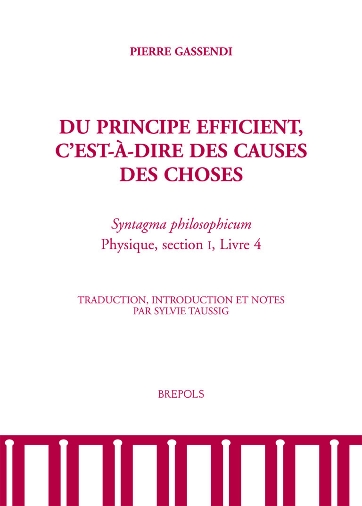
Pierre Gassendi, Du principe efficient, c'est-à-dire des causes des choses
Syntagma philosophicum. Physique, Section I, Livre IV
show More to view fulltext, buy and share links for:Pierre Gassendi, Du principe efficient, c'est-à-dire des causes des choses show Less to hide fulltext, buy and share links for: Pierre Gassendi, Du principe efficient, c'est-à-dire des causes des chosesLe Syntagma philosophicum, tel qu'il occupe les deux premiers tomes des Opera omnia de Pierre Gassendi (1592-1655), constitue une somme philosophique, dont la composition suit les trois grandes divisions hellénistiques de la philosophie. Publié en latin peu de temps après la mort de son auteur, il n'est pas accessible au lecteur non latiniste, sinon dans des traductions partielles. Le livre iv de la Physique dont nous donnons ici la première traduction en langue française contient l'essentiel de la théologie gassendiste. Il fait suite à l'exposé de la conception de la matière selon Gassendi interprétant Épicure et précède le livre intitulé «Mouvement et mutation des choses». Construit en huit chapitres (le chapitre 2 démontre l'existence de Dieu et présente la manière dont on peut la prouver; le chapitre 3 est consacré à la manière dont l'homme peut percevoir sa nature ; le chapitre 4 à la manière dont nous percevons ses attributs; le chapitre 5 présente Dieu comme le créateur du monde; le chapitre 6 défend la thèse de la Providence générale de Dieu et le chapitre 7 celui de sa Providence spéciale) qu'encadre un chapitre un qui pose la question (quelles sont les causes que recherchent les physiciens) à laquelle le dernier chapitre (8) répond, il permet de saisir la conception fondamentale de Gassendi qui distingue la question de l'existence de Dieu du problème de sa nature divine. L'affirmation de l'existence de Dieu, facile à prouver à la fois par la raison et la foi, s'accompagne de la négation d'un savoir absolu sur son essence. Il est doublement typique de la philosophie de Gassendi d'une part parce qu'il tisse l'intrication de principes épistémologiques tirés de la philosophie épicurienne et de croyances traditionnelles et opère un agencement complexe de preuves philosophiques et chrétiennes, d'autre part parce qu'il provient du dépeçage et de la réorganisation du travail que Gassendi a mené autour de la philosophie d'Épicure depuis 1636, pour élaborer sa propre pensée.
-
-
-
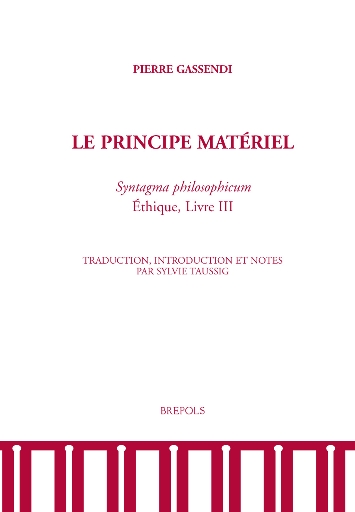
Pierre Gassendi, Le principe matériel, c'est-à-dire la matière première des choses
Syntagma philosophicum, Physique, Section I, Livre III
show More to view fulltext, buy and share links for:Pierre Gassendi, Le principe matériel, c'est-à-dire la matière première des choses show Less to hide fulltext, buy and share links for: Pierre Gassendi, Le principe matériel, c'est-à-dire la matière première des chosesLe Syntagma philosophicum, tel qu’il occupe les deux premiers tomes des Opera omnia de Pierre Gassendi, constitue une somme philosophique dont la composition suit les trois grandes divisions hellénistiques de la philosophie : Logique, Physique et Éthique. Publié en latin peu de temps après la mort de son auteur, il n’est pas accessible au lecteur non latiniste, sinon dans des traductions partielles. Après l’édition du livre IV de la Physique, Du principe efficient, dont les huit chapitres présentent les conditions de possibilité et les présupposés conceptuels de ce qui constitue, selon ses propres dires, l’aboutissement de sa philosophie, à savoir la Morale, et l’édition du dernier livre de la Morale De la liberté, de la fortune, du destin et de la divination (Syntagma philosophicum, Éthique, Livre III), nous proposons ici la première traduction française du livre III de la Physique du Syntagma philosophicum. La Physique étant divisée en trois sections, le livre III sur le Principe matériel se lit dans la première section, consacrée à La nature en général. Il fait suite au livre II (Le lieu et le temps, c’est-à-dire l’espace et la durée des choses, entités absolues qui transcendant l’univers) et précède le livre IV (Le principe efficient, c’est-à-dire les causes des choses).
-
-
-
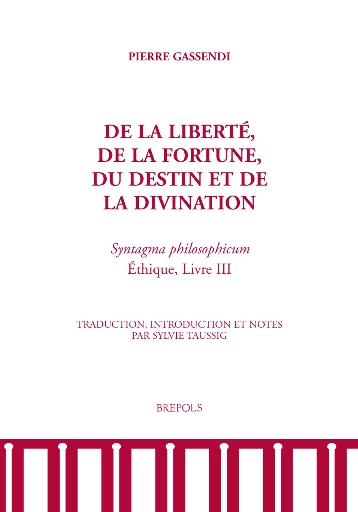
Pierre Gassendi. De la liberté, de la fortune, du destin et de la divination
Syntagma Philosophicum, Éthique, Livre III
show More to view fulltext, buy and share links for:Pierre Gassendi. De la liberté, de la fortune, du destin et de la divination show Less to hide fulltext, buy and share links for: Pierre Gassendi. De la liberté, de la fortune, du destin et de la divinationLe Syntagma philosophicum, tel qu’il occupe les deux premiers tomes des Opera omnia de Pierre Gassendi, constitue une somme philosophique, dont la composition suit les trois grandes divisions hellénistiques de la philosophie : Logique, Physique et Éthique. Publié en latin peu de temps après la mort de son auteur, il n’est pas accessible au lecteur non latiniste, sinon dans des traductions partielles, notamment de l’introduction générale et de la logique. Après l’édition du livre IV de la Physique, Du principe efficient, dont les huit chapitres constituent les conditions de possibilité et les présupposés conceptuels de ce qui constitue, selon ses propres dires, l’aboutissement de sa philosophie, à savoir la Morale, nous proposons ici la première traduction française du dernier livre de l’Éthique.
-
-
-
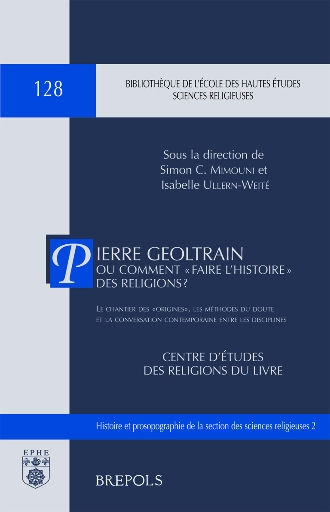
Pierre Geoltrain, ou Comment "faire l'histoire" des religions ?
Le chantier des "origines", les méthodes du doute et la conversation contemporaine entre les disciplines
show More to view fulltext, buy and share links for:Pierre Geoltrain, ou Comment "faire l'histoire" des religions ? show Less to hide fulltext, buy and share links for: Pierre Geoltrain, ou Comment "faire l'histoire" des religions ?Le volume est dédié à la mémoire de Pierre Geoltrain, fondateur de la chaire des «origines du christianisme» à la Section des sciences religieuses de l'École Pratique des Hautes Études. La première partie offre un choix d'articles de l'historien illustrant la polymathie et le caractère pionnier de ses recherches, ainsi qu'une épistémologie dont la démarche sceptique n'interdit pas l'assurance sur les faits fondamentaux: concernant les origines du christianisme, sa constitution comme dissidence herméneutique du judaïsme scripturaire. Un essai d'un des éditeurs explicite les principes ayant guidé la pratique scientifique de l'historien. Principalement consacrées, bien sûr, au premier christianisme, les contributions de collègues et de disciples réunies dans la seconde partie prolongent les chantiers et spéculations scientifiques de Pierre Geoltrain. Un intermède littéraire répond aux échappées qui, dans ses séminaires, manifestaient son intérêt sensible mais distancié pour la fable. Les contributions de la dernière partie font écho au dialogue que l'historien entretenait avec d'autres disciplines: philosophie, théologie et anthropologie. En guise de postface, Pierre Legendre lui dédie ses réflexions anthropologiques sur la Bible comme «emblème monothéiste».
Ont contribué à cet hommage collectif : Olivier Abel (Faculté de théologie protestante de Paris), Serge Bardet (Université d'Evry), Marianne Carbonnier-Burckhardt (Faculté de théologie protestante de Paris), Luigi Cirillo (Institut universitaire oriental de Naples), Corina Combet Galland (Faculté de théologie protestante de Paris), Jean-Daniel Dubois (École Pratique des Hautes Études), Pierre Gisel (Université de Lausanne), Pierre Legendre (École Pratique des Hautes Études), Simon C. Mimouni (École Pratique des Hautes Études), Jean-Noël Pérès (Faculté de théologie protestante de Paris), Pierluigi Piovanelli (Université d'Ottawa), Stéphane Ruspoli (Atlanta), John Scheid (Collège de France), Matthieu Smyth (Université de Lausanne), Françoise Smyth-Florentin (Faculté de Théologie protestante de Paris), Isabelle Ullern-Weité (Centre d'Études des Religions du Livre), Sarah Vajda (écrivain, Paris), Liliane Vana (École Pratique des Hautes Études).
-
-
-
Pierre de Blois
Ambitions et remords sous les Plantegenêts
show More to view fulltext, buy and share links for:Pierre de Blois show Less to hide fulltext, buy and share links for: Pierre de BloisL'essor des villes au XIIe siècle s'accompagne de l'apparition d'un nouveau groupe social, les intellectuels. Ces magistri qui écrivent, enseignent et se déplacent à travers l'Europe naissante commencent de peupler, à partir du règne d'Henri II Plantagenêt, les cours des puissants à la recherche d'un personnel qualifié pour structurer une administration en gestation, ce qui offre aux ambitieux l'occasion de faire carrière, même s'ils sont d'origine modeste.
Pierre de Blois, issu de la petite noblesse bretonne, appartient à ce groupe émergeant. Maître ès arts et poète célèbre, il se laisse emporter par la perspective d'un rôle de premier plan et se retrouve d'abord à la cour royale de Palerme, précepteur du jeune Guillaume II et garde des sceaux. Revenu en France après l'échec politique de l'équipe qu'il avait suivie en Sicile, il est appelé par Henri II en Angleterre. Cependant, au sortir d'une grave maladie, rongé de remords, il quitte ses fonctions auprès du roi pour offrir ses services aux deux successeurs de Thomas Becket à Cantorbéry.
Véritable cas d'espèce, Pierre de Blois n'a pas voulu profiter des avantages que lui réservait sa position privilégiée pour rejoindre le cercle dirigeant de son temps. Pris dans un conflit devenu pour lui presqu'existentiel au fil des ans, il condamne finalement, au nom de sa déontologie, son ambition de vouloir jouer un rôle prééminent: diacre, il ne doit pas s'engager dans les affaires du monde. La peur des compromis, voire des compromissions, l'a donc fait renoncer au but ultime de nombreux magistri, l'épiscopat, et à l'exercice d'un pouvoir spirituel et temporel. S'il s'est contenté du rang d'archidiacre, il ne s'est pas lassé d'encourager les décideurs de l'époque à résoudre son propre problème: accorder action publique et préceptes chrétiens.
-
-
-
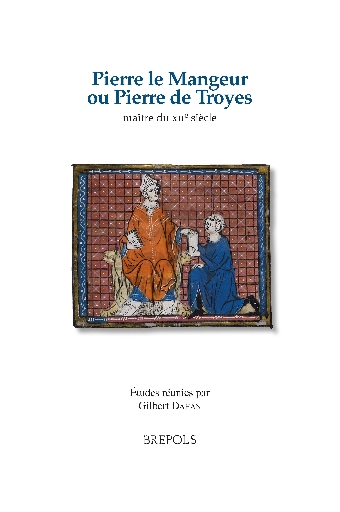
Pierre le Mangeur ou Pierre de Troyes, maître du XIIe siècle
Etudes réunies
show More to view fulltext, buy and share links for:Pierre le Mangeur ou Pierre de Troyes, maître du XIIe siècle show Less to hide fulltext, buy and share links for: Pierre le Mangeur ou Pierre de Troyes, maître du XIIe sièclePierre le Mangeur, connu également sous le nom de Pierre Comestor, est souvent appelé par ses contemporains Pierre de Troyes. Il est né probablement dans cette ville et y a été doyen du chapitre cathédral. Mais, s’il reste fidèle à cette cité, c’est en tant que maître à Paris qu’il jouit d’une réputation considérable: successeur de son maître Pierre Lombard, il a parmi ses élèves des auteurs aussi prestigieux que Pierre de Poitiers ou Étienne Langton. À la fin de sa vie (il meurt en 1178), il se retire à Saint-Victor de Paris. Son œuvre la plus célèbre est l’Historia scholastica, sorte de manuel d’études bibliques, fondé sur une réécriture des parties narratives de la Bible (jusqu’aux évangiles) et intégrant de nombreux éléments d’exégèse. Commentée pendant une ou deux générations (fin du xii e siècle, début du xiii e), elle fait l’objet d’une adaptation extrêmement bien diffusée en latin, l’Aurora de Pierre Riga, puis de traductions-adaptations en diverses langues vernaculaires, notamment la Bible historiale de Guyart des Moulins (à la fin du xiii e siècle), qui constituera la traduction française la plus répandue de la Bible jusqu’au xvi e siècle. Pierre le Mangeur est aussi l’auteur d’un corpus de 189 sermons, qui laissent percevoir une évolution vers le sermon «moderne» plus tardif, et de commentaires des évangiles très passionnants, en ce qu’ils nous font véritablement entrer dans la classe du maître. Son œuvre théologique, encore mal connue, comprend un nombre important de quaestiones, un traité sur les sacrements et, peut-être, un commentaire des Sentences de Pierre Lombard, dont seuls des fragments nous sont parvenus.
Le présent volume examine ces différents aspects de l’œuvre de Pierre le Mangeur et situe cet auteur dans l’histoire culturelle de son temps: très marqué par les conceptions herméneutiques de Hugues de Saint-Victor (et lié à cette école majeure du xii e siècle), il est aussi l’un des représentants principaux de ce que l’on a pu appeler l’«école biblique-morale» parisienne du dernier tiers du xii e siècle. Le retentissement de son œuvre fait l’objet de plusieurs études et rappelle que l’Historia scholastica a été imprimée dès le dernier quart du xv e siècle.
-
-
-
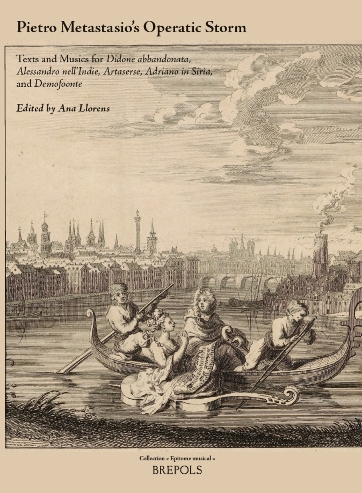
Pietro Metastasio’s Operatic Storm
Texts and Musics for Metastasio’s Didone abbandonata, Alessandro nell’Indie, Artaserse, Demofoonte, and Adriano in Siria
show More to view fulltext, buy and share links for:Pietro Metastasio’s Operatic Storm show Less to hide fulltext, buy and share links for: Pietro Metastasio’s Operatic StormPietro Metastasio (1698–1782) can be considered as the most renowned operatic dramatist of eighteenth-century Europe. His drammi per musica travelled all around Europe – and beyond – throughout the eighteenth century and the early years of the nineteenth. Courts, palaces, and public theatres were eager to perform his dramas, and so hundreds of composers set them to music, sometimes on more than one occasion.
This volume lets the surviving textual and musical traces speak for themselves. As a catalogue of the sources of five of Metastasio’s most successful titles – Didone abbandonata, Alessandro nell’Indie, Artaserse, Adriano in Siria, and Demofoonte –, it offers their most complete chronology up to date, as well as a detailed presentation of the printers and the theatres in which these texts became alive. In the case of the majority of these works, thousands of manuscripts and copies attest to more than one hundred complete musical versions and over two hundred and fifty productions. They may thus rightly be considered witnesses to the operatic fever that took Europe by storm in the Enlightenment.
-
-
-
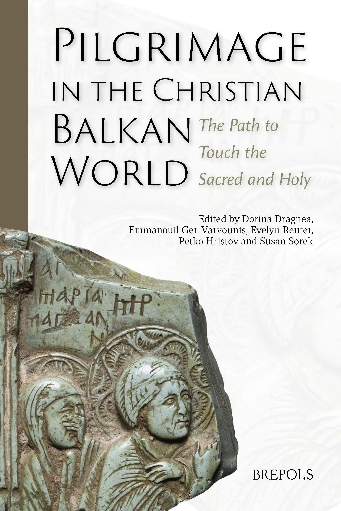
Pilgrimage in the Christian Balkan World
The Path to Touch the Sacred and Holy
show More to view fulltext, buy and share links for:Pilgrimage in the Christian Balkan World show Less to hide fulltext, buy and share links for: Pilgrimage in the Christian Balkan WorldThe purpose of this volume is to explore, re-interpret and re-contextualise the various natures of practices performed by the Orthodox and Catholic pilgrims in Balkan countries in their devotional ʽpath to touch the sacred and holyʼ through the prism of pilgrimage contents, and their articulating, using, and handling strategies. Inter- and transdisciplinary perspectives constitute a strong point for exploring the essence of this collective practice of worship, which is theoretically and critically interpreted, and chronologically and diachronically analysed. Therefore, the various visions of the authors, formed on the basis of qualitative and critical analysis of primary (ethnographic and folkloric data from field interviews, archive documents, samples, etc.) and secondary sources, come to fill a gap in research on pilgrimage in southeast Europe, and especially on pilgrimage practices in Eastern Orthodoxy. Particularly, the ritual practices, sacred places in contemporary Balkan societies, religious folklore, divine intervention stories, miracle-working icons, relics and reliquaries as part of the structure of pilgrimage are discussed.
The authors explore the context in which the Christian shrines in the Balkans are spaces where the ethnic and denominational patterns in pilgrimage are revealed openly on multiple levels; they delve into how the correlative effects between politics and religion are manifested. In this volume, which is the result of a project initiated by the Balkan History Association, the authors focus on theoretical analysis, stressing the historical and contemporary behaviour performed by the Christian pilgrims, and highlighting the fact that the motivations for going to the sacred places can vary, from seeking and obtaining Divine help to leisure, religious/faith tourism, etc.
-
-
-
Pilgrimage to Heaven: Eschatology and Monastic Spirituality in Early Medieval Ireland
show More to view fulltext, buy and share links for:Pilgrimage to Heaven: Eschatology and Monastic Spirituality in Early Medieval Ireland show Less to hide fulltext, buy and share links for: Pilgrimage to Heaven: Eschatology and Monastic Spirituality in Early Medieval IrelandThis book focuses on the expectation of the Judgment and the afterlife in early medieval Irish monastic spirituality. It has been claimed that in the Early Middle Ages, Christianity became for the first time a truly otherworldly religion and in monastic spirituality this otherworldly perspective gained an especially prominent role. In this book, Dr Ritari explores the role of this eschatological expectation in various sources, including hagiography produced by the monastic familia of St Columba, the sermons of St Columbanus, the Navigatio sancti Brendani portraying St Brendan’s sea voyages, and the vision attributed to St Adomnán about Heaven and Hell. One recurrent image used by the Irish authors to portray the Christian path to Heaven is the image of peregrinatio, a life-long pilgrimage. Viewing human life in this perspective inevitably influenced the human relationship with the world making the monastic into a pilgrim who is not supposed to get attached to anything encountered on the way but to keep constantly in mind the end of the journey.
-
-
-
Pius XII and the Low Countries
show More to view fulltext, buy and share links for:Pius XII and the Low Countries show Less to hide fulltext, buy and share links for: Pius XII and the Low CountriesThe opening of the different Vatican Archives for the pontificate of Pius XII (1939-1958) in March 2020 sparked the interest of scholars across different disciplines worldwide. It invigorated tendencies to revisit the history of the 1940s and 1950s beyond the established narratives and sources, and nourished hopes to address both longstanding and emerging questions, and to discover innovative themes and approaches. Three years after the opening of these archives, a multidisciplinary group of scholars from Belgium and the Netherlands convened at a scientific conference in Rome, organized by the editors of this volume, to study the impact of the archival access on diverse research domains. This publication presents new research based on documentation unearthed in the Vatican archives, spanning both the Second World War and the postwar period and challenges existing scholarship not only on the history of the Catholic Church, but also on broader themes in the Low Countries.
-
-
-

Plantagenêts et Capétiens: confrontations et héritages
show More to view fulltext, buy and share links for:Plantagenêts et Capétiens: confrontations et héritages show Less to hide fulltext, buy and share links for: Plantagenêts et Capétiens: confrontations et héritagesAu printemps 1204, Aliénor d’Aquitaine s’éteint tandis que les armées de Philippe Auguste conquièrent l’Anjou et la Normandie. La disparition de la reine coïncide avec l’effondrement de l’Empire Plantagenêt, tout comme, une cinquantaine d’années auparavant, son remariage avec Henri II avait présidé à la naissance de ce conglomérat disparate de territoires de l’Ouest de la France et des îles britanniques. Épouse, mère ou veuve, Aliénor est le personnage clef de cette construction géopolitique, qui est avant tout une histoire de famille. Il en va de même dans le combat acharné qui oppose les Plantagenêts, sa nouvelle dynastie d’adoption, aux Capétiens de Louis VII, dont elle fut jadis la femme, et de Philippe Auguste, son beau-fils. Le conflit entre les deux maisons touche directement des principautés territoriales du continent. Les lignages aristocratiques de Normandie, Bretagne, Anjou, Poitou et Gascogne participent ainsi à ces luttes, qu’attisent parfois les fils d’Henri II ou le neveu de Jean Sans Terre, en révolte contre leur père ou oncle. Enfin, pour mieux gouverner et pour donner de l’éclat à leur cour, les Plantagenêts s’entourent d’intellectuels promouvant une culture originale. Parenté, guerre et savoir aux XIIe et XIIIe siècles sont au cœur de cet ouvrage.
-
-
-
Plato in Medieval England
Pagan, Scientist, Alchemist, Theologian
show More to view fulltext, buy and share links for:Plato in Medieval England show Less to hide fulltext, buy and share links for: Plato in Medieval EnglandFrom the time of the Roman Republic, continental Europeans traveling to England brought knowledge of Greek and Roman intellectual culture in the form of books of every genre. But, until 1111 CE, the island contained not a single Platonic dialogue. And for the next two centuries, it had only a partial Latin translation of the Timaeus. A Latin Phaedo eventually appeared, in 1340, and the Meno in 1423. But this hardly limited the number of ideas people had about Plato. He was a proto-Christian, a sage, a scholar of the cosmos, and a healer. And he had an elaborate oeuvre that did exist in England, works of astrology, numerology, medicine, and science, including Cado, Calf, Circle, Herbal, Question, Alchemy, and Book of Prophecies of a Greek King. This book tells the story of Plato in Medieval England, from a name with too few works to a sage with too many. Based on a complete survey of all extant manuscripts, publications, and library records until the fifteenth century, it traces with extraordinary precision the movement of opinions and information about Plato from Europe to England and then into its various monasteries, schools, and universities. This erudite and illuminating sociology of knowledge provides novel insight into the dubious English career of our best-known philosopher. This is intellectual history and reception studies at its most surprising.
-
-
-
Platonismo, ermetismo, eresia nel medioevo
show More to view fulltext, buy and share links for:Platonismo, ermetismo, eresia nel medioevo show Less to hide fulltext, buy and share links for: Platonismo, ermetismo, eresia nel medioevoLes travaux de Paolo Lucentini ont changé de manière décisive notre approche de l’histoire de la philosophie médiévale. Initiateur de l’Hermes Latinus, il a publié plusieurs éditions et articles ayant trait à ce sujet. Ces publications ont changé fondamentalement notre conception de la « synthèse scolastique », en vigueur jusqu’aux années quatre-vingt. Les éditions de textes inédits qu’il a réalisées permettent de retrouver l’importance de sources encore mal connues et donc peu étudiées.
Comme la plupart de ses articles sont dispersés dans des revues et des ouvrages d’accès parfois difficile, ses collègues et ses élèves de l’Université de Naples, l’ « Orientale », ont souhaité lui rendre hommage en les réunissant en un volume. L’ouvrage rendra bien des services aux chercheurs qui souhaitent étudier de plus près l’hermétisme du Liber Alcidi, de l’Asclepius ou du Liber XXIV philosophorum. L’ensemble de ses articles constitue aussi une initiation privilégiée aux pratiques complexes de l’astrologie et de l’alchimie. Ils ouvrent la voie à des pratiques mystérieuses qui ont influencé profondément la pensée de nombreux auteurs médiévaux.
La table des matières illustre la richesse du contenu de ce livre : de la tradition ériugénienne à Honorius Augustodunensis, de la réception et de l’analyse de l’Asclepius au XIIe siècle, de l’influence du Liber XXIV philosophorum sur la Divine Comédie de Dante jusqu’aux hérésies provoquées par l’interprétation de ces textes chez certains auteurs, tous les articles permettront de mieux comprendre pourquoi l’hermétisme a profondément modifié notre conception de la pensée scolastique.
-
-
-
Pleasure in the Middle Ages
show More to view fulltext, buy and share links for:Pleasure in the Middle Ages show Less to hide fulltext, buy and share links for: Pleasure in the Middle AgesThis volume explores the diverse manifestations and uses of pleasure in medieval culture. Pleasure is a sensation, an affirmation, a practice, and is at the core of the medieval worldview, no less than pain.
Applying a variety of methodological perspectives, the essays collected here analyse the role of pleasure in relation to a variety of subjects such as the human body, love, relationships, education, food, friendship, morality, devotion, and mysticism. They also integrate a wide range of sources including literature (monastic to courtly), medical texts, illuminated prayer books, iconography, and theatrical plays.
Each document, each discipline, and thus each essay combine to provide a complex and diversified picture of medieval joys and delights - a picture that shows the extent to which pleasure is engrained in the period’s culture. This collection shows how pleasure in the Middle Ages is at once a coveted feeling and a constant moral concern, both the object and the outcome of a constant negotiation between earthly and divine imperatives.
-
-
-
Pluralisme religieux : une comparaison franco-vietnamienne
Actes du colloque organisé à Hanoi les 5-6 octobre 2007
show More to view fulltext, buy and share links for:Pluralisme religieux : une comparaison franco-vietnamienne show Less to hide fulltext, buy and share links for: Pluralisme religieux : une comparaison franco-vietnamienneLes notions de pluralité, de pluralisation, de pluralisme, sont l’objet de débats récurrents. Elles n’en sont pas moins clairement identifiées et inscrites dans le vocabulaire scientifique. En prolongeant un dialogue instauré dans le domaine des sciences religieuses depuis de longues années, la rencontre franco-vietnamienne qui s’est tenue à Hanoi en octobre 2007 a permis à un groupe de chercheurs de l’École pratique des hautes études et du Groupe Sociétés, Religions, Laïcités (GSRL) d’une part, à leurs homologues de l’Institut de Recherches sur les Religions et d’autres instances vietnamiennes d’autre part, d’échanger sur diverses formes du pluralisme, sur la pertinence de ses définitions, sur les défis et les nécessités d’une homogénéisation du lexique religieux. Elle a surtout livré - et les présents actes nous les donnent à lire - des descriptions et des études de cas spécifiques visant à analyser, en vue de les comparer, les situations, les processus et les modes de régulation du religieux en France et au Viêt Nam.
Si le passé colonial et ses legs tendent à expliquer la relation particulière que ces deux pays entretiennent, ce fait ne peut expliquer à lui seul une telle mise en miroir. Héritière d’une histoire religieuse complexe, la France continue aujourd’hui de se diversifier et de se transformer sous les effets d’une laïcité plus que centenaire et de son intégration au sein de l’Union européenne. De son côté - et peut-être plus que tout autre pays de la région - le Viêt Nam a synthétisé les enjeux contemporains du XXe siècle en Asie et il soulève aujourd’hui les questionnements fondamentaux en matière de politique et d’épistémologie du religieux.
Religions du monde et courants minoritaires, constructions étatiques et nationales, laïcités au regard des sciences politiques et juridiques, structurent un dialogue sur le pluralisme religieux qui se veut porteur à la fois d’une meilleure connaissance mutuelle et d’une réflexion plus globale sur ce qu’est, en ce début de XXIe siècle, la modernité religieuse.
Pascal Bourdeaux, historien des religions de l’Asie du Sud-Est, est maître de conférences à l’EPHE et membre du GSRL (EPHE-CNRS).
Philippe Hoffmann, directeur d’études à l’EPHE, est ancien doyen de la Section des sciences religieuses et actuel directeur du Labex Hastec.
Nguyễn Hồng Dương, spécialiste du catholicisme vietnamien, est ancien directeur de l’Institut de Recherches sur les Religions (Académie des Sciences sociales du Viêt Nam, Hanoi).
-
-
-
Poco a poco. L’apport de l’édition italienne dans la culture francophone
Actes du LXe Colloque international d'études humanistes (CESR, 27-30 juin 2017)
show More to view fulltext, buy and share links for:Poco a poco. L’apport de l’édition italienne dans la culture francophone show Less to hide fulltext, buy and share links for: Poco a poco. L’apport de l’édition italienne dans la culture francophoneLa notion d’italianisme est, depuis plus d’un siècle, une étiquette prête à l’emploi sous laquelle la critique a voulu rassembler les phénomènes les plus divers, relevant aussi bien des arts que des lettres, des modèles politiques et des pratiques sociales, ou encore des savoirs philosophiques, scientifiques et techniques. Ce volume porte un regard différent sur cette question, car il a comme point de départ l’étude de l’influence de la culture imprimée en langue italienne dans les aires francophones à la Renaissance, mais aussi la persistance de cette culture tout au long de l’Ancien Régime dans les grandes collections publiques et privées. Fruit des recherches conjointes des chercheurs participants, parfois de façon continue, parfois épisodiquement, au projet de recherche ANR-13-BSH3-0010-01 L’édition italienne dans l'espace francophone à la première modernité (EDITEF), ce volume ouvre des nouvelles perspectives méthodologiques et scientifiques sur des aspects méconnus de l’appropriation de la culture italienne dans le monde francophone, tout en suivant la parabole de la diffusion des textes dès leur impression jusqu’à leur conservation, en passant par leur commercialisation, traduction et appropriation dans les contextes sociaux les plus variés.
-
-
-
Poems
show More to view fulltext, buy and share links for:Poems show Less to hide fulltext, buy and share links for: PoemsTheodore Metochites (c. 1270-1332), an important writer of Late Byzantium, composed twenty long Poems in dactylic verse, which constitute an unicum in Byzantine Literature. Some of them are clearly autobiographic, offering important details about their author’s career, while others are devoted to some saints of the Byzantine church (St Athanasius of Alexandria and the three prelates Basil of Caesarea, Gregory the Theologian and John Chrysostom). Some of them are addressed to close friends of Metochites (like the polymath Nikephoros Gregoras, or the church historian Nikephoros Xanthopoulos), asking for their advice or complaining about his own difficulties. Three of them are funerary Poems, extolling the virtues and mourning the death of persons close to the emperor Andronikos II Palaiologos, who was the protector and benefactor of Metochites. The last seven Poems are written in a more reflective mood, discussing the precariousness of human happiness and the inevitability of man’s fall due to the adverse circumstances of his life. All those Poems are preserved in MS. Parisinus graecus 1776, which was written in all probability under Metochites’ supervision. The translation is accompanied by notes clarifying the sense of difficult passages and giving references to the texts that inspired Metochites directly or to parallel passages in the works of Metochites himself, or other Greek and Byzantine authors.
The source text of this volume appeared in Corpus Christianorum Series Graeca as Theodorus Metochita, Carmina (CC SG 83). References to the corresponding pages of the Corpus Christianorum edition are provided in the margins of this translation.
-
-
-
Poeti in Agone
Competizioni poetiche e musicali nella Grecia antica
show More to view fulltext, buy and share links for:Poeti in Agone show Less to hide fulltext, buy and share links for: Poeti in AgoneL’agonismo fu una componente intrinseca, pervasiva e connotante dell’attività poetica e musicale nella Grecia antica. Fu uno dei più importanti veicoli di identità, condivisione comunitaria e acculturazione interna. Questo volume, affrontando la problematica sia da un punto di vista sincronico che diacronico, cerca di lumeggiarne gli aspetti particolarmente significativi: in Atene, i concorsi tragici come performance rituale e atto politico; le multiformi relazioni genetiche, strutturali e funzionali tra le esecuzioni corali drammatiche e i generi della poesia melica; la ‘Nuova Musica’ e il clima di rinnovamento culturale che si affaccia nell’Atene di V sec. a.C. che, a partire dal ditirambo, investe tutte le forme poetiche; la centralità, la vitalità e la varietà degli agoni delfici; l’agonistica poetica e musicale come argomento di interesse, narrazione e riflessione nell’opera di scrittori tra l’epoca ellenistica e quella imperiale; l’iconografia di figure mitiche di eccellenza musicale e le riprese dell’antico.
-
-
-
Poetic Rewritings in Late Latin Antiquity and Beyond
show More to view fulltext, buy and share links for:Poetic Rewritings in Late Latin Antiquity and Beyond show Less to hide fulltext, buy and share links for: Poetic Rewritings in Late Latin Antiquity and Beyond‘Rewriting’ as the reworking of narrative material based on conscious strategies of composition plays a significant role in much of the Latin poetry of Late Antiquity. This book, resulting from the conference Riscritture poetiche nell’Occidente latino tra tarda antichità e medioevo, which was held on 9-11 May 2022 at the Department of Human Sciences (DSU) of the University of L’Aquila, looks at the range of practices and purposes that inform this procedure, with particular regard to the processes of transcodification enacted – in different historical and cultural contexts – by the recasting of authoritative prose texts into a classicising poetic idiom. The contributions present a multifaceted approach to rewriting, cover a variety of authors, genres, and texts, and cast a glance also at medieval Latin literature. In short, the essays in this collection, by reflecting on the interpretative contribution of the critical category of ‘rewriting’, not only add further tesserae to the mosaic of literary studies on Late Latinity, they also invite to grasp the difference between secular and Christian rewritings.
-
-
-
Poetics of Wonder
Testimonies of the New Christian Miracles in the Late Antique Latin World
show More to view fulltext, buy and share links for:Poetics of Wonder show Less to hide fulltext, buy and share links for: Poetics of WonderThe unexpected return of contemporary public Christian miracles in the late antique Latin west, after a centuries-long assumption that these had ceased after apostolic times, helped to create a religious mentality there that would continue to characterize the western European Middle Ages. While the social and political functions of the new miracles have been gaining greater scholarly attention, this study is the first in-depth treatment of their experiential dimension. It examines this dimension in the first reactions to the new phenomenon - enthusiasm, puzzlement, deep suspicion, and outright rejection - as they are reflected and, especially, imagined in the earliest contemporary narrative and poetic sources that describe them. And it traces how the new imaginative representations transformed, for many, the up to then precept-centered way of thinking about religion into one that immersed itself in the supralogical dynamics of symbolic images. The tendency of these image-clusters to precipitate transformations, not only in perception but also in physical condition, is examined for the period from 386, when a first public miracle caught everyone’s attention in the ostensibly flourishing Christian Roman Empire, to c. 460, when this empire was crumbling under the onslaught of Germanic tribes.
-
-
-
Poets and Princes
The Panegyric Poetry of Johannes Michael Nagonius
show More to view fulltext, buy and share links for:Poets and Princes show Less to hide fulltext, buy and share links for: Poets and PrincesPoets and Princes offers a richly textured interdisciplinary survey of late medieval and early Renaissance court cultures across Europe as they are reflected in the neo-Latin verse of the itinerant poet, Johannes Michael Nagonius. In 1496 the poet laureate Nagonius presented Henry VII with a manuscript of Latin panegyric poetry. This elaborate diplomatic gift from Pope Alexander VI solicited the King’s support against Charles VIII of France. The verse emphasized the mutual benefit of an alliance: if Henry supported him the Pope would acknowledge disputed Tudor claims to England’s throne. For Henry, the gift represented a literary and political coup. With all the rhetorical skill of a learned poet, Nagonius presented the King as a classical hero on an epic scale in the latest Italian style. The work thus acknowledged Henry’s international significance. Other recipients of Nagonius’s panegyric verse include Holy Roman Emperor Maximilian I, Vladislav II of Bohemia, Louis XII of France, Doge Leonardo Loredan, the condottieri Niccolò Orsini and Gian Giacomo Trivulzio, Giovanni Bentivoglio, lord of Bologna, and Duke Ercole d’Este of Ferrara. The presentation of a deluxe manuscript to Julius II, celebrating the pontiff ’s campaign in the Romagna, marked the climax of the poet’s career.
This analysis of the life and works of Nagonius thus provides a fascinating insight into the world of late medieval and early Renaissance court cultures. It contributes to the growing field of neo-Latin scholarship, examining the manuscripts and para-texts, studying the relationship between volume and dedicatee, placing these manuscripts within the wider literary and artistic cultures of the courts where they were presented, and investigating the role of neo-Latin verse within court cultures.
-
-
-
Poland, Holy War, and the Piast Monarchy, 1100-1230
show More to view fulltext, buy and share links for:Poland, Holy War, and the Piast Monarchy, 1100-1230 show Less to hide fulltext, buy and share links for: Poland, Holy War, and the Piast Monarchy, 1100-1230This study charts the evolution of the ideology of holy war and crusading in medieval Poland through Polish incursions into the Baltic, the last bastion of paganism in Europe. It traces the transmission of the idea of holy war and crusade to north central Europe, explaining its impact on political and religious life in Poland, and Polish missionary and crusading activity in Prussia, Pomerelia, and Pomerania. Holy war and crusade helped influence state formation, politics, and dynastic succession. Key mechanisms by which the idea of holy war was transmitted to Poland are examined and compelling evidence is provided that the Polish elites were highly familiar with, and receptive to, the idea of crusade. The Polish elites were deliberate participants in Christian holy wars and undertook various crusading activities during the twelfth century. The influence of the idea of holy war on the actions of the Polish dynasts and the central role of women in the establishment of family traditions of participating in crusading are examined in some detail. Furthermore, this book explores the conditions that enabled the cause of the Christianization of Prussia to be taken up by the Teutonic Order by tracing the divergence of the idea of holy war in the Piast realm away from the norms of Latin Christendom in the late twelfth and early thirteenth centuries. This work offers new perspectives for international studies of warfare sanctioned by religion.
-
-
-
Polemics and Networking in Graeco-Roman Antiquity
show More to view fulltext, buy and share links for:Polemics and Networking in Graeco-Roman Antiquity show Less to hide fulltext, buy and share links for: Polemics and Networking in Graeco-Roman AntiquityDisagreement, rivalry and dispute are essential to any intellectual development. This holds true for ancient cultures no less than for us today. From the classical period to the Hellenistic age and to Late Antiquity, competition and polemics have shaped the course of intellectual history in Antiquity. Polemical encounters and controversies are often linked to group identities and intellectual networks such as philosophical schools, textual traditions, artistic circles and religious communities. This collection of studies sprang from the ambition to study the interplay between polemics and intellectual networks from a variety of perspectives and disciplines.
The volume gathers fifteen case studies by leading scholars and young researchers alike. They address a wide range of topics, from the Old Academy and the Hellenistic schools to the Neoplatonic commentators of Late Antiquity, from biographical literature to literary criticism, from artistic manuals to scientific treatises, and from pagans to Christians. As multi-sided as the picture that emerges from these case studies may be, they all testify to the fact that implicit and explicit polemics are ubiquitous in ancient Greek and Roman literature and have served as triggers of intellectual progress across times and disciplinary boundaries.
-
-
-
Political Assemblies in the Earlier Middle Ages
show More to view fulltext, buy and share links for:Political Assemblies in the Earlier Middle Ages show Less to hide fulltext, buy and share links for: Political Assemblies in the Earlier Middle AgesAssembly is a central feature of the European political process between the demise of the Roman Empire and the rise of the bureaucratic state in the twelfth and thirteenth centuries. Historians have often neglected the crucial rule of political assemblies in their own right, concentrating instead on exceptional or extraordinary attention-catching events which occurred at assemblies. Earlier generations of scholars tried to discern in such assemblies the forerunners of later medieval parliaments and other forms of representative government. By contrast, the contributors to this volume present medieval assemblies in their own terms.
Were political assemblies in the earlier Middle Ages convened to confirm decisions already taken elsewhere or were they genuinely deliberative? How, if at all, did political assemblies create consensus? At what level(s) of the political and administrative hierarchy were assemblies held, who attended such gatherings, how were they conducted, and where were they held? The main focus is on assemblies of emperors, kings, and princes, and on those of townsfolk, though some more local assemblies are also discussed. The over-arching thematic structure relates to the purposes of assemblies and how they worked, their practical and ritual or symbolic aspects, and the degree to which they were stage-managed, and by whom. The contributors bring archaeological, as well as historical, evidence to bear and present a range of geographical, political and historiographical approaches and traditions.
-
-
-
Political Liturgies in the High Middle Ages
Beyond the Legacy of Ernst H. Kantorowicz
show More to view fulltext, buy and share links for:Political Liturgies in the High Middle Ages show Less to hide fulltext, buy and share links for: Political Liturgies in the High Middle AgesAlthough as long ago as the 1940s Ernst H. Kantorowicz exhorted medievalists to make greater use of liturgical sources, historians largely continued to ignore the “magic thicket of prayers, benedictions, and ecclesiastical rites” that comprise the liturgy. Instead they left liturgical sources to specialists interested in the development of individual rites through time. This volume, inspired by Kantorowicz’s insights, builds on the work of a new generation of scholars, who see liturgical sources as integral to understanding medieval politics and society. The individual essays focus on different polities and regions of medieval Christian Europe, but all concentrate on the high Middle Ages, a period in which the importance of liturgy to political cultures has traditionally been seen as being in decline. Together the essays demonstrate how a careful reading of liturgical sources can shed new light on political cultures and practices, how liturgical rituals shaped politics, and how political realities influenced liturgical ceremonial. They demonstrate the interrelationship between liturgical scholarship and political theory, and challenge the paradigm of the desacralization of kingship and politics in this period.
-
-
-
Political Ritual and Practice in Capetian France
Studies in Honour of Elizabeth A. R. Brown
show More to view fulltext, buy and share links for:Political Ritual and Practice in Capetian France show Less to hide fulltext, buy and share links for: Political Ritual and Practice in Capetian FranceIn this volume, thirteen of the world’s leading scholars of medieval France explore some of the most important ideas, events, personalities, and artistic creations of the Capetian world (987-1328). From some of the earliest medieval attempts to make narrative treatments of French history, through the invention of the schools, the creation of Gothic architecture, the practices of chivalry, the practice of statecraft, and the promulgation of law codes, the volume offers a panoramic view of the kingdom and the era that has come to define the medieval world in both the scholarly and popular imaginations.
The scholars brought together in this volume share as well a common sense of gratitude and an intellectual debt to Elizabeth A. R. Brown, whose own rigour and brilliance has inspired their work and shaped their sense of the past. Political Ritual and Practice in Capetian France is both a tribute to a scholar of real accomplishment and a collection of original scholarship raised upon on the foundations that Elizabeth A. R. Brown herself set down.
-
-
-
Political Theology in Medieval and Early Modern Europe
Discourses, Rites, and Representations
show More to view fulltext, buy and share links for:Political Theology in Medieval and Early Modern Europe show Less to hide fulltext, buy and share links for: Political Theology in Medieval and Early Modern EuropeThis book aims to provide new historical and theoretical perspectives on political theology with an interdisciplinary approach, from political philosophy and theology to art and history. After a comprehensive introduction and three introductory chapters on both the theory and the concept of “political theology” (based on the works of Schmitt, de Lubac and Kantorowicz), this volume explores the transferences between the temporal and the spiritual experimented on the past. It interprets some historical events (medieval crusades, royal wisdom, and early modern idea of tolerance), examines some philosophical and theological narratives (John of Paris, Spinoza, Locke, Bayle, Leibniz, Montesquieu, Tocqueville), and deciphers some rites (royal coronations) and representations (the Holy Crown, royal banquets, royal coats of arms).
-
-
-
Politics and Piety at the Royal Sites of the Spanish Monarchy in the Seventeenth Century
show More to view fulltext, buy and share links for:Politics and Piety at the Royal Sites of the Spanish Monarchy in the Seventeenth Century show Less to hide fulltext, buy and share links for: Politics and Piety at the Royal Sites of the Spanish Monarchy in the Seventeenth CenturyInstitutions under royal control included not only the king’s royal residences and the royal chapels attached to them, but also magnificent convent-palaces and individual monasteries belonging to specific religious orders with close affiliations to the Spanish Crown. These Spanish Royal Sites, a diverse global network that helped to shape the Spanish Monarchy politically and socially in the seventeenth century, extended across the different kingdoms of the Iberian Peninsula and beyond to other territories in Europe, America and Asia under Spanish rule. The religious practices that occurred there were an essential aspect of studying the justification of power, the pre-eminence of (ecclesiastical and temporal) institutions and, in the case of the Spanish Monarchy, its relations with the Holy See.
This volume brings together scholars from various humanities disciplines, opening up novel avenues of research for studying the organization of royal institutions in the different kingdoms of the Habsburg Spanish Monarchy, especially in questions related to religion and royal piety. Particular attention is paid to the under-researched area of Royal Sites in Catalonia, Valencia, Portugal, Sardinia and the Viceroyalty of Peru.
-
-
-
Polity and Neighbourhood in Early Medieval Europe
show More to view fulltext, buy and share links for:Polity and Neighbourhood in Early Medieval Europe show Less to hide fulltext, buy and share links for: Polity and Neighbourhood in Early Medieval EuropeHow were early medieval people connected to each other and to the wider world? In this collection, archaeologists and historians working in very different areas of early medieval Europe explore diverse evidence - from landscape and burial archaeology to charters and chronicles - to discuss the relationships that constituted neighbourhoods and the roles these played in the processes of state formation that can be observed in the peripheries of the Frankish world. What these case-studies teach us, the contributors argue, is that polities are formed not through the exclusive operation of either top-down or bottom-up agencies, but from the interplay between them. By exploring the ways in which local knowledge, social ties, and understandings of landscape interacted with higher-level authorities and institutions, we can gain real insights into the nature of early medieval power and people’s experiences of it.
Marking the culmination of a collective effort that has spanned over a decade and three funded projects, this volume brings together case-studies from Spain, Italy, England, northern Frankia, Norway, and Iceland to offer a comparative view of polities and neighbourhoods in early medieval Europe. Drawing on new research, and offering new perspectives driven by an interdisciplinary approach, this volume is of relevance to a range of disciplines including archaeology, history, onomastics, geography, and anthropology.
-
-
-
Polyhistor Europaeus
Études sur l’âge classique offertes à Chantal Grell
show More to view fulltext, buy and share links for:Polyhistor Europaeus show Less to hide fulltext, buy and share links for: Polyhistor EuropaeusLe vieux mot grec polyhistor désignait jusqu’au XVIIe siècle à la fois un savant aux multiples compétences et un vade-mecum bibliographique embrassant tout le champ des savoirs.
C’est le cas de Chantal Grell qui, au fil de sa carrière, a exploré tout l’âge classique en Europe dans ses domaines les plus divers de l’Espagne à la Pologne, avec Versailles pour centre de gravité.
C’est aussi le cas du présent recueil où soixante-quatre chercheurs ont rassemblé en deux volumes des contributions de haut niveau scientifique sur ses thèmes de prédilection.
Le tome I traite des antiquités et de l’historiographie, d’histoire des savoirs et des idées, le tome II des cours et de la diplomatie, des arts et des collections.
-
-
-
Popes, Bishops, Religious, and Scholars
Studies in Medieval History Presented to Patrick N. R. Zutshi for his Seventieth Birthday
show More to view fulltext, buy and share links for:Popes, Bishops, Religious, and Scholars show Less to hide fulltext, buy and share links for: Popes, Bishops, Religious, and ScholarsPatrick Zutshi is a leading authority on the later medieval Western Church and papacy and internationally recognised as an expert in papal diplomatic and the Avignon Curia. This volume brings together essays by over twenty of Patrick’s colleagues and friends, all distinguished scholars in medieval history, to celebrate his 70th birthday. The volume reflects both Patrick’s wide scholarly interests, ranging from the administration of the papal curia to intellectual and legal history and the mendicant orders, and his extensive network of colleagues and collaborators in different countries, including Germany, Italy, Ireland, Switzerland, Finland, Australia, USA, and UK. This collection of essays also engages with important themes in later medieval history of wide interest to university students, their teachers, and other researchers in the field, comprising: Mendicants and the Religious Life; University and Intellectual History; Bishops and Secular Clergy; and the Papal Curia between Avignon and Rome. All the essays draw on original research, reflecting Patrick’s own research and editing of manuscript and archival sources.
-
-
-
Pore Caitif
A Middle English Manual of Religion and Devotion
show More to view fulltext, buy and share links for:Pore Caitif show Less to hide fulltext, buy and share links for: Pore CaitifThe Pore Caitif is an anonymous late fourteenth-century manual of devotion and religious instruction destined for a lay readership. The text, in its various forms, circulated widely and was evidently very popular, as the fifty of so extant manuscripts and fragments readily attest. Of them, no fewer that twenty-eight transmit a full text showing remarkable fidelity to the now presumably lost archetype. As such, the Pore Caitif invites comparison with the considerable production and diffusion of religious texts in English which figure prominently in the fourteenth and fifteenth centuries. In this respect, it is to note that some critics have argued for the presence of Lollard interpolators or commentators in a number of the extant manuscripts, including the influence of the Wycliffite Bible translation.
This edition will be published in two volumes. This, the first, provides a full Introduction to the manuscripts and their transmission, classifying them in groups, while examining some of the trends observable in some of the more notable variants they inevitably preserve. A commentary on the text is followed by a full glossary. The second volume will discuss manuscript relationships and the problems arising therefrom.
-
-
-
Portraits de maîtres offerts à Olga Weijers
show More to view fulltext, buy and share links for:Portraits de maîtres offerts à Olga Weijers show Less to hide fulltext, buy and share links for: Portraits de maîtres offerts à Olga WeijersLe présent volume a été conçu comme une galerie de quarante portraits de maîtres médiévaux. Chaque contribution s'est efforcée de saisir le profil intellectuel d'un auteur latin, arabe ou juif, et de souligner l'apport de tel ou tel maître en arts, philosophie, logique, médecine, droit ou théologie.
Les maîtres ici réunis sont : Aegidius de Campis, Albertus Magnus, Anonymus Magister Artium, Apuleius Grammaticus, Bernardus de Rosergio, Bernardus Turensis, Blaise Pelacani de Parme, Elie Del Medigo, Gualterus de Brugis, Gualternus de Pontoise, Guillelmus Perno, Guillelmus de Brena, Guillelmus de Luna, Grimerius Bonifacii, Guiraldus Odonis, Hervaeus Natalis, Henricus de Coesfeldia, Henricus Gandavensis, Henricus de Gheysmaria, Henricus de Lewis, Johannes Buridanus, Johannes de Garlande (musicus), Johannes de Garlande (grammaticus), Johannes de Malignes, Johannes Versoris, Ludovicus de Guastis, Magister Albertus, Odo de Tournai, Oliverus Salahadin, Petrus de Alewaigne, Petrus Limovicensis, Ramon Marti, Robertus de Arbrissello, Ricculdus da Monte di Croce, Richardus de Clive, Richardus de Mores, Richardus Rufus, Robertus Kilwardby, Sitt Al-Kataba.
-
-
-
Portraits of the City
Representing Urban Space in Later Medieval and Early Modern Europe
show More to view fulltext, buy and share links for:Portraits of the City show Less to hide fulltext, buy and share links for: Portraits of the CityDuring the last decades, representations of medieval and early modern urban space have witnessed an increasing popularity as objects of study within the historical disciplines. Scholars with different backgrounds investigate urban landscapes in various forms and using a wide range of media. In general, such ‘portraits of the city’ cover different types of visual and written documents. The twelve essays gathered in this book all cover specific types of such portraits, ranging from historiographical texts and archival record, over drawings, prints and paintings to maps and real urban architectural settings. Moreover, the interdisciplinary scope results in an ample compilation of various innovative methodologies, currently applied in the fields of study and disciplines addressed in the book. ‘Portraits of the City’ provides a representative overview of the current state of knowledge and is in this way a relevant contribution to the international debate on representations of the city.
-
-
-
Portuguese Studies on Medieval Illuminated Manuscripts
show More to view fulltext, buy and share links for:Portuguese Studies on Medieval Illuminated Manuscripts show Less to hide fulltext, buy and share links for: Portuguese Studies on Medieval Illuminated ManuscriptsIn the most recent years a group of young researchers has given a new impetus to the study of Book Illumination in Portugal, promoting national and international research that focuses on understanding illuminated manuscripts in both their aesthetics and material dimensions, as well as the relationship between text and image. The developement of interdisciplinary research thanks, in part, to strategic partnerships between the Humanities and the domain of Exact Science has been established to address new issues raised by the need of more comprehensive and wide studies around the illuminated manuscript.
This volume gives thus light to the most important contributions of these new approaches, including new technical studies of pigments in manuscripts of the fund of the Monastery of Alcobaça and three copies of Hugh of Fouilloy’s Book of Birds, inquiries concerning a mismounted mappamundiin the Lorvão Beatus, a study of two southern French legal manuscripts, the image of the artist in astrological iconography, problems raised by two books of hours in the National Library of Portugal, and penwork decoration in fifteenth-century Hebrew manuscripts.
The authors of the volume belong to three Portuguese academic institutions. Maria Adelaide Miranda, Alicia Miguélez Cavero, Catarina Fernandes Barreira, Maria Alessandra Bilotta, Ana Lemos and Luís Ribeiro are integrated members of the Institute of Medieval Studies of the Nova University of Lisbon; Maria João Melo, Rita Castro, Conceição Casanova, Vania Solange Muralhas e Rita Araújo are members of the Department of Conservation and Restoration of the Nova University of Lisbon; Luís Urbano Afonso e Tiago Moita are members of the Institute of History of Art of the University of Lisbon.
-
-
-
Post-Roman Transitions
Christian and Barbarian Identities in the Early Medieval West
show More to view fulltext, buy and share links for:Post-Roman Transitions show Less to hide fulltext, buy and share links for: Post-Roman TransitionsThis volume looks at changing identities during the transition from the Roman empire to a political world defined by a different kingdoms and peoples in western Europe. It addresses 'ethnicity' in the context of alternative modes of identification, mainly Christianity and Romanness. To widen the horizon of current debates, it shows that the ancient dichotomy between barbarians and Romans is hardly helpful in understanding the complex transitions to a post-imperial age in the West. In a broad sweep of regional examples, from Spain and North Africa to Dalmatia and the British Isles, the book follows the unfolding of Christian and barbarian identities: How were both the Roman and the barbarian past used for the formation and legitimation of new identities?
The ‘scripts of Romanness’ changed in the early Middle Ages, and so did the significance of othering pagans, heretics, or barbarians. The contributions trace the tenacity and the ambiguity of traditional narratives and signs of distinction: manuscripts and material remains, costume and epigraphy, historiography and hagiography were used in creative ways to shape civic, local, or religious communities. Many of the contributions show the fundamental importance of Christian 'strategies of identification' for creating a stronger political role for ethnicity in the post-Roman kingdoms. As such, they follow a line of argument that has also been explored in the book’s companion volume in this series, Strategies of Identification: Ethnicity and Religion in Early Medieval Europe (CELAMA 13).
-
-
-

Postérités européennes de Quinte-Curce
De l’humanisme aux Lumières (xive-xviiie siècle)
show More to view fulltext, buy and share links for:Postérités européennes de Quinte-Curce show Less to hide fulltext, buy and share links for: Postérités européennes de Quinte-CurcePendant des siècles, Quinte-Curce a été l’un des historiens d’Alexandre le Grand les plus lus en Europe. Limitée jusqu’au xiv e siècle, la diffusion de ses Historiae s’amplifie grâce à la lecture et à la plume d’humanistes italiens ; les copies manuscrites, puis les traductions et les éditions se multiplient en Europe. Le présent ouvrage se donne pour objet d’étude leurs réceptions multiples du xiv e au xviii e siècle, c’est-à-dire durant les siècles de leur plus grand succès, il étudie les modalités de leur transmission et ses acteurs, ainsi que leurs exploitations politiques, historiques, linguistiques, littéraires et esthétiques. Au-delà de ses usages scolaires, l’œuvre de Quinte-Curce a en effet suscité des jugements divers et des adaptations variées, qui interrogent le statut que les auteurs et les peintres lui ont donné, ainsi que les finalités de leurs appropriations. Alors que leur célébration comme modèle historique et stylistique domine jusqu’au xvii e siècle, philosophes et historiens les contestent ensuite pour leurs inexactitudes et leurs enjolivements romanesques, même si ce rejet des savants n’entame pas leur succès auprès des écrivains, des lecteurs, des peintres et des artistes passionnés d’Alexandre. Les réceptions ont été d’autant plus nombreuses que les Historiae ont été prises dans des réflexions et des démarches créatrices multiples, durant plusieurs siècles : la pensée politique sur le pouvoir royal et la conquête ; les débats autour de l’écriture de l’histoire ; les réflexions sur les méthodes et les enjeux de la traduction ; la question de l’illustration des langues et l’élaboration de modèles stylistiques ; les transpositions et les recréations de l’histoire et d’un texte historique dans des genres littéraires fictionnels, le théâtre et le roman, et aussi dans les arts visuels, avec les illustrations des manuscrits et plus encore les peintures d’histoire.
-
-
-
Pour la singuliere affection qu’avons a luy. Études bourguignonnes offertes à Jean-Marie Cauchies
show More to view fulltext, buy and share links for:Pour la singuliere affection qu’avons a luy. Études bourguignonnes offertes à Jean-Marie Cauchies show Less to hide fulltext, buy and share links for: Pour la singuliere affection qu’avons a luy. Études bourguignonnes offertes à Jean-Marie CauchiesMembre de la Classe des Lettres et des Sciences morales et politiques de l’Académie royale de Belgique et de la Commission royale d’Histoire de Belgique, Docteur honoris causa des Universités Jean Moulin Lyon 3 et de Haute-Alsace à Mulhouse, Professeur des Universités Saint-Louis de Bruxelles et catholique de Louvain, Secrétaire général du Centre européen d’Études bourguignonnes, Jean-Marie Cauchies a connu un parcours académique et une carrière universitaire prestigieux et exemplaires. À l’heure où il quitte sa charge d’enseignement pour une retraite sereine, mais sans doute aussi très studieuse, ses collègues et amis ont souhaité lui offrir un ensemble d’études relevant d’une matière à laquelle le jubilaire a consacré une part majeure de sa production scientifique - avec les trois volumes d’Ordonnances de Jean sans Peur et de Philippe le Bon, générales et destinées au Hainaut, parus à ce jour (Commission royale pour la publication des Anciennes Lois et Ordonnances de Belgique) et sa biographie de Philippe le Beau (Brepols, Coll. Burgundica) - en l’occurrence l’histoire des pays bourguignons des ducs de la Maison de Valois, puis de leurs successeurs Habsbourg. Si elles ne peuvent rendre compte de l’extrême diversité des thèmes auxquels Jean-Marie Cauchies aura consacré ses travaux bourguignons, lesquels relèvent aussi souvent, de façon fatalement imbriquée, des histoires du Hainaut et du droit, auxquels d’autres recueils d’hommage sont consacrés ailleurs, elles se veulent l’expression, à son égard, d’une admiration fondée et d’un riche esprit de convivialité scientifique et humaine.
-
-
-
Pour une histoire sociale et culturelle de la théologie
Autour de Claude Langlois
show More to view fulltext, buy and share links for:Pour une histoire sociale et culturelle de la théologie show Less to hide fulltext, buy and share links for: Pour une histoire sociale et culturelle de la théologieClaude Langlois est l’auteur d’une œuvre considérable par son ampleur, sa diversité et son inventivité, qui fait sans nul doute de lui l’un des très grands historiens de sa génération. Il fut directeur d’études à l’EPHE de 1993 à 2005, président de la section des sciences religieuses entre 1995 et 2002, co-fondateur avec Régis Debray, en 2002, de l’IESR, dont il fut le directeur de 2002 à 2005. Il n’a cessé - du Catholicisme au féminin (1984) à la suite sur Thérèse de Lisieux, en passant par L’Encyclopédie théologique de Migne (1992), Le crime d’Onan (2005) et nombre de ses articles - de questionner le statut de l’histoire religieuse au regard d’une histoire sociale, d’une histoire culturelle, d’une histoire du genre ; il a fait de la production du discours théologique un observatoire aigu du changement religieux.
Où en est aujourd’hui le débat sur les manières d’historiciser la théologie ? Quel parti tirer des voies pionnières ouvertes par Claude Langlois ? Les auteurs de ce volume - historiens, sociologues, théologiens et spécialistes de littérature - explorent ces questions et donnent à voir, à travers la pluralité de leurs contributions, un paysage de recherche nourri d’intelligence complice.
Cet ouvrage est le témoignage de leur reconnaissance envers un historien et un professeur qui n’a cessé d’ouvrir des chantiers nouveaux et d’arpenter des terrains en friche, livrant sa propre recherche aux surprises de l’archive et à ses détours imprévus, sans jamais renoncer au dialogue avec celles et ceux pour lesquels son œuvre continue d’être une précieuse source de réflexion.
-
-
-
Pouvoir et puissances chez Philon d’Alexandrie
show More to view fulltext, buy and share links for:Pouvoir et puissances chez Philon d’Alexandrie show Less to hide fulltext, buy and share links for: Pouvoir et puissances chez Philon d’AlexandrieThis collection of contributions focuses on the theme of power and divine powers in his work, with the latter constituting the limit of what human beings can know about God. In a vertical dimension, Philo never loses sight of these divine powers. The concept of power, however, also has a crucial horizontal dimension in human interaction and the political sphere, from the Egypt of the exodus, over Rome, to the Alexandria of Philo’s era.
-
-
-
Pouvoir et solidarités d'une famille seigneuriale
Le « Parentat » Lusignan entre France, Îles Britanniques et Orient latin (x e-xiv e siècles)
show More to view fulltext, buy and share links for:Pouvoir et solidarités d'une famille seigneuriale show Less to hide fulltext, buy and share links for: Pouvoir et solidarités d'une famille seigneurialeLa famille châtelaine de Lusignan est un excellent exemple du phénomène de diffusion dynastique de l'aristocratie française. Elle connaît à la fin du xii e siècle et surtout au début du xiii e siècle, une ascension fulgurante, étendant son emprise sur le Haut puis le Bas-Poitou, s'emparant du comté de la Marche puis de celui d'Angoulême, imposant sa domination sur le nord du duché d'Aquitaine. Une série de mariages ajoute au patrimoine de ses membres le comté d'Eu, en Normandie, celui de Penthièvre et les seigneuries de Fougères et de Porhoët, en Bretagne, ainsi que, dans les îles Britanniques, les honneurs de Hastings et de Tickhill, l'évêché de Winchester, les comtés de Pembroke et de Wexford. La couronne de Jérusalem et son substitut, le trône chypriote, reste leur plus marquante acquisition, d'autant qu'elle est directement liée à la perte de la ville sainte.
Cet ouvrage est né d’une interrogation sur le potentiel politique que pouvait constituer un tel ensemble familial, pourvu que les liens du sang perdurent. De fait, la famille de Lusignan forme un groupe cohérent, structuré par les liens de la parenté, dont les membres partagent une identité entretenue par un certain nombre de repères communs ainsi qu’un réseau de coopération et de soutien mutuel. Leur union constitue une véritable puissance politique et territoriale, qui transcende les limites des royaumes et des principautés. Le concept de « parentat » a été forgé à partir d’un vocable latin emprunté à une chronique médiévale pour saisir de manière holistique ce pouvoir politique réticulaire fondé sur la solidarité des membres d’une même famille, ayant rassemblé, au fil des générations, une grande diversité de principautés et de seigneuries parfois voisines, parfois très dispersées.
Cette étude du parentat Lusignan s’intéresse à sa propagation transrégionale, au pouvoir exercé, à l’échelle de l’individu, comme à celle du groupe familial, sur les hommes et les biens, aux pratiques de gouvernementalité, aux procédés de matérialisation du pouvoir comme aux modes de sa contestation, ainsi qu’aux dynamiques familiales qui concourent à structurer le parentat politiquement et socialement, qui entretiennent sa cohésion, forgent sa mémoire, construisent son identité et affermissent son unité.
-
-
-

Poverty and Prosperity in the Middle Ages and Renaissance
show More to view fulltext, buy and share links for:Poverty and Prosperity in the Middle Ages and Renaissance show Less to hide fulltext, buy and share links for: Poverty and Prosperity in the Middle Ages and RenaissanceIn this interdisciplinary and cross-cultural volume edited by Dr. Cynthia Kosso and Dr. Anne Scott, medieval and Early Modern historians and literary scholars unearth, define, and re-define the nature of poverty and prosperity. Through the exploration of texts, religious and spiritual behavior, statistics, class and gender issues, philosophical concepts, and figurative language, the authors investigate poverty and wealth in Middle Ages and Early Modern era. As the introduction to the volume states, “It stands to reason that the multitude of ways in which we represent and have discussed wealth or its absence; the myriad conditions that make us either rich or poor, prosperous or impoverished; and the ways in which we have maintained the better condition or have ameliorated the worse have captured our imaginations and intellect, as they continue to do today.” These essays provide a nuanced examination of the conceptualization and material representation of two terms that help define and shape our very existence today. Drs. Kosso and Scott are the editors of Fear and its Representations in the Middle Ages and Renaissance (2002) and The Nature and Function of Water, Baths, Bathing, and Hygiene from Antiquity through the Renaissance (2009).
-
-
-
Power and Persuasion
Essays on the Art of State Building in Honour of W.P. Blockmans
show More to view fulltext, buy and share links for:Power and Persuasion show Less to hide fulltext, buy and share links for: Power and PersuasionThe transformation of the myriad of medieval kingdoms, principalities, local lordships, city-‘states’ and peasant ‘republics’ into ‘modern’ states, claiming some measure of sovereignty, remains one of the core themes of European history, because it goes to the very heart of how we see Europe in our own time. Some 20 leading experts cast new light on various aspects of this process, such as political communication, foreign diplomacy, dynastic self-representation, political economy, national identities, and military resources. The articles are a tribute to the prominent medieval historian, Wim Blockmans, on the occasion of his retirement as professor of medieval history at Leiden University and rector of the Netherlands Institute for Advanced Study in the Humanities and Social Sciences (nias) at Wassenaar.
-
-
-
Power and Rural Communities in Al-Andalus
Ideological and Material Representations
show More to view fulltext, buy and share links for:Power and Rural Communities in Al-Andalus show Less to hide fulltext, buy and share links for: Power and Rural Communities in Al-AndalusThis volume explores new definitions of state power in Al-Andalus throughout the Middle Ages by examining the interactions of the Andalusian state with its Islamic society, looking at specific moments in Andalusian history in a variety of local, geographical contexts. The essays collected here adopt largely archaeological methodologies, considering in turn the various spaces reclaimed by the state and its material remains, as well as the footprints of state impact on other local and territorial organizational structures. In addition, these means of analysis directly highlight those spaces that remained outside of state control, while also supporting consideration of how and why they managed to do so.
The essays use the territorial dimension of the kinship–state dichotomy as a starting point for considering its means of operation and evolution over time. Beginning with the traditional assumption that territorial configuration patterns are heavily determined by the relative weight of the different authorities operating in a given territory, the essays identify the different agents operating in Al-Andalus (mainly the state and gentry-based peasant communities) through insightful archaeological and historical considerations of medieval Andalusian society’s material remains. With special attention also paid to the Nasrid Kingdom of Granada — the Andalusian territory lasting longest under Muslim rule — this collection makes an important contribution to larger historiographical debates surrounding the medieval Islamic world.
-
-
-

Power in Numbers
State Formation and Christianization on the Eastern Edge of Europe
show More to view fulltext, buy and share links for:Power in Numbers show Less to hide fulltext, buy and share links for: Power in NumbersAround the turn of the first millennium, the political and religious landscape of Central Europe began to change dramatically. As the decentralized pagan societies along its borders became Christian, the polity that later became the Holy Roman Empire began to expand significantly according to the principles of the Imperium Christianum — an idea that first originated with Charlemagne, but that was consciously revived by Emperor Otto I and his predecessors as a way of extending power and authority into the Empire’s newly converted eastern fringes. This acculturation was effective, and societies began to actively adopt the new ideology and social order on their own initiative.
Drawing on material first presented at conferences held in the Department of Archaeology at Charles University, Prague, this volume draws together researchers working on different yet connected events along the Empire’s eastern frontier, and the often-overlooked part of society who nevertheless participated in these events, in particular commoners and the rural population. The papers gathered here cover affairs of the early state and church, networks of archaeological and historical heritage, and archaeological, historical, and digital investigations, to offer a blend of both synthetic archaeological and historical overviews and more focused geographical and thematic case studies that explore the role of Christianization in the centralization processes that occurred at the edge of the Ottonian-Salian world. The result is a forward-looking volume that seeks to explore new approaches to historical narratives, in particular by emphasizing the importance of archaeological material in examining early state formation and religious change. Moreover, it is the first synthetic study to directly compare the north-east and south-east peripheries of the later Holy Roman Empire, making it possible to shed new light on these lands at the periphery of Western Christendom.
-
-
-
Powerbrokers in the Late Middle Ages. The Burgundian Low countries in a European Context
Les courtiers du pouvoir au bas Moyen-Âge. Les Pays-Bas bourguignons dans un contexte européen
show More to view fulltext, buy and share links for:Powerbrokers in the Late Middle Ages. The Burgundian Low countries in a European Context show Less to hide fulltext, buy and share links for: Powerbrokers in the Late Middle Ages. The Burgundian Low countries in a European ContextThe fifteenth century was of crucial importance for the Low Countries. After centuries of gradual political disintegration, a rapid unification took place during the reign of the Burgundian dukes, Philip the Good and Charles the Bold. How did this new ‘state’ work? To most people the political high-points are well known; but the slow process of integration that had by then started remains, by contrast, largely unknown. In this process, the regional institutions, which were thoroughly modernised by the Burgundian dukes, seem to have played a key role. The first part of this volume discusses the role of these regional institutions. In particular it studies the role in the principalities of Brabant, Holland and Flanders of civil servants as formal and informal ‘powerbrokers’ between central government and subjects in the Low Countries during the Burgundian period.
The Low Countries, however, cannot be treated in isolation from its neighbours: they were situated literally on the frontier of the Holy Roman Empire and France and there were intensive commercial and political contacts with England. Therefore, by way of comparison, the second part of this volume contrasts developments in other European countries, in particular, France, the Empire and England.
The articles in this volume are written by a group of distinguished specialists in the field of administrative history, working at universities in Belgium, France, Germany, the Netherlands and the United Kingdom.
-
-
-
Poésie latine à haute voix (1500-1700)
Etudes réunies
show More to view fulltext, buy and share links for:Poésie latine à haute voix (1500-1700) show Less to hide fulltext, buy and share links for: Poésie latine à haute voix (1500-1700)L’ouvrage, qui rassemble huit contributions de néo-latinistes mais aussi de musicologues, se donne pour ambition d’explorer les différents types d’interprétation à haute voix de la poésie latine dans l’Europe des temps modernes, qu’il s’agisse de lecture, de récitation, de jeu théâtral ou de chant. A travers trois sections cohérentes consacrées à l’école, à la musique et aux cénacles romains, ce recueil d’études inédites et novatrices contribue à mettre en évidence la dimension sonore et collective que pouvait revêtir jadis la poésie latine, et à ouvrir des pistes de réflexion sur ce que cette double dimension impliquait pour les différents acteurs en jeu : auteur, compositeur, interprète, public.
les auteurs / S. Benedetti, T. Denecker, J. Duron, G. Ems, M. Ferrand, Ch. Georis, L. Isebaert, F. Lucioli, A.-C. Magniez, D. Sacré, A. Smeesters
-
-
-
Poétique de la prière dans les œuvres d'Ovide
show More to view fulltext, buy and share links for:Poétique de la prière dans les œuvres d'Ovide show Less to hide fulltext, buy and share links for: Poétique de la prière dans les œuvres d'OvideFrom his early works to the poems of exile, Ovid constructed a personal poetic language, mixing religious stylemes belonging to the liturgical language of the Augustan age with purely poetic stylemes, some taken from literary tradition, others quite original: he thus plays on the border-line separating the religious carmen from the poetic carmen, giving birth to a new song endowing poetry with a sacred status, making it the properly poietic music of creation whose breath gives the world its meaning, its form and its beauty.
When Ovid speaks to us of love, he also speaks to us of poetry, but not just a narcissistic poetry taken as its object and own end. What is reflected in the mirror of Ovidian verse as it takes shape in the utterance of prayer is a perspective – a transcendental perspective through which the poet attempts to contemplate the sacred Music which organizes the universe.
-
-
-
Practices of Gender in Late Medieval and Early Modern Europe
show More to view fulltext, buy and share links for:Practices of Gender in Late Medieval and Early Modern Europe show Less to hide fulltext, buy and share links for: Practices of Gender in Late Medieval and Early Modern EuropeThis collection argues that gender must be considered as both an approach to history, and as a reflection of the deep workings of the lived, historical past. The sixteen original essays explore social and cultural expressions of gender in Europe from the fourteenth to the eighteenth centuries. They examine theories and practices of gender in domestic, religious, and political contexts, including the Reformation, the convent, the workplace, witchcraft, the household, literacy, the arts, intellectual spheres, and cultures of violence and memory. The volume exposes the myriad ways in which gender was actually experienced, together with the strategies used by individual men and women to negotiate resilient patriarchal structures. Overall, the collection opens up new synergies for thinking about gender as a category of historical analysis and as a set of experiences central to late medieval and early modern Europe.
-
-
-
Praedicatio Patrum
Studies on Preaching in Late Antique North Africa
show More to view fulltext, buy and share links for:Praedicatio Patrum show Less to hide fulltext, buy and share links for: Praedicatio PatrumThis volume contains the proceedings of the conference “Ministerium Sermonis. An International Colloquium on North African Patristic Sermons” (Malta, 8-10 April 2015) and hopes to give a new impetus to the study of late antique African preaching. Several contributions challenge accepted views regarding the corpus of North African homilies as well as common assumptions concerning supposedly North African sermon collections. Other contributions offer detailed philological, theological and rhetorical text analyses, and focus on the sermons of Augustine as well as on Donatist preaching and the corpus of Pseudo-Fulgentius. The present volume may be considered a sequel to the proceedings of the first two Ministerium Sermonis conferences (Leuven - Turnhout, 2008 and Rome, 2011), which have been published in the same series.
-
-
-
Pragmatic Literacy and the Medieval Use of the Vernacular
The Swedish Example
show More to view fulltext, buy and share links for:Pragmatic Literacy and the Medieval Use of the Vernacular show Less to hide fulltext, buy and share links for: Pragmatic Literacy and the Medieval Use of the VernacularBetween 1150 and 1400 Sweden was transformed from a society which was predominantly reliant on oral communication into a society which increasingly deployed writing. Latin, the traditional language of government and records, was gradually replaced by vernacular Swedish. The watershed moment in this process was the drafting of national and town laws in the 1350s, an event which established Swedish as the language of the judiciary and judicial records. From this period written documentation was gradually integrated into legal procedure.
Pragmatic Literacy argues that the Crown, the expanding bureaucracy, the editing of the laws in Swedish, and the laws’ demands for written documentation in everyday transactions were the main driving forces behind the development in medieval Sweden of lay literacy for practical purposes. The book demonstrates how the early use of writing by the royal administration and the writing of provincial laws in Swedish created “centres of literacy” from which literate ways of thinking and acting spread both geographically and socially. It further illustrates how literacy moved beyond the confines of the clerical elite, by exploring how different members of the laity adopted pragmatic literacy for private purposes. Pragmatic Literacy thus traces the history of pragmatic literacy in Sweden through the lens of the judicial and administrative archive.
Inger Larsson is professor of Swedish Language at the Department of Scandinavian Languages, Stockholm University.
-
-
-
Pragmatic Literacy in Medieval Serbia
show More to view fulltext, buy and share links for:Pragmatic Literacy in Medieval Serbia show Less to hide fulltext, buy and share links for: Pragmatic Literacy in Medieval SerbiaThe interweaving of Latin and Byzantine influences shaped the culture of literacy in medieval Serbia. Unprecedented in the field, this study aims to show that, even if only about 1000 Serbian medieval documents are preserved, this does not mean that little had been written. An exploration of the use of written documents in commercial, legal, and private relations in late medieval Serbia constitutes the basic scope of the research. It focuses on the documents’ fate and on their social roles from the moment they were issued or submitted to their beneficiaries. The making of charters - by rulers, the Church, the aristocracy, towns, and public notaries - is analysed, as are the main fields of the use of the written word - evidentiary procedure, diplomacy, and correspondence. The citation of individual examples of pragmatic literacy allows us to give an approximate idea of how widespread the belief in the power of the written word really was. Even though the ways in which documentary literacy manifested itself in late medieval Serbia display certain idiosyncrasies, the growth in the use and reputation of written documents suggests that the Serbian case was not all that unlike the written customs and practices elsewhere in medieval Europe.
-
-
-
Pragmatique du commentaire
Mondes anciens, mondes lointains
show More to view fulltext, buy and share links for:Pragmatique du commentaire show Less to hide fulltext, buy and share links for: Pragmatique du commentaireCe volume s'inscrit dans la tradition de l'étude du commentaire, de la tradition et de l'autorité, qu'il explore dans une perspective comparatiste sur une longue durée, du monde antique jusqu'à l'époque contemporaine, et dans un espace aussi vaste que possible. En cherchant à approcher les pratiques des commentateurs dans leur diversité, et à faire voler en éclats la notion unificatrice même de commentaire, les auteurs n'ont pas voulu participer à la constitution d'une synthèse ou d'une somme, mais se sont délibérément positionnés à la croisée de plusieurs chemins, philologie, littérature, anthropologie, histoire de l'écrit et de l'érudition, pour multiplier questionnements et points de vue. Le résultat est un dialogue polyphonique, entre une parole et son commentaire, entre une autorité et son commentateur, mais aussi entre commentateurs, érudits de tous ordres, maîtres et disciples, auteurs et lecteurs. Les pratiques de commentaire y voisinent et conversent avec d'autres, l'Antiquité entre en débat avec le Moyen Âge ou la période moderne, la Grèce ou Rome avec le monde des rabbins ou le Japon.
Ce volume est aussi le résultat d'un travail collectif mené au sein du séminaire "Antiquité au présent" en 2011-2013, autour du thème "Commenter, expliquer, paraphraser". Il reflète, dans sa diversité et son foisonnement, la polyphonie des collègues relevant de plusieurs institutions, qui ont trouvé dans le séminaire un espace de dialogue et de discussion.
-
-
-
Pratiques de la culture écrite en France au XVe siècle
Actes du colloque international du CNRS. Paris, 16-18 mai 1992
show More to view fulltext, buy and share links for:Pratiques de la culture écrite en France au XVe siècle show Less to hide fulltext, buy and share links for: Pratiques de la culture écrite en France au XVe siècleCe volume rassemble les contributions présentées au cours du colloque tenu à Paris en mai 1992 en l'honneur de Gilbert Ouy. L'histoire intellectuelle du Moyen Age tardif a été l'object privilégié des recherches menées par Gilbert Ouy et l'equipe qui s'est formée autour de lui. Ce recueil qui constitue une réflexion de synthèse sur l'activité culturelle en France à cette période représente une mise au point sur l'état de la recherche ainsi qu'un instrument de travail indispensable à sa poursuite.
La culture écrite et les pratiques qui la concrétisent dans les productions littéraire, historique, diplomatique, etc. témoignent de l’activité créatrice de toute une époque. Aussi ont-elles été envisagées selon une approche globale: les auteurs et les textes sont inséparables des livres et des lectures, ainsi que des institutions qui produisent et transmettent la culture; ils sont également inséparables de la société et des divers centres de pouvoir qui la favorisent ou tentent de la contrôler. L'ouvrage s'organise en trois parties. I. L'humanisme en France au XV e siècle: les origines du mouvement, les facteurs qui en ont conditionné le développement, son impact. II. Société, politique et culture écrite: le lien entre culture et institutions, scolaires, religieuses et politiques; l'émergence du pouvoir étatique royal; continuités et innovations dans les modèles culturels et linguistiques. III. Livre, culture, société: les modes de production, de circulation et de conservation du livre manuscrit et imprimé: les articulations entre monde du texte et monde de la lecture: l'image comme outil culturel et idéologique.
-
-
-
Pre-Carolingian Latin Computus and its Regional Contexts
Texts, Tables, and Debates
show More to view fulltext, buy and share links for:Pre-Carolingian Latin Computus and its Regional Contexts show Less to hide fulltext, buy and share links for: Pre-Carolingian Latin Computus and its Regional ContextsThe period between the Fall of Rome and the rise of the Carolingians saw a major shift in knowledge production. Learning became monopolised by a Christian intellectual elite in a rapidly developing monastic landscape. This transition and transformation was only fully achieved by the time of Charlemagne, whose reign saw a ‘Carolingian Renaissance’ that re-created links to Late Antiquity and its curriculum, the seven liberal arts. The centuries in between, from the fifth to the eighth, are generally considered a time of stagnation in terms of intellectual achievements, particularly in the quadruvial arts. From Boethius to Alcuin, not a single noteworthy text was produced in the Latin West in astronomy, geometry, arithmetic and music.
This traditional view has been challenged in recent years by highlighting that the artes liberales may not provide the appropriate lens for this time-period, and that it neglects the plentiful anonymous literature. By the seventh century, a decidedly Christian curriculum had developed principally comprising exegesis, grammar, and computus as its three key pillars. Computus (with the calculation of Easter and therewith the mathematical modelling of the course of the sun and the moon at its core) developed out of the Easter controvery into a discipline of monastic learning in its own right. This volume seeks to highlight the vibrancy and regional characteristics of the study of computus and its underlying controversy about the correct calculation of Easter in this transition period from the mid-fifth to the mid-eighth centuries.
-
-
-

Preaching and Political Society
From Late Antiquity to the End of the Middle Ages / Depuis l'Antiquité tardive jusqu'à la fin du Moyen Âge
show More to view fulltext, buy and share links for:Preaching and Political Society show Less to hide fulltext, buy and share links for: Preaching and Political Society[The connections between preaching, politics, and society have been manifold yet varied in the period from Late Antiquity to the end of the Middle Ages. In this multi-lingual volume, these associations are studied within their historical context over twelve new contributions, addressing a wide range of geographical areas and opening up a series of sources which have previously been neglected. Special attention is paid to the cultural and geographical circumstances in which the complex relationship between political thought and preaching should be explored. These contributions reveal the circumstances and the procedures that inspire various preachers to reflect upon political topics, which are often of a sensitive nature. In this way, the powerful and the general public of believers have access to an array of political ideas, allowing opinion-making and political discussion. Furthermore, the collection also shows news ways in which political thought and preaching can be explored, revealing new methods and lines of inquiry allowing insights into the complexities of medieval societies. The international cast of contributors provides a broad perspective on the subject, through six articles in French, and six in English.
,Depuis au moins l’Antiquité tardive, les relations entre prédication et société politique ont été nombreuses et variées. Dans le présent volume ont été réunies douze contributions qui, en mettant en œuvre une documentation le plus souvent encore inédite, étudient comment, dans des contextes historiques, culturels et géographiques différents, ces relations complexes se sont déployées. Les contributions permettent ainsi de mieux apprécier dans quelles circonstances et selon quelles modalités plusieurs prédicateurs ont été amenés à proposer dans leurs sermons une réflexion de nature politique censée contribuer à la formation de l’opinion des puissants et des fidèles en général. Elles montrent aussi quelques-unes des voies qui permettent d’explorer un domaine de recherche qui n’a suscité jusqu’ici qu’un nombre limités de travaux, mais dont la connaissance est sans aucun doute indispensable pour mieux comprendre la complexité des sociétés médiévales.
]
-
-
-
Preaching the Memory of Virtue and Vice
Memory, Images, and Preaching in the Late Middle Ages
show More to view fulltext, buy and share links for:Preaching the Memory of Virtue and Vice show Less to hide fulltext, buy and share links for: Preaching the Memory of Virtue and ViceThis volume explores the integral role of memory and mnemonic techniques in medieval preaching from the thirteenth to the early fifteenth century. It argues that the mendicant orders inherited from the early Middle Ages both the simple mnemonic techniques of rhetorical practice and a tradition of monastic meditation founded on memory images. In the thirteenth century Dominican and Franciscan writers drew on these basic techniques even as they re-evaluated the ancient mnemonic system of the Rhetorica ad Herennium (first century BC). The increasing emphasis that intellectuals placed upon cognitive science, ethics, and on distinctions between rhetoric and logic created a climate that welcomed an image-based memory system designed for orators. The book also explores the Franciscan contribution to mnemonics, which has been almost entirely neglected by scholars. As the Franciscans came to value imaginative meditation as part of their own spiritual lives, their habit of meditating on mental images of the virtues and vices eventually spilled out into their sermons. As the new orators of the period, Franciscans and Dominicans each inserted mnemonic images into their sermons as a way to aid the recall of both preachers and listeners. The products of such mnemonic practices in medieval sermons, which included elaborate descriptions of buildings, schematic renderings of the number seven, and verbal images of the virtues and vices, were then allegorised in moral terms and circulated on the continent in exempla collections. This book argues that verbal images and complicated schema functioned as ‘ordering devices’ for those preaching and listening to sermons, whilst also provoking an affective response that enhanced listeners’ devotional and penitential experiences.
-
-
-
Preaching the Word in Manuscript and Print in Late Medieval England
Essays in Honour of Susan Powell
show More to view fulltext, buy and share links for:Preaching the Word in Manuscript and Print in Late Medieval England show Less to hide fulltext, buy and share links for: Preaching the Word in Manuscript and Print in Late Medieval EnglandThe focus of this volume, on Middle English and Latin material in prose and verse, concerns the preaching of the word of God in an expansive sense in late medieval England. This collection of essays explores the multiple ways in which the sermon in England in the later Middle Ages both influenced and was influenced by other devotional and didactic material, both implicitly and explicitly. The essays pay special attention to examples of textual complexity in the sermon as manifested in the manuscript and early printed traditions. By examining sermon technique and methodology contributors present related material that either travels alongside sermons or shares the same preaching or teaching milieu. While analysing sermons and other homiletic material, the essays also explore areas, such as the dating and illustration of incunabula, which have an important bearing on the sermons and devotional literature of the period, but are normally studied in an isolated fashion. These fit in well with the particular emphasis in the collection on the sermon in the early printed period. In addition, attention is paid to some of the ways in which sermon-study was first brought to the fore by late nineteenth-century editors and early twentieth-century commentators. In this way various threads are brought together, new texts and ideas presented, and potential future avenues for research suggested that will continue to be important for an understanding of sermons and related religious literature in late medieval England.
-