Brepols
Brepols is an international academic publisher of works in the humanities, with a particular focus in history, archaeology, history of the arts, language and literature, and critical editions of source works.2201 - 2300 of 3194 results
-
-
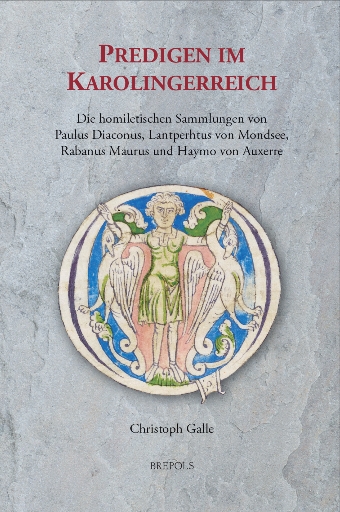
Predigen im Karolingerreich
Die homiletischen Sammlungenvon Paulus Diaconus, Lanthpertus von Mondsee, Rabanus Maurus und Haymo von Auxerre
show More to view fulltext, buy and share links for:Predigen im Karolingerreich show Less to hide fulltext, buy and share links for: Predigen im KarolingerreichBy supporting the Christianization process within their realm, Carolingian rulers not only served matters of faith, obedience, and healing of the soul; they also intended to unify the conquered tribes, remove their pagan traditions, and strengthen royal power. Carolingian sermon collections provide significant insights into the cultural, political, and social background to the process of Christianization in the Carolingian world. Five sample collections compiled by leading intellectuals are now explored extensively and comparatively for the first time.
-
-
-
Prefaces to the Latin Bible
Introductions by Pierre-Maurice Bogaert and Thomas O'Loughlin
show More to view fulltext, buy and share links for:Prefaces to the Latin Bible show Less to hide fulltext, buy and share links for: Prefaces to the Latin BibleDom Donatien De Bruyne's work of a century ago has been all but unobtainable since it was first published quasi-anonymously just after the Great War. Originally conceived as an instrumentum laboris to the great Benedictine project to produce a critical edition of the Vulgate, it now has a new life as a unique collection of the many texts that were presented with, or alongside, the biblical text until the end of the Middle Ages. These texts predisposed readers as to what they found in the sacred texts, and how they imagined the collection as a whole. While these texts have been passed over for centuries by exegetes concerned with the interpretation of scripture, for anyone studying the history of the Bible in western culture, the reception of the scriptures or the history of exegesis - or indeed the history of Latin theology - these short works are of crucial importance. They set the scene for exegesis and established the assumptions that created that universe of interpretation. They are, in short, the key to the medieval biblical paradigm.
This collection makes available the raw material for a new chapter in the study of the Latin Bible and the study of its reception in the later patristic and medieval periods. Moreover, it may usher in a new chapter in the history of biblical exegesis.
-
-
-
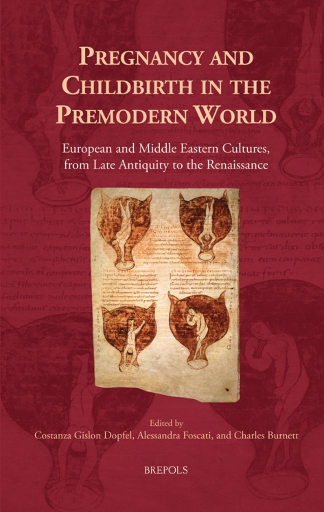
Pregnancy and Childbirth in the Premodern World
European and Middle Eastern Cultures, from Late Antiquity to the Renaissance
show More to view fulltext, buy and share links for:Pregnancy and Childbirth in the Premodern World show Less to hide fulltext, buy and share links for: Pregnancy and Childbirth in the Premodern WorldThis volume of contributions from international scholars offers a cross-cultural and multi-period analysis of pregnancy and childbirth traditions in Western and Middle Eastern cultures. The studies focus on the ideas, practices, and visual representations surrounding pregnancy and birth-giving from Late Antiquity to the Renaissance and offer the reader the possibility of observing the perception, representation, and theoretic paradigm of these events in a wide range of cultural contexts. The collection fits within multiple traditions of specialized scholarship, yet its scope suggests a geographically global approach and a new, multicultural methodology that encompasses a wide range of practices, historical periods, and topics. On one hand, it participates in the well-established medical, historical, and iconographic discourse on childbirth and family that has enticed much interest over the last two decades; on the other, its unique thematic structure includes cultures and periods previously ignored in similar collections of essays. The articles span from Northern Europe to the Mediterranean, the Middle East, and India, and connect the experience of childbirth to the exchanges of knowledge, religious beliefs, and social practices. With its variety of topics and specializations, the volume encourages a global comparative approach to the cultural narrative surrounding the activities and attitudes connected to conception and birth, paying particular attention to material culture, religion, history, and iconography, as well as to the exchange and dispersion of medical knowledge.
-
-
-
Premodern Jewish Books, their Makers and Readers in an Era of Media Change
show More to view fulltext, buy and share links for:Premodern Jewish Books, their Makers and Readers in an Era of Media Change show Less to hide fulltext, buy and share links for: Premodern Jewish Books, their Makers and Readers in an Era of Media ChangeThis volume brings together studies about books as artefacts within transitional zones. The history of the book from the handwritten to the printed medium is understood as a process marked by innovation and social change, but also by disorientation and bewilderment. The journey of a book from production to use was determined by a complex set of factors: communication among authors, makers of books, patrons, and readership; the emergence of publishers; and decisions to be made concerning production and publication. These factors underwent tremendous changes during the fifteenth and sixteenth centuries owing to the spread of printing and the rise of Humanism in Europe. Particular focus is put on the physical evidence of books, both handwritten and printed, and what it can tell us about a book’s production and its reception.
-
-
-

Premodern Translation
Comparative Approaches to Cross-Cultural Transformations
show More to view fulltext, buy and share links for:Premodern Translation show Less to hide fulltext, buy and share links for: Premodern TranslationThis edited collection offers six essays on translations and their producers and users in premodern societies, which explore possibilities for contextualizing and questioning the well-established narratives of translations and translating in history of science and philosophy. To enable such explorations, the editors decided to go beyond a conventional focus on Latin and Arabic medieval cultures. Thus a discussion of translation in East Asia that asks questions about the technologies of translation invites readers familiar with Western contexts to reflect on shared cross-cultural practices. Other authors ask new questions concerning mathematical, medical, or philosophical translations, such as the character and the role of ‘submerged’ translations that never made it into any of the traditional histories of translation in medieval societies. A third group of authors offer perspectives on early modern professionals, which open up the traditional research on translations to other fields of study, and allow us to reflect on changed practices and purposes of translation.
Featuring studies on Old Uyghur translations of Buddhist texts, on the fortune of a Latin translation of Arabic mathematics from al-Andalus, on Arabic philosophy and the division of the sciences in thirteenth-century Paris and Naples, on Albert the Great’s concept of interpretatio as an epistemic practice that combines translation and explanation, on translation between classical Arabic and Humanist traditions in early modern Spain, and on astronomy in early modern German scholarship, this volume offers a unique survey of premodern translations across a variety of languages and disciplines, exploring both their technical commonalities and cultural specificities, while also addressing the reception of the ideas they transmit.
-
-
-
Presbyter Kozma, Gegen die Bogomilen
Orthodoxie und Häresie auf dem mittelalterlichen Balkan
show More to view fulltext, buy and share links for:Presbyter Kozma, Gegen die Bogomilen show Less to hide fulltext, buy and share links for: Presbyter Kozma, Gegen die BogomilenThe Homily of the Unworthy Priest Cosmas Against the Newly-Appeared Heresy of Bogomil (10th century) is a key source for the religious history of the Balkan peninsula. It is one of the earliest and richest sources for the rise of the dualistic religious movement of Bogomilism in the early Middle Ages. Written in a period of war and crisis of the Bulgarian Empire Cosmas sermon is also an important work of Eastern Christian Theology, calling for a thorough reform of clergy and monasticism.
During the subsequent centuries Cosmas' work was copied and excerpted by Bulgarian, Serbian and Russian churchmen who were seeking inspiration in their struggle for ecclesial reform and against religious dissent of various heretical movements. In the processes of national identity construction on the Balkans during the nineteenth and twentieth centuries Cosmas' Homily again played a remarkable role.
The present study provides the first complete translation into a western language of Begunov's 1973 critical edition. The German translation is accompanied by an introduction and a commentary.
-
-
-
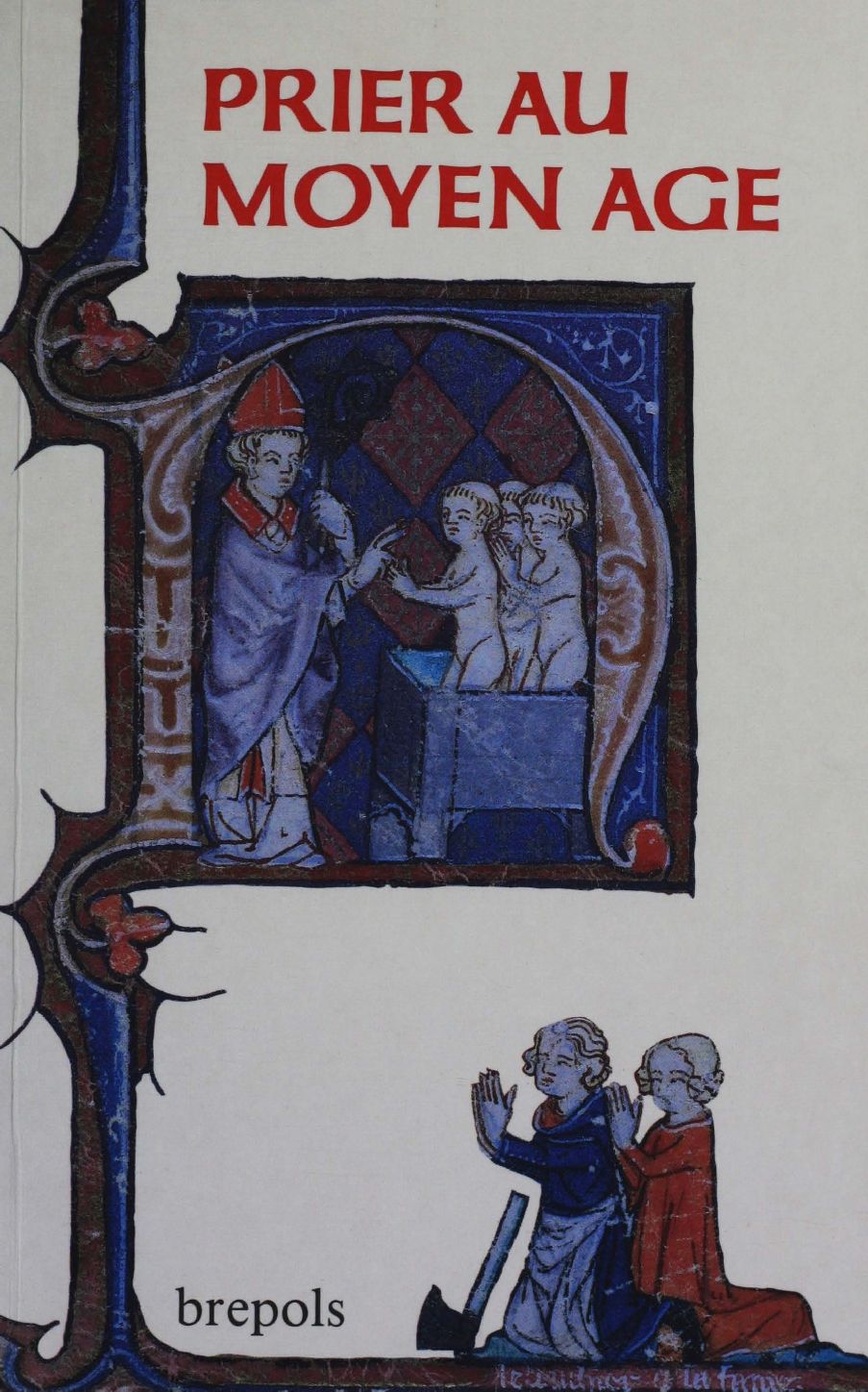
Prier au moyen âge
Pratiques et expériences (Ve-XVe siècles)
show More to view fulltext, buy and share links for:Prier au moyen âge show Less to hide fulltext, buy and share links for: Prier au moyen âgeLa prière est au Moyen Age une pratique fondamentale. Quels en sont les mots, les gestes et les modèles? Comment religieux et laïcs priaient-ils? Hommes ou femmes? Princes ou "simples gens"? Bref, comment la prière était-elle dite, vécue et pensée? Pour répondre à ces questions, des spécialistes de la pensée religieuse médiévale ont interrogé des textes dont ils proposent ici la traduction (pour l'essentiel inédite) et le commentaire. De Florus de Lyon à Abélard, de Césaire d'Arles à Vincent Ferrier, des prières des moines à celles des Cathares, de la prière talisman aux patenôtres glosées, le lecteur se voit convié à goûter toute la richesse d'une prière aux formes multiples et aux aspects parfois inattendus.
-
-
-

Princely Citizen
Lorenzo de' Medici and Renaissance Florence
show More to view fulltext, buy and share links for:Princely Citizen show Less to hide fulltext, buy and share links for: Princely CitizenLorenzo de’ Medici (1449-92) was in his own time one of the most renowned of Renaissance figures. His myth has continued to fascinate both scholars and the many tourists who are drawn by it to explore what remains of the Medicean presence in Florence. Lorenzo’s first English biographer, William Roscoe, described him as the most remarkable man who had ever lived in ancient or modern times. This collection of essays explores Lorenzo’s apprenticeship as the de facto ruler of Florence and the means by which he exerted control over friends and clients to ensure the ascendancy of the Medici dynasty. The essays place the religious and artistic patronage of Lorenzo in the context of his political career and explore other important aspects of his emergence as the princely citizen of a still proud republic.
Francis W. Kent (1942-2010) established his reputation as a cultural and social historian of Renaissance Florence with his first monograph, Household and Lineage in Renaissance Florence. He turned his attention to Lorenzo de’ Medici in the late 1980s, producing a steady stream of essays, collected here for the first time, and a major study of Lorenzo’s art patronage, Lorenzo de’ Medici and the Art of Magnificence. After the death of Nicolai Rubinstein in 2002, the first general editor of the multi-volume critical edition of Lorenzo de’ Medici’s letters, Kent took charge of the ongoing project and oversaw the publication of several more volumes. His forthcoming biographical study of Lorenzo’s early career will be published by Harvard University Press.
-
-
-
Princely Funerals in Europe 1400–1700
Commemoration, Diplomacy, and Political Propaganda
show More to view fulltext, buy and share links for:Princely Funerals in Europe 1400–1700 show Less to hide fulltext, buy and share links for: Princely Funerals in Europe 1400–1700Funerals were among the most extravagant princely ceremonies in Europe. At the end of the Middle Ages, they were grandiose affairs, carefully recorded, bringing together the emotions of both Court and People. The Renaissance heightened their effect, adding surprising elements borrowed from an Antiquity which was largely re-invented. The seventeenth century introduced ephemeral displays, elaborately constructed castrum doloris, dressed up with lavish facades and interior designs which transformed these sanctuaries into theatrical funeral pyres.
Historians, anthropologists, and political scientists have long been interested in this subject, as can be seen from Ralph Giesey's celebrated work Le Roi est mort. Art historians have been attracted to the surviving decorations of tombs and funerary chapels. Yet historians of spectacle and of its ephemera have, hitherto, somewhat neglected a topic which is - nonetheless - at the heart of their concerns: with their elaborate settings, their costumes and decors, princely funerals challenge theatre and opera.
It is within this context that experts from many disciplines attempt to trace the evolution of funeral ceremonies, which were much less static than is generally believed; to expose the gifts of the masters of these solemn occasions (and, indeed, of their predecessors, the heralds) who constantly devised subtle ways of capturing the attention of spectators and moving their emotions. These essays have tried to cover not only a wide time spectrum but also to reveal the variety and range of such ceremonies devised in diverse European Courts as well as unravelling the innovations which underlay fashions which had multiple international repercussions.
Featuring contributions by: Monique Chatenet, Murielle Gaude-Ferragu, Gérard Sabatier, Agostino Paracivini_Bagliani, Alain Marchandisse, Joël Burden, Mickaël Boytsov, Maria Nadia Covini, Eva Pibiri, Marie-Madeleine Fontaine, Giovanni Ricci, Gérard Sabatier, Maria Adelaida Allo Manero, Naïma Ghermani, Birgitte B. Johannsen.
-
-
-
Princely Virtues in the Middle Ages
1200-1500
show More to view fulltext, buy and share links for:Princely Virtues in the Middle Ages show Less to hide fulltext, buy and share links for: Princely Virtues in the Middle AgesThe contributors to this book examine the diverse roles played by moral virtues in the political writing of the Later Middle Ages. Medieval political thought has a long tradition of scholarship, and its ethical dimension has always received sustained attention. This volume specifically concentrates on the meaning and function of virtues in a political context, a theme which has thus far been neglected. The authors deal with Latin texts (occasionally in combination with vernacular ones) from the thirteenth to fifteenth centuries that define, legitimize, or criticize secular rule by using catalogues of virtues, originating from ancient philosophy as well as Christian moral theology. The contributions discuss various aspects related to this theme, such as the relation between the virtues of rulers and general moral precepts; the tension between secular or philosophical perspectives on virtue and Christian moral thought; the use of moral virtues for political ends; the balance between praise of the prince’s virtues and criticism of his vices; and so forth. The medieval texts under discussion are of French, German, English, Italian, and Spanish origin, and vary from educational treatises and historiography to moral theology and political philosophy.
-
-
-
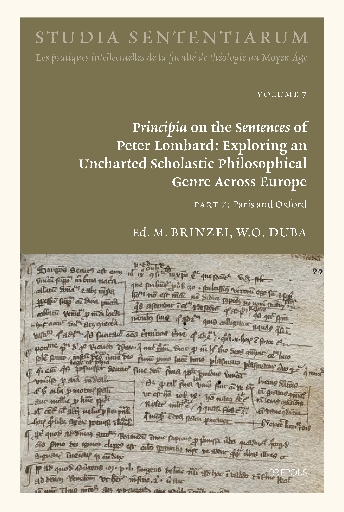
Principia on the Sentences of Peter Lombard
Exploring an Uncharted Scholastic Philosophical Genre Across Europe
show More to view fulltext, buy and share links for:Principia on the Sentences of Peter Lombard show Less to hide fulltext, buy and share links for: Principia on the Sentences of Peter LombardPrincipia were an obligatory step on the medieval university path to becoming a master of theology. As inaugural lectures on the four books of the Sentences of Peter Lombard, they provided the first opportunity for a scholastic to defend a philosophical-theological worldview. These lectures were also a way for the theologian, now a sententiarius, to present himself and to make a name for himself, initially by delivering in a speech an introduction to the course and by debating with his fellows. The present book takes a collective approach to offer a survey of the evolution of the genre, mapping the dissemination of this exercise during the fourteenth and fifteenth centuries across Europe.
As an academic exercise, principia bridge ideas, texts, authors, and institutions across time. Exploring the corpus of surviving principia illuminates the philosophical creativity cultivated in the faculties of theology. The papers in these volumes thus not only discuss the structural aspects of principia, but also treat the philosophical and theological ideas defended and attacked during the principial debates and the topics and imagery used in the speeches.
The various chapters delve into the surviving material in a common attempt, firstly, to assemble pieces of evidence from Paris and Oxford into an image portraying how, when, and by whom the principia were performed in the first European universities. The second part illustrates the spread of the genre to the new faculties of theology in Central Europe and Italy, with case studies from Bologna, Cracow, Florence, Heidelberg, Prague, and Vienna, highlighting the pan-European diffusion of the practice.
-
-
-

Priscien
Transmission et refondation de la grammaire, de l’antiquité aux modernes
show More to view fulltext, buy and share links for:Priscien show Less to hide fulltext, buy and share links for: PriscienChassé d’Afrique par les invasions vandales et installé à Constantinople vers le début du VIe siècle, Priscien a engagé une refonte de la grammaire antique en faisant confluer ses principaux courants, la tradition grammaticale romaine et les apports grecs issus de la philologie alexandrine, auxquels il a intégré des recherches menées dans d’autres domaines de l’analyse de la parole, en rhétorique et en philosophie.
La création de la première grammaire moderne est ainsi d’abord une synthèse, qui correspond dans la partie orientale de l’Empire aux espoirs qu’au même moment, à Rome, Boèce et son cercle plaçaient dans l’hellénisme pour renouveler la vie intellectuelle d’une partie occidentale tombée aux mains des Barbares.
Auteur à multiples dimensions, chez qui se croisent les spécificités et les ambiguïtés de l’Antiquité tardive, Priscien a été le passeur par qui l’époque médiévale a eu connaissance des éléments les plus complexes de la description linguistique antique. Son influence a été immense durant tout le Moyen Âge et ses échos sont perceptibles jusque dans la tradition classique.
Malgré cela, aucune traduction dans une langue moderne n’a encore été faite des principaux textes de Priscien, et la période actuelle commence seulement à mesurer l’importance et l’originalité de cet auteur.
Le présent volume est la première mise au point d’ensemble et dresse un état des recherches à l’issue du colloque international Priscien (ENS Lettres et Sciences Humaines, Lyon, 10 - 14 octobre 2006). Ses 40 articles présentent les points de vue transversaux d’antiquisants, de linguistes, d’historiens et de médiévistes. Réparties en six sections, les contributions traitent successivement de la position historique de Priscien et de la transmission de ses œuvres, des sources et du contenu de son texte majeur, les Institutions Grammaticales, de ses scripta minora et de la réception de sa doctrine du Haut Moyen Âge à la Renaissance.
L’ouvrage comporte une bibliographie globale et plusieurs index (auteurs anciens et modernes, manuscrits, passages cités, concepts et termes).
-
-
-
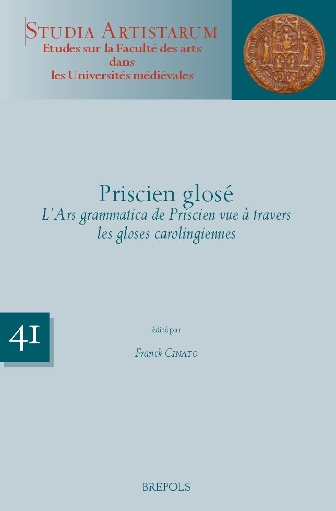
Priscien glosé
L’Ars grammatica de Priscien vue à travers les gloses carolingiennes
show More to view fulltext, buy and share links for:Priscien glosé show Less to hide fulltext, buy and share links for: Priscien gloséL’étude de l’Ars de Priscien, débutée discrètement dans les Îles britanniques au VIIe siècle, a occupé une position essentielle dans la formation médiévale. Sous l’impulsion d’Alcuin, elle a ouvert de nouvelles perspectives aux réflexions grammaticales pour des générations d’écolâtres. Les plus anciens témoins manuscrits de l’Ars attestent que les innombrables explications notées en marges ont tenu un rôle capital dans la transmission du savoir.
Le présent volume décrit le contexte pédagogique et plus largement le milieu culturel dans lequel s’insère l’étude de la grammaire dans le haut Moyen Âge, et s’attache tout spécialement à dégager les étapes de sa réception dans les monastères, d’abord sous l’angle des livres qui la transmettent, puis de celui des maîtres qui les ont utilisés. À cet effet, les gloses constituent des témoignages fondamentaux qui font l’objet d’une triple enquête : typologique, textuelle et historique.
Les gloses présentées ici dévoilent les rouages intimes d’un monde scolaire en constant renouvellement. Elles font la lumière sur les patients travaux des maîtres carolingiens, qui ont minutieusement décortiqué le texte complexe de Priscien. Elles montrent l’élaboration d’une méthodologie promise à un brillant avenir. Et si les Carolingiens se sont attachés surtout aux seize premiers livres, ils n’en ont pas moins préparé le terrain d’une seconde réception, qui placera, dès la fin du XIe siècle, les deux derniers livres sur la syntaxe au centre des débats scolastiques.
-
-
-
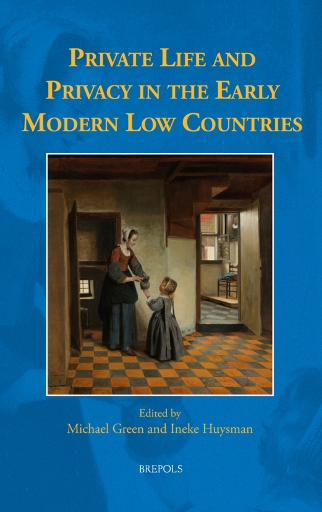
Private Life and Privacy in the Early Modern Low Countries
show More to view fulltext, buy and share links for:Private Life and Privacy in the Early Modern Low Countries show Less to hide fulltext, buy and share links for: Private Life and Privacy in the Early Modern Low CountriesThis volume investigates the origins of one of the most important notions of contemporary society: privacy. Based on case studies from the early modern Low Countries, privacy is tackled from various historical perspectives: social and cultural history, and the history of art and architecture.The Dutch Republic is well known for its financial success, which went hand in hand with the development of a distinguished bourgeois culture and religious toleration. The accumulation of wealth among the urban population led to changes in various spheres, from daily life to art. Privacy, as a concept, started to develop in this period. Indeed, new ideas about housing with the invention of corridors, separate rooms that could be locked, and the separation of the ‘common’ and the ‘private’ space, all illustrate the growing importance of privacy in this geographical area. This volume traces perspectives on early modern privacy and private life based on primary sources in several domains: letters, diaries, and poems; genre painting in art; communal life as illustrated by the Jewish community; and finally, the homes of the Dutch elite.The essays in this volume make a key contribution to the emergence of early modern privacy studies as a research field, and to the ongoing discussion of privacy in the Low Countries. Equally, these case studies can serve as models for the analysis of privacy in other European contexts.
-
-
-

Probable Truth
Editing Medieval Texts from Britain in the Twenty-First Century
show More to view fulltext, buy and share links for:Probable Truth show Less to hide fulltext, buy and share links for: Probable TruthEditing as an academic mode of work has had a variable ‘press’ - it is often seen as just plumbing. But without editions no historian of whatever critical persuasion could operate. Texts that are not edited are effectively invisible.
The advent of electronic means of text production has also raised new possibilities and new problems that need to be openly considered rather than ignored. The papers in this volume reflect those concerns, and explore the ways forward. How do the best editorial procedures of the past get transmitted to the future? A distinguished line-up of experienced editors and younger scholars actively grappling with these issues reflect on their engagement with the challenges of textual theory and editorial practice.
No single solution emerges as applicable to all texts and for all editions; the individual characteristics of each text and its transmission, together with the intended audience of each edition, emerge as primary areas for consideration.
-
-
-
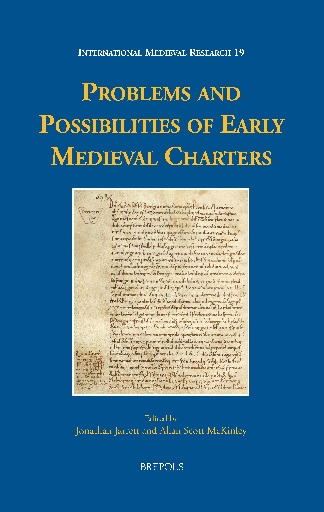
Problems and Possibilities of Early Medieval Charters
show More to view fulltext, buy and share links for:Problems and Possibilities of Early Medieval Charters show Less to hide fulltext, buy and share links for: Problems and Possibilities of Early Medieval ChartersAlthough historical work on the early Middle Ages relies to an enormous extent on the evidence provided by charters and other such documents, the paradigms within which such documents are interpreted have changed relatively slowly and unevenly. The critical turn, the increasing availability of digital tools and corpora for study, and the acceptance among charter specialists that their discipline can inform a wider field all encourage rethinking. From 2006 to 2011 a series of sessions at the Leeds International Medieval Congress addressed this by applying new critiques and technologies to early medieval diplomatic material from all over Europe. This volume collects some of the best of these papers by new and young scholars and adds related work from another session. The subjects range from reinterpretations of Carolingian or Anglo-Saxon political history, through the production and use of charters by all ranks of society and their subsequent preservation from Spain to Germany and England to Italy, to explorations of new media leading to new kinds of results from such evidence. The result is an array of new perspectives which makes an important contribution to recent reconsiderations of charter studies. It will inform a wide audience from all walks of medieval historical studies.
-
-
-
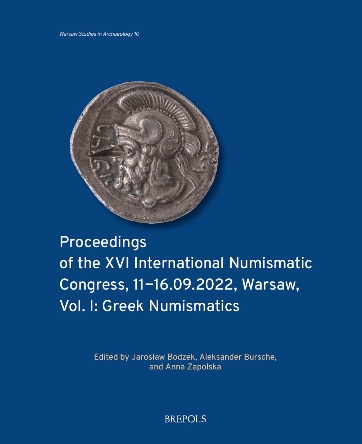
Proceedings of the XVI International Numismatic Congress, 11–16.09.2022, Warsaw, Vol. i: Greek Numismatics
show More to view fulltext, buy and share links for:Proceedings of the XVI International Numismatic Congress, 11–16.09.2022, Warsaw, Vol. i: Greek Numismatics show Less to hide fulltext, buy and share links for: Proceedings of the XVI International Numismatic Congress, 11–16.09.2022, Warsaw, Vol. i: Greek NumismaticsThe XVI International Numismatic Congress, held in Warsaw, Poland, in September 2022, was a landmark event, drawing the largest number of participants in its history. With over 550 papers presented during thematic sessions and round tables, this congress showcased the latest advancements and research in the field of numismatics from leading experts and scholars in their field.
A curated selection of papers from the conference have now been drawn together into peer-reviewed conference proceedings, representing a comprehensive spectrum of numismatic studies from antiquity to modern times. Each paper is meticulously illustrated with high-quality images, often of unique specimens, along with detailed diagrams, maps, and die/typological chains. Topics covered include coins and coin finds, medals, tokens, banknotes, the history of collections and collecting, and cutting-edge chemical analyses and technologies used in coin examination.
This volume, the first in four thematic volumes, focuses on Greek numismatics, and comprises fifty-nine chapters exploring different elements of Greek coinage, as well as touching on coins from ancient India.
-
-
-
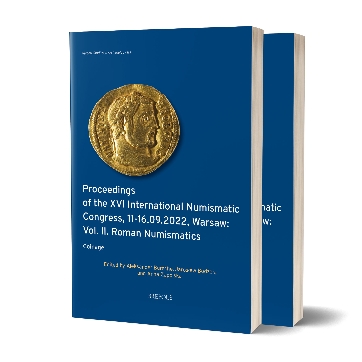
Proceedings of the XVI International Numismatic Congress, 11–16.09.2022, Warsaw, Vol. ii, Roman Numismatics
show More to view fulltext, buy and share links for:Proceedings of the XVI International Numismatic Congress, 11–16.09.2022, Warsaw, Vol. ii, Roman Numismatics show Less to hide fulltext, buy and share links for: Proceedings of the XVI International Numismatic Congress, 11–16.09.2022, Warsaw, Vol. ii, Roman NumismaticsThe XVI International Numismatic Congress, held in Warsaw, Poland, in September 2022, was a landmark event, drawing the largest number of participants in its history. With over 550 papers presented during thematic sessions and round tables, this congress showcased the latest advancements and research in the field of numismatics from leading experts and scholars in their field.
A curated selection of papers from the conference have now been drawn together into peer-reviewed conference proceedings, representing a comprehensive spectrum of numismatic studies from antiquity to modern times. Each paper is meticulously illustrated with high-quality images, often of unique specimens, along with detailed diagrams, maps, and die/typological chains. Topics covered include coins and coin finds, medals, tokens, banknotes, the history of collections and collecting, and cutting-edge chemical analyses and technologies used in coin examination.
This volume, the second in four thematic volumes, focuses on Roman coinage. Divided into two separate volumes, covering respectively forty-three chapters on coinage and forty-one on circulation, the contributions gathered here explore not only Rome and the imperial mints, but also local phenomena from Spain to Asia Minor, including graffiti, imitations, and copies of Roman coinage.
-
-
-
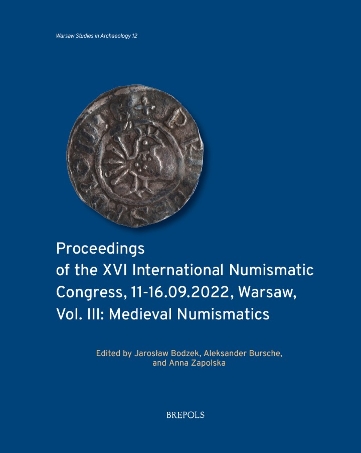
Proceedings of the XVI International Numismatic Congress, 11–16.09.2022, Warsaw, Vol. iii: Medieval Numismatics
show More to view fulltext, buy and share links for:Proceedings of the XVI International Numismatic Congress, 11–16.09.2022, Warsaw, Vol. iii: Medieval Numismatics show Less to hide fulltext, buy and share links for: Proceedings of the XVI International Numismatic Congress, 11–16.09.2022, Warsaw, Vol. iii: Medieval NumismaticsThe XVI International Numismatic Congress, held in Warsaw, Poland, in September 2022, was a landmark event, drawing the largest number of participants in its history. With over 550 papers presented during thematic sessions and round tables, this congress showcased the latest advancements and research in the field of numismatics from leading experts and scholars in their field.
A curated selection of papers from the conference have now been drawn together into peer-reviewed conference proceedings, representing a comprehensive spectrum of numismatic studies from antiquity to modern times. Each paper is meticulously illustrated with high-quality images, often of unique specimens, along with detailed diagrams, maps, and die/typological chains. Topics covered include coins and coin finds, medals, tokens, banknotes, the history of collections and collecting, and cutting-edge chemical analyses and technologies used in coin examination.
This book, the third in four thematic volumes, explores medieval coinage. Research presented in forty-two different chapters ranges from the early Byzantine period through to the late Middle Ages, including Asiatique and Islamic coinages, and medieval tokens.
-
-
-
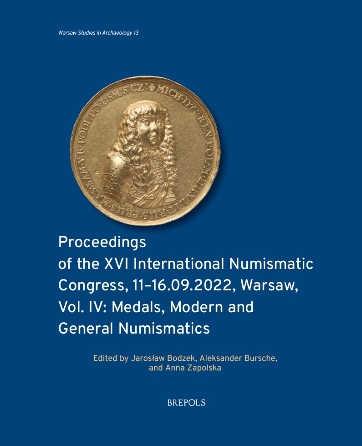
Proceedings of the XVI International Numismatic Congress, 11–16.09.2022, Warsaw, Vol. iv: Medals, Modern and General Numismatics
show More to view fulltext, buy and share links for:Proceedings of the XVI International Numismatic Congress, 11–16.09.2022, Warsaw, Vol. iv: Medals, Modern and General Numismatics show Less to hide fulltext, buy and share links for: Proceedings of the XVI International Numismatic Congress, 11–16.09.2022, Warsaw, Vol. iv: Medals, Modern and General NumismaticsThe XVI International Numismatic Congress, held in Warsaw, Poland, in September 2022, was a landmark event, drawing the largest number of participants in its history. With over 550 papers presented during thematic sessions and round tables, this congress showcased the latest advancements and research in the field of numismatics from leading experts and scholars in their field.
A curated selection of papers from the conference have now been drawn together into peer-reviewed conference proceedings, representing a comprehensive spectrum of numismatic studies from antiquity to modern times. Each paper is meticulously illustrated with high-quality images, often of unique specimens, along with detailed diagrams, maps, and die/typological chains. Topics covered include coins and coin finds, medals, tokens, banknotes, the history of collections and collecting, and cutting-edge chemical analyses and technologies used in coin examination.
This volume, the last in four thematic volumes, comprises fifty-five chapters that explore modern numismatics, as well as medal making and tokens. It also includes discussions that touch more broadly on the general field of numismatics, among them digital numismatics, counterfeit coins, coin finds, and the history of coin collecting.
-
-
-
Procopius the Christian Sophist
Catenist, Compiler, Epitomist
show More to view fulltext, buy and share links for:Procopius the Christian Sophist show Less to hide fulltext, buy and share links for: Procopius the Christian SophistThe rich literary production of Gaza in the fifth and sixth centuries AD has received quite some attention in recent scholarship. Yet, the figure and work of Procopius the Sophist, as author of catenae, compiler, and epitomist of patristic exegesis, have remained relatively unknown and under-explored. This collection of essays delves deeply into Procopius’ exegetical work. At the outset, a strong case is made that one should distinguish between the famous orator of Gaza and "the Christian sophist" Procopius. A first large section of the book deals with the Genesis Epitome that is studied from three different angles: the limited and as a rule critical use of Origen and his tradition; the importance given to Theodore of Mopsuestia’s exegesis of Gen 1–3; and the relations between Procopius’ Epitome and John Philoponus’ De opificio mundi. The section on the Exodus Epitome studies the specificity of Procopius’ work in comparison to the Catena on Exodus, the way the material is organised, and the literary genre of the work. The volume further contains contributions on the connections between the Scholia on Kings attributed to Procopius, the type B catena, and the so-called "Catena Lipsiensis"; the relations between Procopius’ Catena on Proverbs and other catenae on this book; the sources of the Isaiah Epitome that show a diligent and able compiler at work; and the comparison between the characteristic features of Procopius’ Epitomes and those of the Catena III on Obadiah. As a whole, it offers a wide perspective and significantly advances research on, and our knowledge of, Procopius the Christian sophist, a still somewhat mysterious early Byzantine author and scholar.
-
-
-
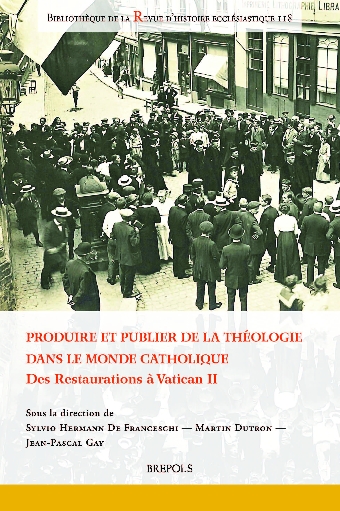
Produire et publier de la théologie dans le monde catholique
Des Restaurations à Vatican II
show More to view fulltext, buy and share links for:Produire et publier de la théologie dans le monde catholique show Less to hide fulltext, buy and share links for: Produire et publier de la théologie dans le monde catholiqueIssu d’un colloque organisé en septembre 2020, ce volume part de la nécessité de faire dialoguer histoire de la théologie et histoire des savoirs. Il se concentre plus particulièrement sur les lieux académiques de la production de la théologie, sur son rapport à d’autres disciplines et son séquençage en sous-disciplines, sur sa circulation dans des espaces plus vastes, et sur le rapport aux éditeurs. Les 16 contributions ici rassemblées rompent avec l’écriture classique de l’histoire de la théologie qui est restée à grande distance des questions et des méthodes de l’histoire des savoirs, ils rompent également avec la réticence des historiens des savoirs à appréhender l’objet-théologie malgré son importance dans les universités européennes des deux derniers siècles. Ce volume s’inscrit dans un agenda renouvelé d’historicisation des conditions et de la production des savoirs théologiques dans le monde catholique, depuis les restaurations européennes du 19e siècle jusqu’à Vatican II.
-
-
-
Property Rights, Land Markets and Economic Growth in the European Countryside (13th-20th Centuries)
show More to view fulltext, buy and share links for:Property Rights, Land Markets and Economic Growth in the European Countryside (13th-20th Centuries) show Less to hide fulltext, buy and share links for: Property Rights, Land Markets and Economic Growth in the European Countryside (13th-20th Centuries)By exploring the fundamental issues of property rights and markets in land, this book will offer important insights into long-term economic change in Europe. The essays gathered here provide a major consideration of the institutional constraints which can be employed by historians and other commentators in order to explain both the slowness or even absence of growth in certain areas of the European economy between the thirteenth and nineteenth centuries, as well as the discrete experiences of countries within Europe in this broad period.
This is an issue of current interest not least because discussion of 'institutional determinism' has become a standard of explanations of historical and economic change; that said, those promoting such approach have sometimes been criticised for generalising from an 'institutional' perspective rather than taking full account of the variety of potential causative explanations within particular historical contexts.
The present collection of essays will therefore explore the conditions which permitted the progress of agriculture in Europe and the emergence of capitalism in the countryside. The research presented in this volume helps to demonstrate that changes in the market (demand, relative prices...) encouraged changes in property rights but certainly did not do so in ways that were consistent or that led inexorably towards individual and exclusive rights of the kind described by the nineteenth-century liberal paradigm.
Specialist of rural and economic history, Gérard Béaur is Directeur de Recherches at CNRS and Directeur d’Etudes at EHESS (Paris, France). He was Chair of the COST Action A35 Progressore and he is currently director of the GDRI (International Research Network, CNRS) CRICEC (Crises and Changes in the European Countryside).
Phillipp Schofield is Professor of Medieval History and Head of the Department of History and Welsh History, Aberystwyth University. His research interests focus on rural society in England in the high and late Middle Ages.
Jean-Michel Chevet is a French researcher in the Institut National de la Recherche Agronomique, ADESS-UMR-5185. He is a specialist in the economic history of the countryside, particularly of the development of the English and French growth and of the history of vine growing.
Maria-Teresa Pérez-Picazo was Professor of Economic History at the University of Murcie (Spain). Her principal work was on agrarian history and she focused particularly on the subject of water management in the modern period.
-
-
-
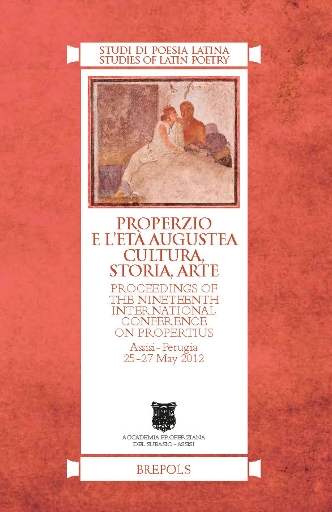
Properzio e l'etá augustea. Cultura, storia, arte
Proceedings of the Nineteenth Conference on Propertius, Assisi-Perugia 25-27 May 2012
show More to view fulltext, buy and share links for:Properzio e l'etá augustea. Cultura, storia, arte show Less to hide fulltext, buy and share links for: Properzio e l'etá augustea. Cultura, storia, arteThe two thousandth anniversary of the death of Augustus is an important opportunity to reconsider the close relationship the poet Propertius and the town of Assisi had with the first emperor and the Roman world. With regard to Propertius, it was felt that the time had come to take stock of the growing interest in the Umbrian poet, and the speakers of the 2012 Conference (Properzio e l’età augustea: cultura, storia, arte) were invited to focus on two perspectives: the interwoven relationship between Propertius and Augustus, on the one hand, and his problematic interaction with the poets and literary circles of Rome on the other. The comparison with Augustus also called for the introduction of new data in the historical debate regarding the complex of monuments in the city of Assisi, from the Temple of Minerva, which dates back to the triumviral age, to the conspicuous epigraphic heritage of the gens Propertia, and archaeological landmarks such as the Domus Musae and the Domus del Lararium. Taking into account the multifarious stimuli hinted at these proceedings are to be read as a exchange of comparative assessments by philologists, the primary and legitimate custodians of the secretum of the poetry of Propertius , archaeologists, epigraphists and historians, called to define in dynamic terms - of imitation, assimilation and comparison - the relations the poet had with Rome and Augustus, with his hometown of Assisi and the Umbrian and Etruscan cities of the Umbrian Valley, and with the culture, art and the political groups active in triumviral and Augustan Rome.
-
-
-
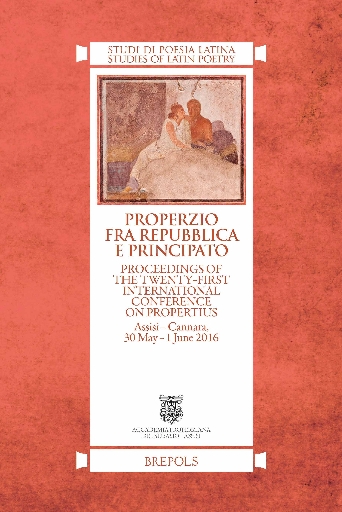
Properzio fra Repubblica e Principato
Proceedings of the twenty-first international conference on Propertius, Assisi – Cannara, 30 May –1 June 2016
show More to view fulltext, buy and share links for:Properzio fra Repubblica e Principato show Less to hide fulltext, buy and share links for: Properzio fra Repubblica e PrincipatoThe 2016 conference’s aim was to place Propertius in context. The papers focused on the compatibility between the choice of the elegiac form and the political framework, with special emphasis on Propertius’ relationship to Tullus before his approach to Maecenas and the more direct contact with Augustus subsequent to Maecenas’ removal. While not overstepping the bounds of the genre, the poet was able to contrive a set of references to the princeps and the political reality, thus originally achieving a balanced attitude. It is impossible, however, to grasp any growing alignment with Augustan policies. Rather, the recognition of the collective perception of the turning point marked by the victory at Actium, though within the patterns typical of the elegiac genre, can be perceived.
-
-
-
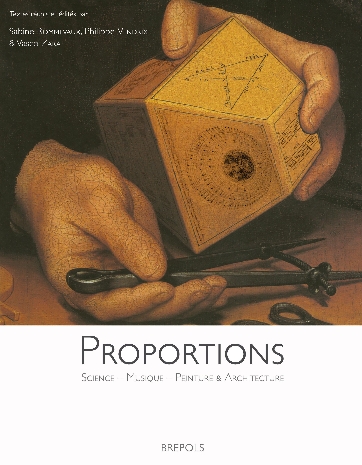
Proportions. Science, Musique, Peinture & Architecture
show More to view fulltext, buy and share links for:Proportions. Science, Musique, Peinture & Architecture show Less to hide fulltext, buy and share links for: Proportions. Science, Musique, Peinture & ArchitectureLe langage des proportions est un langage de comparaison. Outil scientifique, il met en relation grandeurs mathématiques ou physiques (deux cercles, deux mouvements, deux sons). Pour autant, son application ne se restreint pas au seul champ des mathématiques. Erigé en principe philosophique par le principe de comparaison qui le sous-tend, il déploie tout son potentiel analogique en devenant langage constructeur d’harmonie. La théorie des proportions s’ouvre ainsi sur un vaste champ de relations qui définissent canons et règles de beauté dans les diverses disciplines artistiques. S’intéresser aux proportions signifie donc s’intéresser à tous les domaines du savoir. Mais comment aborder et comprendre, dans un dialogue transversal, sa dimension historique ? Tel est le pari de ces essais, issus du LIe Colloque International d’Études Humanistes du Centre d’Études Supérieures de la Renaissance de Tours. De la renaissance menée par les Calculatores d’Oxford sous l’égide d’Aristote, à la Renaissance des peintres et des musiciens, des architectes et des alchimistes, des marchands et des érudits, jusqu’à l’aube de la Révolution scientifique, les spécialistes ici réunis éclairent la notion de proportion en tant qu’objet de théories mathématiques, en tant qu’outil dans tous les domaines du savoir et en tant que principe au cœur de constructions philosophiques ou artistiques.
Avec les contributions de : Sabine Rommevaux, J. V. Field, Ann E. Moyer, Pierre Caye, Jens Høyrup, Maryvonne Spiesser, Bernard Joly, Gabriela Ilnitchi Currie, Dorit Tanay, Anna Maria Busse Berger, Grantley McDonald, Stefano Lorenzetti, Katelijne Schiltz, Rudolf Rasch, Thomas Christensen, Brigitte Van Wymeersch, Pietro Roccasecca, Danilo Samsa, Lucien Vinciguerra, Matthew Landrus, Filippo Camerota, Valérie Auclair, Yves Pauwels, Frédérique Lemerle, Laura Moretti, Frank Zöllner.
-
-
-
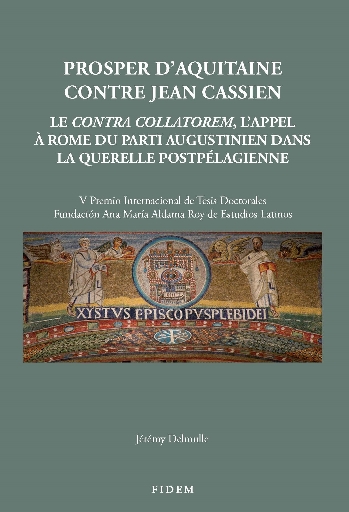
Prosper D’Aquitaine contre Jean Cassien
Le Contra collatorem, l’appel à Rome du parti augustinien dans la querelle postpélagienne
show More to view fulltext, buy and share links for:Prosper D’Aquitaine contre Jean Cassien show Less to hide fulltext, buy and share links for: Prosper D’Aquitaine contre Jean CassienComposé en 432-433, le Liber contra collatorem de Prosper d’Aquitaine entend réfuter les positions d’un certain « conférencier » - comprendre : l’auteur des Conférences, Jean Cassien. C’est dans cette oeuvre que Prosper, défenseur autoproclamé de saint Augustin et de sa doctrine sur la grâce, a pu fournir la première critique, et la plus complète, des théories propagées à Marseille et dans le sud-est de la Gaule par les adversaires provençaux de l’évêque d’Hippone, en s’appuyant exclusivement sur des extraits tirés de la Conlatio XIII « Sur la protection de Dieu », publiée quelques années plus tôt.
En s’attachant, par une approche philologique, historique, stylistique et doctrinale, à étudier les diff érentes spécifi cités de l’oeuvre de l’Aquitain (la fi nalité du traité, le modus operandi de l’auteur, le genre littéraire adopté, les stratégies du polémiste et les enjeux théologiques du traité), le présent livre cherche à défendre l’hypothèse qu’en composant son Liber, Prosper a voulu constituer un dossier à charge suffi samment étayé pour obtenir de l’évêque de Rome nouvellement élu, Xyste III (432-440), une condamnation offi cielle de ce que l’on a nommé le « semipélagianisme » et, par là, la reconnaissance de l’autorité de la doctrine augustinienne en matière de grâce.
-
-
-
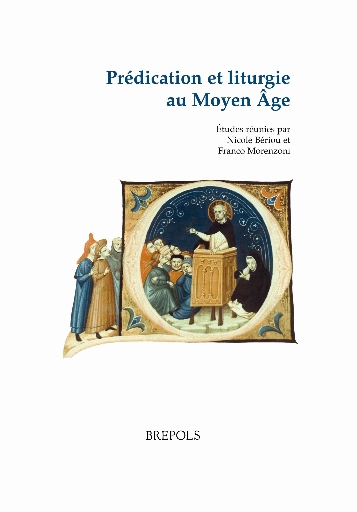
Prédication et liturgie au Moyen Âge
Etudes réunies
show More to view fulltext, buy and share links for:Prédication et liturgie au Moyen Âge show Less to hide fulltext, buy and share links for: Prédication et liturgie au Moyen ÂgeLa transmission des traces écrites de la prédication médiévale prend habituellement la forme de recueils de sermons ordonnés selon les fêtes du calendrier liturgique. Pour autant, la relation d’intimité entre prédication et liturgie qu’on serait tenté d’en déduire n’est ni nécessaire, ni évidente. La discrétion des liturgistes médiévaux sur les pratiques de prédication l’atteste, et de même, celle des auteurs d’artes predicandi sur la liturgie.
Comment la prédication et la liturgie, ces deux manières complémentaires, mais clairement distinctes, de construire un discours public sur la foi, et de pratiquer la religion, au sein de la société, sous la forme d’actions auxquelles on prête une efficacité symbolique, se sont-elles rejointes, voire mutuellement renforcées au cours de l’histoire de la christianisation? Telle est la question qui sous-tend la quinzaine d’études réunies dans ce volume. Le millénaire médiéval s’y trouve à dessein enchâssé entre la période d’épanouissement de la prédication des Pères, qui est aussi le temps de l’élaboration d’assises durables pour la liturgie, et le moment crucial des remises en question de tous ordres qui, à partir du xvi e siècle, permettent d’observer le temps passé comme dans un miroir. La parole y est surtout donnée aux prédicateurs, en réalité très diserts sur les textes lus et chantés, les gestes, les vêtements, les rites et les usages de la liturgie – en particulier, sur les rituels de consécration ou de dédicace des églises, et sur les processions de la Fête-Dieu. Si les prédicateurs, de la sorte, donnent sens au culte, la liturgie est aussi pour eux un instrument pédagogique mis au service de la mémorisation de leur message, un langage qu’ils s’approprient en recourant à la citation poétique, ou à la transposition métaphorique des mots du rituel, voire une autorité qui leur sert d’argument de persuasion ou, plus rarement, dont ils éprouvent la validité rationnelle. De plus, dès le xiii e siècle, dans les villes, les frères mendiants n’hésitent pas à détacher leurs prises de parole des temps et des lieux ordinaires de la célébration liturgique au profit de la conquête et de la sacralisation d’un temps et d’un espace du quotidien, alors que le théâtre et les livres de lecture s’emparent des techniques du sermon et des ressources de la liturgie, en des formes renouvelées de la pratique pastorale.
-
-
-
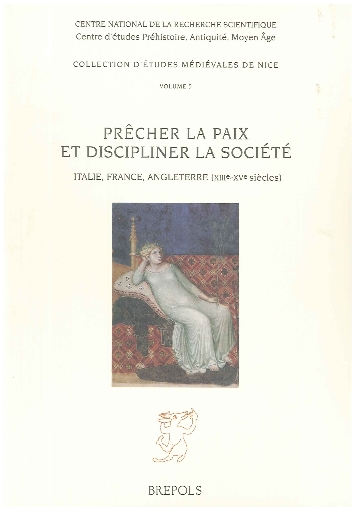
Prêcher la paix et discipliner la société
Italie, France, Angleterre (XIIIe-XVe siècles)
show More to view fulltext, buy and share links for:Prêcher la paix et discipliner la société show Less to hide fulltext, buy and share links for: Prêcher la paix et discipliner la sociétéLa paix donnée par le Christ aux fidèles selon le verset de Jean (14, 27) — «Je vous laisse la paix, je vous donne ma paix» — fut envisagée, au Moyen Âge, en fonction de la capacité qu’avaient les hommes de l’établir au sein de la société et de la sauvegarder. La paix était étroitement liée à une théologie de la domination, renvoyant à Dieu tout en servant de fondement à divers modèles d’autorité et d’obéissance.
C’est de cette paix prêchée pour discipliner et ordonner la société qu’il est surtout question dans ce livre, qui s’ouvre par une étude sur le sens et les usages des concepts de paix et de guerre entre l’Antiquité classique et l’Empire chrétien. La période envisagée ensuite — xiii e-xv e siècles — est celle du renforcement, en Europe occidentale, des institutions urbaines, de la monarchie et de la papauté.
Les études réunies ici ne se limitent pas aux productions savantes; elles tentent aussi de comprendre les relations entre idéologie et pratiques sociales, entre propagande et réception, entre discours et mécanismes de discipline sociale, entre prédication et mouvements collectifs, en observant comment les éléments majeurs énoncés dans les traités se sont glissés dans la parole publique.
À une époque où l’on assiste à l’essor de toutes sortes de prises de parole et à un certain impérialisme de la prédication, le discours sur la paix pose la question des modalités de la rencontre des champs ecclésiastique et laïque dans ce genre de discours: quant au statut des personnes qui prennent la parole (clercs ou laïcs), aux lieux (l’église, la place publique, le conseil urbain, le parlement), aux formes (le sermon ou la harangue), à la langue (latin ou vulgaire), ou encore aux sources (références aux Anciens et à l’Écriture).
-
-
-
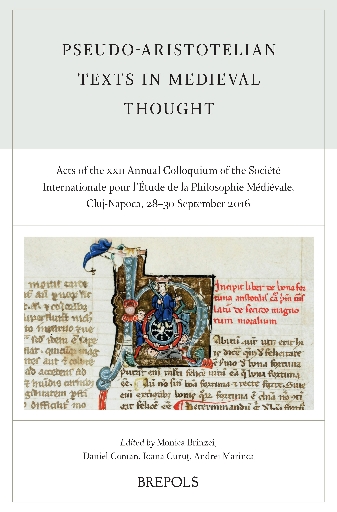
Pseudo-Aristotelian Texts in Medieval Thought
Acts of the XXII Annual Colloquium of the Société Internationale pour l’Étude de la Philosophie Médiévale, Cluj-Napoca, 28–30 September 2016
show More to view fulltext, buy and share links for:Pseudo-Aristotelian Texts in Medieval Thought show Less to hide fulltext, buy and share links for: Pseudo-Aristotelian Texts in Medieval ThoughtThe Philosopher, the Master of Those Who Know, was the dominant pagan authority in all four of the main traditions of medieval philosophy: Arabic, Greek, Hebrew, and Latin. Yet we now know that a number of works attributed to Aristotle were in fact spurious, authored by others who claimed to be, or whom others claimed to be, the Stagirite, for example, the Secretum secretorum, the Liber de causis, De mundo, De proprietatibus elementorum, De pomo, and De plantis. These writings strongly impacted medieval thought in various and fascinating ways, both in the original language, be it Arabic, Greek, Hebrew or Latin, and in translation. The mechanisms of their production, dissemination, and translation are themselves worthy of attention. Many of these works spawned commentary traditions of their own, parallel to those involving the classic texts of Peripatetic philosophy. Apparent contradictions between ideas expressed in these treatises and those found in what we consider to be authentic works, for instance ideas that appeared to derive more from the Academy than from the Lyceum, provoked questions about authenticity and about the possible evolution of Aristotle’s thought. Finally, these texts were employed in one way or another in many genres of philosophical literature in the Middle Ages, including metaphysics, natural and moral philosophy, theology, and even more exotic disciplines like chiromancy and alchemy. This volume aims to shed new light on various aspects of the history of Pseudo-Aristotelian texts in the Middle Ages.
-
-
-
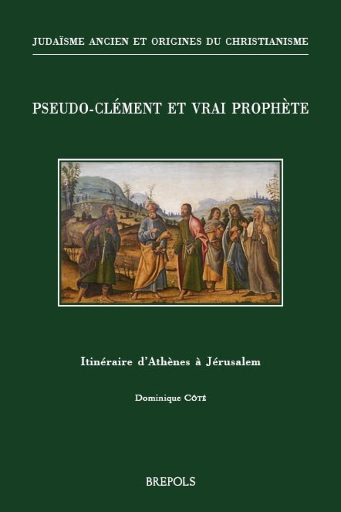
Pseudo-Clément et Vrai Prophète
Itinéraire d’Athènes à Jérusalem
show More to view fulltext, buy and share links for:Pseudo-Clément et Vrai Prophète show Less to hide fulltext, buy and share links for: Pseudo-Clément et Vrai ProphèteLes personnages historiques que sont Clément de Rome, Simon le Magicien, Pierre l’Apôtre et Apion le grammairien deviennent, dans les Reconnaissances de Clément, les personnages d’une fiction romanesque. Rufin d’Aquilée, à la fin du iv e iècle, nous apprend qu’il existait de son temps deux versions de ces Reconnaissances dans lesquelles discussions philosophiques et rebondissements de l’intrigue visaient le même but : démontrer la supériorité de la vérité prophétique sur celle des philosophes et des autres tenants de la culture grecque. Les études que regroupe ce volume propose une analyse du roman de Clément dans sa composition littéraire et dans son contexte culturel et religieux. On y aborde tout d’abord la question des rapports du texte clémentin avec la paideia, dans les études qui portent sur la discussion entre Clément de Rome et Apion d’Alexandrie. C’est la nature littéraire du corpus qui occupe ensuite la partie centrale du recueil. On s’intéresse aussi à la relation qu’entretient le texte avec la philosophie et ses représentations, dans les chapitres qui cherchent à comprendre l’opposition entre Pierre et Simon. C’est enfin la dimension judéenne du texte qui fait l’objet d’une série d’études qui traitent de prophétie, de mystique et d’identité religieuse.
-
-
-
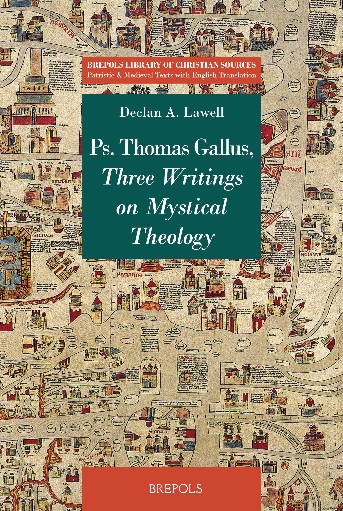
Pseudo-Thomas Gallus, Three Writings on Mystical Theology
show More to view fulltext, buy and share links for:Pseudo-Thomas Gallus, Three Writings on Mystical Theology show Less to hide fulltext, buy and share links for: Pseudo-Thomas Gallus, Three Writings on Mystical TheologyThis volume contains a newly-edited exposition on the Mystical Theology contained in MS UV6 of the Biblioteca degli Intronati in Siena. The MS attributes the work to the abbot of Vercelli (Thomas Gallus), but this is shown to be a false attribution. A commentary on the Canticle of Canticles has also been attributed to Thomas Gallus but argued against by J. Barbet in Brepols' SRSA volume 10 (2005). This commentary is reprinted and accompanied with the first ever English translation. A treatise on the Seven Steps to Contemplation in Latin with an English translation is the third text. An introductory critical study evaluates all three works and argues that they all belong to the same author, pseudo-Thomas Gallus.
-
-
-
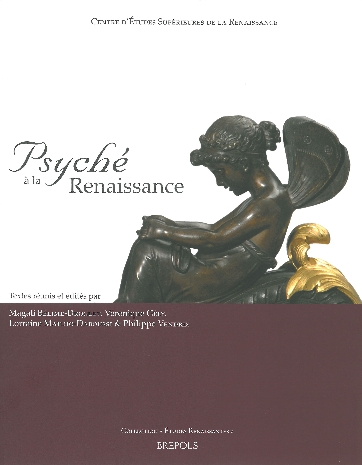
Psyché à la Renaissance
show More to view fulltext, buy and share links for:Psyché à la Renaissance show Less to hide fulltext, buy and share links for: Psyché à la RenaissanceEntre la redécouverte au XIVe siècle du texte des Métamorphoses d'Apulée par Zanobi da Strada et Boccace puis la publication des Amours de Psyché et Cupidon de La Fontaine en 1669, suivis de la tragédie-ballet de Molière, Corneille et Quinault en 1671, la fable de Psyché investit tous les domaines de la littérature, de la philosophie, des arts scéniques et décoratifs, et triomphe dans la société de cour.
Plusieurs publications récentes ont été consacrées à la postérité d'Apulée et à celle de ce récit, les unes dans le domaine de l'histoire de l'art, les autres dans celui de la littérature. La présentation au château d'Azay-le-Rideau, en 2009, d'une exposition originale centrée sur les interprétations de la fable de Psyché dans l'art français à partir de la Renaissance a été l'occasion de confronter ces travaux et d'offrir à la recherche des perspectives nouvelles.
Ce volume, tout en ouvrant sur le devenir du thème jusqu'à l'époque contemporaine, se consacre donc à l'étude d'un processus exemplaire de l'humanisme renaissant : celui par lequel les temps modernes s'approprient un texte antique mal connu pendant le Moyen Âge. La fable de Psyché, contemporaine de la christianisation de l'Empire Romain et tôt christianisée elle-même, offrait à la Renaissance une métaphysique platonicienne, une éducation sentimentale, une mise en scène de la curiosité, et une forme narrative propres à nourrir les réflexions nouvelles sur la notion de sujet et sur les pouvoirs de la fiction.
-
-
-
Ptolemy’s Science of the Stars in the Middle Ages
show More to view fulltext, buy and share links for:Ptolemy’s Science of the Stars in the Middle Ages show Less to hide fulltext, buy and share links for: Ptolemy’s Science of the Stars in the Middle AgesClaudius Ptolemy (c. 100-170 ad) is one of the most influential scholars of all time. While he is also the author of treatises on geography, optics and harmonics, his fame primarily stems from two works on the science of the stars, dealing with mathematical astronomy (the Almagest) and astrology (the Tetrabiblos). The Almagest and the Tetrabiblos remained the fundamental texts on the science of the stars for some 1500 years. Both were translated several times into Arabic and Latin and were heavily commented upon, glossed, discussed, and also criticised and improved upon, in the Islamic world and in Christian Europe. Yet, the reception of Ptolemy in medieval cultures is still to a large extent a terra incognita of the history of science. The Arabic and Latin versions of the Almagest and the Tetrabiblos are for the most part unavailable in modern editions, their manuscripts remain largely unexplored and, generally speaking, their history has never been systematically investigated.
This volume gathers together fifteen contributions dealing with various aspects of the reception of Ptolemy’s astronomy and astrology in the Islamic world and in Christian Europe up to the seventeenth century. Contributions are by José Bellver, Jean-Patrice Boudet, Josep Casulleras, Bojidar Dimitrov, Dirk Grupe, Paul Hullmeine, Alexander Jones, Richard L. Kremer, Y. Tzvi Langermann, H. Darrel Rutkin, Michael H. Shank, Nathan Sidoli, Carlos Steel, Johannes Thomann and Henry Zepeda.
-
-
-
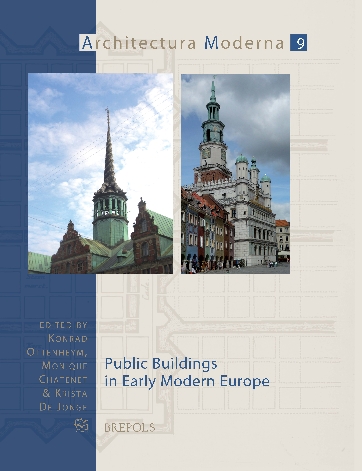
Public Buildings in Early Modern Europe
show More to view fulltext, buy and share links for:Public Buildings in Early Modern Europe show Less to hide fulltext, buy and share links for: Public Buildings in Early Modern EuropeIn the early modern European city, public buildings were the main pillars of the political, mercantile and social infrastructure. In a first attempt to create a preliminary overview of current knowledge in various European countries, the IIIe and Ve Rencontres d’Architecture Européenne, held in 2006 and 2008 at Utrecht University, The Netherlands, in cooperation with the Centre André Chastel, Paris, were dedicated to this subject. In these two meetings, architectural historians from all over Europe discussed the results of their research on the development of various types of public building in the various European regions between the late fifteenth and mid-eighteenth century. This publication brings together most of the contributions to these two conferences, subdivided into three categories:
buildings erected for government and justice
buildings serving mercantile functions
buildings for education, health and social care.
Konrad Ottenheym is professor of Architectural History at Utrecht University.
Monique Chatenet is senior researcher at the Centre André Chastel/Sorbonne Paris-IV, Paris.
Krista De Jonge is professor of Architectural History at the Catholic University Leuven.
-
-
-
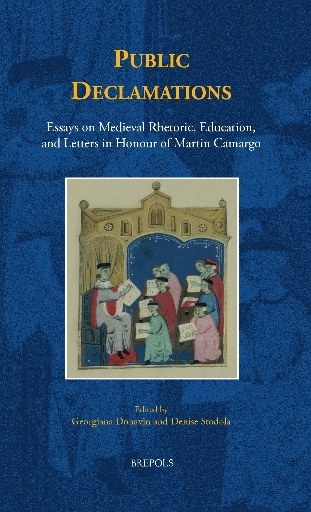
Public Declamations
Essays on Medieval Rhetoric, Education, and Letters in Honor of Martin Camargo
show More to view fulltext, buy and share links for:Public Declamations show Less to hide fulltext, buy and share links for: Public DeclamationsMartin Camargo, Professor of English, Medieval Studies, and Classics at the University of Illinois at Urbana-Champaign, is a beloved teacher, mentor, colleague, and the scholar whose work this collection celebrates. With interests in defining ‘medieval rhetoric’, understanding the history of both literary and bureaucratic epistles, explaining the revival of rhetorical studies in fourteenth-century England, editing texts for teaching the trivium, and excavating performance pedagogies in medieval language classrooms, Carmago has paved the way for scholars in many fields, including educational and institutional history; literature, language, and manuscript studies; and rhetoric in the Middle Ages.
This book pays tribute to his own ground-breaking research by presenting original and inventive new work in many of these fields. Authored by established scholars and innovative new researchers alike, the essays contained in this volume give significant scope to didactic medieval commentaries, theories of medieval rhetoric and language, literary epistles and the ars dictaminis, and poetry of various genres including romances and riddles, as well as to the classroom practices that all of these investigations infer. In keeping with Camargo’s generosity in sharing resources, the authors hope that their essays in turn will provide encouragement and suggestions for further work.
-
-
-
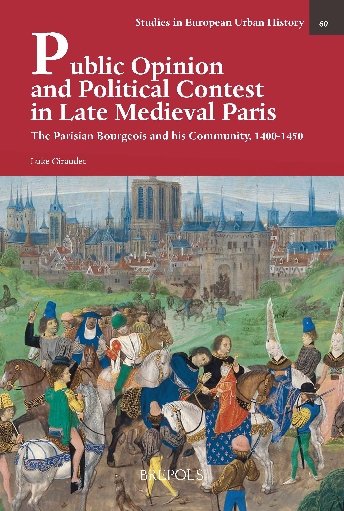
Public Opinion and Political Contest in Late Medieval Paris
The Parisian Bourgeois and his Community, 1400-50
show More to view fulltext, buy and share links for:Public Opinion and Political Contest in Late Medieval Paris show Less to hide fulltext, buy and share links for: Public Opinion and Political Contest in Late Medieval ParisPublic Opinion and Political Contest presents an important historiographical intervention regarding the emergence of larger political publics during the fifteenth century. The study analyses political interaction and public opinion in medieval Europe’s largest city through the lens of the only continuous narrative source compiled in Paris during the early fifteenth century, the well-known Journal d’un bourgeois de Paris. Examining one of the most turbulent periods in Paris’ history, which witnessed civil conflict and English occupation, the monograph contributes substantially to understandings of late medieval popular opinion conceptually and empirically, revealing Parisian groups bound by shared idioms and assumptions engaging with supralocal movements. Through an assessment of contemporary reactions to official communication, protest in public space, rumour and civic ceremony, the book presents a timely mirror to themes in flux today, addressing historiographical conclusions that have relegated premodern societies from considerations of the public sphere. As a result, this nuanced assessment of the Journal d’un bourgeois de Paris reveals how access to informational media and forums for discussion bound Parisians and framed a wider commentary upon political issues beyond the highest echelons of medieval society.
-
-
-
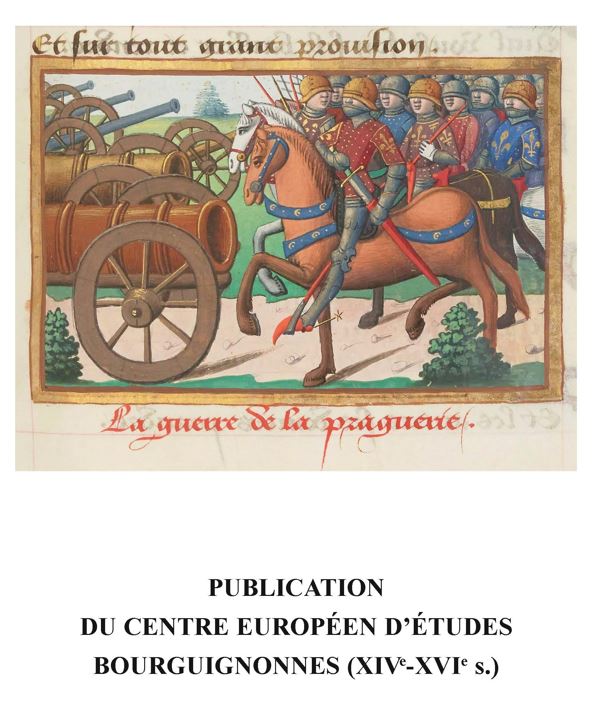
Publications du Centre Européen d'Etudes Bourguignonnes (XIV-XVIe s.)
show More to view fulltext, buy and share links for:Publications du Centre Européen d'Etudes Bourguignonnes (XIV-XVIe s.) show Less to hide fulltext, buy and share links for: Publications du Centre Européen d'Etudes Bourguignonnes (XIV-XVIe s.)Depuis près de cinquante ans, le Centre européen d‘études bourguignonnes (XIVe-XVIe siècles) – jusqu’en 1984 Centre européen d‘études burgondo-médianes – publie annuellement les actes des rencontres scientifiques qu’il organise dans une ville de l’espace géographique couvert par ses travaux. Ses objectifs sont, selon les termes mêmes de ses statuts, la promotion, l’encouragement et la coordination des études historiques relatives à l’époque des ducs de Bourgogne de la Maison de Valois et des premiers Habsbourg, entre Mer du Nord, système fluvial Rhin-Danube et Méditerranée. Les thèmes des rencontres relèvent des divers aspects du passé de ces contrées, en mettant l’accent sur les relations politiques, économiques, culturelles, spirituelles qu’elles entretenaient entre elles. En raison de leur caractère international et plurilingue (français, allemand, anglais, italien), les volumes de la collection trouvent une place de choix dans la bibliographie des études consacrées à cette période de l’histoire qui marque la transition entre Moyen Âge et Renaissance en Occident.
More information about this journal on Brepols.net
-
-
-
Puissances divines à l’épreuve du comparatisme
constructions, variations et réseaux relationnels
show More to view fulltext, buy and share links for:Puissances divines à l’épreuve du comparatisme show Less to hide fulltext, buy and share links for: Puissances divines à l’épreuve du comparatisme«Les dieux helléniques sont des Puissances, non des personnes. La pensée religieuse répond aux problèmes d'organisation et de classification des Puissances. » En partant de ce texte de Jean-Pierre Vernant et en intégrant les perspectives nouvelles issues des travaux des historiens et des anthropologues du religieux, ce livre explore de façon comparatiste, et sans partir de modèles préalables, la pertinence de cette proposition. Il soulève deux questions aussi simples que redoutables : qu’est-ce qu’une puissance divine ? Comment la conçoit-on et l’inscrit-on dans le temps, dans l’espace, dans des réseaux relationnels ? La réflexion s'organise autour de deux axes : étude de la terminologie relative à la puissance divine et des modalités de son expression à travers les images, les textes et les pratiques rituelles ; analyse des modes de construction des puissances et des réseaux dans lesquels elles s'inscrivent. Ce livre pénètre ainsi au cœur même de la fabrique du divin et des structures qui l’organisent, en contexte polythéiste comme monothéiste. Centré sur le système de pensée des Grecs et des Romains, il s’attache aussi à le mettre en regard avec d’autres aires culturelles de l’Antiquité (Égypte, Mésopotamie, Israël) et avec des sociétés qu’étudient aujourd’hui les anthropologues.
-
-
-
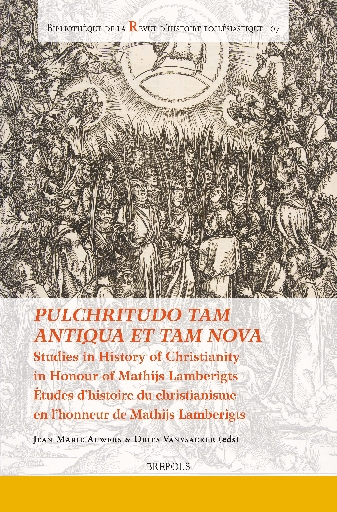
Pulchritudo tam antiqua et tam nova
Studies in History of Christianity in Honour of Mathijs Lamberigts
show More to view fulltext, buy and share links for:Pulchritudo tam antiqua et tam nova show Less to hide fulltext, buy and share links for: Pulchritudo tam antiqua et tam novaThis volume contains twenty-two articles that colleagues and friends of Mathijs Lamberigts, Dean of the Faculty of Theology at KULeuven and Director of the Revue d’histoire ecclésiastique - Louvain Journal Church History, offer him for his 65th birthday. These articles cover all periods in the history of Christianity, from the apocrypha on Saint Matthew to contemporary Christianity, and focus on themes dear to the dedicatee (Pelagianism, Julian of Eclan, Christianity in Flanders, the Louvain’ tradition, the Second Vatican Council).
-
-
-

Pursuing Middle English Manuscripts and their Texts
Essays in Honour of Ralph Hanna
show More to view fulltext, buy and share links for:Pursuing Middle English Manuscripts and their Texts show Less to hide fulltext, buy and share links for: Pursuing Middle English Manuscripts and their TextsThis volume brings together essays by leading authorities on the production, reception, and editing of medieval English manuscripts in honour of Ralph Hanna, on the occasion of his retirement as Professor of Palaeography at the University of Oxford. Ralph Hanna has made an enormous contribution to the study of Middle English manuscripts; his numerous essays and books have discussed the development of London literature, alliterative poetry (especially Piers Plowman), regionalism, and the production and circulation of manuscripts. The essays included in this volume are arranged into four major sections corresponding to Ralph Hanna’s core areas of interest: Manuscript production; Dialect; Regionalism; Reading and Editing manuscripts.
These essays, written by leading scholars in their fields, offer new insights into the manuscripts of major Middle English writers and on scribal practice, as well as studies of individual codices. Essays cover a wide regional and chronological range, stretching from the beginnings of London literature traced in the works of Peter of Cornwall to the circulation of John Lydgate’s Troy Book, and encompassing manuscripts and texts composed and circulated outside the capital. Dialectal studies offer reconsiderations of the evidence for a Wycliffite orthography, the dialect of William Langland, and the vocabulary of the alliterative Morte Arthure. A final section on reading and editing investigates the structure and divisions in the manuscripts of the A Version of Piers Plowman, and examines specific readings in the Prick of Conscience and the Canterbury Tales. The volume also includes a tribute to Ralph Hanna and a list of his extensive publications.
-
-
-
Pursuing a New Order I.
Religious Education in Late Medieval Central and Eastern Central Europe
show More to view fulltext, buy and share links for:Pursuing a New Order I. show Less to hide fulltext, buy and share links for: Pursuing a New Order I.Concentrating on the period of the emergence of the vernaculars in the context of religious text production in Central and Eastern Central Europe from the fourteenth to the sixteenth centuries, the individual studies in this volume present material so far neglected by nationally defined historiographies and literary studies. The process of vernacularization created a new sociolinguistic field for the negotiation of social order through the choice of texts and topics. This volume seeks to answer the questions of whether, why and how distinctive new communicative, literary, and political cultures developed after the vernacular languages had acquired ever higher levels of literacy and education. The volume fills a gap in contemporary scholarship on the role of the vernaculars and vernacular literatures in European medieval societies and with the focus on Eastern European regions it breaks new ground in regard to questions that have so far only been explored on the basis of material from Europe’s ‘West’.
-
-
-
Pursuing a New Order II.
Late Medieval Vernacularization and the Bohemian Reformation
show More to view fulltext, buy and share links for:Pursuing a New Order II. show Less to hide fulltext, buy and share links for: Pursuing a New Order II.In the first two decades of the fifteenth century, the Hussite religious reform movement emerged in Bohemia; it used one of the realm's vernacular languages, Czech, both to disseminate its reform ideas, and to establish strong foundations for the reform. The vernacular became a significant strategy for identification, capable of binding together disconnected religious, ethnic, political and regional identities and generating a very potent aggregate of identifications. This volume considers material from the second half of the fourteenth century to the first half of the sixteenth, beginning with the so-called Hussite ‘forerunners’ and ending with the early German reformation. Individual essays discuss the various functions of the vernaculars in different text types, social situations and religious and political contexts. Together, they correct former assumptions about the topic and provide a basis for further study of Hussite vernacular theology and contribute to the transformation of scholarly narratives about the Hussite movement by including works of vernacular religious education among the most important source material. It offers a basis for the comparative research on the role of the vernaculars in late medieval European religious reform movements.
-
-
-
Pêche et pisciculture dans les eaux princières en Franche-Comté aux XIVe et XVe siècles
show More to view fulltext, buy and share links for:Pêche et pisciculture dans les eaux princières en Franche-Comté aux XIVe et XVe siècles show Less to hide fulltext, buy and share links for: Pêche et pisciculture dans les eaux princières en Franche-Comté aux XIVe et XVe sièclesParmi tous les éléments qui composaient le domaine des comtes de Bourgogne au bas Moyen Âge, les eaux vives et les étangs formaient un ensemble non négligeable, le poisson d’eau douce étant particulièrement recherché. C’est pour mieux mettre en valeur cette partie spécifique de ses propriétés en Franche-Comté que le duc-comte Eudes IV (1330-1349) créa un office nouveau : la gruerie, chargée d’administrer et de gérer les eaux et forêts domaniales.
La comptabilité de l’institution révèle que les rivières ne furent pas toutes prises en charge par le gruyer, d’où l’examen des comptes des autres officiers domaniaux. Dans tous les cas, les eaux vives donnèrent lieu à des amodiations, dont seuls les amodiataires et les revenus sont connus. Le recours aux chartes de franchises permet de mieux percevoir les rapports entre les sujets du prince et le milieu aquatique.
Des étangs les textes décrivent avec précision la structure, la pêche et la vente du poisson. Parmi les réserves piscicoles, il y avait des plans d’eau destinés à la reproduction, d’où le titre de pisciculture utilisé dans le titre de ce livre.
L’ouvrage se termine par une analyse des « mesus » (délits) perpétrés dans les eaux comtales, curieusement inclus dans le poste des « amendes des bois banaux ».
Au total cette étude forme le second volet d’un triptyque consacré aux eaux et forêts princières dans le comté de Bourgogne aux XIVe et XVe siècles. Elle fait suite logiquement à la description de l’office de gruerie en montrant son application aux eaux courantes et " stagnantes " (les étangs), c’est-à-dire deux milieux halieutiques très différents puisque le premier, à l’état naturel, s’oppose aux réserves piscicoles construites par les hommes.
-
-
-
Quaestio
Annuario di storia della metafisica / Cahiers d'histoire de la métaphysique / Jahrbuch für die Geschichte der Metaphysik / Journal of the History of Metaphysics
show More to view fulltext, buy and share links for:Quaestio show Less to hide fulltext, buy and share links for: QuaestioQuaestio is dedicated to the reconstruction of the history of important concepts and themes of the metaphysical tradition. It aims at examining their ancient or medieval origins and their reception, transformation or rejection in modern and contemporary philosophy. This journal mainly focuses on the transition from medieval philosophy to the early modern period and covers numerous concepts (like cause, substance...) as well as the discussion of other disciplines at the boundaries of metaphysics itself.
More information about this journal on Brepols.net
-
-
-
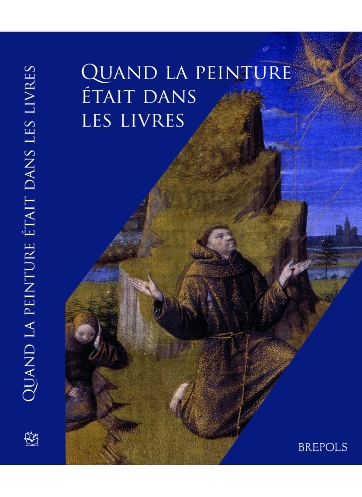
Quand la peinture était dans les livres
Mélanges en l’honneur de François Avril
-
-
-

Quand les auteurs étaient des nains
Stratégies auctoriales des traducteurs français de la fin du Moyen Âge
show More to view fulltext, buy and share links for:Quand les auteurs étaient des nains show Less to hide fulltext, buy and share links for: Quand les auteurs étaient des nainsDepuis quelques dizaines d’années, l’avènement de l’individualité de l’auteur médiéval à la fin du Moyen Âge et l’émergence de stratégies auctoriales destinées à construire et à afficher une figure d’auteur dans l’espace du texte et du manuscrit ont (re)fait l’objet d’une attention soutenue de la critique. Étonnamment, alors que ce processus coïncide avec l’essor des traductions savantes d’autorités latines, la critique n’a guère considéré à sa juste valeur les stratégies auctoriales des traducteurs français des XIVe et XVe siècles, jugés comme un « corps » et corpus à la frontière du champ littéraire et de ses enjeux. Pourtant, les études sur les traductions modernes et pré-modernes ont depuis longtemps entrepris un travail historiographique destiné à revaloriser la figure du traducteur comme une figure auctoriale au sens plein et à part entière du champ littéraire. Dans cette démarche de revalorisation, le corpus médiéval a été négligé. Les contributions réunies ici visent à étudier la figure d’auteur des traducteurs français des XIVe et XVe siècles et sa mise en œuvre textuelle et matérielle afin de déterminer les continuités et les ruptures entre leurs stratégies auctoriales et celles des autres auteurs du même champ littéraire.
-
-
-
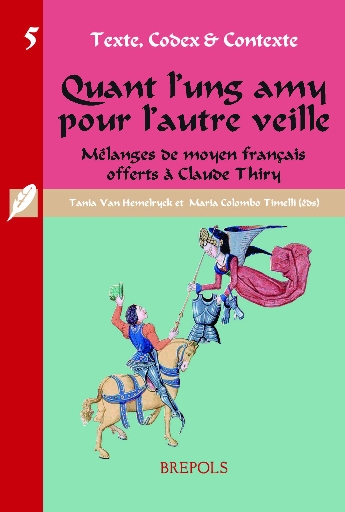
Quant l’ung amy pour l’autre veille
Mélanges de moyen français offerts à Claude Thiry
show More to view fulltext, buy and share links for:Quant l’ung amy pour l’autre veille show Less to hide fulltext, buy and share links for: Quant l’ung amy pour l’autre veilleEn hommage à Claude Thiry et dans le but de faire progresser les connaissances dans un domaine dont il est un éminent spécialiste, ce volume réunit une quarantaine d’études toutes centrées sur le moyen français.
En écho à la richesse des travaux du dédicataire, ces contributions se déploient selon six axes: les richesses de la langue, les formes de la prose, la diversité de la production poétique, l’historiographie princière, les œuvres de théâtre, les questions liées à l’édition de textes.
Tant par la variété des sujets traités que par la diversité des approches, ce livre constitue une contribution importante à ce vaste champ de recherche qu’est devenu le français des XIVe-XVIe siècles.
-
-
-
Quasi aurora consurgens
The Victorine theological anthropology and its decline
show More to view fulltext, buy and share links for:Quasi aurora consurgens show Less to hide fulltext, buy and share links for: Quasi aurora consurgensThe present work tries to set the Victorine theological anthropology in the context of doctrinal history. In the twelfth century, the canons of Saint-Victor formed the single largest community of theologians with the most extensive literary legacy. But is there a distinctive, characteristically Victorine model of theological anthropology? The first half of the present volume investigates this question through a close reading of the works of Hugh, Richard, Walter and Achard, and concludes with a positive answer. In a period of theological experimentation Hugh of Saint-Victor elaborated, through selectively reading and altering Patristic sources, his own model of theological anthropology. Its principles and concepts also appear in the spiritual works of other Victorine authors and set the Victorines apart from other spiritualities of the period. The second half of the work investigates the immediate, thirteenth-century reception of this model. That scholastic authors held Hugh and Richard in high regard is well-known, but a closer investigation reveals a different picture. The testimony of various theological sources (from Sentences glosses and commentaries, to spiritual works) shows that thirteenth-century theologians have already found elements of the Victorine anthropology either untenable or unintelligible,as their reaction varies from explicit rejection to selective reading and reinterpretation. This transition from acceptable and inspirative to problematic occurred in less than a century’s time, and still influences the way Victorine texts are read. Thus, considering a twelfth-century model, together with all of its necessary distortions, in thirteenth-century interpretations, may give us a better understanding of the limitations and potentials of the Victorine theology.
-
-
-
Quatorze proses du XIIe siècle à la louange de Marie
show More to view fulltext, buy and share links for:Quatorze proses du XIIe siècle à la louange de Marie show Less to hide fulltext, buy and share links for: Quatorze proses du XIIe siècle à la louange de MarieChoisies parmi les nombreux chants liturgiques composés au Moyen Age en l'honneur de Marie, quatorze proses parisiennes du XIIe siècle sont ici présentées, accompagnées d'une traduction française littérale. Elles appartiennent au groupe des remarquables séquences rimées et rythmées qui apparaissent vers cette époque, associées au nom du célèbre poète-compositeur Adam, chanoine à l'abbaye de Saint-Victor de Paris. Elles chantent le Verbe du Père prenant chair dans le sein de la Vierge, elles louent Marie en raison de sa maternité virginale, de sa saintete et de la maternité spirituelle qu 'elle exerce à notre égard pour nous joindre à son Fils. Elles n'oublient pas l'existence de l'Ennemi, notre état de misére et notr besoin de salut.
Un symbolisme traditionnel, en grande partie d'origine biblique, se déploie en ces proses: il contribue à leur beauté et fait partie intégrante du riche enseignement doctrinal et spirituel dont elles sont porteuses. L'étude des sources possibles des reuvres étudiées, comme celle du contexte dans lequel elles ont été écrites, mettent en évidence l'influence profonde de l'Ecriture et de la liturgie, ains que les ressemblances entre la langue de ces poèmes et celle de nombreux textes anciens et mediévaux.
-
-
-
Queritur utrum
Recherches sur la 'disputatio' dans les universités médiévales
show More to view fulltext, buy and share links for:Queritur utrum show Less to hide fulltext, buy and share links for: Queritur utrumCe volume présente le troisième volet d’une enquête sur la disputatio dans les universités médiévales. Le premier, paru en 1995, traitait la dispute à la Faculté des arts à Paris au XIIIe siècle ; dans le deuxième, paru en 2002, le champ géographique et chronologique était élargi aux facultés des arts en Europe occidentale jusqu’à la fin du moyen âge. Cette troisième partie propose une comparaison entre la disputatio dans les facultés des arts et celle pratiquée dans les autres facultés. Cette comparaison n’avait pas été faite lors de la publication du volume sur Les questions disputées et les questions quodlibétiques dans les Facultés de théologie, de droit et de médecine, paru en 1985 dans la collection Typologie des sources du Moyen Age occidental.
Comme dans les deux précédentes publications sur la disputatio, on trouvera ici la documentation nécessaire pour comprendre le caractère et le fonctionnement de cet outil intellectuel dans les diverses facultés des universités médiévales. Cette documentation est forcément limitée : le nombre de textes de questions disputées qui a été conservé est immense, seule une partie a été éditée et les manuscrits sont souvent difficiles à lire. Il a donc fallu faire un choix, guidé par les publications récentes et en espérant que les textes choisis sont représentatifs.
Comme dans le second livre de cette série (la disputatio dans les facultés des arts), le présent volume comprend en principe l’ensemble de la période médiévale, depuis l’apparition des questions disputées dans les diverses disciplines jusqu’au XVe siècle.
Une histoire plus générale, remontant plus haut dans le temps et se prolongeant plus tard, reste encore à faire. En attendant qu’il le soit, ce volume montre qu’avant la déchéance qu’elle a connue vers la fin du moyen âge, la disputatio, loin d’être une technique uniforme et figée, fut un formidable instrument de recherche et d’enseignement. C’est en grande partie grâce à elle que les intellectuels ont appris à analyser et à raisonner selon un modèle qui permettait de comprendre toutes les facettes d’un problème et d’aller toujours plus loin dans la recherche de la vérité.
-
-
-
Questioning the World
Greek Patristic and Byzantine Question-and-Answer Literature
show More to view fulltext, buy and share links for:Questioning the World show Less to hide fulltext, buy and share links for: Questioning the WorldThis volume discusses cosmological issues in Greek Patristic and Byzantine question-and-answer literature. By adopting this focus, it yields novel insights into both the (theological / philosophical) content and the (literary) form of the texts under scrutiny. How did Greek Patristic and Byzantine authors understand the cosmos of which they were a part and the world in which they lived? And what literary forms did they use to express their questions and answers on these issues? This collection of studies shows that, in order to bring out the important intellectual contribution of the authors under discussion, both ‘cosmology’ and ‘question-and-answer literature’ should be defined more broadly than expected. Several papers deal with the crucial corpora by Pseudo-Justin and Maximus the Confessor. Other authors under discussion include Philoponus, Pseudo-Caesarius, Michael Psellus, Severian of Gabala, and Nilus Doxopatres. Attention also goes to the critical edition of question-and-answer literature, as well as to the Greek Patristic and Byzantine reception of cosmological questions and answers from Antiquity (i.c. Aristotle, Philo of Alexandria, Plutarch, and Iamblichus).
-
-
-
Questions and Answers
show More to view fulltext, buy and share links for:Questions and Answers show Less to hide fulltext, buy and share links for: Questions and AnswersThe Questions and Answers, presented here for the first time in an English version, form a surprising text. Although put together some thirteen centuries ago (c. 700 A.D.), in what was then a territory newly overrun by Moslem invaders, they retain an astonishing topicality: many of the questions asked at that time by people who had problems with religious beliefs and practices are still being asked today. Anastasios, the person who tried to help people with his replies was linked to the isolated desert monastery of Sinai, founded near the tip of the Arabian peninsula by the great Justinian, probably for strategic defensive reasons as well as out of religious piety. Such a mixture of politics and religion is easy to appreciate today. Anastasios himself does not seem to have lived in any ivory-tower. He toured what is now Egypt and Palestine, preaching and taking part in the religious discussions dividing Christians. His numerous contacts were probably the source of the queries that reached him, and with his obvious delight in writing, he gladly penned replies that are models of pastoral moderation and good sense. The themes that surface have much to do with everyday life: trying to please God while living in a world where family obligations and business interests often leave one perplexed. In the historical background are the Moslems creating very harsh conditions for many Christians, while in the cultural background are the ways of thought that dominated medical and scientific thinking: the four elements that work as instruments of God; the biblical texts that have to be interpreted with common sense; the political and ecclesiastical institutions that need to be respected but not idolized. The danger with such a translation is that it may blur the profound differences that separate us from those who asked the questions then. But on the other hand many will discover with pleasure the common humanity that allows us to listen today with sympathy and understanding to such far-off voices.
The source text of this volume appeared in Corpus Christianorum Series Graeca as Anastasius Sinaita - Quaestiones et responsiones (CCSG 59). References to the corresponding pages of the edition are provided in the margins of this translation.
Dr Joseph A. Munitiz was a founder member of the team that launched the Corpus Christianorum Greek Series in 1976, and contributed three volumes to the series, while also Master of Campion Hall, the Jesuit house of studies in Oxford, and later a Research Fellow of Birmingham University.
-
-
-
Qui a peur du cannibale ?
Récits antiques d'anthropophages aux frontières de l'humanité
show More to view fulltext, buy and share links for:Qui a peur du cannibale ? show Less to hide fulltext, buy and share links for: Qui a peur du cannibale ?Parmi les monstres qui nous remplissent de terreur tout autant qu'ils nous fascinent, l'anthropophage et le cannibale occupent une place d'honneur. Or, cette fascination mêlée de terreur - ou terreur mêlée de fascination - ne date pas d'hier. Dans l'Antiquité déjà, ceux qui se livraient à des actes gravement répréhensibles - conspiration et rébellion, banditisme, parricide, inceste ou pratique des rites pervertis - furent souvent soupçonnés de cannibalisme. La chrétienté de l'Empire romain fut confrontée à ces soupçons pendant les deux premiers siècles de son existence; les prétendus sorciers et les hérétiques pendant tout le Moyen Âge; quant aux Juifs, ils en firent les frais jusqu'au siècle dernier. Pourquoi l'anthropophagie éveille-t-elle tant d'émotion, tant de haine? Pourquoi ce paradigme est-il capable de décrire la peur, le sentiment de danger que l'Autre suscite en nous-mêmes? Le présent livre propose des éléments de réponse par l'analyse des récits antiques d’anthropophages. Le lecteur suivra le chemin qu'a parcouru le motif de l'anthropophagie, de simple marqueur d'identité - puis signe d'exclusion -, jusqu'à devenir une véritable arme fatale contre ceux dont les idées et le mode de vie auraient pu mettre en danger l'ordre établi; il sera également témoin du processus par lequel les exclus, eux-mêmes, s'appropriaient la figure de l'anthropophage pour renverser la situation. Le voyage durera plus de mille ans et aura pour cadre la Grèce des cités, les royaumes hellénistiques, puis l'Empire romain, pour faire une escale en Israël et une brève excursion vers la Mésopotamie avant d’arriver à la destination finale, l'Empire romain chrétien.
Agnès A. Nagy est historienne, spécialiste des religions de la Méditerranée ancienne. Sa thèse de doctorat en histoire des religions, dont le présent livre est issu, fut soutenue en juillet 2006 à l’Université de Genève, sous la direction de Philippe Borgeaud et Enrico Norelli. Après une année passée à l’Institut de Judaïstique de Vienne (Autriche) en tant que boursière du FNRS, et trois ans à la Faculté de Théologie et de Sciences des Religions à l’Université de Lausanne comme collaboratrice scientifique, elle participe actuellement à un projet de recherche centré sur les théories anciennes et modernes de la légitimation religieuse de la mise à mort, en collaboration avec Francesca Prescendi, à l’Université de Genève.
-
-
-

Qui nous délivrera du grand Alexandre le Grand
Alexandre tourné en dérision de l’Antiquité à l’époque moderne
show More to view fulltext, buy and share links for:Qui nous délivrera du grand Alexandre le Grand show Less to hide fulltext, buy and share links for: Qui nous délivrera du grand Alexandre le GrandBien que la dérision s’inscrive aux marges du corpus littéraire et artistique sur Alexandre, il existe une veine comique qui rabaisse le souverain le plus prestigieux de l’Antiquité, avec une tonalité joyeuse ou bien plus grave et accusatrice. Si elle ne cesse d’évoluer au fil des siècles tant le rire, l’irrévérence et la satire sont ancrés dans l’historicité, elle s’affirme, dans ses différentes incarnations esthétiques, comme un discours parallèle, un discours d’à côté, qui devient parfois un véritable contre-discours. L’objet de ce volume est ainsi d’entamer une analyse diachronique - qui n’a encore jamais été menée - des modes de dérision à l’encontre d’Alexandre et de ce qu’il incarne, de leurs significations et de leurs motivations. Comique divertissant, célébration paradoxale d’une icône de la royauté, satire politique de la mégalomanie et de l’autoritarisme, ou parodie révélatrice d’un rejet de conventions esthétiques et de leurs instrumentalisations politiques et culturelles : les écritures visuelles et textuelles de la dérision à l’encontre du grand Alexandre le Grand engagent tous ces aspects depuis l’Antiquité.
-
-
-
Quintilien ancien et moderne
Etudes réunies
show More to view fulltext, buy and share links for:Quintilien ancien et moderne show Less to hide fulltext, buy and share links for: Quintilien ancien et moderneQuintilien (Ier s.) a souvent souffert d’être comparé à l’un de ses grands modèles, Cicéron. On ne voit fréquemment dans l’Institution oratoire qu’une pâle reprise des réflexions et des préceptes du grand philosophe et orateur de la République romaine. Pourtant, le bienveillant maître de rhétorique, dont l’èthos de père, de professeur et de citoyen a souvent séduit la postérité plus que celui de Cicéron (dont la correspondance privée avait déçu maints humanistes), a exercé à sa manière une influence très importante et trop sous-estimée dans de très nombreux domaines de notre culture : rhétorique, poétique, pédagogie, morale, histoire de l’art, théâtre … C’est ce rayonnement fécond à travers les âges que les auteurs du présent volume ont tâché de faire ressortir. La première partie de l’ouvrage, consacrée à l’Antiquité, fait le point sur les dettes de Quintilien lui-même à l’égard de ses prédécesseurs grecs, de Cicéron, et sur certains aspects fondamentaux de sa doctrine qui seront retenus en priorité : la nécessité pour l’orateur d’être un vir bonus (conviction héritée et réinterprétée par Pline le Jeune, par exemple), l’extrême pragmatisme de sa méthode d’enseignement et l’importance, pour lui, des liens entre écriture et vision. La seconde partie du volume, qui s’étend au Moyen Âge (XIIe siècle) et à la Renaissance, aborde la manière dont le rhéteur a été considéré par Jean de Salisbury et Alain de Lille (XIIe s.), puis par Pétrarque, puis a influencé les pédagogues du Quattrocento, le « grammaticus » Lorenzo Valla, a intéressé l’important imprimeur parisien Josse Bade qui l’a édité en France, a servi de modèle aux arts poétiques latins de la Renaissance, avant d’être condamné pour sa théorie des affects par Pierre de la Ramée et réinterprété au début du XVIIe s. par Pierre de Deimier pour une redéfinition « moderne » de l’inventio. La dernière partie du volume étudie la présence de Quintilien à l’Âge classique, son impact sur la définition du « classicisme » et de la clarté, sur la construction du discours, comme sur l’expression des passions en peinture, ainsi que sa récupération par les rhétoriques post-tridentines.
les auteurs / Giovanni Baffetti, Emmanuel Bury, Gualtiero Calboli, Jean Ceard, Maria Silvana Celentano, Pierre Chiron, Sophie Conte, Perrine Galand, Christophe Gutbub, Francis Goyet, Fernand Hallyn, Laure Hermand-Schebat, Volker Kapp, Jean Lecointe, Virginie Leroux, Carlos Lévy, Ida Gilda Mastrorosa, Gabriella Moretti, John Nassichuk, Mariangela Regoliosi, Alexander Roose, Florent Rouillé, Marc van der Poel, Wim Verbaal.
-
-
-
Raban Maur et son temps
show More to view fulltext, buy and share links for:Raban Maur et son temps show Less to hide fulltext, buy and share links for: Raban Maur et son tempsLe colloque organisé à Lille et Amiens en 2006, à l’occasion du 1150e anniversaire de la mort de Raban Maur, complète une série de manifestations consacrées à trois personnalités majeures du haut Moyen Âge: de Bède le Vénérable (colloque de Lille et Amiens, 2002) à Alcuin (colloque de Tours, 2004) et à Raban qui devait à ce dernier son surnom de Maur, la filiation intellectuelle est manifeste. Celui que, depuis les temps modernes, on orne du titre de praeceptor Germaniae fut l’un des plus éminents personnages de la société carolingienne, par sa culture et par son rang: ce membre de l’aristocratie de la vallée du Main et du Rhin moyen enseigna à l’abbaye de Fulda, l’un des principaux foyers d’étude et des plus importants établissements monastiques du monde franc, dont il fut ensuite l’abbé (822-842) avant d’être promu archevêque de Mayence (847-856) et, par conséquent, premier prélat du royaume de Louis le Germanique. C’est à la diversité des compétences de Raban, à la fois pasteur, gestionnaire et fin lettré, que sont consacrés les actes de ce colloque interdisciplinaire.
L’analyse des relations entre Raban et les évêques de son temps montre combien ce tenant du parti impérial était attaché à l’héritage de Charlemagne, bien que son horizon s’avère moins large que ne le suggère son appartenance à l’élite «d’Empire». Par ses œuvres, Raban s’imposa comme un poète et un maître. Son intérêt ne se portait pas seulement vers la culture latine, mais aussi vers la culture et la langue vernaculaires; de même, il avait des connaissances en médecine. Plusieurs contributions sont consacrées à son œuvre exégétique, à sa diffusion manuscrite et à la teneur de ses commentaires (certains sont intemporels, d’autres s’avèrent en prise directe avec la vie politique). Les analyses, menées par des historiens et des philologues, illustrent la diversité des approches possibles, complétées par une étude du Psautier glosé de Fulda. La vie de Raban était rythmée par la liturgie, dans une église à l’image du Temple de Salomon, devant servir à l’édification du temple intérieur — ce à quoi contribuait la présence de reliques. L’étude de la consécration des autels et des tituli composés à cet effet montre que Raban avait une conception très protocolaire de la répartition des apôtres, martyrs et bienheureux, qui traduit sa conscience aiguë de la communion des saints. L’abbé de Fulda fut un théoricien de la société carolingienne, comme le prouve l’analyse de son idéologie du don. Il était sensible aux aspects tout pragmatiques de la vie sociale et l’on peut déceler chez lui une humanité dont témoignent ses prises de position en matière de droit.
-
-
-
Radical Thinking in the Middle Ages: Acts of the XVth International Congress of the SIEPM, Paris, 22-26 August 2022
show More to view fulltext, buy and share links for:Radical Thinking in the Middle Ages: Acts of the XVth International Congress of the SIEPM, Paris, 22-26 August 2022 show Less to hide fulltext, buy and share links for: Radical Thinking in the Middle Ages: Acts of the XVth International Congress of the SIEPM, Paris, 22-26 August 2022These volumes present a selection of papers delivered in Paris at the XV International Congress of the Société Internationale pour l’Étude de la Philosophie Médiévale, August 22-26, 2022. The appearance of the term radix positionis in medieval debates inspired the contributors to investigate whether there was something that could be considered radical thought in the Middle Ages and, if so, what the roots of this radical thought were in the different philosophical traditions in various geographical, cultural, religious, and linguistic contexts (Arabic, Greek, Hebrew, Latin).
Medieval philosophy often engaged in a quest for origins, but it could also be radical in its methodology or in its attitude when it refused any compromise on its principles or basic concepts, be they innovative or rediscovered. Radicalism could be conceived as extremism in pushing a hypothesis, procedure, or line of inquiry to its limits, leading to extreme positions. Radical thought could mean being intellectually inflexible on principles, obstinate in embracing theses that broke from tradition, progressive but also extremist. The contributions in these volumes thus analyse case-studies of doctrinal conflict, dogmatic struggle, and condemnation by religious or academic institutions, presenting examples of both intellectual courage and philosophical intransigence.
-
-
-
Radulphi Britonis Quaestiones super librum Divisionum Boethii
Radulphi Britonis Opera Philosophica, vol. 1
show More to view fulltext, buy and share links for:Radulphi Britonis Quaestiones super librum Divisionum Boethii show Less to hide fulltext, buy and share links for: Radulphi Britonis Quaestiones super librum Divisionum BoethiiBoethius’ De divisione or Liber divisionum was the authoritative book on mereology in medieval scholasticism. Together with other Boethian works it formed part of the Ars vetus, the core of which was constituted by Porphyry’s Isagoge and Aristotle’s Categories and Peri hermeneias, but after c. 1250 the Boethian works were but rarely taught in university. One master who did do courses on De divisione was Radulphus Brito (c. 1270 – 1320/21), who taught in the Parisian Faculty of Arts in the 1290’s and possibly some years into the 1300’s after having become a student of theology about 1299.
Radulphus was an innovative thinker with a considerable impact on the philosophical de-bate in his lifetime, and he continued to be considered relevant till the end of the 15th century. He left a vast amount of writings, most of them from his days as a teacher of the arts. Among those preserved are quaestiones on the whole of the Ars vetus and Ars nova, Parva naturalia, Physics, De anima, Metaphysics and Ethics, as well as Priscianus minor.
Radulphus taught some courses more than once, and each time revised the text of his lectures, leaving us with two or more versions of the relevant questions. On De divisione there are even two completely different sets of questions, both of which are edited for the first time in the present volume. The introduction contains a detailed study of the way Brito’s question commentaries developed over time.
-
-
-
Raffaele Riario, Jacopo Galli, and Michelangelo’s Bacchus, 1471–1572
show More to view fulltext, buy and share links for:Raffaele Riario, Jacopo Galli, and Michelangelo’s Bacchus, 1471–1572 show Less to hide fulltext, buy and share links for: Raffaele Riario, Jacopo Galli, and Michelangelo’s Bacchus, 1471–1572On Michelangelo’s first day in Rome, in June 1496, Cardinal Raffaele Riario asked him if he could create ‘something beautiful’ in competition with the antique. The twenty-one-year old sculptor responded to this unique challenge with the statue of Bacchus now in the Bargello museum. This statue, as well as the Sleeping Cupid which first brought Michelangelo to Riario’s attention, have long been shrouded in mystery, and the Bacchus as well as its patron have long suffered from critical censure.
Through a comprehensive analysis of overlooked and previously-unpublished sources, this study sheds new light on the Sleeping Cupid, the Bacchus,and a fascinating period in the history of Renaissance Rome when the careers of Riario, Galli, and Michelangelo were closely intertwined. It considers the rise of the Riario dynasty starting with the election of Pope Sixtus IV in 1471, Riario’s partnership with Jacopo Galli in the reconstruction of the palace now known as the Palazzo della Cancelleria, the attempted sale of Michelangelo’s Sleeping Cupid in Rome as an antiquity, Riario’s patronage of the Bacchus, and the Bacchus’s displayin the house of the Galli up until its sale to the Medici in 1572. Taking a broad, interdisciplinary perspective, it offers a fundamental reassessment of Cardinal Riario’s career as a patron, of Jacopo Galli’s role as an intermediary for both Riario and Michelangelo, and of Michelangelo’s collaboration with Riario and Galli.
-
-
-
Raising Arms
Liturgy in the Struggle to Liberate Jerusalem in the Late Middle Ages
show More to view fulltext, buy and share links for:Raising Arms show Less to hide fulltext, buy and share links for: Raising ArmsThis is the first full-scale study of the liturgical reaction of Christian Europe to the demise of the Crusader kingdom of Jerusalem. It surveys and analyzes the five main types of liturgy that were evolved during the last three medieval centuries in the struggle to liberate Jerusalem by means of new Holy Land crusades: the Clamor, the three principal Mass prayers, the dedicated war Mass, the English Trental of St Gregory, and the Bidding Prayers. The relevant texts - hitherto unedited, for the most part - have been identified in numerous manuscripts and are given here in critical editions, extensively annotated and commented. They constitute a new corpus of knowledge that bears on the cultural evolution of late medieval Europe in general and on specific fields of study in particular, mainly the Holy Land crusade and the crusading movement, the war liturgy, the Papacy, and several devotional practices that were introduced in this context. Their scope and novelty are such as to cast new light on several aspects of late medieval culture and to open new avenues of research.
-
-
-
Raising Claims
Justice and Commune in Late Medieval Italy
show More to view fulltext, buy and share links for:Raising Claims show Less to hide fulltext, buy and share links for: Raising ClaimsCeccholo, making a claim against Nello for the payment of unpaid land rent. Jacopo, Giovanni and Turi, appealing for an exemption from tax. The long queue of claimants that formed in front of the communal palace was an everyday scene in fourteenth century Lucca. What is remarkable is the enormous ubiquity of such claims. In this Tuscan city of only twenty thousand people, an average of ten thousand claims were filed at the civil court each year. Why did local residents submit claims to the commune in such numbers? And what effect did this daily accumulation have on the development of the commune?
In the fourteenth century, Italian communes, the established public authorities that governed the populace, underwent a shift toward becoming oligarchic regimes. The communes’ character as a form of government in which power was held ‘in common’ by ‘the public’ seemed be on the verge of disappearing. At this time, political leaders and judicial magistrates began to rely on their own discretion when rendering their decisions, a practice that was recognized as legitimate even when such decisions deviated from positive law. By the beginning of the fifteenth century, this shift in the underlying logic of the legitimacy of rulings became entrenched in the jural and political character of the commune, portending the advent of the modern era. Based on the archival records from law courts and councils, this book elucidates the process of the emergence and shaping of a new form of justice and the transformation of the commune by focusing on everyday practices that unfolded in the spheres of civil and criminal justice by inhabitants who raised claims and the governors who heard them.
-
-
-
Raison et démonstration
Les commentaires médiévaux sur les Seconds Analytiques
show More to view fulltext, buy and share links for:Raison et démonstration show Less to hide fulltext, buy and share links for: Raison et démonstrationDurant au moins deux millénaires, les Seconds Analytiques d’Aristote ont joué un rôle de premier plan dans la réflexion sur la science, ses objets et ses procédures. On a souvent retenu la structure syllogistique comme élément essentiel de cette conception. Mais le traité examine aussi de nombreuses autres questions relevant de la philosophie des sciences : statut des principes, nature des prémisses, fonction du moyen terme, rapport entre causalité réelle et causalité épistémique, diversité des types de démonstration, rôle des définitions, confrontation du modèle ainsi élaboré avec les mathématiques. Chaque fois, c’est toute une série de nouveaux problèmes qui surgit à partir ou à l’occasion du texte aristotélicien, amplifiés par la suite des exégèses auxquelles celui-ci a donné lieu.
L’objet de cet ouvrage collectif est d’étudier quelques moments majeurs des interprétations et usages des Seconds Analytiques. Il n’entre pas dans les débats contemporains concernant le texte même d’Aristote et n’examine que de façon marginale les premiers commentaires grecs ; il a pour objet premier leur transmission ultérieure jusque dans l’occident médiéval. Dans ce parcours, il prend en compte le monde byzantin et le monde arabe. Une grande partie de l’ouvrage est ensuite consacrée aux XIIIe et XIVe siècles en Occident médiéval, mais on trouvera aussi quelques études examinant la place des Seconds Analytiques chez quelques humanistes italiens ou dans le nominalisme du début du XVIe siècle.
Ce volume propose ainsi une histoire de la transmission et de l’interprétation de ce texte, tout en visant à éclairer quelques questions importantes pour la nature de la démonstration et de la connaissance scientifique.
-
-
-

Raison et quête de la sagesse
Hommage à Christian Jambet
show More to view fulltext, buy and share links for:Raison et quête de la sagesse show Less to hide fulltext, buy and share links for: Raison et quête de la sagesseUne vingtaine d’amis, de collègues, d’anciens et actuels étudiants de Christian Jambet se sont réunis ici pour présenter leurs recherches sur les nombreux domaines de compétence de celui-ci : la philosophie en général et la philosophie islamique en particulier, la mystique musulmane, la littérature persane, les aspects historiques, intellectuels et spirituels des deux principales branches du shi’isme, l’imamisme duodécimain et l’ismaélisme. Ils rendent ainsi hommage à l’homme et à son œuvre considérable qui ont marqué, depuis plusieurs décennies, les études iraniennes et islamiques et d’une manière plus générale le paysage intellectuel français.
-
-
-
Ramon Llull und Nikolaus von Kues: Eine Begegnung im Zeichen der Toleranz - Raimondo Lullo e Niccolò Cusano: Un incontro nel segno della tolleranza
Akten des Internationalen Kongresses zu Ramon Llull und Nikolaus von Kues (Brixen und Bozen, 25.-27. November 2004)
show More to view fulltext, buy and share links for:Ramon Llull und Nikolaus von Kues: Eine Begegnung im Zeichen der Toleranz - Raimondo Lullo e Niccolò Cusano: Un incontro nel segno della tolleranza show Less to hide fulltext, buy and share links for: Ramon Llull und Nikolaus von Kues: Eine Begegnung im Zeichen der Toleranz - Raimondo Lullo e Niccolò Cusano: Un incontro nel segno della tolleranza[Il presente volume raccoglie i contributi d’un Congresso Internazionale su Raimondo Lullo e Niccolò Cusano, svoltosi dal 25 al 27 novembre 2004 a Bressanone e Bolzano (Alto Adige/Sudtirolo).
Gli articoli, quattordici in tutto, indagano, sotto il profilo storico e sistematico, il perdurevole influsso esercitato dallo studioso maiorchino Raimondo Lullo sui diversi ambiti del pensiero del vescovo di Bressanone, nella cui biblioteca a Kues nessun altro autore è rappresentato con tale frequenza come Lullo. In particolare viene dato ampio spazio all’analisi critica dei modelli di dialogo interreligioso sviluppati da entrambi i pensatori.
,Der vorliegende Band versammelt die Beiträge eines Internationalen Kongresses zu Ramon Llull und Nikolaus von Kues, der vom 25.-27. November 2004 in Brixen und Bozen (Südtirol) stattfand.
Die insgesamt vierzehn Beiträge untersuchen den nachhaltigen Einfluß des mallorquinischen Gelehrten auf den Brixner Bischof — in dessen Kueser Bibliothek kein anderer Autor so häufig vertreten ist wie Lullus — in historischer und systematischer Absicht für die verschiedenen Bereiche des cusanischen Denkens. Ein besonderer Schwerpunkt liegt dabei auf der kritischen Würdigung der Modelle, die beide Denker für das Gespräch zwischen den Religionen entwickeln.
]
-
-
-
Ratio et superstitio
Essays in Honor of Graziella Federici Vescovini
show More to view fulltext, buy and share links for:Ratio et superstitio show Less to hide fulltext, buy and share links for: Ratio et superstitioTwenty-four critical essays, including a substantial introduction, written by the most distinguished international scholars, make up this volume, in honour of Graziella Federici Vescovini.The essays offer by far the most thorough and thoughtful discussion of relationship between ratio and superstitio, beginning with medieval reflections and ending with “modern” speculation. The unifying themes of these contributions is the spectrum between different forms of reason and superstition. The essays show the tortuous and complex path of philosophical thinking as aiming at truth and discoveries yet previously unknown. This path has not privileged itineraries, but it proceeds by integrations that modify the perspectives continuously, now demonstrating illusory what previously seemed certain, now recuperating in different contexts what was formerly rejected. So what we, the children of modern scientism, might call the foolishness of an epoch (as, for example, medieval judiciary astrology), could well be the scientific wisdom of that epoch. The volume is a broad and suggestive analysis that altogether opens a wide tear in the volume's themes, demonstrating how some authors and some texts have to the modern reader a sense that was not recognized in their time. Anyone with a serious interest in Medieval, Renaissance and “Modern” philosophy will enjoy this invaluable collection.
Original essays by: F. Barocelli, J. Biard, F. Bottin, C. Burnett, G. Cacciatore, F. Cambi, G. D‚Onofrio, J. Hackett, M. McVaugh, G. Marchetti, G. Mari, P. Morpurgo, J. North, A. Pieretti, D. Pingree, O. Pluta, R. Rashed, V. Sorge, F. Tessitore, C. Trottmann, C. Vinti, O. Weijers, P. Zambelli, M. Zanatta.
-
-
-
Rationale IV
On the Mass and Each Action Pertaining to it
show More to view fulltext, buy and share links for:Rationale IV show Less to hide fulltext, buy and share links for: Rationale IVWilliam Durand (c. 1230-Nov. 1, 1296), Bishop of Mende, France, was unquestionably the most renowned liturgical scholar of the later Middle Ages. His encyclopedic allegorical exposition of the rites and worship services of the Latin Church, the Rationale divinorum officiorum, or "Rationale for the divine offices," is the best known medieval work in its genre. Divided into eight books of varying length, the Rationale is exhaustive in its treatment of a wide variety of subjects: the church building and liturgical art; the ministers of the church and their functions; liturgical vestments; the Mass and the Divine Office; the Church's calendar and its feast days.
Modern scholarship has clearly shown that Durand's Rationale superseded all previous liturgical commentaries within only a few years of its publication (c. 1292-1296). By the end of the fifteenth century, it had become one of the most widely disseminated treatises of its kind in western Europe.
Book 4, Durand’s lengthy and detailed commentary on the Mass, has never been translated into English. The present volume makes this important text available for modern students of liturgy, musicology, theology, and art history for whom the original Latin text is not accessible. The present translation also provides extensive annotation and explanation of Durand’s sometimes cryptic etymologies, while bringing to light important source material embedded within his commentary.
The source text of this volume appeared in Corpus Christianorum Continuatio Mediaeualis as Guillelmus Durantus - Rationale divinorum officiorum IV (CCCM 140). References to the corresponding pages of the Corpus Christianorum edition are provided in the margins of this translation.
-
-
-
Rationale V. On the Divine Offices
show More to view fulltext, buy and share links for:Rationale V. On the Divine Offices show Less to hide fulltext, buy and share links for: Rationale V. On the Divine OfficesWilliam Durand (c. 1230-Nov. 1, 1296), Bishop of Mende, France, was unquestionably the most renowned liturgical scholar of the later Middle Ages. His encyclopedic allegorical exposition of the rites and worship services of the Latin Church, the Rationale divinorum officiorum, or "Rationale for the divine offices," is the best known medieval work in its genre. Divided into eight books of varying length, the Rationale is exhaustive in its treatment of a wide variety of subjects: the church building and liturgical art; the ministers of the church and their functions; liturgical vestments; the Mass and the Divine Office; the Church's calendar and its feast days.
Modern scholarship has clearly shown that Durand's Rationale superseded all previous liturgical commentaries within only a few years of its publication (c. 1292-1296). By the end of the fifteenth century, it had become one of the most widely disseminated treatises of its kind in western Europe.
Book 5, Durand’s detailed commentary on the Divine Office, has never been translated into English. The present volume makes this important text available for modern students of liturgy, musicology, theology, and art history for whom the original Latin text is not accessible. The present translation also provides extensive annotation and explanation of Durand’s sometimes cryptic etymologies, while bringing to light important source material embedded within his commentary.
The source text of this volume appeared in Corpus Christianorum Continuatio Mediaeualis as Guillelmus Durantus - Rationale divinorum officiorum V-VI (CCCM 140A). References to the corresponding pages of the Corpus Christianorum edition are provided in the margins of this translation.
-
-
-
Re-Membering the Present
The Medieval German Poet-Minstrel in Cultural Context
show More to view fulltext, buy and share links for:Re-Membering the Present show Less to hide fulltext, buy and share links for: Re-Membering the PresentThis book examines the social and cultural conditions that governed performance art in the German Middle Ages from 1170 to 1400. Poet-performers are central to understanding both literature and performance art because these entertainers, more than any other group, created, disseminated, and interpreted the medieval poetic oeuvre. Performance theory is used as a framework throughout.
Since no social history of poet-performers exists in English, part I presents a social history that re-examines what is known about social status, cultural image and employment. Part II investigates the affective nature of performance and focuses on poet-composer-performers. This study argues that performance techniques (gesture, voice, instrumentation) that create an electrifying experience for audiences determine the performer's lifestyle and also the thematic and rhetorical strategies of their compositions.
The itinerant poet-performer presented himself as a moral judge and critic of epoch-making political events. His performances transform time, place and people and thus become a socializing process that can change people's attitudes. Poet-minstrels were capable of re-membering the listeners' memories of the past during the intense present of the performance. Readings of several texts are offered, including romances, the political songs of well-known poet-performers (i.e. Walther von der Vogelweide) and the gnomic poets (Spruchdichter) whose songs have been neglected until recently. The songs are quite intricate and multivalent as they masterfully display an aesthetic totally integrated with their performative context.
-
-
-
Re-Thinking Late Antique Armenia: Historiography, Material Culture, and Heritage
show More to view fulltext, buy and share links for:Re-Thinking Late Antique Armenia: Historiography, Material Culture, and Heritage show Less to hide fulltext, buy and share links for: Re-Thinking Late Antique Armenia: Historiography, Material Culture, and HeritageThis book questions the place of Armenian visual and material culture in the period known as Late Antiquity, at a time when Armenia is usually presented as an in-between space defined by surrounding external entities: the Roman and the Persian, and later Arab world. The volume includes articles that confront this notion both from the perspective of art history, architecture, and archaeology, and from a historiographical point of view, which examines the reception of Armenian arts by scholars from Italy, Russia, and France. The articles in this richly illustrated volume aim to reposition Armenia as one of the forces of artistic creation and mediation to be reckoned with within the Mediterranean and Eurasian space of Late Antiquity. This project draws on the papers presented at the conference “Re-Constructing Late Antique Armenia (2nd–8th Centuries CE). Historiography, Material Culture, Immaterial Heritage” that took place in February 2022 at the Center for Early Medieval Studies in Brno, Czech Republic.
-
-
-
Readers and Hearers of the Word
The Cantillation of Scripture in the Middle Ages
show More to view fulltext, buy and share links for:Readers and Hearers of the Word show Less to hide fulltext, buy and share links for: Readers and Hearers of the WordReaders and Hearers is a broad, multi-disciplinary treatment of the chanting of the Scriptures (epistle and gospel) at Mass in the Middle Ages. This form of chanting followed a procedure that continued to be used in the western Latin liturgy until the mid-twentieth century and in the traditional Latin Mass today. The readings were not simply spoken, but chanted to formulae that stood halfway between heightened speech and song (cantillation). Specific clerics (lectors, subdeacons, deacons), distinctively vested, were commissioned to chant the Scriptures, employing a ritual that came to be surrounded by an elaborate ceremonial. For the gospel this involved acolytes, processional movement, and the employment of ecclesiastical ‘furniture’ (pulpit, ambo, and choir screen).
While the laity attending Mass could generally see all of the ritual actions, what did they understand of the Latin text they were hearing? In areas where Latin was spoken in Antiquity the ability to comprehend Latin passively as it morphed into the Romance vernaculars survived longer than generally assumed. Naturally, in Germanic lands, christianized in the early Middle Ages, that capability never existed. Several manuals were created to guide layfolk to engage in devotions suitable to the various parts of the Mass. How all of these elements - ceremony and devotional aids - united ‘readers’ with ‘hearers’ at Mass is the theme of the present volume, which also covers Martin Luther’s guidelines for the chanting of the Scriptures in German.
-
-
-
Reading Gothic Architecture
show More to view fulltext, buy and share links for:Reading Gothic Architecture show Less to hide fulltext, buy and share links for: Reading Gothic ArchitectureThe Gothic style is now one of the supreme products of Medieval and Renaissance visual culture. Subject to multiple readings and (re)interpretations from ca. 1500 to the present, Gothic stands as one of two dominant languages of European historical architecture. This volume explores methods of reading and interpreting the Gothic from the twelfth through the sixteenth century. Following the editor’s introduction, it contains ten essays written by leading scholars from Canada, the United States, and Great Britain. In challenging the traditional parameters of Gothic, the papers explore ‘Medieval’ and ‘Renaissance’ manifestations of the Gothic, and they consider material ranging geographically from Ireland to Poland, and from Paris to Sicily. Each paper explores ways in which Gothic was or could be read by the contemporary viewers for which it was designed, and by post-modern commentators. In placing the act of reading at the centre of their investigations, the papers offer significant new insights into the forms and meanings of the Gothic.
-
-
-
Reading Images and Texts
Medieval Images and Texts as Forms of Communication. Papers from the Third Utrecht Symposium on Medieval Literacy, Utrecht, 7-9 December 2000
show More to view fulltext, buy and share links for:Reading Images and Texts show Less to hide fulltext, buy and share links for: Reading Images and TextsRelations between images and texts have benefited from an increase in scholarly attention. In medieval studies, art historians, historians, codicologists, philologists and others have applied their methods to the study of illuminated manuscripts and other works of art. These studies have shifted from a concern about the contents of the messages contained in the artefacts (e.g. in iconography) to an interest in the ways in which they were communicated to their intended audiences. The perception of texts and images, their reception by contemporaries and by later generations have become topics in their own right. According to some, medieval images may be ‘read’. According to others, the perception of images is fundamentally different from that of texts. The analysis of individual manuscripts and works of art remains the basis for any consideration of their transmission and uses. The interactions between non-verbal and verbal forms of communication, more in particular the relations between visual symbols other than writing and the recording of speech in writing, are important for the evaluation of both images and texts.
-
-
-

Reading Sacred Scripture with Thomas Aquinas
Hermeneutical Tools, Theological Questions and New Perspectives
show More to view fulltext, buy and share links for:Reading Sacred Scripture with Thomas Aquinas show Less to hide fulltext, buy and share links for: Reading Sacred Scripture with Thomas AquinasThomas Aquinas is still most widely known for his works in systematic theology (Summa theologiae) and as a commentator of Aristotle. Recent decades, however, have seen a revived interest in Aquinas as a biblical scholar. The essays gathered in this volume explore the richness of his biblical commentaries by analyzing the hermeneutical tools employed in his reading of Scripture and investigating the contemporary relevance of his biblical exegesis. Its goal is to familiarize the contemporary reader with an indispensable dimension of his scholarly activity: as a master in Sacred Scripture (magister in sacra pagina) Aquinas taught theology as a form of speculative reading of the revealed Word of God and hence the reading of the various books of the Bible constituted the axis of his scriptural didactics. Altogether, the nineteen contributions in the volume offers an up-to-date analysis of Aquinas’s contribution to medieval biblical exegesis and points to ways in which it can enrich contemporary debates on the relation between exegesis and systematic theology.
Contributors: Christopher Baglow, Timothy F. Bellamah, Lluís Clavell, Gilbert Dahan, Leo J. Elders, Jeremy Holmes, Daniel Keating, Matthew Levering, Enrique Martínez, Miroslaw Mróz, Mauricio Narváez, Marco Passarotti, Matthew J. Ramage, Elisabeth Reinhardt, Margherita Maria Rossi, Piotr Roszak, Olivier-Thomas Venard, Jörgen Vijgen, Robert J. Woźniak.
-
-
-
Reading and Literacy
in the Middle Ages and Renaissance
show More to view fulltext, buy and share links for:Reading and Literacy show Less to hide fulltext, buy and share links for: Reading and LiteracyIt is not surprising that the development of the internet and related electronic technologies has coincided with an academic interest in the history of reading. Using and transmitting texts in new ways, scholars have become increasingly aware of the precise ways in which manuscripts and printed books transmitted texts to early modern readers. This volume collects nine essays on reading and literacy in Europe from the fourteenth to the seventeenth centuries. Topics include: the function of marginalia in vernacular medieval manuscripts; the trope of reading in the fourteenth century; the definition of literacy in early modern England; marginalia and reading practices in early modern Italy; revision of medieval texts in the Renaissance; the prevalence of translated French poetry in sixteenth-century England; the use of poems as props in the plays of Shakespeare; the private reading of the playscripts of masques; and early-modern women’s reading practices. These essays demonstrate the energy and excitement of the rapidly developing field of the history of reading. They will appeal to those interested in European cultural history, the transition from manuscript to print culture, the history of literacy, and the history of the book.
-
-
-
Reading the Anglo-Saxon Chronicle
Language, Literature, History
show More to view fulltext, buy and share links for:Reading the Anglo-Saxon Chronicle show Less to hide fulltext, buy and share links for: Reading the Anglo-Saxon ChronicleThe Anglo-Saxon Chronicle is among the earliest vernacular chronicles of Western Europe and remains an essential source for scholars of Anglo-Saxon and Norman England. With the publication in 2004 of a new edition of the Peterborough text, all six major manuscript versions of the Chronicle are now available in the Collaborative Edition. Reading the Anglo-Saxon Chronicle therefore presents a timely reassessment of current scholarly thinking on this most complex and most foundational of documents.
This volume of collected essays examines the Anglo-Saxon Chronicle through four main aspects: the production of the text, its language, the literary character of the work, and the Chronicle as historical writing. The individual studies not only exemplify the different scholarly approaches to the Chronicle but they also cover the full chronological range of the text(s), as well as offering new contributions to well-established debates and exploring fresh avenues of research. The interdisciplinary and wide-ranging nature of the scholarship behind the volume allows Reading the Anglo-Saxon Chronicle to convey the immense complexity and variety of the Chronicle, a document that survives in multiple versions and was written in multiple places, times, and political contexts.
-
-
-
Reading the Church Fathers with St. Thomas Aquinas
Historical and Systematical Perspectives
show More to view fulltext, buy and share links for:Reading the Church Fathers with St. Thomas Aquinas show Less to hide fulltext, buy and share links for: Reading the Church Fathers with St. Thomas AquinasIn his richly documented and still valuable study of Aquinas and the Church Fathers, published in 1946, Gottfried Geenen, o.p. noted that the study of this aspect of Thomas Aquinas’s thought was just beginning to take place. More than seventy years later considerable progress has been made, both historically and doctrinally, not at least due to the technological advances in the area of the study of Aquinas’s writings. It has been argued both that Aquinas had a remarkable knowledge of a wide range of the Church Fathers and that he was actively engaged in acquiring new material from hitherto unknown Fathers. Due to Thomas’s profound commitment to both Latin and Greek patristic sources he was not only able to draw on the rich tradition of the past but also to explore new possibilities and solutions. This commitment and interaction between tradition and speculative reason has led some to claim tentatively that one might characterize Thomas Aquinas’s theology as being ad mentem patrum.
The goal of this volume is to explore ways to corroborate this claim. In order to do so, the contributions investigate the presence and use of the Church Fathers in Aquinas’s thought both historically and systematically.
-
-
-
Reading the Natural World in the Middle Ages and the Renaissance
Perceptions of the Environment and Ecology
show More to view fulltext, buy and share links for:Reading the Natural World in the Middle Ages and the Renaissance show Less to hide fulltext, buy and share links for: Reading the Natural World in the Middle Ages and the RenaissanceThe environment - together with ecology and other aspects of the way people see their world - has become a major focus of pre-modern studies. The thirteen contributions in this volume discuss topics across the millennium in Europe from the late 600s to the early 1600s. They introduce applications to older texts, art works, and ideas made possible by relatively new fields of discourse such as animal studies, ecotheology, and Material Engagement Theory. From studies of medieval land charters and epics to the canticles sung in churches, the encyclopedic natural histories compiled for the learned, the hunting parks described and illustrated for the aristocracy, chronicles from the New World, classical paintings from the Old World, and the plays of Shakespeare, the authors engage with the human responses to nature in times when it touched their lives more intimately than it does for people today, even though this contact raised concerns that are still very much alive today.
-
-
-
Realms of the Silk Roads: Ancient and Modern
show More to view fulltext, buy and share links for:Realms of the Silk Roads: Ancient and Modern show Less to hide fulltext, buy and share links for: Realms of the Silk Roads: Ancient and ModernRealms of the Silk Roads Part 1: New Sources on Inner Asian History N. Sims-Williams, Some Reflections on Zoroastrianism in Sogdiana and Bactria; G. Mikkelsen, Traité/Sermon on the Light-Nous in Chinese and its Parallels in the Parthian, Sogdian and Old Turkish; A.V.G. Betts & V.N. Yagodin, Hunting Traps on the Ustiurt Plateau, Uzbekistan. Part 2: Long Distance Contacts S. Lieu, Byzantium, Persia and China: Interstate Relations on the Eve of the Islamic Conquest; D. Christian, Silk Roads or Steppe Roads ? The Silk Roads in World History; M. Underdown, The Northern Silk Road: Ties between Turfan and Korea. Part 3: Political Life C. Benjamin, The Yuezhi and their Neighbours: Evidence for the Yuezhi in the Chinese Sources c. 220 - c. 25 BCE; K. Nourzhanov, Politics of National Reconciliation in Tajikistan: From Peace Talks to (Partial) Political Settlements; S. Akbarzadeh, Islam and Regional Stability in Central Asia; C. Mackerras, Relations Between the Uygur State and China's Tang Dynasty, 744-840. Part 4: Perspectives G. Watson, Prestigious Peregrinations : British Travellers in Central Asia c. 1830-1914; F. Patrikeeff, The Geopolitics of Myth: Interwar Northeast Asia and Images of an Inner Asian Empire; D. Thwaites, The Road to Urumqui: Zunun Kadir's Lost World; F. Patrikeeff & J. Perkins, National and Imperial Identity: A Triptych of Baltic Germans in Inner Asia. Part 5: Teaching Inner Asian History R. Fletcher & E. Hetherington, The China TimeMap Project: China and the Silk Roads; M. With, Creating Responsible Educational Images of Judaic / Christian / Islamic Relations.
-
-
-
Recherches Augustiniennes et Patristiques
show More to view fulltext, buy and share links for:Recherches Augustiniennes et Patristiques show Less to hide fulltext, buy and share links for: Recherches Augustiniennes et PatristiquesLes Recherches Augustiniennes et Patristiques, créées en 1958, de périodicité moins régulière que la Revue d’Études Augustiniennes et Patristiques, rassemblent, sur les mêmes périodes, des mémoires plus amples que les articles de la Revue.
More information about this journal on Brepols.net
-
-
-
Recherches sur Dietrich de Freiberg
show More to view fulltext, buy and share links for:Recherches sur Dietrich de Freiberg show Less to hide fulltext, buy and share links for: Recherches sur Dietrich de FreibergDietrich de Freiberg a peu à peu trouvé sa place dans l’historiographie philosophique du Moyen Âge. Dans l’histoire de sa découverte et de sa promotion sur les devants de la scène scientifique, un rôle essentiel revient à Kurt Flasch, à qui rend hommage ce volume recueillant les contributions prononcées à l’occasion de son soixante-quinzième anniversaire. Elles tentent un bilan des recherches récentes sur le dominicain allemand et attestent l’appartenance de Dietrich à l’histoire de l’aristotélisme médiéval, nullement invalidée par le statut de maître en théologie à Paris (en 1296/7), ni par le fait que le dominicain n’ait pas laissé de commentaire des œuvres du Stagirite.
-
-
-
Reconsidering Consent and Coercion
Power, Vulnerability, and Sexual Violence in Medieval Literature
show More to view fulltext, buy and share links for:Reconsidering Consent and Coercion show Less to hide fulltext, buy and share links for: Reconsidering Consent and CoercionHow can contemporary theorisations of consent help us to nuance our understanding of consent and coercion in the Middle Ages? And what can reconsidering medieval attitudes towards consent offer to our own ‘consent culture’? Contemporary feminist approaches have identified consent both as a potent political framework for liberation and as an inherently limited concept that opens out onto other important ethical questions. Proceeding from this moment, this book looks in two directions to understand the varied ways in which structural inequalities impact meaningful consent and facilitate coercion in the Middle Ages and today.
Building upon the momentum of ‘medieval consent studies’ as a newly defined field, this volume expands the focus beyond rape and raptus, assessing more varied representations of consent and coercion through an intersectional consideration of power, inequality, and sexual violence. The contributions bring together different methodologies, cultural contexts, and literary traditions to highlight literature’s capacity to reflect otherwise undocumented forms of sexual vulnerability. Offering a compelling case for integrating critical approaches like trans history, codicology, animal studies, ecocriticism, and disability studies into this field, Reconsidering Consent and Coercion demonstrates the vital necessity of a nuanced and inclusive understanding of the past for our present discourses of consent.
-
-
-
Reconstruire les villes
Modes, motifs et récits
show More to view fulltext, buy and share links for:Reconstruire les villes show Less to hide fulltext, buy and share links for: Reconstruire les villesLe dixième anniversaire de la revue Semitica & classica a donné lieu, à Paris, les 18 et 19 octobre 2017, à un colloque international sur le thème de la reconstruction des villes en Méditerranée du troisième millénaire avant notre ère au Moyen Âge.
Archéologues, philologues, historiens, historiens de l'art et épigraphistes y ont traité de la reconstruction des villes, tantôt d'un point de vue général, tantôt à partir d'études de cas, dont Mari, Ougarit, Sélinonte, Athènes, Milet, Rome, Jérusalem, Antioche, Hermopolis, Byzance, Gaza ou Alep.
Issu de ce colloque, le présent volume, s'appuyant sur les sources antiques, textes ou vestiges archéologiques, étudie les rapports entre destruction et reconstruction, qu'elles soient le fait des habitants eux-mêmes ou de l'envahisseur, que la destruction soit un fait de guerre, une catastrophe naturelle ou qu'il s'agisse, dans un cas comme dans l'autre, d'une volonté de rénovation partielle ou totale.
Les modes de destruction d'une ville, tout ou partie, et les modalités de reconstruction, remplois architecturaux, formes de restauration et de rénovation sont appréhendés à l'aide des données archéologiques et des récits antiques, comme autant de souvenirs de ces illustres cités, témoignages de ce qu'elles furent réellement, mais aussi parfois récits littéraires et reconstructions fictives du passé.
-
-
-
Recueil des chartes de l'abbaye de Morimond au XIIe siècle
show More to view fulltext, buy and share links for:Recueil des chartes de l'abbaye de Morimond au XIIe siècle show Less to hide fulltext, buy and share links for: Recueil des chartes de l'abbaye de Morimond au XIIe siècleL'abbaye de Morimond, quatrième fille de Cîteaux, fondée en 1117-1118 aux confins des diocèses de Langres et de Toul, a déjà fait l'objet d'une étude complète due à l'abbé Dubois (1851, 1852 et 1879) qui n'a pas été remplacée à ce jour. Cependant, aucune des sources de son histoire n'a été publiée, contrairement aux cas de Cîteaux, La Ferté, Pontigny et Clairvaux. La mise à disposition des chartes de Morimond vient combler une lacune que de nombreux historiens du monachisme cistercien déploraient depuis longtemps. Evidemment, les quelques deux cents chartes du XIIe siècle conservées dans les archives ne peuvent rivaliser avec les cinq cents chartes de Clairvaux, et cette différence mériterait d'être expliquée. Néanmoins, elles fournissent un nombre considérable de renseignements sur le mode de fonctionnement d'une grande abbaye cistercienne au cours du premier siècle de son histoire, sur ses relations avec des abbayes de sa filiation, sur ses liens avec l'épiscopat langrois et toulois, sur la mise en valeur de son patrimoine, sur les problèmes issus de sa proximité avec d'autres communautés ecclésiastiques, cisterciennes ou non. Dans ce volume, le texte de ces chartes est accompagné des mentions de l'abbaye de Morimond au Chapitre général de Cîteaux, des chartes émises par les abbés de Morimond, d'une étude du sceau de l'abbaye au cours de ce siècle, ainsi que d'une représentation cartographique et chronologique de ses abbayes-filles et de ses granges.
-