


Brepols
Brepols is an international academic publisher of works in the humanities, with a particular focus in history, archaeology, history of the arts, language and literature, and critical editions of source works.2601 - 2700 of 3194 results
-
-
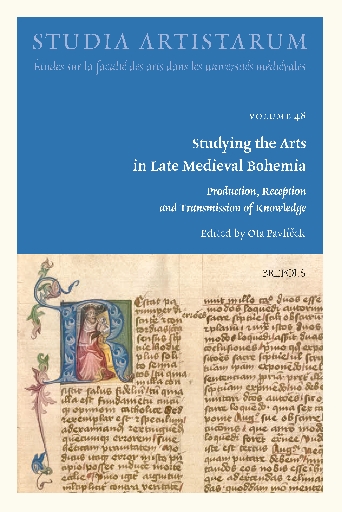
Studying the Arts in Late Medieval Bohemia
Production, Reception and Transmission of Knowledge
show More to view fulltext, buy and share links for:Studying the Arts in Late Medieval Bohemia show Less to hide fulltext, buy and share links for: Studying the Arts in Late Medieval BohemiaFrom its foundation in 1348, the University of Prague attracted students as well as scholars from all over Europe to its Faculty of Arts, where they studied and taught the subjects of the curriculum in all their variety. Nevertheless, our knowledge about these Prague scholars and their thought is still rather limited. In an effort to fill this gap, this volume is the first devoted entirely to the production, reception, and transmission of knowledge in the Arts Faculty of the medieval University of Prague, covering topics in astronomy, linguistics, logic, metaphysics, meteorology, and optics. It also links Prague's Faculty of Arts to several others at universities across Europe and it examines the study of the arts in Bohemia outside the university, including the Jewish milieu. The book contributes to advancing the status quaestionis in various ways, mainly through the analysis of less well-known and even unpublished texts, critical editions of some of which are printed here for the first time.
-
-
-
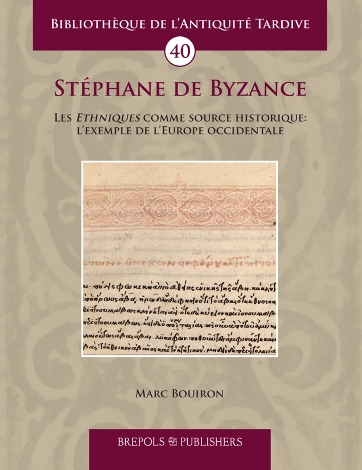
Stéphane de Byzance
Les Ethniques comme source historique: l’exemple de l’Europe occidentale
show More to view fulltext, buy and share links for:Stéphane de Byzance show Less to hide fulltext, buy and share links for: Stéphane de ByzanceLe lexique géographique du grammairien byzantin Stéphane de Byzance, les Ethniques, est une œuvre à l’origine monumentale. Ce lexique contenait de nombreuses mentions d’auteurs disparus, se rapportant à des toponymes du monde antique connu des Grecs et des Romains. À l’intérieur de ce lexique, nous avons choisi d’étudier plus spécialement ceux situés en Europe occidentale (péninsule ibérique, Gaule, Germanie et Bretagne antiques), en lien avec les sites archéologiques connus s’y rapportant. L’ouvrage ayant été abrégé à plusieurs reprises au cours du Moyen Âge, la confrontation de l’ensemble des notices a permis de proposer de nouvelles attributions d’auteurs antiques, leur nom et leur citation ayant très souvent disparu des manuscrits conservés. Par ailleurs l’analyse précise de la transmission de l’œuvre apporte un éclairage nouveau sur les moments où ce grammairien a été lu et utilisé, du VIe s. jusqu’à sa redécouverte à la fin du XVe s. La structure même du lexique permet de revenir sur la lexicographie antique et médiévale, et d’envisager les apports à la fois des grammairiens et des auteurs antiques (pour la plupart géographes et historiens) qui étaient cités. Enfin, le cadre géographique choisi permet d’explorer les autres textes antiques ainsi que les données archéologiques depuis l’époque grecque archaïque jusqu’à la fin de l’Empire romain. Nous avons inclus dans ce travail une analyse et une traduction de l’Ora maritima d’Aviénus, afin de compléter l’étude de la péninsule ibérique et du Midi de la Gaule.
-
-
-
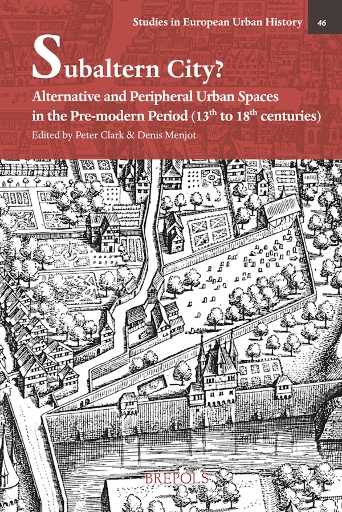
Subaltern City?
Alternative and peripheral urban spaces in the pre-modern period (13th-18th Centuries)
show More to view fulltext, buy and share links for:Subaltern City? show Less to hide fulltext, buy and share links for: Subaltern City?The purpose of this volume is to question traditional notions of city space in pre-modern Europe (with its stress on space being incorporated, regulated and integrated, dominated by its merchants and crafts), and to investigate how far it was in fact economically and politically pluralistic with a great variety of functions and juridictions. The volume examines comparatively the range of different urban spaces in and outside the medieval and early modern city from gardens, farmland and wasteland to industrial sites, poor and rich suburbs, shooting grounds, green space, grey space and military zones. Case studies cover cities in France, Germany, Italy, the Low Countries, England, Portugal and the Middle East. We ask: how far was the pre-modern city a compact city? Or was it in fact a ‘subaltern city’, as geographers have recently proposed, where many urban spaces were contested and the municipality has to be seen as only one key spatial actor?
-
-
-
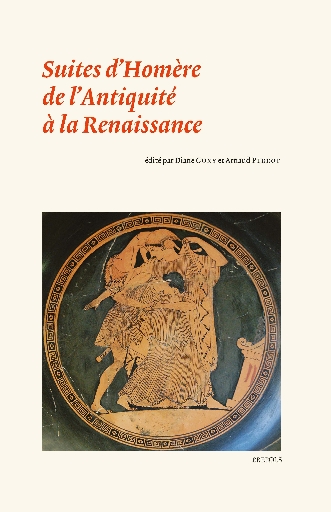
Suites d’Homère de l’Antiquité à la Renaissance
show More to view fulltext, buy and share links for:Suites d’Homère de l’Antiquité à la Renaissance show Less to hide fulltext, buy and share links for: Suites d’Homère de l’Antiquité à la RenaissanceThis book is the result of an international conference organized by the University of Tours in May 2021. It sets out to explore the notion of sequel in literature by examining the Homeric poems. While Gérard Genette evoked Homer in a considerable number of pages of his essay Palimpsestes, he however paid particular attention to forms of continuity from the front, from the back and from the sides, afterwards and sideways, which seem to make Homeric material the first victim of the cyclical additions that appear to constitute the ineluctable future of the great epics. In recent decades, however, these positions have been strongly nuanced and the time was ripe, therefore, for diachronic reflection on the validity of the notion of the ‘Homeric sequel’ by testing the meaning it has in various geographical and cultural contexts, from Antiquity to the Middle Ages and the Renaissance.
The authors of this volume contribute to the discussion of the literary concept of ‘continuation’ and offer a wide panorama of the poet's fruitful reception over time; they do so without neglecting the phenomena of transformation made possible by the survival of a mythology of Homeric origin which exists despite the absence of a direct reading of the Greek texts.
-
-
-
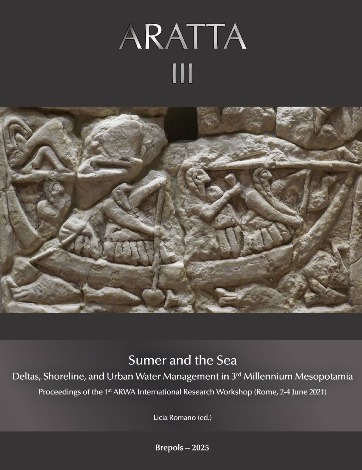
Sumer and the Sea
Deltas, Shoreline, and Urban Water Management in 3rd Millennium Mesopotamia. Proceedings of the 1st ARWA International Research Workshop (Rome, 2–4 June 2021)
show More to view fulltext, buy and share links for:Sumer and the Sea show Less to hide fulltext, buy and share links for: Sumer and the SeaFrom the Chalcolithic onwards, the culture and society of Sumer flourished along the banks of the Tigris and Euphrates Rivers, with communities living close to the ancient shoreline in an environment that was closely linked to the exploitation of fluvial systems, the sea, and the unique marshlands of the area. This volume gathers together research first presented as part of a workshop, entitled Sumer and the Sea: Deltas, Shoreline, and Urban Water Management in 3rd Millennium Mesopotamia, to explore the interaction between Sumerians and their water-dominated environment. The chapters gathered here offer updates on methodologies and the most recent research from the field to provide new understanding and fresh insights into how the Sumerians adapted to the world in which they lived.
-
-
-
Summaries, Divisions and Rubrics of the Latin Bible
Introductions by Pierre-Maurice Bogaert and Thomas O'Loughlin
show More to view fulltext, buy and share links for:Summaries, Divisions and Rubrics of the Latin Bible show Less to hide fulltext, buy and share links for: Summaries, Divisions and Rubrics of the Latin BibleDom Donatien De Bruyne's work of a century ago has been all but unobtainable since it was first published quasi-anonymously just before the outbreak of the Great War. Originally conceived as an instrumentum laboris to the great Benedictine project to produce a critical edition of the Vulgate, it now has a new life as a unique collection of the division systems that were used with the biblical books before the twelfth century. These constitute a primary interpretation of the text, anterior to, and more pervasive in influence than any work of formal biblical exegesis.
This collection makes available the raw material for a new chapter in the study of the Latin Bible and the study of its reception in the later patristic and medieval periods. Moreover, it may usher in a new chapter in the history of biblical exegesis.
Donatien De Bruyne (1871-1935), a monk of the abbey of Maredsous (Belgium), worked from 1907 onward as a member of the Pontifical Commission for the Revision of the Vulgate. Visiting the European libraries he collected a great amount of material for the critical edition of the Vulgate, with a special attention to the Old Latin and also to ‘parabiblical’ texts such as summaries, divisions, and prefaces, a care uncommon at that time. His expertise in Latin palaeography and patristics was broadly recognised.
-
-
-
Summe der kirchlichen Offizien
show More to view fulltext, buy and share links for:Summe der kirchlichen Offizien show Less to hide fulltext, buy and share links for: Summe der kirchlichen OffizienDas vorliegende Lehrbuch der Liturgie entstammt den Schulen von Poitiers und Paris in der Mitte des 12. Jahrhunderts. Der Autor Johannes Beleth tritt ganz hinter seinem Werk von 1160-1165 zurück. Nur durch Zufall (eine spätere Abbildung in einem anderen Buch) wissen wir, dass er Schüler des Bischofs von Poitiers, Gilbert de la Porrée, war. Bei den theologischen Streitfragen seiner Zeit zeigt er sich unabhängig. Er hat seine Summa für die einfachen Pfarrer als Hilfe bei ihrer Seelsorge, aber auch für Laien abgefasst. Neben Hinweisen auf die Aufgaben der Kleriker und Laien legt er in knapper Form die Gottesdienste mit Offizium, Messe Prozessionen und Fasten dar. Dabei gliedert er kurz nach Geschichte, Verlauf und Bedeutung, Letzteres unter Zuhilfenahme der Allegorie. Das Kirchenjahr gliedert er nach Weihnachts- und Osterfestkreis, anschließend wird die Zeit bis zum Advent nach dem Fest- und Heiligenkalender dargestellt. Besonders wertvoll ist sein Wissen um Sonderbräuche, hauptsächlich in Frankreich. Die Summa des Johannes Beleth war im Spätmittelalter eines der beliebtesten Liturgiebücher, davon zeugen die noch erhaltenen 180 Handschriften. Übertroffen wird die Wirkung allerdings, wenn auch indirekt, durch die (noch in ca. 1.000 Handschriften vorhandene) Legenda aurea, die die heilsgeschichtliche Grundstruktur von Beleths Werk in stark erweiterter Fassung volkstümlich gemacht hat.
Der zugrundeliegende Text dieses Bandes erschien 1974 in der Reihe Corpus Christianorum Continuatio Mediaeualis als Johannes Beleth, Summa de ecclesiasticis officiis (Bd. 41A), herausgegeben von Herbert Douteil CSSp. Der Übersetzer Lorenz Weinrich, Professor a. D. für mittelalterliche Geschichte an den Freien Universität Berlin hat zahlreiche mittelalterliche Werke herausgegeben und ins Deutsche übersetzt.
Die Ziffern am Seitenrand verweisen auf die entsprechenden Seiten der Edition.
-
-
-

Supernatural Encounters in Old Norse Literature and Tradition
show More to view fulltext, buy and share links for:Supernatural Encounters in Old Norse Literature and Tradition show Less to hide fulltext, buy and share links for: Supernatural Encounters in Old Norse Literature and TraditionThe Icelandic sagas have long been famous for their alleged realism, and within this conventional view, references to the supernatural have often been treated as anomalies. Yet, as this volume demonstrates, such elements were in fact an important part of Old Norse literature and tradition, and their study can provide new and intriguing insights into the world-view of the medieval Icelanders.
By providing an extensive and interdisciplinary treatment of the supernatural within sagas, the eleven chapters presented here seek to explore the literary and folkloric interface between the natural and the supernatural through a study of previously neglected texts (such as Bergbúa þáttr, Selkollu þáttr, and Illuga saga Gríðarfóstra), as well as examining genres that are sometimes overlooked (including fornaldarsögur and byskupa sögur), law codes, and learned translations. Contributors including Ármann Jakobsson, Margaret Cormack, Jan Ragnar Hagland, and Bengt af Klintberg explore how the supernatural was depicted within saga literature and how it should be understood, as well as questioning the origins of such material and investigating the parallels between saga motifs and broader folkloric beliefs. In doing so, this volume also raises important questions about the established boundaries between different saga genres and challenges the way these texts have traditionally been approached.
-
-
-
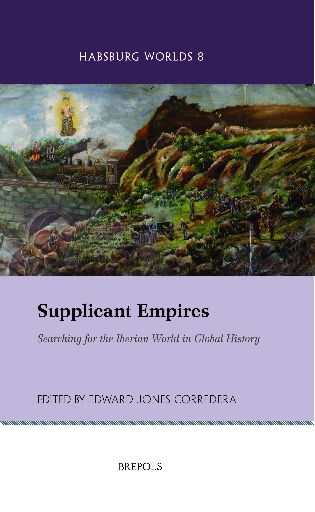
Supplicant Empires
Searching for the Iberian World in Global History
show More to view fulltext, buy and share links for:Supplicant Empires show Less to hide fulltext, buy and share links for: Supplicant EmpiresThis volume is a collection of reflections from leading senior and junior historians regarding the merits of historical comparativism in the field of Iberian history. The first purpose of the book is to encourage a dialogue between scholars of the Iberian Empires and to foster a reconsider how they see the broader history of the early modern world in light of recent historiography. The second aim of the book is to prompt scholars of other regions in global history to consider the recent literature on the Iberian Empires anew, to move beyond the tropes of the Black Legend and narrative of growth, splendour, and decline, and to study those imbrications had connected disparate parts of the world and which the postcolonial turn has unearthed. In a series of articles and interviews, contributors were encouraged to consider the role of linguistic divides in the growth of historiographical strands, and to speak plainly about the possible siloes that have emerged in the field. Contributors discuss the Atlantic turn, corporate cultures, the Catholic adoption of Protestant ideals, gender and race, all while drawing on insights from scholars who work on early modern nuns, the material history of sugar and coffee, or those who are exploring the uses of the concept of barbarity in borderlands.
-
-
-
Supplicare deis
La supplication expiatoire à Rome
show More to view fulltext, buy and share links for:Supplicare deis show Less to hide fulltext, buy and share links for: Supplicare deisAmongst the rites for procurating prodigies, those ominous signs of divine anger, the supplication holds a special place.
A lavish ceremony in which not only the priests but the whole Roman people took part, it gathered men, women, and children who were due to visit all the sanctuaries of the City in order to address their prayer to the gods, according to a religious rhetoric where verbal request and body language were associated. Through the supplicatio, ‘self-abasement’ rather than a properly ‘kneeling’ rite which a much debated etymology suggests, Roman people intended to placate deities of whom they acknowledged in the same way as the undeniable superiority.
The purpose of the present work is to define this rite, regarding the people, the places and the various elements it involved. At the same time, the point is also to clarify the controversial origins of a ceremonial traditionally related to the ritus Graecus. Quite similar to the supplication ‘between human people’ with which it shares most of its ritual elements, the religious supplication seems to have been influenced by the ritus Graecus and the practices which come under it, without asserting, though, a Greek origin. Complexity and contradictions characterise, as well, the supplication which, without breaking thoroughly with the austerity of ancestral rites, still belongs to the typically Roman procuration. Officially attested since the fifth century B. C., this rite disappeared in the last century of the Roman Republic, just as the notion of prodigy changed, under the influence of a new way of thinking.
Caroline Février is maître de conférences in Latin language at the University of Caen. Her research work focuses mainly on Roman religion. Her doctoral thesis and several of her articles are devoted to the expiation of prodigies.
-
-
-
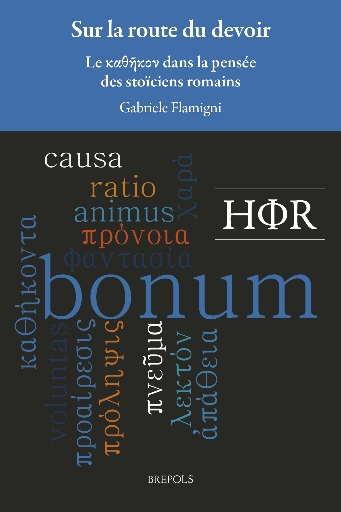
Sur la route du devoir
Le καθῆκον dans la pensée des stoïciens romains
show More to view fulltext, buy and share links for:Sur la route du devoir show Less to hide fulltext, buy and share links for: Sur la route du devoirQu’y a-t-il à l’origine du devoir, une idée d’une importance capitale dans l’histoire intellectuelle de l’Occident ? Parmi ses premières incarnations, il faut reconnaître le καθῆκον stoïcien, « ce qui est convenable », latinisé en officium, « devoir ». Cette notion a été développée par les stoïciens hellénistiques, mais les témoignages les plus amples à ce sujet proviennent des représentants de l’école ayant vécu à l’époque de l’Empire romain, à savoir Sénèque, Musonius Rufus, Épictète, Hiéroclès et Marc Aurèle. Dans ce livre, nous essayons de reconstruire une histoire aussi complète que possible du καθῆκον à travers une analyse exhaustive des sources disponibles.
-
-
-
Sur le culte divin et la musique
Écrits rassemblés
show More to view fulltext, buy and share links for:Sur le culte divin et la musique show Less to hide fulltext, buy and share links for: Sur le culte divin et la musiqueCet ouvrage rassemble des écrits épars, souvent peu connus des milieux universitaires et pour beaucoup d’entre eux difficiles à trouver. Au-delà de leur regroupement en six parties aux intitulés en apparence académiques, le lecteur ne manquera pas de découvrir la diversité de la nature des textes ici rassemblés autour de la notion de Culte, considérée en particulier dans le lien étroit et complexe qu’elle entretient avec la Musique tout au long de l’histoire du christianisme. Articles de fond incontournables pour tout chercheur intéressé par les questions de culte, de cérémonial et de musique ecclésiastique, se mêlent ainsi à des textes à visée plus large, transcriptions de conférences ou d’interviews, ou textes de présentation de disques.
L’implication personnelle de l’auteur durant sa vie professionnelle et intellectuelle, étendue sur plus d’un demi-siècle, favorise la dimension de témoignage qu’ont acquis plusieurs de ces textes face aux évolutions historiques récentes des pratiques cultuelles, toujours interrogées, sous des angles variés ressortant de l’histoire, de l’anthropologie, de la musicologie, voire de la théologie.
Toutefois, par le regard distancié qu’il a toujours réussi à maintenir sur son propre engagement, ils contribuent aussi, au même titre que les articles d’approche historiques ou méthodologiques, à reposer les questions essentielles qui permettent de mieux saisir et d’interroger les axes fondamentaux qui gouvernent la diversité des pratiques au sein du culte chrétien en Occident à travers son histoire.
-
-
-
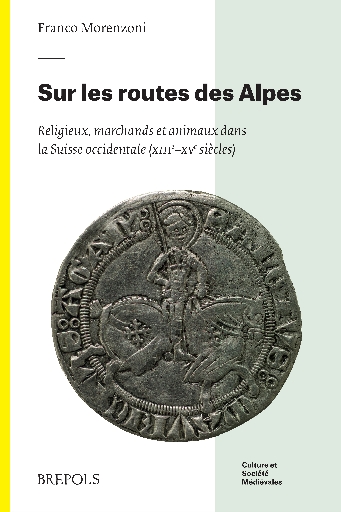
Sur les routes des Alpes
Religieux, marchands et animaux dans la Suisse occidentale (xiii e-xv e siècles)
show More to view fulltext, buy and share links for:Sur les routes des Alpes show Less to hide fulltext, buy and share links for: Sur les routes des AlpesÀ l’occasion du départ à la retraite du Professeur Franco Morenzoni (Université de Genève), le présent ouvrage réunit un certain nombre de ses travaux les plus marquants consacrés à l’actuelle Suisse occidentale au Moyen Âge. Ce recueil d’articles, divisé en quatre parties thématiques - chacune préfacée par des spécialistes et d’anciens collègues - vise à rendre compte de la richesse de recherches menées sur plus de vingt-cinq ans, dans l’histoire économique et sociale aussi bien que dans l’histoire religieuse. Ces domaines, a priori bien distincts, constituent différents points d’entrée qui dévoilent un même intérêt pour l’homme médiéval dans ses interactions avec le monde qui l’entoure. Pionniers par bien des aspects, les travaux de Franco Morenzoni ont renouvelé l’histoire de la Savoie et des Alpes aux derniers siècles du Moyen Âge: ce recueil en est le témoignage.
-
-
-

Survival and Discord in Medieval Society
Essays in Honour of Christopher Dyer
show More to view fulltext, buy and share links for:Survival and Discord in Medieval Society show Less to hide fulltext, buy and share links for: Survival and Discord in Medieval SocietyThis book, a tribute to an exceptional scholar known for his broad-ranging interests, brings together the new work of students, friends, and colleagues of Prof. Dyer. The volume reflects his interests in the twin disciplines of history and archaeology and his ground-breaking work in medieval standards of living, social tensions, and town-country relations. The varied and stimulating essays presented in this volume examine a host of critical issues dealing with diet, settlement, employment opportunities, taxation, credit and debt, and the tensions felt in town and country alike which often exploded into full-scale revolt. This new work not only looks at these issues from the standpoint of new evidence and theoretical perspectives, but also imparts a strong sense of the controversy surrounding many of these central issues in medieval history, ranging from how well common people managed to live and reproduce to the nature of their relationships with each other and with their social superiors. The volume, in short, stimulates a vital reconsideration of many of the key concerns pertaining to the study of medieval societies.
-
-
-

Survival and Success on Medieval Borders
Cistercian Houses in Medieval Scotland and Pomerania from the Twelfth to the Late Fourteenth Century
show More to view fulltext, buy and share links for:Survival and Success on Medieval Borders show Less to hide fulltext, buy and share links for: Survival and Success on Medieval BordersThis comparative study analyses Cistercian strategies on the northern and north-eastern frontiers of medieval Europe. Through case studies of six houses in Pomerania and Neumark (Kołbacz, Marienwalde, and Himmelstädt) and on the Scottish-English border (Melrose, Dundrennan, and Holm Cultram), the author traces the development of social networks around these monasteries within their own regions and across borders, and explores the importance of the international Cistercian networks for communities located in these politically sensitive areas. Very different socio-economic conditions in the regions under discussion resulted in quite different strategies of land accumulation by Cistercian monasteries in Scotland and Pomerania, which in turn had a lasting impact on their relationships with their neighbours. The author also examines the role of these abbeys in wider ecclesiastical politics and in relation to the key issues of the time: church reform and the expectations of the order’s lay patrons and benefactors. In the fourteenth century, all of the abbeys experienced war, violence, and long-term instability. Their responses to these threats and difficulties are significant for our understanding of monastic strategies in hostile environments. Above all, this study shows how a Cistercian model was adapted to fit the complex political, cultural, and ethnic contexts of the southern Baltic, Northern England, and Scotland.
-
-
-
Sweden, Russia, and the 1617 Peace of Stolbovo
show More to view fulltext, buy and share links for:Sweden, Russia, and the 1617 Peace of Stolbovo show Less to hide fulltext, buy and share links for: Sweden, Russia, and the 1617 Peace of StolbovoIn 1617, after seven years of war between Sweden and Russia and talks facilitated by English and Dutch diplomats, the peace treaty of Stolbovo was signed. This important but little-studied document was to form the basis for relationships between Sweden and Russia for the next one hundred years, before it was replaced by the Peace of Nystad in 1721, and it had a huge influence on the lives of the people who lived in the region.
This wide-ranging volume draws together contributions by scholars from Britain, Sweden, Germany, Estonia, Russia, and Finland to offer new insights into, and analysis of this peace treaty and its impact on the wider region during the seventeenth century. Covering disciplines including political and economic history, church history, and Slavonic and Classical philology, the chapters gathered here shed new light on, and provide a new understanding of, the Early Modern period in the Baltic Sea area.
-
-
-
Sylvain Lévi (1863-1935). Études indiennes, histoire sociale
Actes du colloque tenu à Paris les 8-10 octobre 2003
show More to view fulltext, buy and share links for:Sylvain Lévi (1863-1935). Études indiennes, histoire sociale show Less to hide fulltext, buy and share links for: Sylvain Lévi (1863-1935). Études indiennes, histoire socialeUn colloque international consacré à Sylvain Lévi s'est tenu à Paris, du 8 au 10 octobre 2003, sous l'égide de l'École Pratique des Hautes Études et de la Maison des Sciences de l'Homme. Le présent volume en constitue les Actes.
Directeur d'études à l'École Pratique des Hautes Études (de 1886 à 1935, à la IVe et à la Ve section) et professeur de langue et littérature sanskrites au Collège de France de 1894 à 1935, Sylvain Lévi (1863-1935) fut une haute figure de l'indianisme français, à une époque où la philologie sanskrite en était la discipline reine. Multipliant apprentissages et domaines de recherche afin d'appréhender de toutes parts la pensée indienne, il construisit une œuvre considérable, au rayonnement international. De même fut-il bâtisseur institutionnel, posant aussi bien les fondements de l'enseignement indianiste français que ceux de l'Institut de civilisation indienne, créé en 1927. Parallèlement, dans les années 1880, Sylvain Lévi rejoignit l'Alliance israélite universelle. Élu à sa présidence en 1920, il assuma cette fonction jusqu'à sa mort, en octobre 1935. Le nom de Sylvain Lévi est connu. Paradoxalement, pourtant, l'homme et l'œuvre sont aujourd'hui frappés d'un relatif oubli. Pour tenter d'y remédier, il était nécessaire d'adopter le double point de vue des études indiennes et de l'histoire sociale, tant il est vrai qu'en Sylvain Lévi se conjoignent exemplairement le savant adonné à sa recherche et l'intellectuel engagé, l'un et l'autre animés du même idéal d'humanisme et d'aspiration à l'universel.
Ainsi a-t-on relu l'œuvre indianiste et orientaliste de Sylvain Lévi, en s'efforçant d'en saisir la diversité (théâtre, littérature, études védiques, histoire des religions, bouddhisme, philologie, philosophie, histoire), et pris la mesure de son rayonnement international (Russie, Inde, Japon). On a également examiné la place qu'il occupa dans le monde intellectuel de la fin du XIXe siècle et du début du XXe, selon deux axes thématiques : les approches disciplinaires de l'orientalisme dans l'espace francophone à l'époque de Sylvain Lévi (philologie, histoire, anthropologie, sociologie); Sylvain Lévi et les milieux juifs en France, de l'Affaire Dreyfus à la Seconde Guerre mondiale.
Au terme de l'enquête, on se prend à penser qu'elle pourrait être l'effet différé de l'énergie militante que Sylvain Lévi a continûment insufflée dans ses travaux et dans sa vie. Comme on voit la roue du potier tournoyer quelque temps encore, après que la main a cessé d'en soutenir le mouvement.
-
-
-

Sympozjum Egejskie
Papers in Aegean Archaeology 3
show More to view fulltext, buy and share links for:Sympozjum Egejskie show Less to hide fulltext, buy and share links for: Sympozjum EgejskieSympozjum Egejskie. Papers in Aegean Archaeology is a peer-reviewed series that has been designed to full the role of a platform for presenting and introducing a wide range of new research approaches and themes within the broad area of Aegean Archaeology. This is primarily achieved through showcasing the work of newcomers to the discipline, in other words those scholars who are currently at the beginning of their research career in the field of Aegean Archaeology, as well as scholars working outside the traditional university structure such as independent scholars, professional field archaeologists, museum curators and conservators. It is our hope that this series will serve as a concise guide to the most recent research undertaken by early career scholars and the diverse and inspiring new trends in the archaeology of the Prehistoric Aegean, as well as shining a light on the future direction of the discipline.
-
-
-

Sympozjum Egejskie, vol. 4
Papers in Aegean Archaeology
show More to view fulltext, buy and share links for:Sympozjum Egejskie, vol. 4 show Less to hide fulltext, buy and share links for: Sympozjum Egejskie, vol. 4Sympozjum Egejskie. Papers in Aegean Archaeology is a peer- reviewed series that has been designed to fulfil the role of a platform for presenting and introducing a wide range of new research approaches and themes within the broad area of Aegean Archaeology. This is primarily achieved through showcasing the work of newcomers to the discipline, in other words those scholars who are currently at the beginning of their research career in the field of Aegean Archaeology, as well as scholars working outside the traditional university structure such as independent scholars, professional field archaeologists, museum curators and conservators. It is our hope that this series will serve as a concise guide to the most recent research undertaken by early career scholars and the diverse and inspiring new trends in the archaeology of the Prehistoric Aegean, as well as shining a light on the future direction of the discipline.
-
-
-

Synesios von Kyrene: Politik - Literatur - Philosophie
show More to view fulltext, buy and share links for:Synesios von Kyrene: Politik - Literatur - Philosophie show Less to hide fulltext, buy and share links for: Synesios von Kyrene: Politik - Literatur - PhilosophiePhilosopher and man of letters, Lybian magnate, political writer in Constantinople, pupil of Hypatia the neoplatonist, and eventually metropolitan bishop of Ptolemais - Synesius of Cyrene is among the most interesting figures of Late Antiquity.
The present volume brings together the papers presented at the conference “Synesios von Kyrene: Politik - Literatur - Philosophie”, held at the University of Constance in November 2008. They offer a broad approach to selected aspects concerning Synesius’ works as well as to the historical background, philosophical contexts, and reception in scholarship and literature, from Late Antiquity to the present.
Helmut Seng is Associate Professor at the University of Constance and Lecturer at the Institute of Classical Philology at the University of Frankfurt. Main research interests include Synesius and the Chaldaean Oracles as well as aspects of form and of intertextuality in Greek and Latin literature.
Lars Hoffmann was a researcher at the University of Mainz, where he taught in all fields of Byzantine studies. Since 2010 he has been a researcher at the Max-Planck-Institute for European Legal History at Frankfurt and in collaboration with other scholars, he is responsible for a new edition of a collection of Byzantine legal sources. Main research interests include the cultural history of Byzantium as well as the tradition and reception of ancient and Byzantine Greek texts.
-
-
-
Sénèque au risque du don
Une éthique oblative à la croisée des disciplines
show More to view fulltext, buy and share links for:Sénèque au risque du don show Less to hide fulltext, buy and share links for: Sénèque au risque du donÀ la croisée entre philologie, histoire, anthropologie et sociologie, cette étude revisite la problématique du don dans la Rome antique. Les écrits de Sénèque, en particulier son traité intitulé De beneficiis, sont lus à la lumière des travaux de Marcel Mauss et de ses héritiers scientifiques, pour cerner l’épineuse question du statut et de la finalité de la bienfaisance. Doit-elle être pratiquée pour elle-même ou en vue d’une fin particulière ? Faut-il privilégier sa portée vertueuse ou sa dimension sociale ? Un examen de l’œuvre stoïcienne au prisme des théories modernes du don révèle une morale en tension et une vision originale de la pratique du don, de ses temporalités, de ses effets et de ses acteurs.
-
-
-
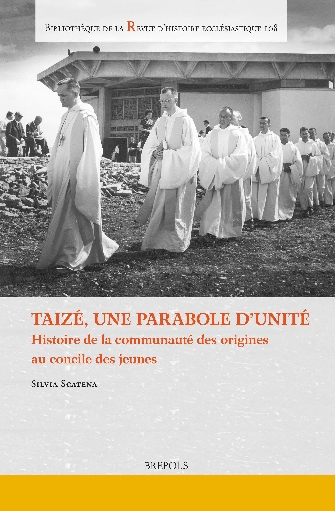
Taizé, une parabole d’unité
Histoire de la communauté des origines au concile des jeunes
show More to view fulltext, buy and share links for:Taizé, une parabole d’unité show Less to hide fulltext, buy and share links for: Taizé, une parabole d’unitéChapitre important de l’histoire du XXe siècle religieux européen, l’itinéraire de la communauté de Taizé a croisé les différents événements qui ont marqué la recherche de l’unité des chrétiens divisés et l’histoire de nombreuses églises du continent entre la Seconde Guerre mondiale et la chute du rideau de fer. Première communauté cénobitique masculine née sur terrain réformé, vite devenue point de rencontre d’une sorte d’église œcuménique en gestation, Taizé a interpellé les chrétiens et les églises en des lieux et en des temps différents. Observatoire original des événements caractéristiques de la soif d’unité qui a fait irruption parmi les chrétiens au cœur du XXe siècle, Taizé attendait encore un nécessaire effort d’historicisation. Ce volume essaie de répondre à cette exigence grâce à l’étude d’une très riche documentation inédite, conservée à Taizé et en beaucoup d’autres archives européennes. Ce travail est le fruit d’une recherche de nombreuses années, consacrée aux premières décennies de l’histoire de la communauté fondée par Roger Schutz : depuis les premiers projets communautaires partagés avec quelques amis au lendemain du déclenchement de la guerre, jusqu’à l’annonce, au printemps de 1970, d’un « état conciliaire » tout à fait inédit pour sortir de l’impasse où se trouvait l’œcuménisme après les promesses du début des années 60. Les origines, l’évolution, l’accueil et les résistances rencontrées par cette création communautaire originale constituent donc l’objet de ce volume. Cette ouvrage entend donc suivre, reconstruire et documenter l’« itinérance » de Taizé entre les différentes réalités ecclésiales ainsi que le dynamisme déployé par cette communauté au long des différentes lignes de fracture de l’histoire du XXe siècle.
-
-
-
Talent / maltalent
La culture des émotions au seuil de la littérature française
show More to view fulltext, buy and share links for:Talent / maltalent show Less to hide fulltext, buy and share links for: Talent / maltalentS’inscrivant dans l’histoire des affects, le livre propose une relecture des premiers récits français sous le signe des polarités émotionnelles médiévales du « talent » et du « maltalent ». À l’époque de leur première réception, la Cantilène de sainte Eulalie, la Vie de saint Alexis, la Chanson de Roland et le Roman de Thèbes étaient des œuvres fermées, des textes de plaisir. Pour le lecteur du XXIe siècle, ils deviennent un beau défi jouissif. Ainsi, les détails qui débordent le cadre théologique se révèlent nombreux et savoureux : Maximien réussit son coup d’épée contre Eulalie, la « pucelle » d’Alexis parvient à consommer son mariage céleste, Charlemagne boude Gabriel, Jocaste frôle le rôle d’entremetteuse pour faire la paix par l’amour … et les mondes s’entrechoquent, ambigument possibles.
L’étude aborde les styles émotionnels, les actes émotifs, les normes affectives et les communautés responsables des « émotionologies » de ces textes liminaires de la littérature française, où les personnages font de Dieu un acte émotif de plus en plus dépouillé. Du nom à l’interjection, de la foi à l’émotion, c’est l’histoire d’une véritable émancipation qui s’écrit, en initiant, à fleur de texte, une désacralisation progressive des affects.
-
-
-
Teachers and Code-Breakers: The Latin Genesis Tradition, 430-800
show More to view fulltext, buy and share links for:Teachers and Code-Breakers: The Latin Genesis Tradition, 430-800 show Less to hide fulltext, buy and share links for: Teachers and Code-Breakers: The Latin Genesis Tradition, 430-800That Genesis was a key text in the formation of the medieval intellectual world is well recognised. But what were the motives and methods of those who used it? This book looks at the writers and how they wrote about Genesis to reconstruct the intellectual history of the period. It explores how their use of Genesis discloses common attitudes to revelation, authority, and one another.In turn the book examines, how awareness of their self-understanding, can help in understanding their exegesis. Since they built on authorities and one another, and wished 'to remain true' to their authorities, how did exegesis change and develop? This study reveals a group who saw themselves as a single body dispersed over time, charged with a common task as 'Christian Schoolmasters', and who wished to retain all the had received, make it suitable for teaching their students, and ensure its continuance. The book explores the intellectual bonds between those we usually study (e.g. Augustine) and umpteen others whose often anonymous exegeses we tend to ignore - yet it was the cumulative impact of both that created medieval theology. born in 1958 in Ireland, Thomas O'Loughlin is a lecturer in theology in the Department of Theology and Religious Studies in the University of Wales Lampeter. His research in recent years has focused on the theology of the early medieval period, especially as seen in their biblical exegesis.
-
-
-
Teaching Plato in Italian Renaissance Universities
show More to view fulltext, buy and share links for:Teaching Plato in Italian Renaissance Universities show Less to hide fulltext, buy and share links for: Teaching Plato in Italian Renaissance UniversitiesDuring the Renaissance, the Arts curriculum in universities was based almost exclusively on the teaching of Aristotle. With the revival of Plato, however, professors of philosophy started to deviate from the official syllabus and teach Plato’s dialogues. This collection of essays offers the first comprehensive overview of Platonic teaching in Italian Renaissance universities, from the establishment of a Platonic professorship at the university of Florence-Pisa in the late 15th century to the introduction of Platonic teaching in the schools and universities of Bologna, Padua, Venice, Pavia and Milan in the 16th and 17th centuries. The essays draw from new evidence found in manuscripts and archival material to explore how university professors adapted the format of Plato’s dialogues to suit their audience and defended the idea that Plato could be accommodated to university teaching. They provide significant and fundamental insight into how Platonism spread during the 16th and 17th centuries and how a new interpretation of Plato emerged, distinct from the Neoplatonic tradition revived by Marsilio Ficino.
-
-
-
Teaching and Learning in Medieval Europe
Essays in Honour of Gernot R. Wieland
show More to view fulltext, buy and share links for:Teaching and Learning in Medieval Europe show Less to hide fulltext, buy and share links for: Teaching and Learning in Medieval EuropeOver the span of his career, Gernot R. Wieland has been actively engaged in the contribution and promotion of the study of medieval literature, particularly in Anglo-Latin and Old English. From his early work on glosses in Anglo-Saxon manuscripts, to his later editorial work for The Journal of Medieval Latin, Wieland has provided the field with diverse, diligent, and creative scholarship. The contributors of this volume pay tribute to the significance of Wieland’s teaching and learning in the literature of medieval Europe by presenting him with twelve essays on varied aspects of the subject.
The first section of the volume aims to honour Wieland’s contributions to the study of medieval glossing. It deals with the history of glossing from early medieval Latin literature to late Middle English grammatical texts, as well as the early interpretative history of Walter of Châtillon’s Alexandreis and Geoffrey of Monmouth’s Historia regum Britannie. The following section corresponds with Wieland’s interest in Anglo-Saxon literature, with essays on the bilingual letters of Ælfric of Eynsham, the poetry of Alcuin of York, and the Old English Hexateuch. The second half of the volume, which examines elements of Latin literature from the eleventh to the fourteenth century, is divided into two sections containing essays that well represent Wieland’s diverse philological and literary interests in medieval Latin. The third section of the volume on the texts and contexts of Latin literature presents essays on the books of Abbot Maiolus of Cluny, on scholastic virtues of good teaching, and on Walter Map’s Dissuasio Valerii. The final section on the texts and manuscripts of Latin literature provides editions of and commentaries on a Latin-Greek phrase-book, a treatise on the firmament of Genesis 1:6.
With these contributions, this volume honours the research interests of a great teacher and learner of the Middle Ages: Gernot Weiland.
-
-
-
Teaching and Learning in Northern Europe
1000-1200
show More to view fulltext, buy and share links for:Teaching and Learning in Northern Europe show Less to hide fulltext, buy and share links for: Teaching and Learning in Northern EuropeThe essays in this collection focus not on texts but on people, specifically on teachers and their students, beginning with the late Carolingian era and continuing through the creation of monastic and secular schools in the centuries before the first universities. Central to the articles in this volume are the schools and communities of Northern France and England, including Reims, Bec, Soissons, and Canterbury, whose patterns of thought and learning gave shape to intellectual endeavours throughout medieval Europe. In addition to some of the most prominent personalities of the day (among them Gerbert of Reims, Lanfranc and Anselm of Bec, Ivo of Chatres, and John of Salisbury), the contributors examine those teachers and students who worked in the shadows: figures like the biblical exegete Richard of Préaux and the musical innovator Theinred of Dover. The focus throughout the volume is on personalities and personal relationships, thus recreating the human connections that lay behind medieval humanism and the Twelfth-Century Renaissance. Taken together, the essays here create a coherent and compelling picture of the tumultuous time before the universities came to organize and take control of teaching and learning, a seminal period when teaching methods and curricula grew out of the particular experience of specific teachers and their interactions with their students.
-
-
-
Teaching and Learning the Sciences in Islamicate Societies (800-1700)
show More to view fulltext, buy and share links for:Teaching and Learning the Sciences in Islamicate Societies (800-1700) show Less to hide fulltext, buy and share links for: Teaching and Learning the Sciences in Islamicate Societies (800-1700)This book surveys teaching and learning in the mathematical and occult sciences, medicine and natural philosophy in various Islamicate societies between 800 and 1700. It focuses in particular on Egypt and Syria between 1200 and 1600, but looks also at developments in Iran, India, Anatolia, and Iraq. It discusses institutions of teaching and learning such as house and court teachers, madrasas, hospitals, in-family teaching, and travelling in search of knowledge, as well as the content of the various sciences taught by or at them. Methods of teaching and learning, teaching bestsellers and their geographical and temporal dissemination, as well as encyclopaedias and literature on the classification of the sciences are treated in further chapters.
-
-
-
Teaching and Studying Philosophy in Jewish Culture during the Middle Ages
show More to view fulltext, buy and share links for:Teaching and Studying Philosophy in Jewish Culture during the Middle Ages show Less to hide fulltext, buy and share links for: Teaching and Studying Philosophy in Jewish Culture during the Middle AgesThis book offers the first survey of philosophical pedagogy in Jewish culture during the Middle Ages, with a focus on Northern France, the Provence, Italy and Spain. By examining not only the discourse of renowned philosophers such as Maimonides and Gersonides, but also oft-neglected manuscript evidence of educational practices and students’ notes, the book offers a nuanced understanding of the medieval Jewish intellectual landscape and shows how Jewish educators brought intricate debates on metaphysics, ethics, and epistemology into the classroom. The book also sheds light on the broader societal and cultural contexts that influenced these philosophical pursuits.
An essential read for anyone interested in the history of philosophy, Jewish studies, or medieval intellectual culture, this book celebrates the enduring legacy of Jewish philosophical thought and its pivotal role in shaping the intellectual currents of the Middle Ages.
-
-
-
Technologies of Learning
Apprenticeship in Antwerp Guilds from the 15th Century to the End of the Ancien Régime
show More to view fulltext, buy and share links for:Technologies of Learning show Less to hide fulltext, buy and share links for: Technologies of LearningThe importance of training and education is on the increase. While the production of ‘human capital’ is seen as a motor for a competitive economy, skills and expertise proof to be necessary for social mobility. Remarkably, in conceiving modern forms of ‘apprenticeship’, several mechanisms from the acien régime, seem to return. The difference between public and private initiative is disappearing, education and training is being confused, and in order to acquire generic skills as flexibility, communicability, self-rule, creativity and so on, youngsters have to learn ‘in context’. Even for maths, scholars now talk of ‘situated learning’.
Before the advent of a formal schooling system, training took place on the shop floor, under the roof of a master. The apprentice not only worked but also lived in his master’s house and was thus trained and educated at the same time. In cities, this system was formally complemented by an official apprenticeship system, prescribing a minimum term to serve and an obligatory masterpiece for those who wanted to become masters themselves. Traditionally, historians see this as an archaic and backward way of training, yet this book’s aim is to show that is was instead a very flexible and dynamic system, perfectly in tune with the demands of an early modern economy.
In order to understand it fully, however, we should differentiate the informal training system organised via a ‘free market’ of indentures on the one hand and the institutionalised system of craft guilds on the other. In Antwerp, early modern guilds had a project of ‘emancipating’ their members. They didn’t simply produce certain skills, but through a system of quality marks defended the honour of craftsmen. This is the difference with current practices. By representing hands-on skills as superior, guilds supplied a sort of symbolic capital for workers.
Bert De Munck is lecturer at the University of Antwerp and member of the Centre for Urban History. His research focuses on the history of the guilds, vocational training and social capital.
-
-
-
Technology and Engineering
Proceedings of the XXth International Congress of History of Science (Liège, 20-26 July 1997) Vol. VII
show More to view fulltext, buy and share links for:Technology and Engineering show Less to hide fulltext, buy and share links for: Technology and EngineeringToo often technology is seen as inferior to science, as a simple practical application of a self-sufficient "pure" knowledge. Such a dichotomy is for sure an illusion. The contributions met in this volume, reflecting the richness and the density of the session Science, Technology and Industry during the XXth International Congress of History of Science in Liège in 1997, show all technology as nothing less than the bridge between science on one side, society and economy on the other side. And this bridge is not a one-way road but a place of interactions between the theoretical and the applied, between the knowledge and the know-how. A special section of this book demonstrates that this equal footing dialogue has been particularly intense as far as the military technical development is concerned, and that for many centuries.
This collection does not bring a synthesis or a state of the art, but some rich material able to stimulate the debates, still active since the 1970s, in the social studies of science and technology. Most of the papers integrate and try to touch the complexity of the processes at work when a discovery, an invention, has to be adapted, or when the social and economic structures solicit from science a solution to very peculiar problems. The diversity of topics, approaches, even the variety of the vocabulary used by the authors to describe apparently similar patterns, reflect the dynamic of a research flow but also, probably, the necessity to elaborate new analytical frames, new synthetic schemes.
-
-
-
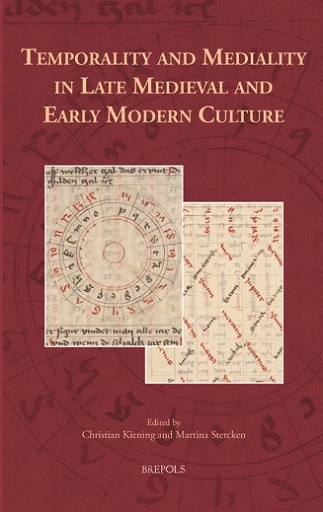
Temporality and Mediality in Late Medieval and Early Modern Culture
show More to view fulltext, buy and share links for:Temporality and Mediality in Late Medieval and Early Modern Culture show Less to hide fulltext, buy and share links for: Temporality and Mediality in Late Medieval and Early Modern CultureThis interdisciplinary volume explores the ways in which time is staged at the threshold between the Middle Ages and the early modern period. Proceeding from the reality that all cultural forms are inherently and inescapably temporal, it seeks to discover the significance of time in mediations and communications of all kinds.
By showing how time is displayed in diverse cultural strategies and situations, the essays of this volume show how time is intrinsic to the very concept of tradition. In exploring a variety of medial forms and communicative practices, they also reveal that while the beginning of the age of printing (around 1500) may mark a fundamental change in terms of reproduction and circulation, artefacts and other historical traditions continue to employ earlier systems and practices relating time and space.
The volume features articles by leading researchers in their respective fields, including studies on mosaics as a medium reflecting space and time; the triptych’s potential as a time machine; winged altarpieces mediating eternity; texts and images of the passion of Christ permeating past, present, and future; dimensions of time embedded in maps; a compendium of world knowledge organized by forms of time and temporality; the figuration of prophecy in times of crisis; the portrayal of time in architecture.
The volume thus provides a new approach to media and mediality from the perspective of cultural history.
-
-
-
Temps, sciences et empire
Cosmographie et navigation dans les monarchies ibériques au xvi e siècle
show More to view fulltext, buy and share links for:Temps, sciences et empire show Less to hide fulltext, buy and share links for: Temps, sciences et empireDès la fin du xve siècle, les monarchies portugaise et espagnole se lancent au grand large dans un élan de construction impériale qui saisit le globe. Une diversité d’acteurs et de savoirs, dont la cosmographie et la navigation, sont porteurs de ce processus. Ce dernier transforme, à jamais, l’image et le concept de la Terre comme espace de l’habitat humain, retravaillant les liens entre espace et temps. Pilotes et cosmographes contribuent alors à une reconceptualisation des temporalités et des temps de la Terre. Quels textes ont-ils rédigés et lus, quels instruments ont-ils manipulés à cette fin ?
En explorant ces dynamiques à partir d’une pluralité de matériaux, le livre embarque le lecteur sur des bateaux naviguant vers les Indes, l’invite dans des Casas et des entrepôts portuaires ou dans des universités où résonnent les échos d’une mer transformatrice des connaissances. La création de la chaire de cosmographie à la Casa de la contratación (Séville, 1552) et la trajectoire de son premier détenteur, Jerónimo de Chaves (1523-1574), servent de « laboratoire » privilégié d’où observer ces problématiques.
Le livre élargit ainsi la manière de comprendre la cosmographie au xvie siècle, souvent réduite à son rapport à la cartographie, à l’intersection de plusieurs pratiques et savoirs (histoire naturelle, théologie, astrologie, astronomie, navigation) et au-delà du clivage « Anciens-Modernes ». En embrassant d’un regard les monarchies ibériques, l’ouvrage ancre dans l’Europe méridionale la question plus large de la production des techniques et des sciences à l’époque moderne, inscrivant l’espace ibérique dans une première globalisation.
-
-
-
Tendenda Vela
Excursions littéraires et digressions philosophiques à travers le Moyen Âge
show More to view fulltext, buy and share links for:Tendenda Vela show Less to hide fulltext, buy and share links for: Tendenda VelaÉdouard Jeauneau a déjà publié deux recueils d'articles. Le premier, Lectio philosophorum (1973) était centré sur l'École de Chartres, le second, Études érigéniennes (1987, prix Victor Cousin 1990) sur Jean Scot Érigène. Ce troisième recueil, "Tendenda Vela", combine les deux thèmes.
Les travaux qui y sont rassemblés, et qui couvrent plus de vingt années de recherches, portent non seulement sur Jean Scot et sur les maîtres chartrains, mais sur leurs sources bibliques, patristiques et profanes. Parmi les sources patristiques, une place de choix est faite aux Pères grecs: Denys l'Aréopagite, Grégoire de Nysse, Maxime le Confesseur. Pour les sources profanes, l'accent est mis sur les textes philosophiques qu'on lisait dans le monde latin en la première moitié du XIIe siècle, notamment le Timée de Platon et la Consolation de Philosophie de Boèce.
Ce nouveau recueil ne se distingue pas seulement par la diversité des sujets traités, mais aussi par la variété de leur approche. Tantôt l'auteur dresse le bilan des recherches qu'il a menées sur les manuscrits en pays tchèque (Plato apud Bohemos) ou en Californie (Berkeley UCB Ms. 95), tantôt il approfondit les thèmes philosophiques (Translatio studii, Processio et Reditus, Cogito érigénien) et théologiques (le Filioque) qu'il a rencontrés au cours de ses excursions à travers le Moyen Âge, tantôt il propose une nouvelle interprétation de quelques œuvres d'art appartenant à cette période: De l'art comme mystagogie, Les sirènes dans le chœur des Vieillards. Un livre qui devrait intéresser les historiens de l'art, de la philosophie et de la théologie.
De 1958 à 1992, Édouard Jeauneau (° 1924) á été chercheur et depuis 1975 directeur de recherche de 1ère classe au Centre National de la Recherche Scientifique (Section Philosophie) à Paris. Depuis 1974 il est aussi fellow du Pontifical Institute of Mediaeval Studies (Toronto).
-
-
-
Teresianum
show More to view fulltext, buy and share links for:Teresianum show Less to hide fulltext, buy and share links for: TeresianumThe journal Teresianum is edited by authors of various nationalities and is intended for international circulation. It primarily offers studies concerning spiritual theology and Christian anthropology, leaving a privileged place for Carmelite studies. The journal also includes contributions on theology, Church history and biblical studies, as well as a selection of reviews. It has been published since 1947 with two issues per year of about 300 pages each.
More information about this journal on Brepols.net
-
-
-
Territoires, régions, royaumes
Le développement d’une cartographie régionale et locale dans l’Occident latin et le monde arabe (x e-xv e siècle)
show More to view fulltext, buy and share links for:Territoires, régions, royaumes show Less to hide fulltext, buy and share links for: Territoires, régions, royaumesPendant longtemps, les travaux sur la cartographie ont surtout porté sur les mappemondes, aussi bien dans le monde latin que dans le monde arabo-musulman. Les représentations cartographiques des espaces locaux et régionaux ont suscité un intérêt plus modéré, même si les études sur la cartographie à grande ou à moyenne échelle des xii e-xv e siècles connaissent depuis quelques années un renouveau notable tant dans le domaine latin que dans le domaine arabe.
La publication des actes du colloque international qui s'est tenu à Tours en juin 2018 rassemble quinze études consacrées à la représentation cartographique du territoire, et, plus généralement, à la cartographie des espaces régionaux et locaux qui émerge dès le x e siècle dans le monde arabo-musulman et à partir du xii e siècle dans l’Occident latin, pour connaître un essor remarquable dans les deux derniers siècles du Moyen Âge. Le livre réunit des articles de synthèse et des études de cas, abordant les questions complexes de l'émergence de cette cartographie, de ses formes et de ses usages dans le monde arabo-musulman et dans l'Occident latin.
-
-
-
Tertullianus Afer
Tertullien et la littérature chrétienne d'Afrique
show More to view fulltext, buy and share links for:Tertullianus Afer show Less to hide fulltext, buy and share links for: Tertullianus AferPremier Père de l’Église latin d’Afrique, Tertullien (160-220) a marqué de son empreinte le christianisme de l’Occident. Cependant, si son influence sur des auteurs comme Jérôme ou Isidore de Séville a souvent été soulignée, peu d’études ont été consacrées au rôle théologique, spirituel et littéraire que son œuvre volumineuse a joué dans le développement de la pensée et de la langue des écrivains chrétiens d’Afrique durant l’Antiquité tardive. Pourtant, ce rôle est assez bien documenté, comme l’attestent les témoignages, certes parfois contradictoires, de grands écrivains chrétiens africains comme Cyprien, Lactance ou Augustin. Aussi nous semblait-il nécessaire de nous interroger à nouveaux frais sur l’influence de Tertullien sur la littérature chrétienne d’Afrique du Nord (ii e-vi e siècles), à travers une étude tant des formes littéraires, des contenus dogmatiques, que des contextes ecclésiologiques de sa réception. Au final, les travaux de cette journée d’étude, organisée dans le cadre du programme de recherche du G.R.A.A., « Tradition, évolution et mutation des formes littéraires en Afrique romaine », offrent quelques éclaircissements à la question fondamentale de la construction, réelle, imaginaire ou fantasmée, d’une « africanité » de la littérature chrétienne d’Afrique du Nord.
-
-
-
Testi cosmografici, geografici e odeporici del medioevo germanico
Atti del XXXI convegno dell'Associazione Italiana di Filologia Germanica (A.I.F.G.), Lecce, 26-28 maggio 2004
show More to view fulltext, buy and share links for:Testi cosmografici, geografici e odeporici del medioevo germanico show Less to hide fulltext, buy and share links for: Testi cosmografici, geografici e odeporici del medioevo germanicoEn présentant un petit recueil de textes rares et peu étudiés, écrits en langue vulgaire, que ce soit l'anglo-saxon, le moyen-haut-allemand, le moyen-anglais, l'ancien islandais ou le norrois, ce volume donne un panorama de la diffusion des connaissances géographiques et cosmographiques parmi les populations germaniques de l'Antiquité tardive jusqu'au début de l'époque moderne. Après avoir analysé le Heimlýsing, une description du monde en ancien Islandais qui paraît dépendre des écrits d'Isidore de Séville, et les Fornaldarsögur Norórlanda, c'est-à-dire le corpus des anciennes sagas en norrois, on examine l'itinéraire du Grafen von Katzenelnbogen, à savoir un compte rendu très précis d'un voyage dans la Terre Sainte ainsi que les voyages 'virtuels' imaginés dans le poéme Cartula perge d'Alcuin de York et dans les Pilgrimages to the Holy Land en moyen-anglais. L'Enchiridion anglo-saxon du moine Byrhtferth documente la diffusion des connaissances astronomiques dans la culture de l'Angleterre du Haut Moyen Age ; le Lucidarius allemand et le Niederreinischer Orientbericht nous apprennent quant à eux les merveilles de l'Orient.
Dagmar Gottschall (Lecce) a coordoné les travaux de neuf spécialistes des langues germaniques anciennes : Francesca Chiusaroli (Rome), Carla Del Zotto (Rome), Carmela Giordano (Arezzo), Maria Cristina Lombardi (Naples), Lorenzo Lozzi Gallo (Bari), Simonetta Mengato (Venise), Andrea Meregalli (Arezzo), Celestina Milani (Milan) et Lucia Sinisi (Bari), qui esquissent par leurs contributions les contours d'un espace littéraire et culturel peu connu - l'Europe septentrionale -, dans lequel les écrivains rédigeant en langue vulgaire ont developpé une littérature géographique d'une valeur documentaire de première main.
-
-
-
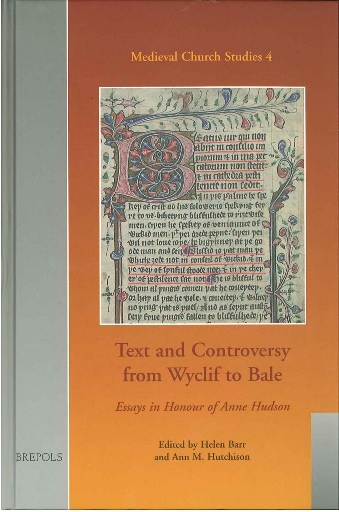
Text and Controversy from Wyclif to Bale
Essays in Honour of Anne Hudson
show More to view fulltext, buy and share links for:Text and Controversy from Wyclif to Bale show Less to hide fulltext, buy and share links for: Text and Controversy from Wyclif to BaleText and Controversy from Wyclif to Bale reflects and develops Anne Hudson’s pioneering work in textual criticism and religious controversy from the late medieval period to the Reformation. Written by newly emergent as well as internationally recognised scholars, the volume explores the wide spectrum of religious thought and practices between c. 1360 and c. 1560. Many essays, following the methodology of Anne Hudson’s scholarship, engage in the close study of manuscripts and archival holdings, disclosing new material and offering significant re-evaluation of documentary evidence and neglected texts. At a time of urgent calls for the reform of the Church, both in Britain and in mainland Europe, the voices of heresy can not always be distinguished from those of orthodox critics. Anne Hudson’s coinage of the term ‘grey area’ to describe the indeterminate boundary between radical orthodoxy and heterodoxy provides the lead for investigations into theological debate, devotional habits, and censorship. The volume significantly redefines our understanding of texts, history, and controversies from Wyclif to Bale.
-
-
-
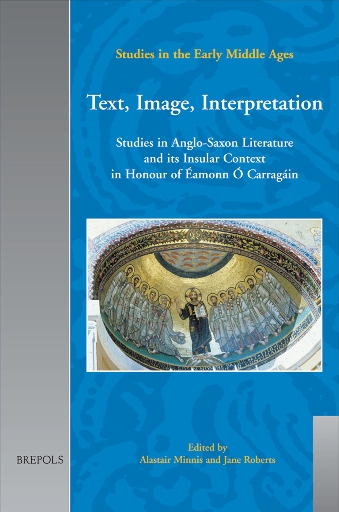
Text, Image, Interpretation:
Studies in Anglo-Saxon Literature and its Insular Context in Honour of Éamonn Ó Carragáin
show More to view fulltext, buy and share links for:Text, Image, Interpretation: show Less to hide fulltext, buy and share links for: Text, Image, Interpretation:In emulation of Professor Éamonn Ó Carragáin, who has, over the last few decades, demonstrated how words and images together join in that extraordinary cultural achievement which is the Ruthwell Cross, the volume seeks to transcend the established methods of the single discipline.
The twenty-six essays draw together insights from fields as diverse as archaeology, art history, and liturgy to reflect on the literature and material culture of the Anglo-Saxons. The first section looks outwards from the insular context, to medieval Rome, more generally to western Europe, and backwards to the world-geography of the ancient world; its illustrations include colour plates to illumine the hangings, clothing and vestments extant from Anglo-Saxon England. A range of texts is considered in the central section, Latin, English, and Old Norse. The third section focuses on sculpture, buildings and the insular landscape, juxtaposing the sculptured stonework of Northern Britain with early Christian monuments and remains from Ireland; among the illustrations are striking coloured photographs of Irish ecclesiastical sites. The contributors are from Canada, the United States, Italy, Britain, and Ireland.
-
-
-
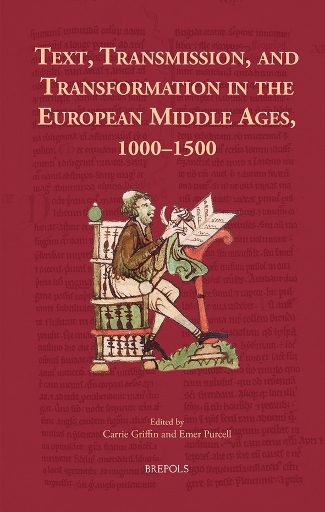
Text, Transmission, and Transformation in the European Middle Ages, 1000–1500
show More to view fulltext, buy and share links for:Text, Transmission, and Transformation in the European Middle Ages, 1000–1500 show Less to hide fulltext, buy and share links for: Text, Transmission, and Transformation in the European Middle Ages, 1000–1500These essays are concerned primarily with the different ways in which European writers, translators, and readers engaged with texts and concepts, and with the movement and exchange of those texts and ideas across boundaries and geographical spaces. It brings together new research on Anglophone and Latinate writings, as well as on other vernaculars, among them Old Norse, Anglo-Saxon, Medieval Irish, Welsh, Arabic, Middle Dutch, Middle German, French, and Italian, including texts and ideas that are experienced in aural and oral contexts, such as in music and song. Texts are examined not in isolation but in direct relation and as responses to wider European culture; several of the contributions theorize the translation of works, for example, those relating to spiritual instruction and prayer, into other languages and new contexts.
The essayists share a common concern, then, with the transmission and translation of texts, examining what happens to material when it moves into contexts other than the one in which it was produced; the influence that scribes, translators, and readers have on textual materiality and also on reception; and the intermingling different textual traditions and genres. Thus they foreground the variety and mobility of textual cultures of the Middle Ages in Europe, both locally and nationally, and speak to the profound connections and synergies between peoples and nations traceable in the movement and interpretation of texts, versions, and ideas. Together the essays reconstruct an outward-looking, networked, and engaged Europe in which people used texts in order to communicate, discover, and explore, as well as to record and preserve.
-
-
-

Texte et discours en moyen français
Actes du XIe Colloque international sur le moyen français
show More to view fulltext, buy and share links for:Texte et discours en moyen français show Less to hide fulltext, buy and share links for: Texte et discours en moyen françaisC’est dans le cadre du renouveau de la linguistique diachronique et de l’attention croissante portée au moyen français que s’inscrivent les présentes études sur la linguistique textuelle du moyen français. Quels sont, dans cette période, les éléments linguistiques contribuant à la structuration du texte? Comment la cohésion textuelle et la continuité thématique sont-elles assurées? Les contributions réunies ici explorent ces domaines, en décrivant l’emploi d’une série de connecteurs, modalisateurs et signes de ponctuation et en analysant les mécanismes sous-jacents au fonctionnement des expressions anaphoriques et des constructions topicalisantes et focalisantes.
Le présent volume, qui est le fruit du XIe colloque international sur le moyen français tenu à Anvers (19-21 mai 2005), offre une analyse originale et détaillée des outils linguistiques dont dispose le moyen français pour rendre accessible son discours.
-
-
-
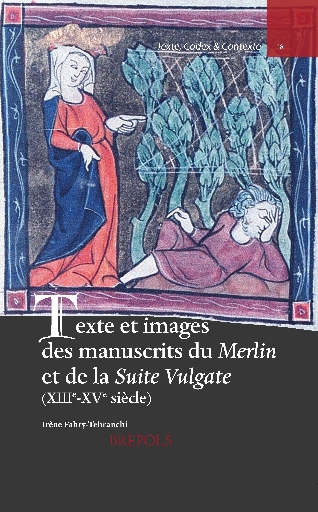
Texte et images des manuscrits du Merlin et de la Suite Vulgate (XIIIe-XVe siècle)
show More to view fulltext, buy and share links for:Texte et images des manuscrits du Merlin et de la Suite Vulgate (XIIIe-XVe siècle) show Less to hide fulltext, buy and share links for: Texte et images des manuscrits du Merlin et de la Suite Vulgate (XIIIe-XVe siècle)Rédigée dans la première moitié du XIII e siècle, la Suite Vulgate du Merlin en prose constitue la dernière pièce du cycle du Graal. Partagée entre le déroulement de la vie de Merlin, qui lui donne une unité de type biographique, et la peinture de la jeunesse héroïque du roi Arthur, cette suite rétrospective sert de transition vers le Lancelot. Elle expose la dynamique d’écriture et l’émulation suscitées par le développement de la prose arthurienne et l’effort de mise en cycle. L’étude de la mise en recueil, de la mise en page et de l’illustration des manuscrits éclaire le mode de production et de réception d’ oeuvres qui continuent d’être copiées et enluminées tout au long du Moyen Âge. Le Merlin et la Suite Vulgate, le plus souvent intégrés à des compilations centrées sur l’histoire du Graal, entretiennent un lien particulier avec le Joseph d’Arimathie, l’Estoire del saint Graal et les Prophéties de Merlin, mais circulent aussi dans des recueils d’ambition didactique ou historique.
Si l’écriture de la Suite Vulgate favorise l’intégration cyclique du Merlin propre, ces textes et leurs programmes iconographiques développent une veine militaire et historique qui interroge leur appartenance générique et tranche avec l’orientation religieuse ou courtoise des autres œuvres de la Vulgate arthurienne.
-
-
-
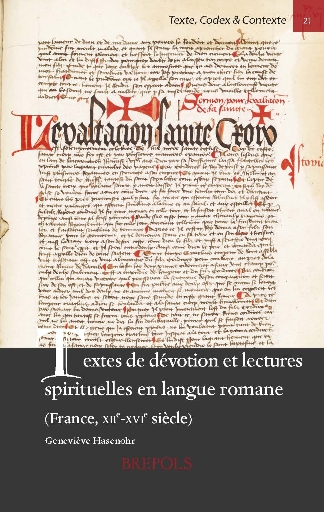
Textes de dévotion et lectures spirituelles en langue romane (France, XIIe-XVIe siècle)
show More to view fulltext, buy and share links for:Textes de dévotion et lectures spirituelles en langue romane (France, XIIe-XVIe siècle) show Less to hide fulltext, buy and share links for: Textes de dévotion et lectures spirituelles en langue romane (France, XIIe-XVIe siècle)Ce volume réunit 27 articles que Geneviève Hasenohr a consacrés à la littérature de dévotion médiévale entre 1978 et 2007. Études et éditions de textes romans font toucher du doigt ce que furent au quotidien les modèles de vie chrétienne et les lectures spirituelles proposés aux laïcs en France entre e et e siècle, leur fonds monastique commun et leur touche propre. Cette reprise est complétée par la publication actualisée d’une documentation inédite, attendue depuis des décennies par les médiévistes : une partie des notices documentaires primitivement destinées à prendre place dans le t. 2 (jamais paru) du vol. VIII du Grundriss der romanischen Literaturen des Mittelalters : La littérature ançaise aux e et e siècles (t.1, Heidelberg, 1988). uelques études plus philologiques, une bibliographie de l’auteur et plusieurs index complètent la sélection.
Chartiste, ancien membre de l’École Française de Rome, Geneviève Hasenohr est une philologue, historienne des textes de spiritualité médiévaux en langue romane. Elle a dirigé la Section romane de l’Institut de Recherche et d’Histoire des Textes (CNRS) et enseigné à l’Université de Paris-Sorbonne ainsi qu’à l’École Pratique des Hautes Études. Elle est correspondante de l’Académie des Inscriptions et Belles-Lettres.
-
-
-
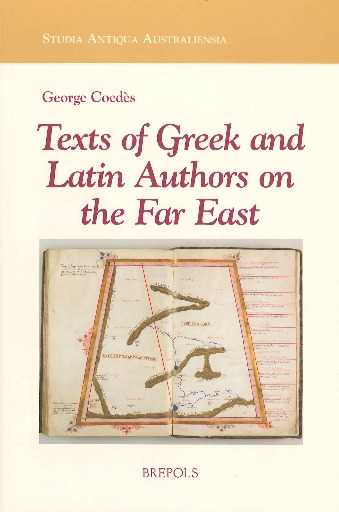
Texts of Greek and Latin Authors on the Far East
From the 4th C. B.C.E. to the 14th C. C.E.
show More to view fulltext, buy and share links for:Texts of Greek and Latin Authors on the Far East show Less to hide fulltext, buy and share links for: Texts of Greek and Latin Authors on the Far EastThis volume comprises a unique collection of Greek and Latin texts containing references to the Far East. Compiled by George Coedès (1886-1969) and published by him in 1910, these well-selected writings have waited until now for an English translation. The texts range from ‘Ctesias’ in the Fourth Century BCE to Byzantine writers of the 14th Century CE like Nicephorus Gregoras. There are allusions in literary works, both prose and verse, as well as extracts from geographers and historians, some tangential, others giving in-depth descriptions. Even when these are based on second or third hand information they are the basis for any study of the Far East seen through Western eyes. Coedès collected his information very thoroughly and his presentation of the material betokens a sound grasp of all the highly diverse though related literature. The Greek and Latin texts in this volume have been translated direct from the original languages by John Sheldon with an introductory essay by Sam Lieu as well as a translation by Greg Fox of the original preface and introduction by George Coedès.
-
-
-
Texts, Practices, and Groups. Multidisciplinary approaches to the history of Jesus’ followers in the first two centuries
First Annual Meeting of Bertinoro (2-5 October 2014)
show More to view fulltext, buy and share links for:Texts, Practices, and Groups. Multidisciplinary approaches to the history of Jesus’ followers in the first two centuries show Less to hide fulltext, buy and share links for: Texts, Practices, and Groups. Multidisciplinary approaches to the history of Jesus’ followers in the first two centuriesWithin the contemporary renewal of the exegetical and historical research on Jesus and early Christianity, this book focuses on a wider knowledge of the social and cultural context of the first two centuries, thanks to a systematic research of documentary materials and archaeological data (epigraphs and documentary papyri). Secondly, the book faces the increasingly perceived need to use all the existing literary material for the reconstruction of the historical Jesus and the first groups of his followers. Thirdly, the book stresses the importance of giving space to new epistemological and methodological perspectives in the field of human sciences. The last section of the volume is dedicated to the connection of contemporary research with the interpretations of Jesus and early Christianity developed in the modern age.
-
-
-
Textual Transmission in Byzantium: between Textual Criticism and Quellenforschung
show More to view fulltext, buy and share links for:Textual Transmission in Byzantium: between Textual Criticism and Quellenforschung show Less to hide fulltext, buy and share links for: Textual Transmission in Byzantium: between Textual Criticism and QuellenforschungA workshop was held in February 2012 in Madrid to stimulate a debate on textual criticism centred on the analysis of Byzantine texts and their modes of publication, rewriting and diffusion. The main aim was to provide future editors or scholars of the history of texts with a rich typology of concepts to guide their task, such as interpolation, paraphrasis, metaphrasis, quotation, collection, amplification or falsification, among others, but always taking into account that the principles upon which the discipline of textual criticism was founded needed to be reconsidered when dealing with the transmission of Byzantine texts. The present book brings together the different case studies produced by the participants of the workshop into a coherent whole and distributes them into five different sections according to their methodological approaches: 1. Language and style; 2. Virtual libraries and crossed readings; 3. Philosophical treatises and collections; 4.The sources of history; 5. Law texts and their reception. The results of the different approaches put forward by the contributors offer a broad palette of methodological strategies that are, to a great extent, complementary, and will, so we hope, illuminate the task of the future editors with new reflections.
List of contributors: F. J. Andrés Santos, M. Bandini, D. Bianconi, B. Crostini, L. Cuppi, J. M. Featherstone, T. Fernández, E. Gielen, P. Golitsis, M. Hinterberger, C. Macé, M. Menchelli, M. Miglietta, P. Odorico, I. Pérez Martín, F. Pontani, A. Rhoby, J.-D. Rodríguez Martín, F. Ronconi, J. Signes Codoñer, T. E. van Bochove, S. Wahlgren, T. Wauters.
-
-
-
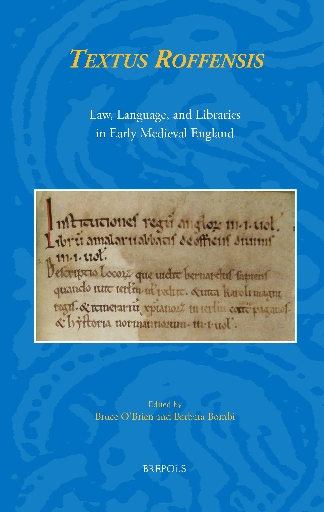
Textus Roffensis
Law, Language, and Libraries in Early Medieval England
show More to view fulltext, buy and share links for:Textus Roffensis show Less to hide fulltext, buy and share links for: Textus RoffensisTextus Roffensis, a Rochester Cathedral book of the early twelfth century, holds some of the most significant texts issued in early medieval England, ranging from the oldest English-language law code of King Æthelberht of Kent (c. 600) to a copy of Henry I’s Coronation Charter (5 August 1100). Textus Roffensis also holds abundant charters (including some forgeries), narratives concerning disputed property, and one of the earliest library catalogues compiled in medieval England. While it is a familiar and important manuscript to scholars, however, up to now it has never been the object of a monograph or collection of wide-ranging studies. The seventeen contributors to this book have subjected Textus Roffensis to close scrutiny and offer new conclusions on the process of its creation, its purposes and uses, and the interpretation of its laws and property records, as well as exploring significant events in which Rochester played a role and some of the more important people associated with the See. The work of the contributors takes readers into the mind of the scribes and compiler (or patron) behind the Textus Roffensis, as well as into the origins and meaning of the texts that the monks of early twelfth-century Rochester chose to preserve. The essays contained here not only set the study of the manuscript on a firm foundation, but also point to new directions for future work.
-
-
-
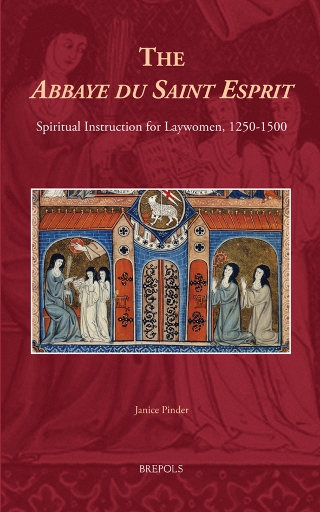
The Abbaye du Saint Esprit
Spiritual Instruction for Laywomen, 1250–1500
show More to view fulltext, buy and share links for:The Abbaye du Saint Esprit show Less to hide fulltext, buy and share links for: The Abbaye du Saint EspritThe Abbaye du Saint Esprit was a successful work of vernacular spiritual advice for women, surviving in sixteen manuscripts and a widely copied Middle English translation. Unlike many other didactic religious texts, it offers few prescriptions for behaviour; rather, it instructs the reader to build a convent of virtues in her conscience and uses the allegorical structure of the building and its inhabitants to arrange brief teachings on prayer and virtuous practice. Between its genesis in the last quarter of the thirteenth century to its final development towards the end of the fifteenth, it was reworked several times for new audiences of women both lay and cloistered, bourgeois and aristocratic. The examination of these successive adaptations offers insights into the growth of lay religious culture, the participation of women in new religious movements, and the use and transformation of twelfth and early thirteenth-century monastic formation literature for new audiences.This book also offers, for the first time, editions of all the French versions of the Abbaye and a modern English translation of the earliest version.
-
-
-

The Cent Nouvelles nouvelles (Burgundy-Luxembourg-France, 1458 - c. 1550)
Text and Paratext, Codex and Context
show More to view fulltext, buy and share links for:The Cent Nouvelles nouvelles (Burgundy-Luxembourg-France, 1458 - c. 1550) show Less to hide fulltext, buy and share links for: The Cent Nouvelles nouvelles (Burgundy-Luxembourg-France, 1458 - c. 1550)A collaborative investigation of one of the best-known works of late medieval European literature, the Franco-Burgundian collection of short stories known as the Cent Nouvelles nouvelles. Modelled loosely on Boccaccio’s Decameron and incorporating elements from Old French fabliaux as well as Poggio Bracciolini’s Liber Facetiarum, the anonymous collection attributes its morally challenging and frequently humorous tales to named narrators including Philip the Good, Duke of Burgundy and Louis of Luxembourg, Count of Saint Pol.
The contribution of this new volume of essays is threefold: - empirical, in that it brings entirely new interdisciplinary insights into the study of the genesis and reception of the work; - methodological, in that it integrates study of the text within a 360-degree evaluation of the work’s manuscript and early printed context; and - conceptual, in that it seeks to understand the social dimensions of textual production and consumption.
These approaches unite ten principal contributions by specialists in the fields of art history, book history, court history and linguistics from France, the Netherlands, the USA and the UK.
-
-
-
The Collectio Avellana and the Development of Notarial Practices in Late Antiquity
show More to view fulltext, buy and share links for:The Collectio Avellana and the Development of Notarial Practices in Late Antiquity show Less to hide fulltext, buy and share links for: The Collectio Avellana and the Development of Notarial Practices in Late AntiquityThe essays collected in this volume study the competences and status of late antique notaries, who from simple stenographers acquired responsibilities and growing importance within the imperial court and in the papal chancellery, being charged with drawing up the acts of the consistorium and the ecclesiastical councils, and with preserving and often delivering sensitive documents from Rome to Constantinople. The analysis of their multiple activities and of the functions they occupied, in the imperial and episcopal archives as well as in the libraries of the great Roman domus, also allows us to verify some new hypotheses on the compiler and on the editing of the Collectio Avellana. Since in the Middle Ages, the collection was transcribed into two main manuscripts both preserved in Santa Croce di Fonte Avellana, the essays also try to understand what role the founder of the Monastery, San Pier Damiani, played in preserving this collection.
-
-
-
The Disputatio Chori et Praetextati. The Roman Calendar for Beginners
show More to view fulltext, buy and share links for:The Disputatio Chori et Praetextati. The Roman Calendar for Beginners show Less to hide fulltext, buy and share links for: The Disputatio Chori et Praetextati. The Roman Calendar for BeginnersThe first book of Macrobius' Saturnalia, written probably in the 430s AD, includes a historical exposition of the Roman calendar with a dramatic date some fifty years earlier, set in the mouth of the learned senator Vettius Agorius Praetextatus, followed by more technical detail at the request of an Egyptian named Horus, who as a foreigner is allowed to seek elementary information for which no one brought up in Roman culture would need to ask.
This text was excerpted in early medieval Ireland, with some but by no means all its pagan matter excised, to provide an introduction for those who at best understood the rules of this recent import but not the rationale for them; it is quoted by Bede as Disputatio Chori et Praetextati, Chorus being a corrupted form of Horus.
The excerpt took on a textual life of its own, which the present edition, the first devoted to the Disputatio rather than Macrobius, seeks to clarify; it examines the manuscripts and the relations between them, presents a critical edition with apparatus criticus and translation, and attaches a full-scale commentary concerned above all with the information provided in the text.
-
-
-
The Liber de ordine creaturarum
show More to view fulltext, buy and share links for:The Liber de ordine creaturarum show Less to hide fulltext, buy and share links for: The Liber de ordine creaturarumThe Liber de ordine creaturarum is an anonymous Latin work with an Irish provenance that dates back to the seventh century. It presents the creation as the divine handiwork and is notable for serving as both a commentary on the Hexaemeron (Six-day Work) in Genesis and as one of the earliest works of systematic theology. Although previously attributed to Isidore of Seville, the Liber de ordine creaturarum is far more than a mere compilation of 'authorities.' Instead, it emphasizes the inherent order that exists within the creation itself.
-
-
-
The Pal.M.A.I.S. Syro-Italian Joint Project
Selected Essays on the Southwest Quarter and the Peristyle Building of Palmyra in Memory of Prof. Maria Teresa Grassi
show More to view fulltext, buy and share links for:The Pal.M.A.I.S. Syro-Italian Joint Project show Less to hide fulltext, buy and share links for: The Pal.M.A.I.S. Syro-Italian Joint ProjectThe Pal.M.A.I.S. Syro-Italian joint project at Palmyra, established in 2007, aimed to shed light on private housing in the Roman East. Through excavations in Palmyra’s southwest quarter, the remains of a residential complex, the ‘Peristyle Building’, were uncovered; this site was built in the Roman period but was inhabited up to the eighth century ad.
This volume, dedicated to Prof. Maria Teresa Grassi (Università degli Studi di Milano), who co-directed the project together with Dr Waleed al-As‘ad (Museum of Palmyra), presents selected studies stemming from the Pal.M.A.I.S. project. It draws together contributions dedicated to the topography of the southwest quarter, the excavation of the Peristyle Building, and selected classes of material. Through detailed analysis and the presentation of fresh data, this volume sheds new light on a relatively unexplored sector of a threatened UNESCO World Heritage site.
-
-
-
The Protevangelium of James
show More to view fulltext, buy and share links for:The Protevangelium of James show Less to hide fulltext, buy and share links for: The Protevangelium of JamesAs a prehistory to the Nativity accounts of the gospels of Matthew and Luke the Protevangelium of James, dated to the second half of the second century, aimed to fill in alleged gaps in the canonical accounts of Jesus' and his mother's ancestry and births. Thus, it describes the birth of Mary, the mother of Christ, the Annunciation, the Nativity and the death of Zachariah, the high priest and father of John the Baptist.
The edition of the original Greek text has an English version on its facing pages.
The commentary pays particular attention to the early liturgical use of the Protevangelium and to artistic representations of the scenes it describes as these were the main means by which this highly influential text was transmitted throughout the known world. It also questions the usually accepted genre and purpose of the text and suggests that its author may have had a satirical intention or have intended it as an early Christian novelette, using scriptural scenes and themes as his inspiration. Maybe we have approached the Protevangelium of James with solemn faces and have been prepared to carry out serious theological investigations, whereas the many inconsistencies and glaring contradictions so obvious as to be ridiculous might suggest the author's intentions were not quite so grave or weighty.
-
-
-
The Villages of the Fayyum, a Thirteenth-Century Register of Rural, Islamic Egypt
show More to view fulltext, buy and share links for:The Villages of the Fayyum, a Thirteenth-Century Register of Rural, Islamic Egypt show Less to hide fulltext, buy and share links for: The Villages of the Fayyum, a Thirteenth-Century Register of Rural, Islamic EgyptMedieval Islamic society was overwhelmingly a society of peasants, and the achievements of Islamic civilization depended, first and foremost, on agricultural production. Yet the history of the medieval Islamic countryside has been neglected or marginalized. Basic questions such as the social and religious identities of village communities, or the relationship of the peasant to the state, are either ignored or discussed from a normative point of view.
This volume addresses this lacuna in our understanding of medieval Islam by presenting a first-hand account of the Egyptian countryside. Dating from the middle of the thirteenth century, Abū ‘Uthmān al-Nābulusī’s Villages of the Fayyum is as close as we get to the tax registers of any rural province. Not unlike the Domesday Book of medieval England, al-Nābulusī’s work provides a wealth of detail for each village which far surpasses any other source for the rural economy of medieval Islam. It is a unique, comprehensive snap-shot of one rural society at one, significant, point in its history, and an insight into the way of life of the majority of the population in the medieval Islamic world. Richly annotated and with a detailed introduction, this volume offers the first academic edition of this work and the first translation into a European language. By opening up this key source to scholars, it will be an indispensable resource for historians of Egypt, of administration and rural life in the premodern world generally, and of the Middle East in particular.
-
-
-

The "Costuma d’Agen"
A Thirteenth-Century Customary Compilation in Old Occitan. Transcribed from The "Livre Juratoire"
show More to view fulltext, buy and share links for:The "Costuma d’Agen" show Less to hide fulltext, buy and share links for: The "Costuma d’Agen"The Costuma d’Agen (customary laws of the Agenais, in south-west France) compiled in Occitan at various times in the thirteenth century and preserved in the Livre Juratoire, or swearing copy (Bibliothèque municipale d’Agen, MS 42), is here transcribed with an English translation on facing pages. An introduction and an index are included. Appendices provide the text of five chapters “missing” from this manuscript, along with several pertinent charters from Agen and a fuller description of the Livre juratoire by Professor M. Alison Stones, University of Pittsburgh. The manuscript contains many colored illustrations and capitals.
The Costuma emphasizes the power of the local city council, which often seems to override that of the local count. The laws or customs written in the book deal with many topics including jurisdiction, citizenship and military duties, crime, property, civil and criminal procedure, the local wine and salt trades, and local feudal law.
F. R. P. (Ron) Akehurst (B.A. Oxford, 1962, Ph.D. Colorado, 1967, in French; J.D., Minnesota, 1986). A professor of French at Minnesota since 1968. He has published translations of two other medieval French customaries.
-
-
-
The 'Alawī Religion: An Anthology
show More to view fulltext, buy and share links for:The 'Alawī Religion: An Anthology show Less to hide fulltext, buy and share links for: The 'Alawī Religion: An AnthologyThe ‘Alawī religion, known for most of its history by the name Nuṣayriyya, emerged in Iraq over a millennium ago. An esoteric, syncretistic religion with a close affinity to Shī‘ī Islam, its origins are shrouded in obscurity. Over time, beliefs and rituals deriving from paganism, Zoroastrianism and Christianity were grafted to the radical Shī‘ī substrate, giving the religion its distinctive character. Throughout their history the ‘Alawites were a persecuted religious minority, but in the 1970s they came to power in Syria and retained absolute rule until recently. There is also a significant population in Hatai Province in southern Turkey.
Arising from the authors’ long-standing interest in the ‘Alawī religion, this anthology offers for the first time a selection from the distinctive literature of the mysterious religion. The book opens with a detailed introduction setting the background for the themes it will cover: the mystery of the divinity in the ‘Alawī faith; rituals and ceremonies; calendar and festivals; the doctrine of reincarnation; initiation into the divine mysteries and the esoteric circle; and finally, the identity and self-definition of the religion’s followers vis-à-vis Islam and other religions.
-
-
-
The Abel Distinctions
show More to view fulltext, buy and share links for:The Abel Distinctions show Less to hide fulltext, buy and share links for: The Abel DistinctionsPeter the Chanter was a master at Notre-Dame cathedral in Paris in the late 12th century. Among his many works is The Abel Distinctions, an alphabetized collection that treats key words by ‘distinguishing’ their various symbolic meanings in accordance with the traditions of biblical exegesis. The work was innovative in form and deeply conservative in content. Of special use to preachers who would shape a sermon around such sets of distinctions, it also appealed in general to clerics and laity interested in biblical meaning and allegory. The Abel Distinctions may have been the first collection of its kind; it spawned dozens of imitators through the next two centuries and more. Its immense popularity and influence is indicated by its nearly ninety extant manuscripts.
The source text of this volume appeared in Corpus Christianorum. Continuatio Mediaeualis as Petrus Cantor, Distinctiones Abel (CCCM, 288-288A). References to the corresponding pages of the Corpus Christianorum edition are provided in the margins of this translation.
-
-
-
The Age of Affirmation
Venice, the Adriatic and the Hinterland between the 9th and 10th Centuries
show More to view fulltext, buy and share links for:The Age of Affirmation show Less to hide fulltext, buy and share links for: The Age of AffirmationThis volume brings together the Proceedings of the seminar held on 29 and 30 October 2015 at the Department of Humanities of Ca’ Foscari University of Venice. The title of the book, which is the same as the seminar, refers to the “age of consolidation” of Venice, that had been identified by the promoters of the initiative as the 9th and 10th centuries. All the papers in the volume, therefore, consider a Venetian reality as already formed, even in its early days; a reality, or rather a social, economic and political community which, at this moment in time, reinforces its urban aspect, and creates the basis for the growth that will characterize its history after the tenth century.
The book collects twelve papers of archaeological, historical, epigraphic and historical-artistic subject.
-
-
-
The Age of Alfred
Rethinking English Literary Culture c. 850–950
show More to view fulltext, buy and share links for:The Age of Alfred show Less to hide fulltext, buy and share links for: The Age of AlfredKing Alfred the Great (r. 871–899) remains a key figure in English literary history. Although his reputation as a scholar who was personally responsible for the translation of a number of Latin works is no longer secure, the figure of the wise king nevertheless casts a long shadow over vernacular writing from the late ninth century through to the twelfth. This volume takes stock of recent developments and debates in the field of Alfredian scholarship and showcases new directions in research. Individual chapters consider how English authors before, during, and after Alfred’s reign translated and adapted Latin works, often in innovative and imaginative ways. Other contributions provide new contexts and connections for Alfredian writing, highlighting the work of Mercian scholars and expanding the corpus beyond the works traditionally attributed to the king himself. Together, these essays force us to rethink what we mean by ‘Alfredian’ and to revise the literary history of the ‘long ninth century’.
-
-
-
The Agro-Food Market: Production, Distribution and Consumption
show More to view fulltext, buy and share links for:The Agro-Food Market: Production, Distribution and Consumption show Less to hide fulltext, buy and share links for: The Agro-Food Market: Production, Distribution and ConsumptionVolume editorial board:
Leen Van Molle (University of Leuven, Belgium), Yves Segers (University of Leuven, Belgium) (directors)
John Chartres (University of Leeds,UK) , Marc de Ferrière le Vayer (University of Tours, France), Pim Kooij (Wageningen University, Netherlands), Michael Kopsidis (IAMO, Halle (Saale), Bjørn Poulsen (Aarhus University, Denmark), Jean-Pierre Williot (University of Tours, France)
Agriculture and alimentation have, from early times, always been crucial elements in the development of market systems. Shortage and surplus gave shape to different forms of exchange and sale, to the dynamics of supply and demand, and to expanding interconnections between both regions and social groups. Farmers learned to adapt their production to market conditions and to the shifting needs and tastes of a growing and demanding public. But the path from a self-supporting way of life to the present forms of market integration in the complex, global world was far from uniform and linear. Food production, market structures and market mechanisms changed over time and differed between regions and countries of the North Sea area. This volume aims at exploring and unravelling the complexity of the agro-food market, from the field to the table.
-
-
-
The Allure of Glazed Terracotta in Renaissance Italy
show More to view fulltext, buy and share links for:The Allure of Glazed Terracotta in Renaissance Italy show Less to hide fulltext, buy and share links for: The Allure of Glazed Terracotta in Renaissance ItalyThis book explores the role of glazed terracotta sculpture in Renaissance Italy, from c. 1450 to the mid-1530s. In its brightness and intense colour glazed terracotta strongly attracted the viewer’s gaze. Its pure and radiant surfaces also had the power to raise the mind and soul of the faithful to contemplation of the divine. The quasi-magical process of firing earthenware coated with tin-based paste, promoted initially by imports from the East, was seized upon by Luca della Robbia, who realised that glazed terracotta was the ideal vehicle for the numinous. He began to create sculptures in the medium in the 1430s, and continued to produce them for the rest of his life. After Luca’s death, his nephew, Andrea della Robbia, inherited his workshop in Florence and continued to develop the medium, together with his sons. The book considers some of the large-scale altarpieces created by the Della Robbia family in parallel with a number of small-scale figures in glazed terracotta, mostly made by unidentified sculptors. The captivating illustrations integrate these two categories of glazed terracotta sculpture into the history of Italian Renaissance art. By focusing on a specific artistic medium which stimulated piety in both ecclesiastical and domestic contexts, this book offers new ways of thinking about the religious art of the Italian Renaissance. The links it establishes between lay devotion and the creation of religious images in glazed terracotta invite reassessment of habitual distinctions between private and public art.
-
-
-
The Anaphoral Tradition in the ‘Barcelona Papyrus’
show More to view fulltext, buy and share links for:The Anaphoral Tradition in the ‘Barcelona Papyrus’ show Less to hide fulltext, buy and share links for: The Anaphoral Tradition in the ‘Barcelona Papyrus’Since the discovery in the 1950’s of the so-called 'Barcelona Papyrus', the anaphora contained within it has remained the most understudied classical anaphora. However, a close analysis of this anaphora can reshape liturgical historians’ understanding of a number of classical anaphoras, and thus their approach to anaphoral development more broadly. This anaphora requires scholars to rethink questions concerning the construction, geographical provenance, and structural patterns of early anaphoras and their units. It is a witness to a very early form of Eucharistic praying, and points to various ways in which older less developed Eucharistic prayers developed into the anaphoral patterns common in the fourth century. As such, an analysis of this anaphora is of historical and methodological interest. This anaphora is also an early witness to Egyptian Eucharistic praying. It stems from the same anaphoral tradition as the anaphora of St. Mark, but on the whole it is an earlier witness to that tradition. The anaphora in the Barcelona Papyrus also bears a number of structural and textual similarities to the anaphora described in the Mystagogical Catecheses, which is often attributed to Cyril of Jerusalem. As such, it sheds further light on the relationship between Egypt and Jerusalem.
-
-
-
The Angela Burdett-Coutts Collection of Greek Manuscripts
show More to view fulltext, buy and share links for:The Angela Burdett-Coutts Collection of Greek Manuscripts show Less to hide fulltext, buy and share links for: The Angela Burdett-Coutts Collection of Greek ManuscriptsBaroness Angela Burdett-Coutts (1814-1906), descendant of a wealthy and well-known family of bankers, inherited quite young, through a series of unpredictable circumstances, the enormous fortune of Thomas Coutts, her maternal grand-father. She spent most of her long life in London, where she occupied a prominent position in society, becoming well-known not only for her splendid life-style and her important literary and political acquaintances, as, for instance, Charles Dickens and Admiral Nelson, but also for her active role as a philanthropist. This book explores a little-known side of her life; although she did not know Greek, she became the owner of ca. 100 Greek manuscripts, mostly theological, datable between the tenth and the sixteenth century, a part of which she donated to Highgate School. The manuscripts, with all the Baroness's possessions, were dispersed at auction in 1921 and in 1987 and are now mainly divided between American and European University Libraries. This book has identified for the first time the Baroness's Greek manuscripts, located and described them in detail, with special attention to their script style and their origin, adding to their description one or two plates of each codex.
-
-
-
The Anglo-Norman Bible’s Book of Joshua, a Critical Edition
(BL Royal 1 C III)
show More to view fulltext, buy and share links for:The Anglo-Norman Bible’s Book of Joshua, a Critical Edition show Less to hide fulltext, buy and share links for: The Anglo-Norman Bible’s Book of Joshua, a Critical EditionThe Anglo-Norman Bible’s Joshua includes tales of spies, giants, the prostitute Rahab, the punishment of Achan, oracles, and Joshua’s brilliant military victories. Joshua stops the sun. The first half of the book relates Joshua’s stunning conquests in Canaan. The second half, the apportionment of the land among the tribes, detailed geographical surveys of territorial boundaries, and the death of Joshua.
Skilful, well-paced story telling is a feature of the ANB’s Joshua. To the accounts of Rahab and Achan we may add the chronicle of Joshua’s successful, crushing campaign in the wake of the destruction of Makkedah. In rapid succession, and in an annalistic style involving staccato repetition of key phrases, the narrator relates the destruction of Libnah, Lachish, Eglon, Hebron, and Debir.
The text of the ANB’s Joshua is extant in British Library Royal 1 C III (base manuscript, L) and Paris, Bibliothèque nationale de France, MS français 1 (P), both c. 1350 and both the Bibles of kings. L belonged at some point in the fifteenth century to Reading’s Benedictine abbey, entering the royal library in 1530. Characteristic of L is its occasional insertion of short glosses in English or Latin to clarify or correct the Anglo-Norman text. An illustrated text, P was prepared by an English workshop for the fourth baron de Welles, John, and his wife, Maud, daughter of William, Lord Ros. This is clearly the Bible of a wealthy and well-connected English family. After the Welles family, the manuscript belonged to Louis de Bruges († 1492), then to King Louis XII of France.
-
-
-
The Anglo-Norman Bible’s Book of Judges
(BL Royal 1 C III)
show More to view fulltext, buy and share links for:The Anglo-Norman Bible’s Book of Judges show Less to hide fulltext, buy and share links for: The Anglo-Norman Bible’s Book of JudgesA silver-tongued assassin, a motherly prophetess, a consecrated strongman unable to resist the charms of foreign women: the Anglo-Norman Bible’s Book of Judges features a roll-call of unlikely heroes. At the book’s core is a cycle of saviour stories. Twelve times the Israelites embrace foreign gods, succumb to neighbouring enemies, repent and are delivered by a ‘judge’. As Israel itself descends into ever-greater religious, moral and political decay, the narrative pattern also unravels. The book ends bleakly, with stories of rape, murder and civil war. The stage is set for a king.
Gideon-a doubting Thomas who repeatedly ‘tests’ God-and Samson-lion-killer and lover of Delilah-were firm medieval favourites. Their tales and those of other flawed judges inspired heroic deeds on the battlefield and provided lessons on how to behave (and indeed how not to behave). With its remarkable heroines, moreover-from cut-throat Jael, who wields a tent-peg to devastating effect, to Jephthah’s dignified daughter, sacrificed because of her father’s rash vow-this is a book that prompted much reflection in the Middle Ages on the place of women in society.
The Anglo-Norman Bible’s Book of Judges survives in two fourteenth-century manuscripts: British Library Royal MS 1 C III (L), noted for its multilingual glosses, and the richly illustrated Paris, Bibliothèque nationale de France, fonds français 1 (P). The critical text, based on L, has been prepared by Pitts. An introduction and notes by Grange aim to elucidate and interpret the Anglo-Norman Bible’s Book of Judges for the modern reader.
-
-
-
The Anglo-Norman Bible’s Books of Samuel, a Critical Edition
(BL Royal 1 C III)
show More to view fulltext, buy and share links for:The Anglo-Norman Bible’s Books of Samuel, a Critical Edition show Less to hide fulltext, buy and share links for: The Anglo-Norman Bible’s Books of Samuel, a Critical EditionTales of treachery and friendship, adultery and murder, rape and revenge, as well as prophecy, repentance, forgiveness and thanksgiving — such is the stuff of the Anglo-Norman Bible’s Books of Samuel. They recount the life of the last of Israel’s judges but include some of the world’s best-known characters — Saul, David and Jonathan, Goliath, Bathsheba, and Absalom.
The first book traces the life of Samuel, and the initial success of King Saul, chosen to satisfy the Israelites’ demand for a king. After Saul loses God’s favour, David enters his court to console him, but Saul envies David’s success. When Saul dies in battle, David succeeds him. In book two, David consolidates control over his kingdom, but his adultery with Bathsheba precipitates the reverses of the final chapters. Historically, the Books of Samuel trace the creation of Israel’s monarchy and explain its ultimate failure. Religiously, they relate Israel’s continuing relationship with God and the establishment of Jerusalem as the religious and political capital of the new kingdom.
Two mid-fourteenth-century manuscripts preserve the text of the Anglo-Norman Bible’s Samuel. The base manuscript (L), British Library Royal 1 C III, notable for its inclusion of multi-lingual glosses, was acquired by Henry VIII from the Benedictine Abbey of Reading in 1530. The lavishly illustrated Paris, Bibliothèque nationale de France, MS français 1 (P), produced in England for the baronial de Welles family, later belonged to King Louis XII of France. Brent A. Pitts has prepared the critical edition and Maureen Boulton’s introduction and notes elucidate the text and its interpretation by medieval commentators.
-
-
-
The Anglo-Saxon Psalter
show More to view fulltext, buy and share links for:The Anglo-Saxon Psalter show Less to hide fulltext, buy and share links for: The Anglo-Saxon PsalterThe psalms are at the heart of Christian devotion, in the Middle Ages and still today. Learned early and sung weekly by every medieval monastic and cleric, the psalms were the language Christ and his ancestor David used to speak to God. Powerful and plaintive, angry and anguished, laudatory and lamenting: the psalms expressed the feelings and thoughts of the individuals who devised them and those who sang them privately or publicly in Anglo-Saxon England many generations later. Psalters from Anglo-Saxon England are the largest surviving single group of manuscripts, and also form a very significant percentage of the fragments of manuscripts extant from the period. Psalters were central to the liturgy, particularly for the daily Office, and were the first schoolbooks for the learning of Latin and Christian doctrine. Moreover, from Anglo-Saxon England comes the earliest complex of vernacular psalter material, including glossed and bilingual psalters, complete psalter translations, and poems based on individual psalms and on psalmic structures. The lament psalms are remarkably similar to the Old English elegies in both form and imagery, and the freedom with which vernacular adaptors of the psalms went about their work in Anglo-Saxon England suggests an appropriation of the psalter not as the sacred and unchanging Word but as words that could be turned to use for meditation, study, reading, and private prayer. Worth investigation are both individual figures who used the psalms such as Bede, Alfred, and Ælfric, and also the unknown compilers and scribes who developed new layouts for psalter manuscripts and repurposed earlier or Continental manuscripts for use in Anglo-Saxon England. In Latin and in the vernacular, these codices were central to Anglo-Saxon spirituality, while some of them also continued to be used well into the later Middle Ages.
-
-
-
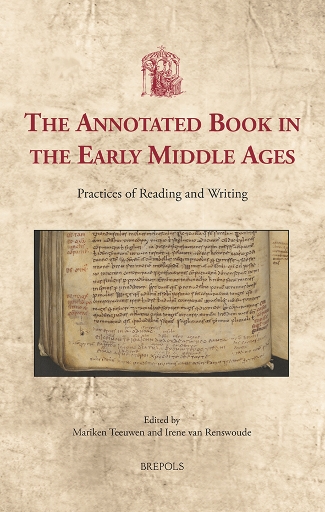
The Annotated Book in the Early Middle Ages
Practices of Reading and Writing
show More to view fulltext, buy and share links for:The Annotated Book in the Early Middle Ages show Less to hide fulltext, buy and share links for: The Annotated Book in the Early Middle AgesAnnotations in modern books are a phenomenon that often causes disapproval: we are not supposed to draw, doodle, underline, or highlight in our books. In many medieval manuscripts, however, the pages are filled with annotations around the text and in-between the lines. In some cases, a ‘white space’ around the text is even laid out to contain extra text, pricked and ruled for the purpose. Just as footnotes are an approved and standard part of the modern academic book, so the flyleaves, margins, and interlinear spaces of many medieval manuscripts are an invitation to add extra text.
This volume focuses on annotation in the early medieval period. In treating manuscripts as mirrors of the medieval minds who created them - reflecting their interests, their choices, their practices - the essays explore a number of key topics. Are there certain genres in which the making of annotations seems to be more appropriate or common than in others? Are there genres in which annotating is ‘not done’? Are there certain monastic centres in which annotating practices flourish, and from which they spread?
The volume investigates whether early medieval annotators used specific techniques, perhaps identifiable with their scribal communities or schools. It explores what annotators actually sought to accomplish with their annotations, and how the techniques of annotating developed over time and per region.
-
-
-
The Anthropology of St Gregory Palamas
The Image of God, the Spiritual Senses, and the Human Body
show More to view fulltext, buy and share links for:The Anthropology of St Gregory Palamas show Less to hide fulltext, buy and share links for: The Anthropology of St Gregory PalamasHow are we to regard our body? As a prison, an enemy, or, maybe, an ally? Is it something bad that needs to be humiliated and extinguished, or should one see it as a huge blessing, that deserves attention and care? Is the body an impediment to human experience of God? Or, rather, does the body have a crucial role in this very experience? Alexandros Chouliaras’ book The Anthropology of St Gregory Palamas: the Image of God, the Spiritual Senses, and the Human Body argues that the fourteenth-century monk, theologian, and bishop Gregory Palamas has interesting and persuasive answers to offer to all these questions, and that his anthropology has a great deal to offer to Christian life and theology today.
Amongst this book’s contributions are these: for Palamas, the human is superior to the angels concerning the image of God for specific reasons, all linked to his corporeality. Secondly, the spiritual senses refer not only to the soul, but also to the body. However, in Paradise the body will be absorbed by the spirit, and acquire a totally spiritual aspect. But this does not at all entail a devaluing of the body. On the contrary, St Gregory ascribes a high value to the human body. Finally, central to Palamas’ theology is a strong emphasis on the human potentiality for union with God, theosis: that is, the passage from image to likeness. And herein lies, perhaps, his most important gift to the anthropological concerns of our epoch.
-
-
-
The Apocryphal Acts of the Apostles in Latin Christianity
Proceedings of the First International Summer School on Christian Apocryphal Literature (ISCAL), Strasbourg, 24-27 June 2012
show More to view fulltext, buy and share links for:The Apocryphal Acts of the Apostles in Latin Christianity show Less to hide fulltext, buy and share links for: The Apocryphal Acts of the Apostles in Latin ChristianityThe lives of the apostles after Pentecost are described in the books of the New Testament only in part. Details of their missionary wanderings to the remote corners of the world are found in writings not included in the biblical canon, known as the Apocryphal Acts of the Apostles. In the early Middle Ages these originally Greek writings were translated and rewritten in Latin and circulated under the title Virtutes apostolorum. These texts became immensely popular. They were copied in numerous manuscripts, both as a comprehensive collection with a chapter for each apostle and as individual texts, echoing the needs of monastic and other religious communities that used these texts to celebrate the apostles as saints.
The First International Summer School on Christian Apocryphal Literature (Strasbourg, 2012) concentrated on the transmission of the Apocryphal Acts of the Apostles in the Latin world. This volume also highlights the use of the Bible in the apocryphal Acts, the imagination of the apostles in early Christian art and poetry, and the apocryphal Acts in early medieval print. Other contributions concern the study of Christian apocryphal literature in general and in the context of the Strasbourg Summer School in particular.
-
-
-
The Apostles' Creed. Origin, History and some early Commentaries
show More to view fulltext, buy and share links for:The Apostles' Creed. Origin, History and some early Commentaries show Less to hide fulltext, buy and share links for: The Apostles' Creed. Origin, History and some early CommentariesThis work will offer a comprehensive and up-to-date account of the origin and development of the Apostles' Creed (symbolum apostolorum), the first to appear since Kelly's Early Christian Creeds (1950). Westra offers a concise Forschungsgeschichte, gathers the fruits of more recent literature, and critically discusses the work of Markschies, Kinzig, and Vinzent (Tauffragen und Bekenntnis), who presented a completely novel theory on the origin of the Apostles' Creed in 1999.
A new feature in Westra's work is its discussion of the phenomenon of credal change - a long-felt need, as the different variants. How did these variants originate, and how did they develop over the course of the centuries in the different parts of th Western Church?
Consequently, Westra presents an elaborate overview of these different variants. He discusses the testimony of wellknown authors such as Ambrose, Augustine, and Rufinus anew, and also draws attention to a number of hitherto neglected or even unknown sources, thus replacing (at least as far as the Apostles' Creed is concerned) Hahn's Bibliothek der Symbole.
-
-
-

The Appearances of Medieval Rituals
The Play of Construction and Modification
show More to view fulltext, buy and share links for:The Appearances of Medieval Rituals show Less to hide fulltext, buy and share links for: The Appearances of Medieval RitualsAppearances can be deceptive; and medieval ritual practices are in this respect no exception. They perform stability through the codification of repetitive modes of behaviour and simultaneously admit flexibility in their integration of newer forms of representation. They mask the historical contingencies of their own creation and construct alternative narratives of authority and continuity. They do not simply appear; their appearance reflects the mutual interplay of construction and modification.
This collection of eleven essays-which chronologically spans the period from the Carolingians to the Catholic Reform movement of the later sixteenth century-explores this double-edged potential in the appearance of medieval ritual practices; and, in this case, chiefly church rituals. It comprises a series of individual studies by scholars of literature, theology, music, and the visual arts. Each study examines a particular moment of change or transformation in ritual practices, illuminating, thereby, processes of ritualization. In this way, the book both provides an impulse to the recent renewal of methodological interest in ritual studies and presents individual contributions to specific scholarly discourses within this broad area.
-
-
-
The Art and Architecture of the Cistercians in Northern England, c. 1300–1540
show More to view fulltext, buy and share links for:The Art and Architecture of the Cistercians in Northern England, c. 1300–1540 show Less to hide fulltext, buy and share links for: The Art and Architecture of the Cistercians in Northern England, c. 1300–1540The Cistercian abbeys of northern England provide some of the finest monastic remains in all of Europe, and much has been written on their twelfth- and thirteenth-century architecture. The present study is the first in-depth analysis of the art and architecture of these northern houses and nunneries in the late Middle Ages, and questions many long-held opinions about the Order’s perceived decline during the period c.1300-1540. Extensive building works were conducted between the fourteenth and sixteenth centuries at well-known abbeys such as Byland, Fountains, Kirkstall, and Rievaulx, and also at lesser-known houses including Calder and Holm Cultram, and at many convents of Cistercian nuns. This study examines the motives of Cistercian patrons and the extent to which the Order continued to enjoy the benefaction of lay society.
Featuring over a hundred illustrations and eight colour plates, this book demonstrates that the Cistercians remained at the forefront of late medieval artistic developments, and also shows how the Order expressed its identity in its visual and material cultures until the end of the Middle Ages.
-
-
-
The Art of Publication from the Ninth to the Sixteenth Century
show More to view fulltext, buy and share links for:The Art of Publication from the Ninth to the Sixteenth Century show Less to hide fulltext, buy and share links for: The Art of Publication from the Ninth to the Sixteenth CenturyWritten transmission relies on the fact of ‘publication,’ the step between the authorial process and reception. But what does ‘publishing’ mean in the context of a manuscript culture, in which books were copied slowly and singly by hand? This is a fundamental question. If one fails to appreciate the act of publication, one’s understanding of any authorial work and its reception from any period will remain defective. The case studies in this volume ask what it meant for medieval and renaissance authors and their associates to publish. The contexts under scrutiny range from England to Italy, from hagiography to literary criticism, and from Carolingian monasteries to renaissance libraries. Medieval publishing remains undiscovered territory in the main. This volume constitutes a first effort towards a long-term narrative, from the ninth to the sixteenth century.
-
-
-
The Beginning of Scandinavian Settlement in England
The Viking 'Great Army' and Early Settlers, c. 865-900
show More to view fulltext, buy and share links for:The Beginning of Scandinavian Settlement in England show Less to hide fulltext, buy and share links for: The Beginning of Scandinavian Settlement in EnglandThe conquest and settlement of lands in eastern England by Scandinavians represents an extreme migratory episode. The cultural interaction involved one group forcing themselves upon another from a position of military and political power. Despite this seemingly dominant position, by 900 CE the immigrants appear to have largely adopted the culture of the Anglo-Saxons whom they had recently defeated. Informed by migration theory, this work proposes that a major factor in this assimilation was the emigration point of the Scandinavians and the cultural experiences which they brought with them.
Although some of the Scandinavians may have emigrated directly from Scandinavia, most of the first generation of settlers apparently commenced their journey in either Ireland or northern Francia. Consequently, it is the culture of Scandinavians in these regions that needs to be assessed in searching for the cultural impact of Scandinavians upon eastern England. This may help to explain how the immigrants adapted to aspects of Anglo-Saxon culture, such as the issuing of coinage and at least public displays of Christianity, relatively quickly. The geographic origins of the Scandinavians also explain some of the innovations introduced by the migrants, including the use of client kings and the creation of ‘buffer’ states.
-
-
-
The Bible and the Apocrypha in the Early Irish Church (A.D. 600-1200)
show More to view fulltext, buy and share links for:The Bible and the Apocrypha in the Early Irish Church (A.D. 600-1200) show Less to hide fulltext, buy and share links for: The Bible and the Apocrypha in the Early Irish Church (A.D. 600-1200)The twenty-one essays in this volume, published from 1971 onwards, together with the introductions and conclusion, treat of the Bible and apocryphal works in Ireland during the pre-Norman period, from A.D. 600 to 1200. The essays cover developments during the period from Professor Bernhard Bischoff’s seminal 1954 essay ("Wendepunkte"), on new evidence for Irish contributions in the field, down to the present day. After an initial survey of research during this period, attention is paid to the texts of the Latin Bible, in particular the Psalms and the Four Gospels, and to the Antiochene influence on Psalm interpretation, as well as to the rich corpus of Irish apocryphal writings, some of them very early (Transitus Mariae, so-called Infancy Narrative of Thomas, texts on the Magi and a related Infancy Narrative). Special attention is paid to the creative biblical interpretation of the Psalms in the early Irish Church A.D. 600-800, and also to what appears to be an early Irish (early eighth-century) commentary on the Apocalypse. It is hoped that these essays will contribute to a renewed examination of early Irish exegesis in this the sixtieth year of the publication of Dr Bischoff’s 1954 essay.
Martin McNamara studied theology in Rome and later biblical studies at the Pontifical Biblical Institute, Rome and Jerusalem, and at the École Biblique, Jerusalem. He specialised in the Aramaic translations of the Hebrew Bible (‘Targums’), with a doctoral dissertation in 1965 (published 1966) and has many later essays on the topic, published as collected essays in 2011. He has been active since 1954 in the study and critical edition of Irish texts on the Bible and the Apocrypha, and has written extensively on these topics.
-
-
-
The Book of Nature and Humanity in the Middle Ages and the Renaissance
show More to view fulltext, buy and share links for:The Book of Nature and Humanity in the Middle Ages and the Renaissance show Less to hide fulltext, buy and share links for: The Book of Nature and Humanity in the Middle Ages and the RenaissanceSome modern commentators welcome the alleged approach of the “post-human” era as a liberation from the constraints of essentialist identity. Others lament it as a harbinger of the death of the soul. But both groups will find it instructive to consider that the nature of humanity has always been a contested topic. The chapters collected here suggest that the emergence of the modern idea of the human was at least as fraught a process as its putative demise.
David Hawkes and Richard G. Newhauser have selected a wide array of contributions for this volume. Renowned scholars from several disciplines have produced a series of fascinating essays, which concentrate on the relation between humanity and nature as it was understood in the Middle Ages and the Renaissance. The issues they examine range from poaching to flatulence, from Aztec animal symbolism to Jesus’s grandmother, from tulips to the Trinity.
Some chapters examine a wide variety of popular texts, from the bloody legend of Robert the Devil to the sinister magic of the Anglo-Saxon “wen charm”, from Lutheran Books of Nature to Emperor Maximillian’s wedding. The result is a book that raises intriguing implications for the modern struggle over the meaning of mankind.
-
-
-
The Bronze Coins of Eastern Mount Ossa in the Thessalian Perioikic Region of Magnesia
Homolion, Eureai, Eurymenai, and Meliboia
show More to view fulltext, buy and share links for:The Bronze Coins of Eastern Mount Ossa in the Thessalian Perioikic Region of Magnesia show Less to hide fulltext, buy and share links for: The Bronze Coins of Eastern Mount Ossa in the Thessalian Perioikic Region of MagnesiaThis monograph examines the Late Classical and Hellenistic bronze coinages of five mints in the Thessalian perioikic region of Magnesia. At the core of this work lies a new die-study of the coins produced by the strategically and economically important coastal cities of Homolion and Meliboia as well as the lesser-known mints of Eureai, Eurymenai, and Rhizous. Combining this die-study with a close examination of the cities’ topographical context in a border region between Thessaly and Macedon and drawing on archaeological data from Magnesia and beyond, the monograph addresses key questions concerning the chronology, denominations, and circulation patterns of the bronze issues minted on eastern Mount Ossa. This analysis not only throws new light on coin production in Late Classical and Hellenistic Magnesia, but also allows a discussion of the possible military and non-military functions of the region’s different bronze issues.
Placing the coins of Eureai, Eurymenai, Homolion, Meliboia, and Rhizous in their wider context, this monograph furthermore addresses broader issues in the history of Thessalian coinage. In particular, the monograph’s regional approach offers an unusual opportunity to examine to what extent Thessaly’s Late Classical and Hellenistic civic coins were genuinely local in design, production, and function. The monograph thus both explores the coins of Mount Ossa and contributes towards a better understanding of the introduction and development of bronze coinages in the wider Thessalian region and beyond.
-
-
-
The Byzantine Historiographical Prefaces (4th–15th Centuries)
A Study on the Praxis and Culture of Writing History in Byzantium
show More to view fulltext, buy and share links for:The Byzantine Historiographical Prefaces (4th–15th Centuries) show Less to hide fulltext, buy and share links for: The Byzantine Historiographical Prefaces (4th–15th Centuries)In recent years a lively debate has developed on the features of Byzantine historiography. The increasingly dominant tendency today is to treat historical texts more as pleasant literary narratives than as systematic historical accounts of the political and military history of Byzantium. The present study aims to contribute to this debate by revisiting the voices of the Byzantine authors themselves, focusing on the extant historical prefaces from the Early, Middle, and Late Byzantine eras. This seemed timely, more than a century after the publication of Ηeinrich Lieberich’s fundamental work on Byzantine historiographical proems.
Obviously, not all prefaces are of equal interest: some serve a purely conventional function, while others are composed more thoughtfully and merit more careful attention. The book’s goal is twofold: firstly, to outline the details of the prefatory function of the Byzantine historiographical proems as microtexts; secondly, to detect and evaluate the theoretical views expressed by the authors of each period regarding the genre of Byzantine historiography. This will expand our knowledge of how the Byzantines wrote (praxis) and thought (culture) about historiography.
-
-
-
The Calligraphy of Medieval Music
show More to view fulltext, buy and share links for:The Calligraphy of Medieval Music show Less to hide fulltext, buy and share links for: The Calligraphy of Medieval MusicThe Calligraphy of Medieval Music treats the practical aspects of the book making and music writing trades in the Middle Ages. It covers most major regions of music writing in medieval Europe, from Sicily to England and from Spain to the eastern Germanic regions. Specific issues raised by the contributors include the pricking and ruling of books; the writing habits of scribes and their reliance on memory; the cultural influence of monastic orders such as the Carthusians; graphic variants between regional styles of music notation ranging from tenth-century Saint-Gall to sixteenth-century Cambrai; and the impact of print on late medieval notation. The volume opens with a few essays dealing with general issues such as page layout and manuscript production both in and out of medieval Europe. The second part of the book covers early music notations from the tenth and eleventh centuries, and the third part, the twelfth to the sixteenth centuries.
-
-
-
The Cambridge Gloss on the Apocalypse
Cambridge University Library Dd.X.16
show More to view fulltext, buy and share links for:The Cambridge Gloss on the Apocalypse show Less to hide fulltext, buy and share links for: The Cambridge Gloss on the ApocalypseThe Glossa in Apocalypsin (Cambridge Gloss on the Apocalypse) is a recently-discovered anonymous Hiberno-Latin (that is, authored by an Irish cleric writing in Latin) commentary on the Apocalypse of John found in a tenth-century manuscript at Cambridge University Library. This gloss is written in a similar style to other Irish-authored exegetical texts of the same period. That is, the author proceeds verse by verse through the entire Apocalypse, citing short phrases or even single words of the biblical text, followed by brief explanations that serve to clarify meaning and are often moral or allegorical in nature, as well as offering alternative interpretations of a given passage. The text has a marked dependence on the hermeneutical method of the fourth-century Donatist Tyconius as laid out in his Liber Regularum (Book of Rules), and applied in his Exposition on the Apocalypse. The Cambridge Gloss promotes an ecclesiological and spiritual interpretation of the Apocalypse, muting speculation about an imminent endtime scenario. The gloss contains numerous references to heretics, emphasises the hierarchy and the privileged role of teachers within the church, and likely dates from the eighth century, the ‘Northumbrian Golden Age’, exemplified by the works of Bede the Venerable and Alcuin of York. This English translation (accompanied by numerous notes) is intended to give readers an insight into understanding the viewpoint that medieval exegetes held in explaining the Apocalypse of John.
The source text of this volume appeared in Corpus Christianorum Series Latina as Glossa in Apocalypsin e codice Bibliothecae Vniuersitatis Cantabrigiensis Dd.X.16 (CCSL 108G). References to the corresponding pages of the Corpus Christianorum edition are provided in the margins of this translation.
-
-
-
The Capetian Century, 1214 to 1314
show More to view fulltext, buy and share links for:The Capetian Century, 1214 to 1314 show Less to hide fulltext, buy and share links for: The Capetian Century, 1214 to 1314This volume provides a fresh look at the Capetian century (1214-1314), a period that changed the cultural and political fabric and laid the foundation for the modernisation of the medieval West.
The period from the birth of Louis IX to the death of Philip the Fair is remarkable for a series of developments and accomplishments associated with the Capetian kings of France. Innovations in architecture, manuscript illumination, and music all helped shape the cultural fabric of French and European life. Administrative historians emphasize the development of political institutions that have been said to lay foundations of the modern State. ‘Moral reform’, partly in support of the crusading movement, led to various changes in policies toward Jews, prostitutes, heretics, and many other social groups.
This volume brings together essays presented at the Capetian Century Conference held at Princeton University, commemorating two seminal anniversaries bracketing the 'Capetian Century' - the Battle of Bouvines (1214), and the death of Philip the Fair (1314).
-
-
-
The Carolingian Revolution
Unconventional Approaches to Medieval Latin Literature I
show More to view fulltext, buy and share links for:The Carolingian Revolution show Less to hide fulltext, buy and share links for: The Carolingian RevolutionThis book presents samples of experimental methods for reading medieval Latin texts that have scarcely been adopted, if at all, by mainstream research in the field. It contributes to the discovery of some underestimated aspects of early medieval (especially Carolingian) Latin literature: intertextuality as intercultural relationship (in Biblical epic), intermediality (text-image-sound connections), interdisciplinarity (science, religion, and poetry), hermeneutics (Biblical exegesis as poetry-engine), post-colonial reading (medieval Latin as a second language), socio-literary approaches (monastic epigraphs as witnesses of everyday life, writing as a status symbol of an intellectual class and a whole civilization). It also discusses quantitative methods, which are explored in more detail in a second volume, Digital Philology and Quantitative Criticism of Medieval Literature: Unconventional Approaches to Medieval Latin Literature II): http://www.brepols.net/Pages/ShowProduct.aspx?prod_id=IS-9782503588018-1.
The book thus seeks to encourage scholarly interest in obscure or less familiar elements of the Carolingian literary renewal, interpreted here as more a laboratory of innovations than a revival of traditional patterns.
-
-
-
The Censorship and Fortuna of Platina's 'Lives of the Popes' in the Sixteenth Century
show More to view fulltext, buy and share links for:The Censorship and Fortuna of Platina's 'Lives of the Popes' in the Sixteenth Century show Less to hide fulltext, buy and share links for: The Censorship and Fortuna of Platina's 'Lives of the Popes' in the Sixteenth CenturyWhen Bartolomeo Sacchi ('Platina', 1421-1481) wrote his Vitae pontificum (Lives of the Popes) and presented it to Pope Sixtus IV in 1475, he surely could not have imagined how influential it would become over the centuries. His was the first papal history composed as a humanist Latin narrative and, as such, marked a distinct breakthrough in relation to the Liber pontificalis, the standard medieval chronicle of the papacy. Whatever Platina's intentions for the book, it soon came to be regarded as the official history of the Roman pontiffs. After the editio princeps of Venice 1479, updated and extended editions continued to be produced until late in the eighteenth century.
The largely untold story of Platina's Lives of the Popes and its fortuna is the focus of this book. The Lives were particularly popular because of Platina's frank criticisms of papal behaviour which did not live up to his humanist moral values. He reminded the popes that they were mere human beings and urged them not to indulge in luxury and nepotism. Catholics, whether or not they agreed with such indictments, read the Lives eagerly, while Protestants naturally appreciated Platina's fault-finding approach towards the papacy. The role which censorship played in the reception of the Lives was previously unknown. This book examines the censorship process (1587-1592) in detail, including a critical edition of the assessments and corrections by English and Italian censors newly uncovered in the Vatican and in Milan.
-
-
-
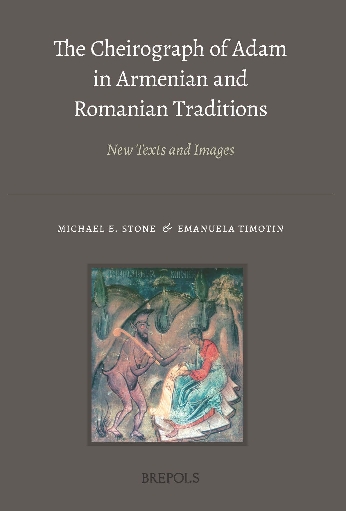
The Cheirograph of Adam in Armenian and Romanian Traditions
New Texts and Images
show More to view fulltext, buy and share links for:The Cheirograph of Adam in Armenian and Romanian Traditions show Less to hide fulltext, buy and share links for: The Cheirograph of Adam in Armenian and Romanian TraditionsThis book explores the legend of Adam’s Contract with Satan that was made after the expulsion from the Garden of Eden.This legend was current in the Eastern Orthodox churches of SE Europe as well as in the Caucasus. Unknown forms of the legend have been found in two traditions, the Romanian and the Armenian, and are investigated here. Notably this legend has found its way into folk stories and sometimes into folk music, showing how widely it was accepted and distributed. This legend also inspired images in both traditions. In Romania the most striking illustrations are to be found in Bukovina province, in frescos on the famous painted churches of that region, as well as in manuscripts. In Armenia features of this story are incorporated into the iconography of the Baptism of Christ in the River Jordan.
-
-
-

The Christian Metaphysics of St Maximus the Confessor
Creation, World-Order, and Redemption
show More to view fulltext, buy and share links for:The Christian Metaphysics of St Maximus the Confessor show Less to hide fulltext, buy and share links for: The Christian Metaphysics of St Maximus the ConfessorThis book offers an investigation into the basic structures of St Maximus the Confessor’s thought in the context of ancient and late antique philosophy. The introduction explains what is meant by the term ‘metaphysics of Maximus’, and discusses possible senses of terms like ‘Christian philosophy’ and ‘Byzantine philosophy’. On the background of a definition of ‘Christian philosophy’, the author devotes two chapters to discuss Maximus’ ideas of knowledge of the created world and of God. The chapters that follow are devoted to the doctrine of creation, the function of the so-called logoi (divine Ideas) in the procession and conversion of the totality of beings in relation to God, and the relation between the logoi and the so-called divine activities. The logoi, eternally comprised in God’s knowledge as the divine thoughts in accordance with which everything is created, are then shown to function as principles of a rather complex order of being: the cosmos instituted as a whole-part system. This whole-part system secures the possible communion between all creatures and facilitates the conversion of everything to the divine source as a unity in plurality deified by God. The last chapter treats of the doctrines of Incarnation and deification in order to clarify the exact sense of deification for all beings. In the final part of the book, the author applies Maximian metaphysics to a major ethical challenge in our days: the environmental crisis, thus proving that late antique philosophy still has relevance today.
-
-
-
The Christian Topography of Early Islamic Jerusalem: The Evidence of Willibald of Eichstätt (700-787 CE)
show More to view fulltext, buy and share links for:The Christian Topography of Early Islamic Jerusalem: The Evidence of Willibald of Eichstätt (700-787 CE) show Less to hide fulltext, buy and share links for: The Christian Topography of Early Islamic Jerusalem: The Evidence of Willibald of Eichstätt (700-787 CE)The Christian Topography of Early Islamic Jerusalem: The Evidence of Willibald of Eichstätt (700-787 CE) is an analysis of Willibald’s description of Jerusalem for the year 724-6, as contained in Hugeburc’s Vita Willibaldi, a text composed in Heidenheim (Germany) in 778. The work makes a fresh examination of the Christian landscape of Early Islamic Jerusalem, while describing various aspects of the Byzantine and Crusader city. Willibald’s account of the Holy City includes the Church of the Holy Sepulchre, the Church of Holy Sion, the pool of Bethesda, the Church of St Mary, the Church of the Agony and the Church of the Ascension. Particular attention is given to the monument of the Miraculous Healing (the legend of the Holy Cross), the portico of Solomon, the Jephonias Monument (the Dormition of Mary) and the Jerusalem circuit.
At the same time, the work explores the religious imagination of Willibald, including his perceptions of the holy sites, his image of Jerusalem and his understanding of the Christian life. Willibald’s image of the city as a far and distant place is supported by his attention to personal hardships and to his interactions with the ‘pagan Saracens’, while embedded within the tales of his oriental travels is his vision of the Christian life - whereas Willibald viewed the earthly life as a laborious journey, the Christian life was one of faithful perseverance.
The work makes a significant contribution to two fields of study: the commemorative topography of Jerusalem and the Anglo-Saxon, or Boniface, mission in Germany.
Rodney Aist is a scholar of Christian pilgrimage, both past and present, with a particular expertise in the city of Jerusalem.
-
-
-
The Christology of Theodore of Tarsus
The Laterculus Malalianus and the Person and Work of Christ
show More to view fulltext, buy and share links for:The Christology of Theodore of Tarsus show Less to hide fulltext, buy and share links for: The Christology of Theodore of TarsusTheodore of Tarsus served as archbishop of Canterbury for twenty-two years until his death in 690, aged eighty-eight. Because the only significant record we had of Theodore was that contained in Bede’s Historia, until recently it was very difficult to say anything about his life before this appointment, and even more difficult to determine anything about his thought. All of that changed in the last half of the twentieth century, when the discovery of some biblical glosses from Canterbury was revealed and the ensuing scholarship uncovered more of Theodore’s work than had previously been known. The Laterculus Malalianus is a text that benefited from treatment in this period. This present work examines the Laterculus for what it has to say about the person and work of Christ, and establishes that Theodore’s main theological inspiration was Irenaeus of Lyons and the concept of recapitulation, even while he cast his thought in language heavily drawn from the Syriac East, and Ephrem the Syrian in particular.
The volume represents a contribution to our understanding of the early medieval theological project in Britain, the transmission of eastern Mediterranean thought in the early medieval West and, ultimately, of the work of Theodore of Tarsus.
James Siemens continues to research theological questions arising from the encounter between the Greek and Semitic East and Latin West through the late antique and early medieval periods. He is an honorary research fellow at Cardiff University, and director of the nascent Theotokos Institute for Catholic Studies.
-
-
-

The Chronicles of Medieval Wales and the March
New Contexts, Studies and Texts
show More to view fulltext, buy and share links for:The Chronicles of Medieval Wales and the March show Less to hide fulltext, buy and share links for: The Chronicles of Medieval Wales and the MarchThe chronicles of medieval Wales are a rich body of source material offering an array of perspectives on historical developments in Wales and beyond. Preserving unique records of events from the fifth to the fifteenth centuries, these chronicles form the essential narrative backbone of all modern accounts of medieval Welsh history. Most celebrated of all are the chronicles belonging to the Annales Cambriae and Brut y Tywysogyon families, which document the tumultuous struggles between the Welsh princes and their Norman and English neighbours for control over Wales.
Building on foundational studies of these chronicles by J. E. Lloyd, Thomas Jones, Kathleen Hughes, and others, this book seeks to enhance understanding of the texts by refining and complicating the ways in which they should be read as deliberate literary and historical productions. The studies in this volume make significant advances in this direction through fresh analyses of well-known texts, as well as through full studies, editions, and translations of five chronicles that had hitherto escaped notice.
-
-
-
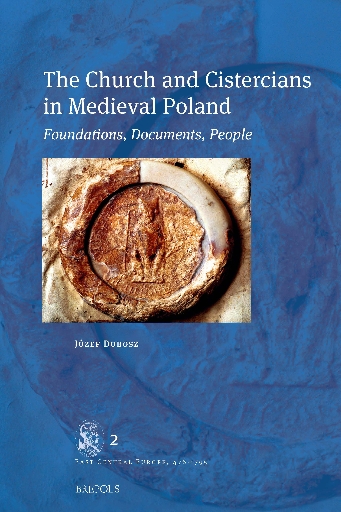
The Church and Cistercians in Medieval Poland
Foundations, Documents, People
show More to view fulltext, buy and share links for:The Church and Cistercians in Medieval Poland show Less to hide fulltext, buy and share links for: The Church and Cistercians in Medieval PolandIn this volume, the research of Józef Dobosz, one of Poland’s leading historians of the Middle Ages, is made accessible in English for the first time. It brings together nineteen studies focused on the role of the Church, the Cistercian Order, and other religious institutions in the history of the Piast realm from which Poland emerged. The introduction offers a broad outline of the first two centuries of the rule of the Piast dynasty after the Baptism of Poland in 966 until the fragmentation of the Piast patrimony during the twelfth century. The subsequent essays examine the circumstances of the foundation of Poland’s leading Cistercian monasteries in Sulejów, Jędrzejów, Wąchock, Owińska, and Łekno. The author analyses the means of their establishment, evaluates the existing sources, and places these within the context of the Piast dynasty’s economic, political, and social policies.
The studies offer an in-depth analysis of the motivations of the leading dynasts, magnates, and prelates in supporting the mission of the Church in Poland and enabling further embedding of Christianity across all strata of the society. The author examines the oldest Polish documents related to Cistercian monasteries and canons regular (in particular foundation charters) including early medieval charter forgeries. The volume’s key conclusions about the impact of Christianity on nascent Poland are based on a detailed examination of medieval charters, the role of scriptoria, identities of significant people of the Church, and the wider historical record.
-
-
-
The Church of Saint-Eustache in the Early French Renaissance
show More to view fulltext, buy and share links for:The Church of Saint-Eustache in the Early French Renaissance show Less to hide fulltext, buy and share links for: The Church of Saint-Eustache in the Early French RenaissanceConsidered the most important French Renaissance church, Saint-Eustache in Paris has long remained an enigma. What new circumstances allowed its parishioners, long desirous of a new church, suddenly to begin buiding it 1532? Did Francis I play a role? Was the obscure Jean Delamarre possibly its architect? Could the ideas of the Italian theorist, Serlio, have affected his design? These and other key issues are resolved by the author in a sustained reading of all known evidence. The baffling formal complexity of the church is clarified through lucid analysis that employs hundreds of new photographs executed by the author. The building is studied within the context of sixteenth-century French architecture and its roots in antiquity, the Italian Renaissance, Romanesque and Gothic France, and the Flamboyant Style. Sankovitch’s work will serve as a standard for all those who desire to understand this mysterious building and its times. A bright, clear window revealing an unseen architecture, previously an invisible - or at best murky - episode in the history of art, it is a portal to all future research on the building, and a key to the architectural life of the period.
-
-
-
The City, the Duke and their Banker
The Rapondi Family and the Formation of the Burgundian State (1384-1430)
show More to view fulltext, buy and share links for:The City, the Duke and their Banker show Less to hide fulltext, buy and share links for: The City, the Duke and their BankerDuring the second half of the fourteenth and the first half of the fifteenth century, it was particularly hazardous for medieval merchants to invest in government finance. The 'certainty of uncertainty' involved in dealing with princes proved disastrous for innumerable businesses, whether they were modest one-man firms or colossal 'super companies'. Yet, in this same period, the Rapondi, a family active in Bruges but originating from the Italian city of Lucca, achieved a career of more than thirty years in the money-lending business, ending with encomiums of princely praise instead of a bankruptcy. This book explains this remarkable achievement, not with a conventional focus on the individuals who agreed the loans and made up the bills, but by linking their work to the phenomenon that dominated the social and political scene of the Low Countries at the time: the formation of the Burgundian state. In the context of the politics of centralization conducted by the Burgundian dukes and the resistance of the Flemish cities the success story of the Rapondi can be understood. The Duke, the City and their Banker analyses how the firm first engaged in this interaction, how it was able to maintain its position while others failed and how these relations came to an end. While the emphasis of the book lies on the Rapondis' activities in Bruges, the meeting-place of international trade and finance in the fourteenth and fifteenth century, it also offers new insights into other important episodes of this fascinating period, including the Great Western Schism that divided the papacy, the continuing hostilities between England and France and the internal French conflict between Bourguignons and Armagnacs. In doing so, The Duke, the City and their Banker shows how an Italian merchant family was able to shape late medieval economic and political history.
-
-
-
The Classics in the Medieval and Renaissance Classroom
The Role of Ancient Texts in the Arts Curriculum as Revealed by Surviving Manuscripts and Early Printed Books
show More to view fulltext, buy and share links for:The Classics in the Medieval and Renaissance Classroom show Less to hide fulltext, buy and share links for: The Classics in the Medieval and Renaissance ClassroomMedievalists and Renaissance specialists contribute to this compelling volume examining how and why the classics of Greek and Latin culture were taught in various Western European curricula (including in England, Scotland, France,Germany, and Italy) from the tenth to the sixteenth centuries. By analysing some of the commentaries, glosses, and paraphrases of these classics that were deployed in medieval and Renaissance classrooms, and by offering greater insight into premodern pedagogic practice, the chapters here emphasize the ‘pragmatic’ aspects of humanist study. The volume proposes that the classics continued to be studied in the medieval and Renaissance periods not simply for their cultural or ‘ornamental’ value, but also for utilitarian reasons, for ‘life lessons’. Because the volume goes beyond analysing the educational manuals surviving from the premodern period and attempts to elucidate the teaching methodology of the premodern period, it provides a nuanced insight into the formation of the premodern individual. The volume will therefore be of great interest to scholars and students interested in medieval and Renaissance history in general, as well as those interested in the history of educational theory and practice, or in the premodern reception of classical literature.
-
-
-
The Co-production of Judaism, Christianity, and Islam
Artefacts, Rituals, Communities, Narratives, Doctrines, Concepts
show More to view fulltext, buy and share links for:The Co-production of Judaism, Christianity, and Islam show Less to hide fulltext, buy and share links for: The Co-production of Judaism, Christianity, and IslamJudaism, Christianity, and Islam have always formed, re-formed, and transformed themselves in conversation. That is, these religions have come to exist in all their varieties by interacting with, thinking about, and imagining each other. In this sense they are co-produced, linked by a dynamic and ongoing inter-dependence. The fifteen essays collected in this volume explore moments of such religious coproduction from the second to the twenty-first century, from early pilgrimage sites to social media. The case studies range across textual and material cultures, showing how a variety of artefacts, coins, rituals, communities, narratives, theological doctrines, and scholarly concepts, were all co-produced across the three religious traditions. In so doing they present a panorama of possibilities from the past, as well as a taxonomy that can help us think about the future of religious co-production. An introductory essay describes the advantages of approaching the past, present, and future of these religions through the lens of co-production, and reflects on crucial methodological issues related to the understanding of Judaism, Christianity, and Islam as co-produced religions.
-
-
-
The Colonial Machine
French Science and Overseas Expansion in the Old Regime
show More to view fulltext, buy and share links for:The Colonial Machine show Less to hide fulltext, buy and share links for: The Colonial MachineThe rise of modern science and European colonial and imperial expansion are indisputably two defining elements of modern world history. James E. McClellan III and François Regourd explore these two world-historical forces and their interactions in this comprehensive and in-depth history of the French case in the Old Regime presented here for the first time. The case is key because no other state matched Old-Regime France as a center for organized science and because contemporary France closely rivaled Britain as a colonial power, as well as leading all other nations in commodity production and participating in the slave trade.
Based on extensive archival research and vast primary and secondary literatures and sharply reframing the historiography of the field, this landmark volume traces the development and significance for early-modern history of the Colonial Machine of Old-Regime France, an unparalleled agglomeration of institutions geared to the success of the French colonial enterprise, including the Royal Navy, the Académie Royale des Sciences, the Jardin du Roi, and a host of related specialist institutions working together at home and overseas. Mainly supported by the French state, the Colonial Machine reveals itself through its actions from the time of Colbert and Louis XIV as it grappled with fundamental problems facing contemporary European colonialism: cartography and navigation; medical care of sailors, colonists, and slaves; and applied botany and commodity production.
Historians of globalization and European overseas expansion, of Old-Regime France, and of science in the seventeenth and eighteenth centuries will henceforth take this stimulating volume as a necessary starting point for further reflection and research.
-
-
-

The Commentary Tradition on Aristotle’s ’De generatione et corruptione’. Ancient, Medieval and Early Modern
show More to view fulltext, buy and share links for:The Commentary Tradition on Aristotle’s ’De generatione et corruptione’. Ancient, Medieval and Early Modern show Less to hide fulltext, buy and share links for: The Commentary Tradition on Aristotle’s ’De generatione et corruptione’. Ancient, Medieval and Early ModernIn this book, a dozen distinguished scholars in the field of the history of philosophy and science investigate aspects of the commentary tradition on Aristotle’s De generatione et corruptione, one of the least studied among Aristotle’s treatises in natural philosophy. Many famous thinkers such as Johannes Philoponus, Albert the Great, Thomas Aquinas, John Buridan, Nicole Oresme, Francesco Piccolomini, Jacopo Zabarella, and Galileo Galilei wrote commentaries on it. The distinctive feature of the present book is that it approaches this commentary tradition as a coherent whole, thereby ignoring the usual historiographical distinctions between the Middle Ages, the Renaissance, and the seventeenth century.
-
-
-
The Common Thread
Collected Essays in Honour of Eva Andersson Strand
show More to view fulltext, buy and share links for:The Common Thread show Less to hide fulltext, buy and share links for: The Common ThreadThe Ancient Egyptians used it for both the living and the dead, the Greeks and Romans used it to signal their status, and it aided the Vikings in reaching the far shores of Europe and Eurasia. Textiles have surrounded us, literally and figuratively for millennia, but this common thread has long been ignored in scholarly research. With the inception of the Centre for Textile Research at the University of Copenhagen in 2005, however, this approach changed fundamentally, and today, every type of research discipline comes together to begin unravelling the stories told by textiles. How do we understand textiles and how do we talk about them? Who produced textiles, where, and for what purposes? How do we conduct research into the origins of materials? How did cultivating flax or raising sheep change the ancient landscape? How have we researched textiles so far? What can we learn from textiles about society, gender, and production? This volume engages with these questions and explores how the fabric of society has changed through researching textiles in all its facets, from archaeology and history to natural sciences. Taking as its starting point the research interests and career of its honorand, Eva Andersson Strand, this meticulously researched volume consists of three parts, covering the tools and techniques that form the basis of all research explores; how craftspeople made use of tools and techniques; and how textiles have been used over millennia to signify identity and status.
-
