


Brepols Online Books Medieval Miscellanea Collection 2011 - bob2011mime

Collection Contents
6 results
-
-
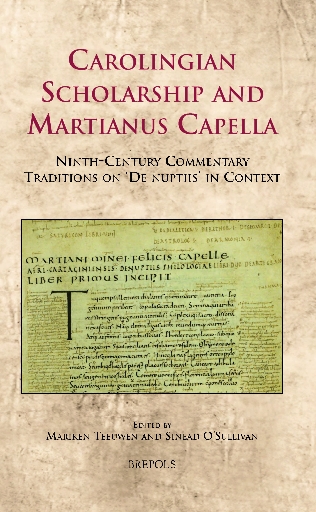
Carolingian Scholarship and Martianus Capella
show More to view fulltext, buy and share links for:Carolingian Scholarship and Martianus Capella show Less to hide fulltext, buy and share links for: Carolingian Scholarship and Martianus CapellaIt is well known that the Carolingian royal family inspired and promoted a cultural revival of great consequence. The courts of Charlemagne and his successors welcomed lively gatherings of scholars who avidly pursued knowledge and learning, while education became a booming business in the great monastic centres, which were under the protection of the royal family. Scholarly emphasis was placed upon Latin language, religion, and liturgy, but the works of classical and late antique authors were collected, studied, and commented upon with similar zeal. A text that was read by ninth-century scholars with an almost unrivalled enthusiasm is Martianus Capella’s De nuptiis Philologiae et Mercurii, a late antique encyclopedia of the seven liberal arts embedded within a mythological framework of the marriage between Philology (learning) and Mercury (eloquence). Several ninth-century commentary traditions testify to the work’s popularity in the ninth century. Martianus’s text treats a wide range of secular subjects, including mythology, the movement of the heavens, numerical speculation, and the ancient tradition on each of the seven liberal arts. De nuptiis and its exceptionally rich commentary traditions provide the focus of this volume, which addresses both the textual material found in the margins of De nuptiis manuscripts, and the broader intellectual context of commentary traditions on ancient secular texts in the early medieval world.
-
-
-
Chromatius of Aquileia and His Age
show More to view fulltext, buy and share links for:Chromatius of Aquileia and His Age show Less to hide fulltext, buy and share links for: Chromatius of Aquileia and His AgeThis volume presents the proceedings of the International Congress Chromatius of Aquileia and His Age which took place at Aquileia (Italy) from 22 to 24 May 2008 under the direction of Pier Franco Beatrice (University of Padova) and Alessio Peršič (Università Cattolica del Sacro Cuore, Milan) and was fostered by the National Commitee for the Sixteenth Centenary of the Death of Saint Chromatius Bishop of Aquileia headed by Dr. Mons. Duilio Corgnali, in common accord with the Dioceses of the Autonomous Region of Friuli Venezia Giulia and the adjacent Slovenian and Austrian Dioceses of Ljubljiana, Koper / Capodistria, and Gurk-Klagenfurt.
The Congress was part of a vast range of celebratory activites inspired by the desire to create a renewed Christian historical awareness of both the significance of Aquileia and its Fathers and of the strong vitality of evangelical spirituality directed at creating a synthesis between East and West, between Greco-Roman civilization, the revealed Hebrew epos, and the disruptive diversity of the new invading peoples. The Christian communities are heirs to the long tradition of the Patriarcate of Aquileia which lasted for over a thousand years and it was the passionate interest in their Christian origins which prompted the Congress. The Aquileian metropolis—patriarcal see until the eighteenth century and a crossroads where Romans and Illyrians, Germanic peoples and Slavs all met—was a cradle of monasticism and home to some of its greatest masters (Martin, Chromatius, Rufinus, and Jerome). These scholars have proven to be the beneficiaries of earlier exegetic skills (Victorinus, Fortunatianus) as well as intrepid and creative mediators of the highest and most controversial expressions of Greek spiritual and theological culture in the Roman world and of the rediscovered veritas hebraica of Old Testament sources. Lastly, Paulus Diaconus and the Patriarch Paulinus II distinguished themselves as inspiration for a modern European identity after its slow Christian and barbarian palingenesis.
The Congress brought together scholars from Europe and America who are experts on the work of Chromatius—only recently saved from the near obscurity into which it had fallen in manuscript tradition—for the purpose of providing original contributions on an international level to Aquileian literary historiography, Chromatius in particular, not always taken into account and given due merit.
-
-
-
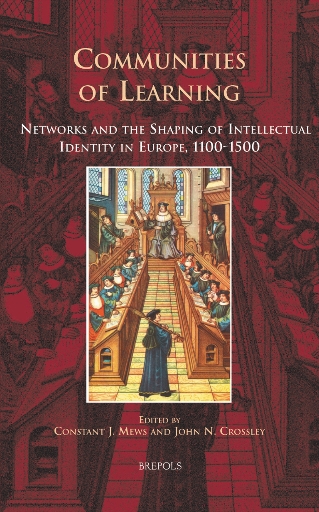
Communities of Learning
show More to view fulltext, buy and share links for:Communities of Learning show Less to hide fulltext, buy and share links for: Communities of LearningCommunities of Learning: Networks and the Shaping of Intellectual Identity in Europe, 1100-1500 explores the fundamental insight that all new ideas are developed in the context of a community, whether academic, religious, or simply as a network of friends. The essays in this volume consider this notion in a variety of contexts and locations within Europe, from the pioneering age of translation activity in twelfth-century Toledo, when Jewish, Christian, and Muslim scholars came together to discuss Aristotle, to the origins of the University of Paris in the thirteenth century, and up to the period of great cultural renewal in France, Germany, and Italy in the fourteenth and fifteenth centuries. The collected essays bring together disciplinary approaches that are often discussed quite separately, namely that of the history of ideas, and the sociologies of both intellectual and religious life, with a view to exploring the multiplicity of communities in which ideas are pursued. Underpinning these various essays is an awareness of the delicate relationship between education and the diversity of religious practice and expression within Europe from 1100 to 1500. The collection emphasizes the fundamental continuity of intellectual concerns, which were shaped by both classical thought and monotheist religious tradition, but interpreted in a variety of ways.
-
-
-
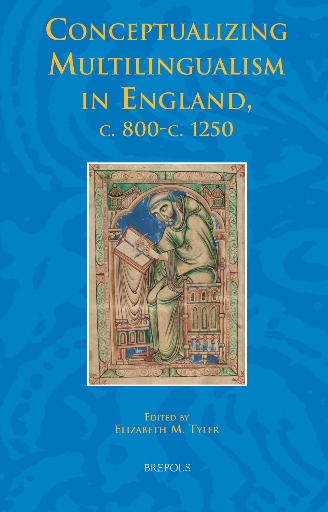
Conceptualizing Multilingualism in England, c.800-c.1250
show More to view fulltext, buy and share links for:Conceptualizing Multilingualism in England, c.800-c.1250 show Less to hide fulltext, buy and share links for: Conceptualizing Multilingualism in England, c.800-c.1250Throughout the period 800–1250, English culture was marked by linguistic contestation and pluralism: the consequence of migrations and conquests and of the establishment and flourishing of the Christian religion centred on Rome. In 855 the Danes ‘over-wintered’ for the first time, re-initiating centuries of linguistic pluralism; by 1250 English had, overwhelmingly, become the first language of England. Norse and French, the Celtic languages of the borderlands, and Latin competed with dialects of English for cultural precedence. Moreover, the diverse relations of each of these languages to the written word complicated textual practices of government, poetics, the recording of history, and liturgy. Geographical or societal micro-languages interacted daily with the ‘official’ languages of the Church, the State, and the Court. English and English speakers also played key roles in the linguistic history of medieval Europe. At the start of the period of inquiry, Alcuin led the reform of Latin in the Carolingian Empire, while in the period after the Conquest, the long-established use of English as a written language encouraged the flourishing of French as a written language. This interdisciplinary volume brings the complex and dynamic multilingualism of medieval England into focus and opens up new areas for collaborative research.
-
-
-
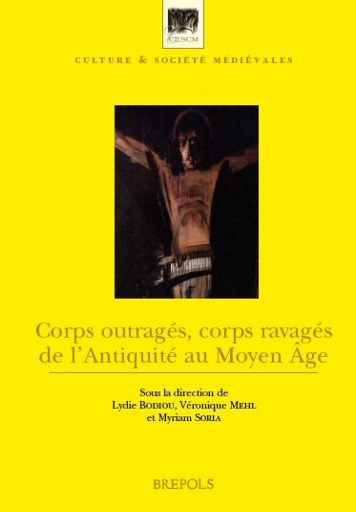
Corps outragés, corps ravagés de l’Antiquité au Moyen Âge
show More to view fulltext, buy and share links for:Corps outragés, corps ravagés de l’Antiquité au Moyen Âge show Less to hide fulltext, buy and share links for: Corps outragés, corps ravagés de l’Antiquité au Moyen ÂgeLes ravages corporels et leurs représentations, signes d’outrage aux corps, forment un trait d’union trop souvent négligé entre l’Antiquité et le Moyen Âge. À avoir opposé des civilisations anciennes marquées par un certain « culte de corps » à des sociétés médiévales méprisant la chair, on en aurait presque oublié que le corps y voyage à travers les savoirs, de l'histoire à la littérature, de la science au droit, de la biologie à la théologie et la philosophie. Aussi les sources nous invitent-elles à regarder au-delà des frontières historiques et culturelles qui séparent l'Antiquité et le Moyen Âge. De la plus haute Antiquité au Moyen Âge tardif, chaque outrage au corps physique est lourd de sens: faisant écho dans le corps social, il renvoie aux normes et aux assises de l’ordre politique, affirmant une morale, des valeurs et des croyances qui cimentent les corps constitués dont l’individu n’est qu’une partie. La signification des outrages aux corps diverge suivant la personnalité ou la fonction de celui qui brutalise, comme de celui qui est maltraité. Elle est aussi tributaire du système de représentation du temps et du lieu, du contexte et de l'univers culturel dans lesquels ils s'inscrivent. L’objet de cet ouvrage collectif est de comprendre comment les sociétés antiques et médiévales représentent le modelage du corps humain, à la fois au plan social, mental, politique et religieux, dans l'intention de façonner des individus adaptés à des environnements propres. Il s'agit de saisir comment les outrages et les ravages infligés aux corps physiques et symboliques offrent des clés de compréhension générale de la société qui voit le corps vivre et mourir.
-
-
-
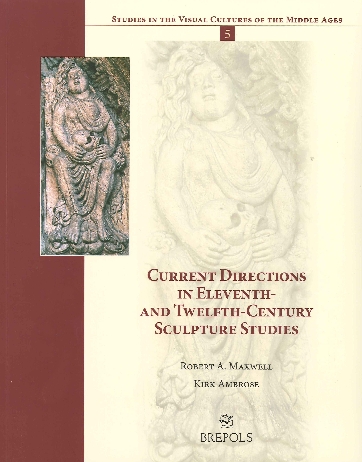
Current Directions in Eleventh- and Twelfth-Century Sculpture Studies
show More to view fulltext, buy and share links for:Current Directions in Eleventh- and Twelfth-Century Sculpture Studies show Less to hide fulltext, buy and share links for: Current Directions in Eleventh- and Twelfth-Century Sculpture Studies
-