


Brepols Online Books Medieval Miscellanea Collection 2011 - bob2011mime

Collection Contents
3 results
-
-
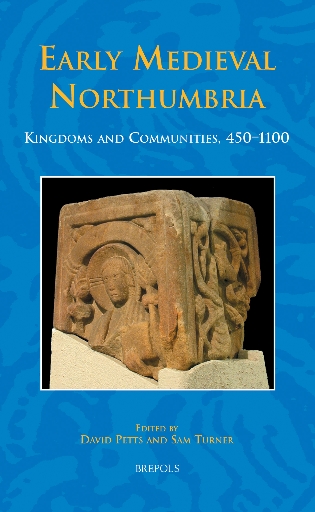
Early Medieval Northumbria
show More to view fulltext, buy and share links for:Early Medieval Northumbria show Less to hide fulltext, buy and share links for: Early Medieval NorthumbriaResponding to renewed interest in the powerful early medieval kingdom of Northumbria, this volume uses evidence drawn from archaeology, documentary history, place-names, and artistic works to produce an unashamedly cross-disciplinary body of scholarship that addresses all aspects of Northumbria’s past. Northumbria at its peak stretched from the River Humber to the Scottish highlands and westwards to the Irish Sea, producing saints, kings, and scholars with contacts across Europe, from Scandinavia, Ireland, and Francia to Rome itself. This volume unites papers on all aspects of this major European power of its day, from its origins in the fifth and sixth centuries from British and Anglo-Saxon chiefdoms, through its ‘Golden Age’ as eighth-century Europe’s intellectual powerhouse, to its role as a key element of an international Viking kingdom. Where traditional scholarship has centred on the ecclesiastical high culture of the age of Bede, this work examines the kingdom’s social and economic life and its origins and decline as well. There is a stress on approaching established bodies of material from new perspectives and engaging with wider debates in the field, including monumentality, the development of kingships, and the evolution of the early Church. Areas investigated include the kingdom’s political history, its economy and society, and its wider place within Europe. Its unique artistic legacy, in the form of illuminated manuscripts and a rich sculptural tradition, is also explored.
-
-
-
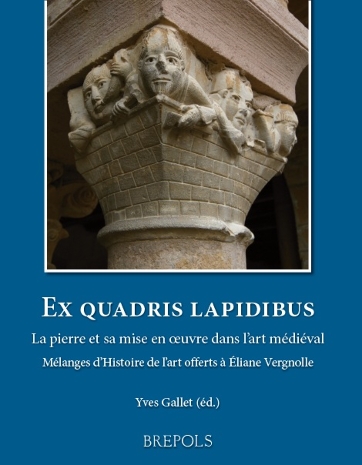
Ex quadris lapidibus. La pierre et sa mise en oeuvre dans l'art médiéval
show More to view fulltext, buy and share links for:Ex quadris lapidibus. La pierre et sa mise en oeuvre dans l'art médiéval show Less to hide fulltext, buy and share links for: Ex quadris lapidibus. La pierre et sa mise en oeuvre dans l'art médiévalLa pierre et sa mise en oeuvre dans l’art du Moyen Age: autour de ce thème, plus de quarante spécialistes français et étrangers, historiens de l’art, archéologues, conservateurs ou architectes, se sont associés pour rendre hommage à Éliane Vergnolle, dont les travaux sur l’art et l’architecture de la période romane font aujourd’hui autorité. Le domaine de recherche d’Éliane Vergnolle et ses études sur les techniques de taille de la pierre ont dicté les thèmes explorés dans ce volume, qui couvre un large champ. De nombreuses contributions abordent la question du travail de la pierre dans la sculpture et dans l’architecture romane ou gothique, ainsi que dans la création artistique des périodes plus récentes. Plusieurs études sont consacrées aux rapports entre la pierre et les arts de la couleur (enluminure, peinture, vitrail), aux questions de méthode d’analyse, à l’archéologie du bâti, à la pratique du réemploi, aux comptabilités des chantiers, aux modes de transmission des formes et des connaissances, aux tailleurs de pierre eux-mêmes, ainsi qu’à la pierre « rêvée », celle des représentations et de l’imaginaire médiéval. Au total, cet ouvrage offre, sous un angle original, un panorama complet des principales orientations de la recherche actuelle autour des arts monumentaux à l’époque médiévale.
-
-
-
The Easter Controversy of Late Antiquity and the Early Middle Ages. Its Manuscripts, Texts, and Tables
show More to view fulltext, buy and share links for:The Easter Controversy of Late Antiquity and the Early Middle Ages. Its Manuscripts, Texts, and Tables show Less to hide fulltext, buy and share links for: The Easter Controversy of Late Antiquity and the Early Middle Ages. Its Manuscripts, Texts, and Tables2010 saw the publication of the Proceedings of the 1st International Conference on the Science of Computus in Ireland and Europe, which took place in Galway, 14–16 July, 2006. That first collection, which had the sub-title Computus and its Cultural Context in the Latin West, AD 300–1200, brought together papers by ten of the leading scholars in the field, on subjects ranging from the origins of the Annus Domini to the study of computus in Ireland c. 1100. All those who participated in the Conference were unanimous that a second, follow-up event should be organized, and that duly took place (also in Galway), 18–20 July, 2008. The proceedings of that Conference are published in this current volume. The topics covered in the 2nd Galway Conference ranged from the general – but vitally important – vocabulary of computus (i.e., the technical terminology developed by computists to describe what they were doing) to the origins of the different systems used to calculate the date of Easter in Antiquity and the Early Middle Ages. In addition, there was discussion also of the great debates about Easter, epitomized by the famous Synod of Whitby in AD 664, and the role of well-known individuals in the evolution of computistical knowledge (e.g., Anatolius of Laodicea, the African Augustalis, Sulpicius Severus, Victorius of Aquitaine, Cassiodorus, Dionysius Exiguus, Willibrord, the ninth-century Irish scholar-exile, Dicuil, as well as the late-tenth century Abbo of Fleury). Immo Warntjes is lecturer in Medieval History at the University of Greifswald (Germany). Besides computistics, his main areas of research include the use of languages in Early Medieval Europe, succession to high offices, high and late medieval burial practices, and German, English, and Irish political history and culture. Dáibhí Ó Cróinín lectures in history at NUI, Galway, where he is the Director of The Foundations of Irish Culture project. His research interests are Ireland, Britain and Europe during the Early Middle Ages, computistics, Medieval Latin Palaeography and Irish traditional music and song.
-