


Brepols Online Books Medieval Miscellanea Collection 2011 - bob2011mime

Collection Contents
7 results
-
-
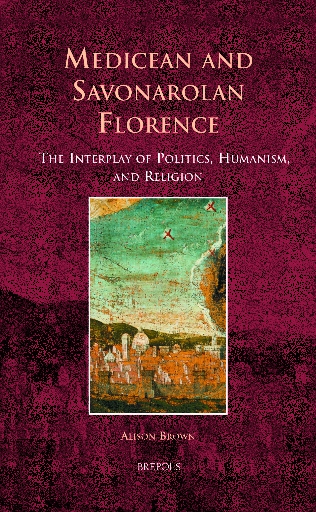
Medicean and Savonarolan Florence
show More to view fulltext, buy and share links for:Medicean and Savonarolan Florence show Less to hide fulltext, buy and share links for: Medicean and Savonarolan FlorenceThis volume examines Florentine society at crucial moments of change that are often treated separately in historical narratives: the later years of Medici government under the aegis of Lorenzo the Magnificent, the four tumultuous years of Savonarola’s religious regime from 1494 to 1498, and the unsettled early decades of the sixteenth century. Drawing upon original research conducted during the past decade, it provides important insights into the politics and conflicting ideologies in the city as experienced by different levels of society, not only by the politicians, preachers, and intellectuals whose voices are more familiar to us, but also by women and lower-class citizens. Since no single paradigm is adequate to describe these years of flux, this volume attempts to reassess the period by uncovering the debate underlying nearly all the topics it discusses. In this way, it offers a new and multifocused approach to the study of this important and influential period in Florentine history.
-
-
-
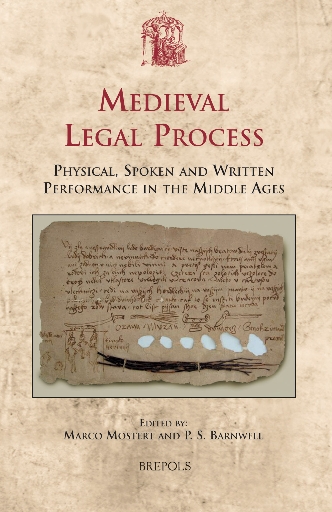
Medieval Legal Process
show More to view fulltext, buy and share links for:Medieval Legal Process show Less to hide fulltext, buy and share links for: Medieval Legal ProcessIn medieval legal transactions the use of the written word was only one of many ways of conducting business. Important roles were played by the spoken word and by the ‘action’ of ritual. The relationship between ‘rituals’ and literacy has been the focus of much recent research. Medieval societies which made extensive use of written instruments in legal transactions have been shown to employ rituals as well. This has led to investigation of the respective functions of written instruments and legal rituals. What is the nature of legal rituals? If they included oral verbalization, how did the spoken words relate to those of the written instruments that played a role in the same legal transactions? Usually, we only have the written documents to answer these questions, and they are often silent about the rituals and oral elements of the transactions they document. Furthermore, the importance attached to written instruments and rituals may not have been the same at all levels of a society, differing, for example, between princely and local courts. The contributors to this volume discuss fifteen cases, ranging from the early Middle Ages to the eighteenth century, and from England to Galician Rus’.
-
-
-
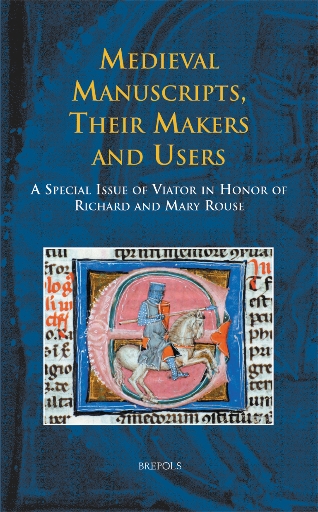
Medieval Manuscripts, Their Makers and Users
show More to view fulltext, buy and share links for:Medieval Manuscripts, Their Makers and Users show Less to hide fulltext, buy and share links for: Medieval Manuscripts, Their Makers and UsersThe essays in this collection pertain to art history, medieval Latin culture both ecclesiastic and legal, the history of vernacular literatures, and the devotional practices of the laity. They reflect the patronage of authors and manuscript painters, from the royal through the monastic to the urban middle class, and they trace the sometimes astonishing afterlife of manuscripts. The subject matter of these studies ranges chronologically from late antiquity to the later Middle Ages, adding the emergent medievalism of the eighteenth and nineteenth centuries. Its geographic breadth extends through the major Western cultures and literatures, from England to Italy, Germany, and France. Its wide range in time and space reflects the lifetime of manuscript research, teaching, and collecting by its honorees, Richard and Mary Rouse.
A particular emphasis distinguishes this volume from other such collections: its stress on the use, and usefulness, of medieval manuscripts in the teaching of most historical disciplines in Western culture, from the broad undergraduate survey (of art, literature, history) to the specialized graduate seminar. In the last half century, public colleges and universities have increasingly appreciated the pedagogical opportunities inherent in building, through gift and purchase, collections of medieval manuscripts, formerly thought to be the province only of wealthy private schools. No similar collection of manuscript studies exhibits so clearly the role of medieval manuscripts in teaching.
The specialist authors represented in this volume have displayed, over the whole of their careers, an ability to combine the highest caliber of research with an eagerness to make their subject accessible to others through teaching and writing and public lectures. The essays offer the results of new and sometimes technical research, set forth in a manner intelligible not only to the expert but to the interested amateur.
-
-
-
Meditations of the Heart: The Psalms in Early Christian Thought and Practice
show More to view fulltext, buy and share links for:Meditations of the Heart: The Psalms in Early Christian Thought and Practice show Less to hide fulltext, buy and share links for: Meditations of the Heart: The Psalms in Early Christian Thought and PracticeThe Psalms are one of the most important biblical texts in Patristic exegesis, commentary, preaching, liturgical practice and theological reflection. Their language and imagery is all-pervasive; they were not only interpreted by the fathers but a good deal of Patristic exegetical practice actually evolved from engagement with them; they directly informed Christological and Ecclesiological reflection; were central to early monasticism; inspired early Christian poetry and provided material for liturgical chant, prayers, hymns and penitential or doxological expression. This volume of essays on the Psalms in Early Christian Thought and Practice is offered with profound gratitude, admiration and respect by colleagues and friends of Professor Andrew Louth FBA, to honour his long and immensely distinguished career as priest, teacher and prolific author in almost every aspect of Greek and Latin Patristics.
-
-
-
Mots médiévaux offerts à Ruedi Imbach
show More to view fulltext, buy and share links for:Mots médiévaux offerts à Ruedi Imbach show Less to hide fulltext, buy and share links for: Mots médiévaux offerts à Ruedi ImbachCes Mots médiévaux offerts à Ruedi Imbach rendent un hommage dans les formes du lexique historique et historiographique. Plutôt que de brosser le portrait d' un professeur et d' un chercheur, ils présentent une image de son monde intellectuel et des intérêts des spécialistes qui travaillent le même champ disciplinaire que lui, la philosophie et l' histoire de la philosophie médiévale en particulier. Le lecteur circule librement à travers soixante-dix études courtes consacrées à des notions négligées, marginales ou encore mal définies de la culture médiévale; il accomplit aussi quelques excursions de l' Antiquité à la Modernité, à travers les aléas de l 'histoire de la transmission des doctrines philosophiques.
Le volume comprend des contributions de: Jan A. Aertsen, Etienne Anheim, Henryk Anzulewicz, Iñigo Atucha, Alessandra Beccarisi, Luca Bianchi, Joël Biard, Magdalena Bieniak, Serge-Thomas Bonino, Bruno-Marie Borde, Jean-Baptiste Brenet, Olivier Boulnois, Alain Boureau, Charles Burnett, Philippe Büttgen, Dragos Calma, Monica Calma, Stefano Caroti, Delphine Carron, Julie Casteigt, Laurent Cesalli, Stephen Chung, Emanuele Coccia, Valérie Cordonier, Iacopo Costa, Fernando Domínquez Reboiras, Gianfranco Fioravanti, Kurt Flasch, Frédéric Gabriel, Christophe Grellard, Barbara Hallensleben, Maarten J.F.M. Hoenen, Tobias Hoffmann, mary E. Ingham, Isabel Iribarren, Zénon Kaluza, Theo Kobusch, Catherine König-Pralong, Alfonso Maierù, John Marenbon, Jean-Luc Marion, Burkhart Mojsisch, Adriano Oliva, Dominic O' Meara, Gianfranco Pellegrino, Dominik Perler, Sylvain Piron, Dominique Poirel, Olaf Pluta, Pasquale Porro, François-Xavier Putallaz, Francis Python, Fiorella Retucci, Thomas Ricklin, Aurélien Robert, Andrea Robiglio, Anne-Sophie Robin, Irène Rosier-Catach, Jacob Schmutz, Peter Schulthess, Philibert Secrétan, Andreas Speer, Loris Sturlese, Tiziana Suarez-Nani, Christian Trottmann, Luisa Valente, Anca Vasiliu, Guido Vergauwen, Ubaldo Villani-Lubelli, Peter von Moos, Olga Weijers, Irene Zavattero.
-
-
-
Matériaux du livre médiéval
show More to view fulltext, buy and share links for:Matériaux du livre médiéval show Less to hide fulltext, buy and share links for: Matériaux du livre médiévalCet ouvrage présente les résultats des travaux effectués dans le cadre d’un Groupement de recherche (GDR) initié par le CNRS en 2003 pour une durée de quatre ans et portant sur les matériaux du livre médiéval.
Ce groupement de recherche avait pour but de fédérer, dans un travail collectif interdisciplinaire et pluridisciplinaire, des équipes de recherche en sciences humaines, des laboratoires de sciences dites «dures», autrement dit des historiens, des paléographes, des archivistes-paléographes, des chimistes, des physiciens, des conservateurs de bibliothèques, d’archives, de musées, mais également des enseignants, des artisans-papetiers et formaires (les formaires étant des fabricants de formes à faire le papier à la main); participaient aussi au projet parcheminiers, enlumineurs, calligraphes, relieurs, etc., ainsi qu’un cinéaste documentariste. L’objectif était de faire progresser la connaissance des matériaux du livre médiéval sur le plan livresque, historique, expérimental ou analytique, en mettant en synergie et en fédérant les approches et les compétences spécifiques des personnels et des laboratoires participant au GDR. Connaissance indispensable pour son apport à l’histoire du livre et capitale pour gérer au mieux les problèmes de la conservation et de la sauvegarde de tout patrimoine.
L’originalité de ce GDR fut d’associer des recherches à la fois très différentes et très complémentaires qui pourraient, pour citer T. Delcourt, être regroupées en trois grandes catégories: «les recherches techniques sur les supports matériels de l’écrit que sont le papier, le parchemin, les encres; les recherches sur les différentes étapes intervenant dans la fabrication du livre autour de la reliure, mais aussi des ateliers de parcheminiers ou des moulins à papier; enfin des recherches sur le vocabulaire du livre et de l’écrit au Moyen Age si l’on veut comprendre avec un peu de certitude les textes, les inventaires ou les recettes qui traitent de la fabrication du livre au Moyen Age.»
Ces travaux ont été exposés au cours d’un colloque qui s’est tenu à Paris en novembre 2007.
-
-
-
Medicina y Filología. Estudios de léxico médico latino en la Edad Media
show More to view fulltext, buy and share links for:Medicina y Filología. Estudios de léxico médico latino en la Edad Media show Less to hide fulltext, buy and share links for: Medicina y Filología. Estudios de léxico médico latino en la Edad MediaEl Grupo de investigación de la Universidad de Valladolid Speculum medicinae, compuesto por una docena de filólogos clásicos, en el que colaboran también un historiador de la medicina y una arabista, lleva trabajando muchos años en la elaboración del que se ha llamado Diccionario latino de andrología y ginecología (DILAG). En este momento se encuentra ya en fase de revisión.
El DILAG es un diccionario técnico especializado que recoge, en las fuentes médicas más significativas de la Antigüedad, la Edad Media y el Renacimiento, términos médicos latinos encuadrados en las especialidades de la andrología, la ginecología y la embriología. En la redacción del DILAG sus colaboradores han encontrado diferentes aspectos de la medicina medieval dignos de estudio, que abarcan los campos de la anatomía, la fisiología, la patología y la terapéutica o problemas relacionados con ellos, como la sexualidad o la deformación de términos técnicos mal interpretados. Con sus trabajos pretenden mostrar las múltiples aplicaciones, tanto médicas como filológicas o históricas, que los estudiosos pueden llevar a cabo con el material de dicho diccionario y apreciar las posibilidades investigadoras que brinda. Algunas de estas aportaciones de carácter parcial se presentaron en el IVe Congrès européen d´études médiévales, organizado por la FIDEM e la Officina di Studi Medievali en Palermo el año 2009, y otras han sido elaboradas expresamente para este libro.
Se reúnen en esta monografía, a modo de capítulos autónomos, los trabajos mencionados, con el fin de contribuir al conocimiento e investigación de un tipo de léxico que cada vez atrae más la atención de los estudiosos.
-