


Brepols Online Books Medieval Miscellanea Collection 2012 - bob2012mime

Collection Contents
3 results
-
-
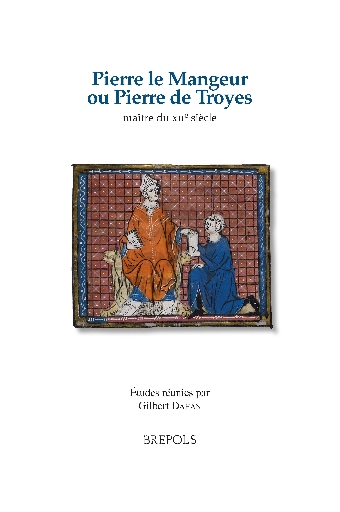
Pierre le Mangeur ou Pierre de Troyes, maître du XIIe siècle
show More to view fulltext, buy and share links for:Pierre le Mangeur ou Pierre de Troyes, maître du XIIe siècle show Less to hide fulltext, buy and share links for: Pierre le Mangeur ou Pierre de Troyes, maître du XIIe sièclePierre le Mangeur, connu également sous le nom de Pierre Comestor, est souvent appelé par ses contemporains Pierre de Troyes. Il est né probablement dans cette ville et y a été doyen du chapitre cathédral. Mais, s’il reste fidèle à cette cité, c’est en tant que maître à Paris qu’il jouit d’une réputation considérable: successeur de son maître Pierre Lombard, il a parmi ses élèves des auteurs aussi prestigieux que Pierre de Poitiers ou Étienne Langton. À la fin de sa vie (il meurt en 1178), il se retire à Saint-Victor de Paris. Son œuvre la plus célèbre est l’Historia scholastica, sorte de manuel d’études bibliques, fondé sur une réécriture des parties narratives de la Bible (jusqu’aux évangiles) et intégrant de nombreux éléments d’exégèse. Commentée pendant une ou deux générations (fin du xii e siècle, début du xiii e), elle fait l’objet d’une adaptation extrêmement bien diffusée en latin, l’Aurora de Pierre Riga, puis de traductions-adaptations en diverses langues vernaculaires, notamment la Bible historiale de Guyart des Moulins (à la fin du xiii e siècle), qui constituera la traduction française la plus répandue de la Bible jusqu’au xvi e siècle. Pierre le Mangeur est aussi l’auteur d’un corpus de 189 sermons, qui laissent percevoir une évolution vers le sermon «moderne» plus tardif, et de commentaires des évangiles très passionnants, en ce qu’ils nous font véritablement entrer dans la classe du maître. Son œuvre théologique, encore mal connue, comprend un nombre important de quaestiones, un traité sur les sacrements et, peut-être, un commentaire des Sentences de Pierre Lombard, dont seuls des fragments nous sont parvenus.
Le présent volume examine ces différents aspects de l’œuvre de Pierre le Mangeur et situe cet auteur dans l’histoire culturelle de son temps: très marqué par les conceptions herméneutiques de Hugues de Saint-Victor (et lié à cette école majeure du xii e siècle), il est aussi l’un des représentants principaux de ce que l’on a pu appeler l’«école biblique-morale» parisienne du dernier tiers du xii e siècle. Le retentissement de son œuvre fait l’objet de plusieurs études et rappelle que l’Historia scholastica a été imprimée dès le dernier quart du xv e siècle.
-
-
-
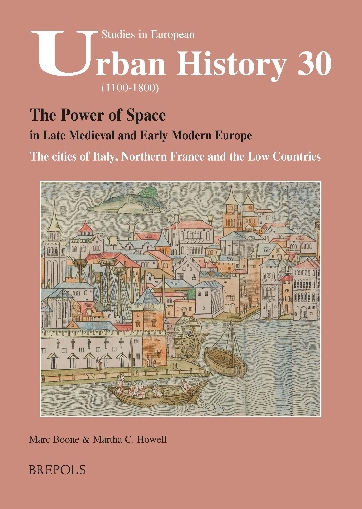
The Power of Space in Late Medieval and Early Modern Europe
show More to view fulltext, buy and share links for:The Power of Space in Late Medieval and Early Modern Europe show Less to hide fulltext, buy and share links for: The Power of Space in Late Medieval and Early Modern EuropeThis volume examines the politics of space in the most densely urbanized areas of Europe during the late Middle Ages and Renaissance. It ranges from Italy to the Parisian region and then to the greater Low Countries, home of Europe’s most powerful commercial cities of the period. Hardly inert sites on which political action took place, the spaces these authors investigate conferred power on those who possessed them. At the same time they were themselves transformed by the struggles, thus acquiring new powers that invited future contest. Thus implicitly responding to Georges Lefebvre’s claim that space is “produced”, the authors ask how space was perceived and used in everyday life, giving specific spaces cultural, social, and political coherence (“le perçu”); how it was represented or theorized, thus encoded in symbols, maps and laws (“le conçu”); and how it was lived, in effect the result of the dialectical relation between the perceived and the represented (“le vécu”).
Marc Boone is full professor of medieval social and political history of the (late) Middle Ages at Ghent University. He has been president of the European Association of Urban History and has published mainly in the field of urban history.
Martha C. Howell is Miriam Champion professor of History at Columbia University (New York). She has published on late medieval and early-modern European gender history and social history.
-
-
-

Philosophy and Theology in the 'Studia' of the Religious Orders and at Papal and Royal Courts
show More to view fulltext, buy and share links for:Philosophy and Theology in the 'Studia' of the Religious Orders and at Papal and Royal Courts show Less to hide fulltext, buy and share links for: Philosophy and Theology in the 'Studia' of the Religious Orders and at Papal and Royal CourtsMost scholars know that the great universities were the institutional setting of Scholastic philosophical and theological activity in the later Middle Ages. Fewer realize, however, that perhaps far more Scholastic learning in the liberal arts and theology took place in the studia or study-houses of the religious orders, which out-numbered the universities and were more widely distributed across Europe. Indeed, most members of the mendicant orders received most or all of their learning in the liberal arts and theology in the studia of their order, and the most famous members of the orders (e.g., Albert the Great, Thomas Aquinas and John Duns Scotus) spent more time teaching in the studia than they did serving as Regent Masters in the university proper. As a consequence, the greater part of later medieval Scholastic literature was produced in the institutional context of the studia of the religious orders. Moreover, there were other significant institutional loci for Scholastic learning and discourse in the later Middle Ages besides the universities and the study-houses, namely the Papal Court—notably the Sacred Palace at Avignon—and several royal courts, for example, the courts of Robert the Wise in Naples and of the Emperor Lewis IV in Munich. It is not surprising, therefore, that many of the greatest Scholastic masters at different times taught in, or were associated with, all of these venues. This volume, which originated at the XVth annual Colloquium of the Société Internationale pour l’Étude de la Philosophie Médiévale held at the University of Notre Dame (USA) in October 2008, contains essays concerning the study and teaching of philosophy and theology in the studia of the Dominicans, Franciscans, Augustinian Hermits, Carmelites, Benedictines and Cistercians, as well as the intellectual activity at the Papal Court in Rome and Avignon and at various royal courts (London, Naples, Munich).Contributions by: Fabrizio Amerini, Luca Bianchi, Alain Boureau, Stephen F. Brown, Amos Corbini, William O. Duba, Russell L. Friedman, Hester G. Gelber, Joseph Goering, Wouter Goris, Guy Guldentops, Jacqueline Hamesse, Maarten J.F.M. Hoenen, Roberto Lambertini, Alfonso Maierù, Michèle Mulchahey, Patrick Nold, Adriano Oliva, OP, Alessandro Palazzo, Giorgio Pini, Sylvain Piron, François-Xavier Putallaz, Christopher D. Schabel and Garrett R. Smith, Neslihan ?enocak, Thomas Sullivan, OSB, Christian Trottmann, with an introduction by Kent Emery, Jr. and an epilogue by William J. Courtenay.
-