


Brepols Online Books Other Miscellanea Collection 2013 - bob2013miot

Collection Contents
21 - 25 of 25 results
-
-
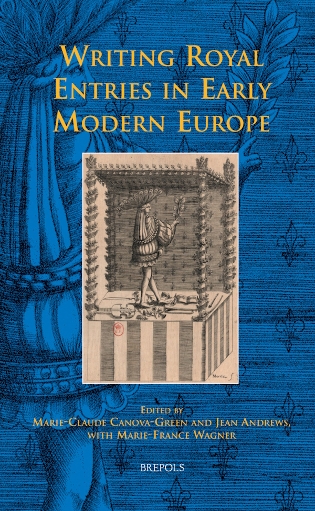
Writing Royal Entries in Early Modern Europe
show More to view fulltext, buy and share links for:Writing Royal Entries in Early Modern Europe show Less to hide fulltext, buy and share links for: Writing Royal Entries in Early Modern EuropeRoyal and ducal entries into major cities were an important aspect of political life in Renaissance and early modern Europe and the New World. The festivities provided an opportunity for the municipal authorities to show off their wealth, learning, political nous, and aspiration while allowing writers, painters, sculptors, architects, set-designers, scene-painters, dancers, musicians, choreographers, and others an unparalleled opportunity to showcase their wares. The essays in this volume cover a range of royal and ducal entries, some well documented and well known, others less so, some barely documented at all. Each essay tackles an aspect of the business of putting together an entry festivity, discusses a particular difficulty posed for the contemporary scholar by the extant documentation, or offers a consideration of issues central to the development of this type of festivity or the literature associated with it. The entries and royal progresses of members of the Habsburg, Medici, Valois, Bourbon, and Tudor dynasties are examined, as are the festivities commissioned and mounted by powerful and strategically important cities such as Berlin, Antwerp, Paris, Florence, London, and Mexico City to welcome these great personages or their marginally less great ducal representatives.
-
-
-
Anthropologie de l’Antiquité. Anciens objets, nouvelles approches
show More to view fulltext, buy and share links for:Anthropologie de l’Antiquité. Anciens objets, nouvelles approches show Less to hide fulltext, buy and share links for: Anthropologie de l’Antiquité. Anciens objets, nouvelles approchesLes contributions réunies dans ce livre sont nées d’une collaboration et d’une proximité intellectuelle entre deux institutions de recherche : l’équipe PLH-ERASME qui travaille, à Toulouse, dans les domaines de la réception de l’Antiquité et de l’anthropologie historique, et le centre ANHIMA (Anthropologie et Histoire des mondes antiques), qui réunit, à Paris, des chercheurs engagés dans tous les domaines et toutes les périodes de l’Antiquité. Ce rapprochement s’est traduit par l’organisation de deux journées d’étude internationales à Toulouse, en mars 2010, et par la création d’une nouvelle collection : « Antiquité et sciences humaines. La traversée des frontières », accueillie par les éditions Brepols.
Ces initiatives témoignent de la vitalité et du renouvellement des perspectives anthropologiques : redéfi nir les concepts les mieux connus (comme le don, le commerce), s’attacher à un champ d’études laissé à l’écart (l’archéologie gallo-romaine), prendre en compte des déplacements de catégories entre hommes et femmes, masculin et féminin dans les études de genre, explorer des domaines nouveaux (les émotions, la perception des couleurs).
La prise en compte des différences qui nous sépare nt des hommes de l’Antiquité, l’attention portée aux spécifi cités qui marquent l’ensemble de leurs représentations et de leurs comportements dans tous les champs de la vie sociale, politique, religieuse, culturelle, la conscience des mutations qui se sont opérées sur la longue durée, c’est ce que chacun des auteurs de ce volume, dans le domaine qui lui est propre, a tenté de mettre en oeuvre.
Liste des contributeurs : Vincent Azoulay, Maurizio Bettini, Corinne Bonnet, Violaine Sebillotte-Cuchet, Ton Derks, Adeline Grand-Clément, Pascal Payen, Nicholas Purcell, Évelyne Scheid-Tissinier, Pauline Schmitt Pantel, Emmanuelle Valette, Andreas Wittenburg.
-
-
-
Cyprus and the Renaissance (1450-1650)
show More to view fulltext, buy and share links for:Cyprus and the Renaissance (1450-1650) show Less to hide fulltext, buy and share links for: Cyprus and the Renaissance (1450-1650)These twelve essays by leading scholars in the field are products of an international research project on early modern Cyprus and its relation to cultural developments in the West, started in November 2009.
Cyprus, an independent ‘Frankish’ kingdom from 1191 to 1473, became a Venetian protectorate, then, in 1489, a Venetian colony until its conquest by the Ottomans in 1570. Its population was diverse and rich in religious experience - preponderantly followers of the Greek rite, but also Latins, Eastern Christians and Jews.
Its heritage from Antiquity, as well as from the Byzantine and Frankish periods, its monasteries (which received, reproduced and produced manuscripts) and its geopolitically pivotal site on East-West trade routes attracted numerous Westerners. The cultural magnet drew deeper interests than those of pilgrimage and tourism.
The continuous to and fro of Europeans, many of them Venetian, the island’s importance to economic and military strategies, and the allure conferred by a mythological past stimulated and fostered a generous descriptive and allusive literature.
The present collection is the first of its kind, centered on written culture and exchanges during the Renaissance period, deepening their source-based documentary study, as well as our knowledge of the island’s culture and heritage in relation to cultural developments in Western countries.
-
-
-
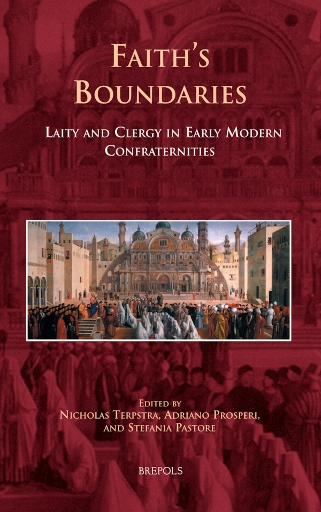
Faith’s Boundaries
show More to view fulltext, buy and share links for:Faith’s Boundaries show Less to hide fulltext, buy and share links for: Faith’s BoundariesWho owns the spaces of religion? Does the question matter, or even make sense? Modern distinctions between sacred and secular spheres tend to assume that clergy dominate the former, and lay people the latter. A man or woman living in the early modern period might not have been so sure. They would have thought more immediately of things of heaven and things of earth, and would have seen each as the concern of clergy and laity alike. Faith’s boundaries, while real, were very porous. This collection offers the first sustained comparative examination of lay-clerical relations in confraternities through the late medieval and early modern periods. It shows how laity and clergy debated, accommodated, resolved, or deflected the key issues of gender, race, politics, class, and power. The sixteen essays are organized into six sections that consider different aspects of the function of confraternities as social spaces where laity and clergy met, mediated, and sometimes competed and fought. They cover a period historically when kinship was a dominant metaphor in religious life and when kinship groups like confraternities were dominant models in religious institutions. They deal with Catholic, Jewish, and Islamic confraternities, and range geographically from Europe to the Middle East, Central and South Asia, and Latin America.
-
-
-
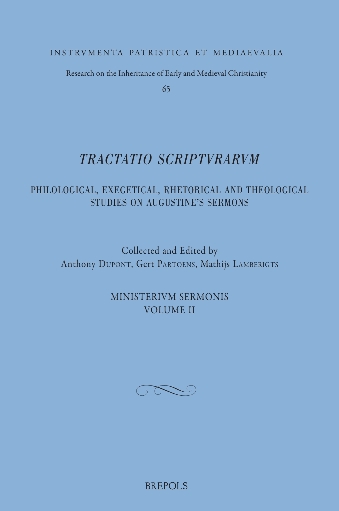
Tractatio Scripturarum. Philological, Exegetical, Rhetorical, and Theological Studies on Augustine's Sermons
show More to view fulltext, buy and share links for:Tractatio Scripturarum. Philological, Exegetical, Rhetorical, and Theological Studies on Augustine's Sermons show Less to hide fulltext, buy and share links for: Tractatio Scripturarum. Philological, Exegetical, Rhetorical, and Theological Studies on Augustine's SermonsThe contributions collected in this volume of Instrumenta Patristica et Mediaevalia share a common focus on Saint Augustine's sermons on the New Testament and address a wide range of topics within this extended field of research. Several contributions deal with the transmission of these homilies, while others tackle questions concerning exegesis, rhetoric and theology. The foundation for this compilation was laid during the conference 'Ministerium sermonis. An International Colloquium on Saint Augustine's Sermons on the New Testament and their Reception' (September 15-17, 2011), hosted by the Academia Belgica in Rome (Italy).
The present volume may be considered a sequel to the book Ministerium sermonis. Philological, Historical and Theological Studies on Augustine's Sermones ad populum, which was published in 2009 as volume 53 of the series Instrumenta Patristica et Mediaevalia and bundled the contributions to the first Ministerium sermonis colloquium of May 2008 (Leuven - Turnhout).
List of contributors: Andrea Bizzozero, Isabelle Bochet, Pierre-Maurice Bogaert, Shari Boodts, François Dolbeau, Hubertus R. Drobner, Anthony Dupont, Alicia Eelen, Wim François, Uta Heil, Pierre-Marie Hombert, Paul Mattei, Gert Partoens, Stanley P. Rosenberg, Paul van Geest, Joost van Neer, Clemens Weidmann, Jonathan Yates
-