


Brepols Online Books Medieval Monographs Collection 2013 - bob2013mome

Collection Contents
3 results
-
-
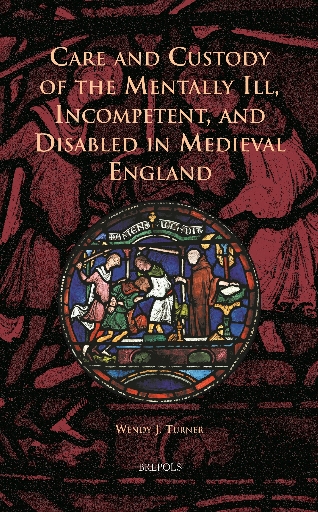
Care and Custody of the Mentally Ill, Incompetent, and Disabled in Medieval England
show More to view fulltext, buy and share links for:Care and Custody of the Mentally Ill, Incompetent, and Disabled in Medieval England show Less to hide fulltext, buy and share links for: Care and Custody of the Mentally Ill, Incompetent, and Disabled in Medieval EnglandThis book is about the social understanding and treatment of the mentally ill, incompetent, and disabled in late medieval England. Drawing on archival, literary, medical, legal, and ecclesiastic sources and studies, the volume seeks to present a coherent picture of society’s treatment, protection, abuse, care, and custody of the incapacitated. Although many medieval stories stereotyped the mad (most often as sinners or innocents), for example, there is clear evidence that English society treated and cared for the impaired on a person-by-person basis. The mentally incapacitated were not lumped into one category and not ignored or sent away; on the contrary, both the English administration and the public had many categories and terms for mental conditions, cognitive abilities, and levels of physicality (violence) associated with impairment. English society also had safeguards and assistants (keepers, custodians, guardians) in place to help mentally impaired persons in life.
This study therefore eschews totalizing assumptions about a societal ‘core’ and its ‘margins’; instead, it instigates a new consideration of communities as holistic entities with an ebb and flow among the contributing and non-contributing elements as people live, grow, age, get sick, become well, have children, break bones, or live with mental or physical impairments.
-
-
-
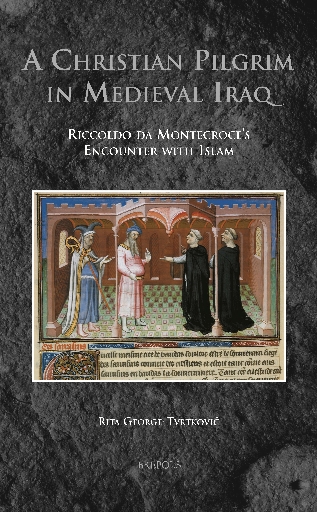
A Christian Pilgrim in Medieval Iraq
show More to view fulltext, buy and share links for:A Christian Pilgrim in Medieval Iraq show Less to hide fulltext, buy and share links for: A Christian Pilgrim in Medieval IraqThis book analyses the events of a decade long encounter between an Italian Dominican, Riccoldo da Montecroce (c. 1243–1320), and the Muslims of Baghdad, as recounted by the friar himself. While many of Riccoldo’s views of the Muslims are consonant with those of his medieval confrères, the author examines the much more ambivalent sections of his writings, such as his praise-filled descriptions of Muslim praxis, his obvious love of Qur’anic Arabic, his frequent references to personal encounters with Muslims, and his candid descriptions of the wonder and doubt which these confrontations often elicited. The author argues that the tensions and inconsistencies inherent in Riccoldo’s account of Islam should not be viewed as defects. Rather, she contends, their presence illustrates the complex nature of interreligious encounter itself. In addition to a critical discussion, this volume provides — for the first time — English translations of two remarkable Riccoldian texts: The Book of Pilgrimage (Liber peregrinationis) and Letters to the Church Triumphant (Epistolae ad ecclesiam triumphantem).
-
-
-
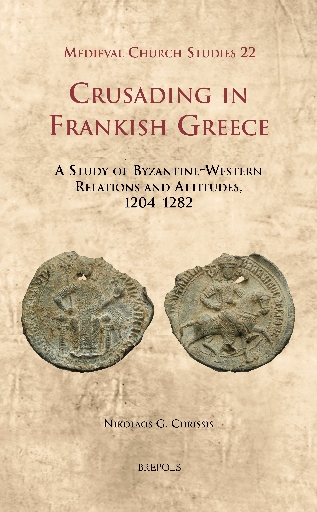
Crusading in Frankish Greece
show More to view fulltext, buy and share links for:Crusading in Frankish Greece show Less to hide fulltext, buy and share links for: Crusading in Frankish GreeceAfter becoming a major aspect of the contact between East and West during the twelfth century, the Crusades were even more widely deployed in the thirteenth century at the frontiers of Latin Christendom (in the Holy Land, the Iberian peninsula, and the Baltic), as well as within western Europe. Another such front was opened up after the conquest of Constantinople by the army of the Fourth Crusade in 1204, where the opponents were the Christian but ‘schismatic’ Greeks. A series of crusades were proclaimed for the defence of the Frankish states which were set up in the formerly Byzantine territories.
This development defined the policy of the papacy, of the Latin powers, and of the Greek states in the area, and had a profound impact on Greco-Latin relations in the thirteenth century. At the same time, it constituted an important stage in the expansion of crusading at large, and was an integral part of the process of Latin Christendom’s self-definition against the various ‘others’ it came in contact with: Muslims, pagans, as well as Eastern Christians. Yet, despite their importance, these expeditions have not been systematically examined before.
This book addresses this omission. Drawing from both Byzantine and crusade historiography and making use of a wealth of unexploited sources, it investigates the evolution of crusading in Frankish Greece and places it in the context of Byzantine-western interaction, of political circumstances across Europe, and of developments in the theory and practice of Holy War.
-