


Brepols Online Books Other Monographs Collection 2013 - bob2013moot

Collection Contents
2 results
-
-
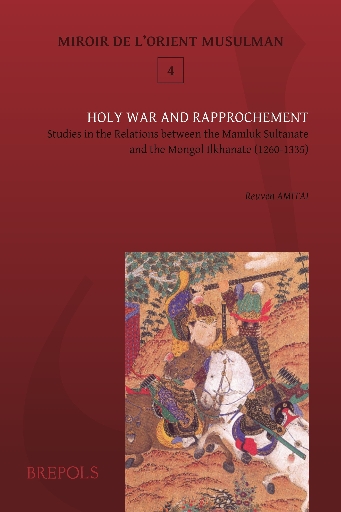
Holy War and Rapprochement
show More to view fulltext, buy and share links for:Holy War and Rapprochement show Less to hide fulltext, buy and share links for: Holy War and RapprochementThe sixty year struggle (1260-1320) between the Mamluk Sultanate of Syria and Egypt and the Ilkhanate, the Mongol realm in Iran and the surrounding countries, had a profound impact on the region’s ruling elites and the general population, as well as on neighboring countries and beyond. It is possible to speak of a thirteenth century “world war”: on one side were arrayed the Mamluks and the Mongol Golden Horde of southern Russia, at times Genoa and the Byzantine empire, while on the other side we find the Ilkhanate, the Venetians (albeit still trading with the Mamluks), the states of western Europe, the Papacy, the Armenians of both the Caucasus and Cilicia, and Georgia. To these we could add minor, but still important actors: the Bedouin of Syria, the Seljuqs of Rum (Anatolia), the Turcoman of that country, and even more. Far away, the Mongols of Central Asia and the Great Khan in China also had an impact on affairs along the Mediterranean coast and southwest Asia.
The present volume is based on four lectures given at the Ecole Pratique des Hautes Etudes in Paris in February 2007, and first provides an overview of the military struggle between these two regional powers, continues with a detailed discussion of the ideological posturing and sparring between them - both before and after the conversion of the Mongols to Islam in the 1290s, and finally reviews and compares how the Mamluks and Mongols presented themselves to the local, mainly Muslim, populations that they ruled. The book provides an analysis of an important chapter in Middle Eastern, Asian and world history.
Reuven Amitai holds the Eliyahu Elath Chair for Muslim History at the Hebrew University of Jerusalem, where he is now the dean of the Faculty of Humanities. His publications include Mongols and Mamluks: The Mamluk-Ilkhanid War, 1260-1281 (Cambridge, 1995) and The Mongols in the Islamic Lands: Studies in the History of the Ilkhanate (Aldershot, 2007).
-
-
-
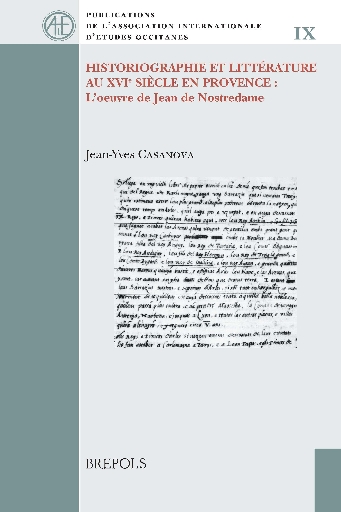
Historiographie et littérature au XVIe siècle en Provence: l'oeuvre de Jean de Nostredame
show More to view fulltext, buy and share links for:Historiographie et littérature au XVIe siècle en Provence: l'oeuvre de Jean de Nostredame show Less to hide fulltext, buy and share links for: Historiographie et littérature au XVIe siècle en Provence: l'oeuvre de Jean de NostredameJean de Nostredame est connu pour la publication en 1575 des Vies des plus celebres et anciens poetes provençaux que la critique médiéviste a souvent critiqué ou dénigré pour ses « inventions ». Camille Chabaneau avait mis au jour des proses historiographiques qui révélaient l’ampleur d’un travail historique et littéraire, d’une pensée linguistique au cœur du XVIe siècle provençal. Par l’édition des Memoires Historiques, réalisée d’après le manuscrit original d’Aix-en-Provence, la place de Jean de Nostredame est ainsi considérablement réévaluée. Nous ne sommes pas en présence d’un « faussaire », mais d’un humaniste provençal dont l’œuvre et l’action ont été méconnues, négligées, et que l’on doit relire à l’aune de nos connaissances actuelles. Jean de Nostredame devient ainsi un historien et un écrivain dont la pensée s’est effacée, et ce à cause de la situation particulière des lettres occitanes, tombant en quelque sorte dans « un trou de la pensée littéraire et linguistique ». Il n’est que justice aujourd’hui de le redécouvrir et d’apprécier ce que furent son œuvre et sa pensée.
Jean-Yves Casanova est professeur à l’Université de Pau et des Pays de l’Adour. Il est notamment l’auteur de plusieurs ouvrages et études critiques sur la littérature occitane, du XVIe siècle à l’œuvre de Frédéric Mistral.
-