


Brepols Online Books Medieval Miscellanea Collection 2014 - bob2014mime

Collection Contents
2 results
-
-
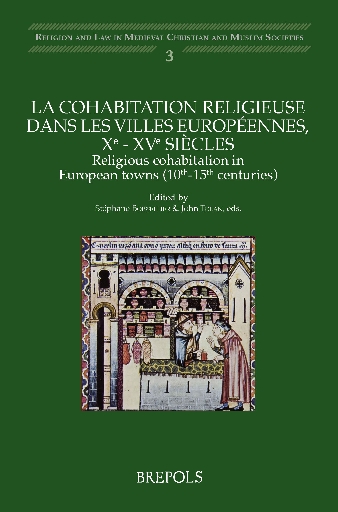
Religious cohabitation in European towns (10th-15th centuries)
show More to view fulltext, buy and share links for:Religious cohabitation in European towns (10th-15th centuries) show Less to hide fulltext, buy and share links for: Religious cohabitation in European towns (10th-15th centuries)Medieval towns, from Portugal to Hungary to Egypt, were places of contact between members of different religious communities, Muslim, Christian and Jewish, who rubbed shoulders in the ports and on the streets, who haggled in the markets, signed contracts, and shared wells, courtyards, dining tables, bath houses, and sometimes beds. These interactions caused legal problems from the point of view of the Jewish, Christian and Muslim judicial scholars of the middle ages, not to mention for the rulers of these towns. These legal attempts to define and solve the problems posed by interreligious relations are the subject of this volume, which brings together the work of seventeen scholars from nine countries (France, Italy, Spain, Hungary, Portugal, Lebanon, Israel, Tunisia, USA), specialists in history, law, archeology and religion.
-
-
-
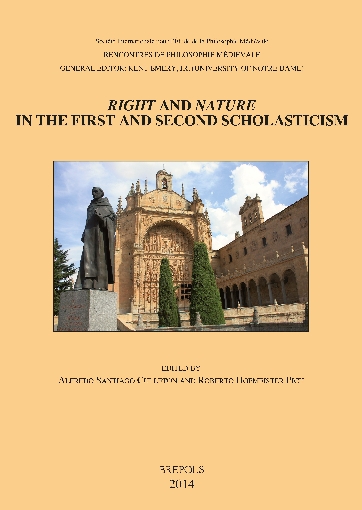
Right and Nature in the First and Second Scholasticism. Derecho y Naturaleza en la primera y segunda escolástica
show More to view fulltext, buy and share links for:Right and Nature in the First and Second Scholasticism. Derecho y Naturaleza en la primera y segunda escolástica show Less to hide fulltext, buy and share links for: Right and Nature in the First and Second Scholasticism. Derecho y Naturaleza en la primera y segunda escolásticaAuthors of the ‘Second Scholasticism’ (as discussed in this volume, at least, mainly Iberian philosophers and theologians of the sixteenth and seventeenth centuries) not only commented on the works and updated the teachings of medieval Scholastic masters, but also introduced many new ideas in all areas of philosophy, namely logic, natural philosophy, metaphysics, moral philosophy, political philosophy and the philosophy of law. In particular, issues arising from the “discovery” of the New World presented new challenges to these thinkers, provoking various reactions among them and causing them to develop new interpretations and theories, especially in practical philosophy and theology. In this volume, scholars from Europe, North America and South America identify and describe some of the main topics and central lines of thought in this still quite unknown chapter in the history of philosophical ideas. The contributors focus on the reception and development of Aristotelian-Thomistic and (to a lesser extent) Scotistic political theory, natural law, positive law and the law of nations in the sixteenth and seventeenth centuries; some authors, moreover, address issues in the development of metaphysics during the same period. For the most part, the studies presented here concern the writings and thought of masters from the Universities of Salamanca, Alcalá, Évora and Coimbra, who responded to new questions and conceived new theories in political philosophy, law and moral philosophy closely related to the issues pertaining to the Spanish and Portuguese colonies in the New World.
-