


Brepols Online Books Other Miscellanea Collection 2014 - bob2014miot

Collection Contents
2 results
-
-
Measuring Agricultural Growth
show More to view fulltext, buy and share links for:Measuring Agricultural Growth show Less to hide fulltext, buy and share links for: Measuring Agricultural GrowthThis work takes a new look at the question of agricultural production and productivity and reopens the issue of agricultural growth and the questions that still surround its extraordinary impact on European societies. The nine contributions making up the volume set out another approach to this unprecedented shift, written from a new angle with new methods and a new way of associating micro and macro analyses.
These chapters also make a break with the illusion of a single and dominant English or Anglo-Dutch model, and take a critical look against preconceptions that consist of interpreting everything in terms of advances or delays, and of ignoring the context behind the economic decisions made by producers. This collection makes it possible to get away from the eternal confrontation of French and English models, and to change the picture by careful consideration of another country with its own very specific natural and institutional conditions: Spain. It sets out to analyse some of the paths taken by farmers to overcome the constraints under which they operated, using historical experience and statistical analysis, without preconceived ideas.
These papers do not hesitate to cross traditional chronological boundaries and look at different scales of production, at different times and in different places. They make incursions into a subject that is still crucial to present-day society, at a moment when the future of the food supply on much of the planet is as urgent and acute as ever.
-
-
-
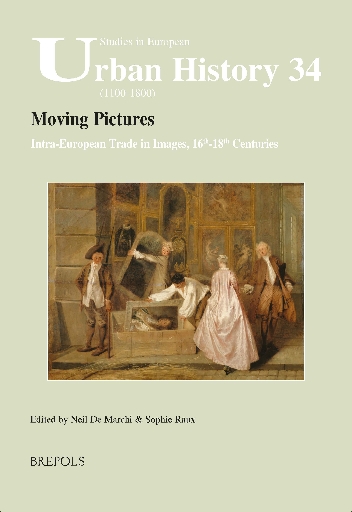
Moving Pictures
show More to view fulltext, buy and share links for:Moving Pictures show Less to hide fulltext, buy and share links for: Moving PicturesThis collection focuses overtly on the internal dynamics and links between art markets in the Early Modern period, but presupposes that art objects - here visual images - are objects of desire. During this period, however, desire changed; a great deal more of these objects came to be made for ordinary domestic consumption, including devotional purposes, than as tokens of the magnificence, piety, cultivation or learning of individual commissioners. Probably most still were commissioned, but to satisfy tastes that, though differentiated internationally, were widely shared within one country or region. Most too were commissioned at a distance, by agents, and were moved between maker and end-point distributor by specialised traders, many of whom - though far from all - were large-scale operators. The dominant focus of contributors here is therefore on the agents of this distance trade, its mechanisms and its impacts in terms of both satisfying and subtly shaping tastes, all at a range of prices. Measurement and mappings are aspects of this traffic. Focus was sharpened by concentrating on three questions: what is currently known about the number of images, whether in the form of paintings, prints, small sculptures or woven textiles, that circulated in early modern Europe? Through what channels and networks were they distributed? And what were the economic, social and institutional contexts?
-