


Brepols Online Books Medieval Monographs Collection 2014 - bob2014mome

Collection Contents
3 results
-
-
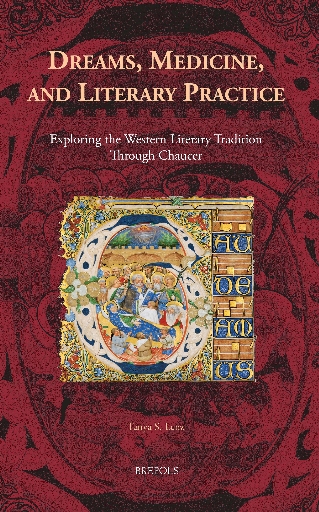
Dreams, Medicine, and Literary Practice
show More to view fulltext, buy and share links for:Dreams, Medicine, and Literary Practice show Less to hide fulltext, buy and share links for: Dreams, Medicine, and Literary PracticeThis groundbreaking volume explores the intersection of dreams, medicine, and literary practice in the poetry of Chaucer and influential literary works from antiquity through the late fourteenth century. An introductory exploration considers topics such as Asclepian dream healings of ancient Greece, Old English poetry, medieval mystics, and foundational works by Hippocrates, Aristotle, Galen, Avicenna, Macrobius, and others. Detailed analyses of a series of Chaucer’s poems follow. Frequently incorporating and commenting on antecedent works, these late medieval poems span various genres including the dream-vision, the romance-tragedy, and the comic tale. Dreams and medicine are woven into the fabric of these texts, the author contends, revealing distinct and often surprising insights. One such insight is the ‘double potential’ of literary practice, medicine, and dreams - that is, each is capable of facilitating healing and wholeness yet equally capable of causing harm and disease. Ultimately, this book shows that the joining together of medicine and dreams constitutes a vital dimension of these key works in Western literature - one that reveals a profound connection between literature and the fundamentally human experiences of disease, healing, and dreaming.
-
-
-
The Daughters of Henry II and Eleanor of Aquitaine
show More to view fulltext, buy and share links for:The Daughters of Henry II and Eleanor of Aquitaine show Less to hide fulltext, buy and share links for: The Daughters of Henry II and Eleanor of AquitaineThe three daughters of Henry II and Eleanor of Aquitaine all undertook exogamous marriages which cemented dynastic alliances and furthered the political and diplomatic ambitions of their parents and their spouses. It might be expected that the choices made by Matilda, Leonor, and Joanna with regard to religious patronage and dynastic commemoration would follow the customs and patterns of their marital families, yet in many cases these choices appear to have been strongly influenced by ties to their natal family. Their involvement in the burgeoning cult of Thomas Becket, their patronage of Fontevrault Abbey, the names they gave to their children, and the ways in which they were buried, suggests that all three women were able, to varying degrees, to transplant Angevin family customs to their marital lands.
By examining the childhoods, marriages, and programmes of patronage and commemoration of Matilda, Leonor and Joanna, this monograph compares and contrasts the experiences of three high-profile twelfth-century royal women, and advances the hypothesis that there may have been stronger emotional ties within the Angevin dynasty than has previously been allowed for.
-
-
-

The Death Ritual at Cluny in the Central Middle Ages
show More to view fulltext, buy and share links for:The Death Ritual at Cluny in the Central Middle Ages show Less to hide fulltext, buy and share links for: The Death Ritual at Cluny in the Central Middle AgesThis volume presents a complete reconstruction of the ritual response to terminal illness and death at the monastic community of Cluny at the height of its development in the later eleventh and early twelfth centuries. Based on the best manuscript of the customary of Bernard, the only account of the abbey's customs written at and for Cluny itself, the reconstruction contains not just Bernard's Latin description of the ritual process, but also the full texts of the prayers and chants that accompanied it, gathered, in the absence of surviving ritual books from Cluny itself, from contemporary sources with clear ties to the Cluniac customs. Facing-page English and French translations make the results available to readers with little or no facility in Latin. The author places the Cluniac death ritual in the context of religious responses to death, dying and the care of the dead in medieval Latin Christianity as a whole. He also explicates the origins, development and meaning of the Cluniac death ritual's myriad elements as they were spoken, sung and performed within the sacred spaces of the monastic complex-cloister, chapter house, infirmary, church and cemetery.
Frederick S. Paxton is Brigida Pacchiani Ardenghi Professor of History at Connecticut College, in New London, CT, USA. He is the author of Christianizing Death: The Making of a Ritual Process in Early Medieval Europe (1990), Anchoress and Abbess in Ninth-Century Saxony: the Lives of Liutbirga of Wendhausen and Hathumoda of Gandersheim (2009) and numerous articles and essays on sickness, death, dying and the dead in medieval Europe.
-