


Brepols Online Books Medieval Monographs Collection 2014 - bob2014mome

Collection Contents
3 results
-
-
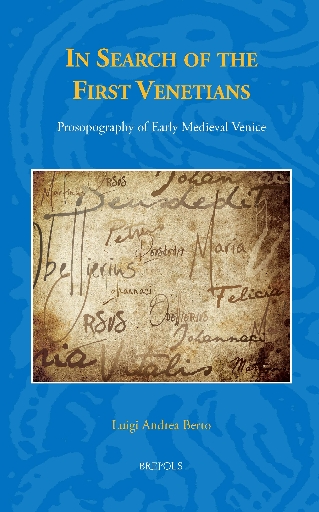
In Search of the First Venetians
show More to view fulltext, buy and share links for:In Search of the First Venetians show Less to hide fulltext, buy and share links for: In Search of the First VenetiansThis prosopographical study provides information about each Venetian living in the early Middle Ages, from the invasion of the Lombards in 569 - an action that forced part of northeast Italy’s population to seek refuge on the islands of the Venetian lagoon - to the rule of Duke Petrus Ursoylus II (991-1008). There is an entry for each individual listing all available information and quoting the full text of primary sources within the footnotes. The data are organized in categories such as families, first names, rulers, women, office holders, ecclesiastics, occupations, and places of residence (Venice was a duchy with different urban centres).
Venice is an extremely important place for this kind of analysis. It is the area in which family name use began for the first time in medieval Europe. Venice was never conquered by a ‘Germanic’ people, and therefore it is possible to study the evolution of a post-Roman/Byzantine society by analyzing the names of the Venetians. Moreover, scholars interested in later periods will be able to find the origins of all the most important Venetian families.
-
-
-
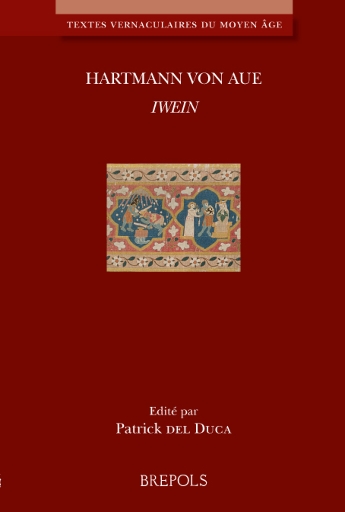
Iwein
show More to view fulltext, buy and share links for:Iwein show Less to hide fulltext, buy and share links for: IweinA la fin du XIIe siècle, Hartmann von Aue, un clerc allemand originaire de Souabe, adapte Yvain ou le Chevalier au Lion de Chrétien de Troyes. Iwein constitue sans nul doute l’œuvre la plus aboutie et la plus fascinante de Hartmann. L’adaptateur y reprend les aventures autour desquelles s’organise le roman français : la fontaine merveilleuse, la conquête d’une reine et d’un pays, la folie d’Iwein, l’aide apportée aux chevaliers prisonniers du géant Harpin ou aux trois cents captives d’un château, le combat contre Gawein. Toutefois, Hartmann ne se contente pas d’adapter le roman de Chrétien à la langue allemande, il réinterprète sa source et transforme en profondeur les motivations des personnages et le sens des aventures. Ce qui prime chez Hartmann n’est plus le rapport entre fin’ amor et prouesse mais le rôle de la chevalerie et l’idéal du miles christianus. Pour la première fois, ce roman allemand est traduit en français moderne.
Patrick del Duca est Maître de Conférences et enseigne la langue et la littérature allemandes du Moyen Âge à l’Université Blaise Pascal de Clermont-Ferrand.
-
-
-
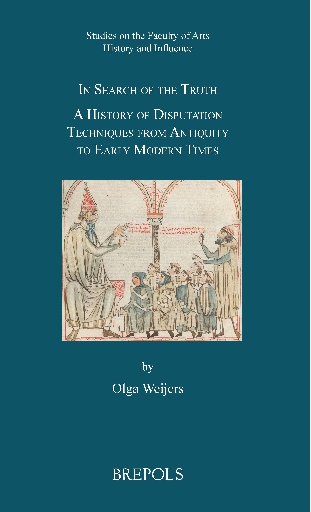
In Search of the Truth
show More to view fulltext, buy and share links for:In Search of the Truth show Less to hide fulltext, buy and share links for: In Search of the TruthDisputation and debate have accompanied human development from its beginnings. However, what we still call ‘disputation’, technically speaking, is a particular method of reasoning and analysing, involving either a debate between two people, or of one person with himself. It is this method which is the object of this study. The disputation was one of the main methods of teaching and research during the Middle Ages. Tracing its development shows how it influenced the way in which people examined abstract problems. Reasoning and arguing about contradictory positions remained a feature of intellectual life well into the nineteenth century, and the practice remains alive even today.
For a long time the disputation was the main tool for analysing problems in a range of fields, especially in philosophy and theology. The main features were the analysis of opposite positions and thorough discussion of the various arguments for both sides, the collective search for the truth in special public disputations, the recognition that the truth may differe from the conclusion reached and the willingness to accept better arguments if they brought one closer to the truth. All this is typical of an intellectual attitude, the key features of which are critical thinking and honest collaborative research, that still marks the Western world. The history of the disputation can tell us something about the way in which we learned to think.
-