


Brepols Online Books Medieval Miscellanea Collection 2015 - bob2015mime

Collection Contents
2 results
-
-
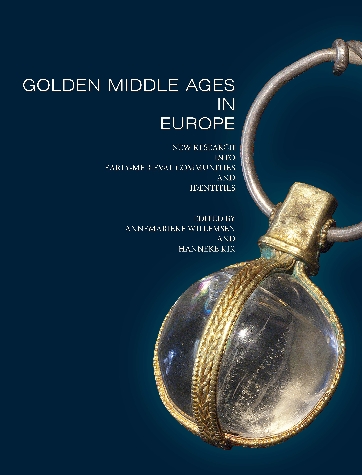
Golden Middle Ages in Europe
show More to view fulltext, buy and share links for:Golden Middle Ages in Europe show Less to hide fulltext, buy and share links for: Golden Middle Ages in EuropeDorestad was an important harbour town in the middle of the present-day Netherlands, that had its hey-day in the Carolingian period, but was already an important settlement in the centuries before, with a famous 7th-century Frankish mint. In July 2014, the National Museum of Antiquities in Leiden hosted the second Dorestad congress, exactly five years after the first. This congress was attached to the exhibition ‘Golden Middle Ages: The Netherlands in the Merovingian World, 400-700 ad’ and brought together historians, archaeologists and linguists to discuss these ‘Dark Ages’, their burials and settlements, rituals and identities, and the position of the Low Countries in the world-wide networks of early-medieval Europe. Contributions in these congress proceedings are devoted to key themes like early-medieval identity and agency, so-called royal burials in Europe, significant find categories like garnets, coins and Merovingian glass, important new sites and finds from the Low Countries and recent work in the Carolingian ‘vicus famosus’ of Dorestad.
Dr. Annemarieke Willemsen is curator of the Medieval Department of the National Museum of Antiquities (Leiden), where she organized the 2009 exhibition & congress on Carolingian Dorestad and the 200 exhibition & congress on the early-medieval Netherlands.
Hanneke Kik m.a. is project manager at the same museum, and was secretary of the Dorestad Congress in 2009 and 2014.
-
-
-
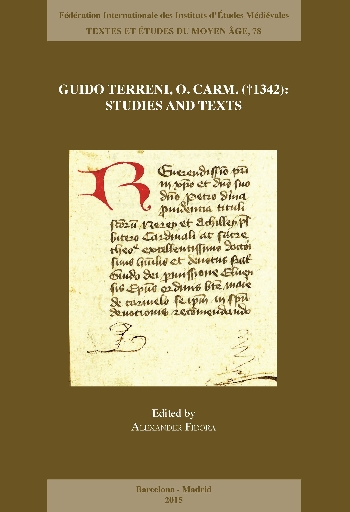
Guido Terreni, O. Carm. ( †1342)
show More to view fulltext, buy and share links for:Guido Terreni, O. Carm. ( †1342) show Less to hide fulltext, buy and share links for: Guido Terreni, O. Carm. ( †1342)The Catalan philosopher and theologian Guido Terreni (ca. 1270-1342) is one of the most outstanding fi gures in the history of the Carmelite order. The articles gathered in the first part of this volume explore the extremely rich, though still understudied, oeuvre of the Bishop of Majorca and Elne which comprises philosophicotheological, polemical, biblical and juridical texts. Since many of these works remain unedited, the second part of the volume contains selected text editions from Guido’s commentaries on Aristotle’s Physics and the Decretum Gratiani, as well as from his influential Quodlibetal Questions. Altogether, the sixteen contributions in this volume offer a comprehensive and up-to-date appraisal of Guido’s major contribution to the intellectual and political debates of his age and beyond.
-