


Brepols Online Books Medieval Monographs Collection 2015 - bob2015mome

Collection Contents
3 results
-
-
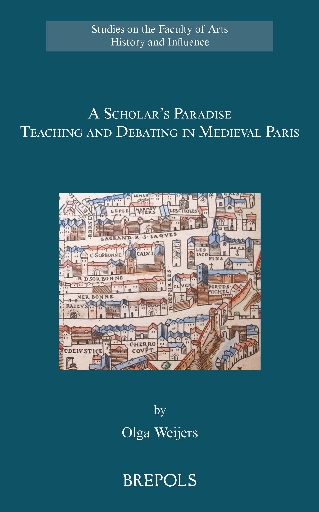
A Scholar's Paradise
show More to view fulltext, buy and share links for:A Scholar's Paradise show Less to hide fulltext, buy and share links for: A Scholar's ParadiseThis volume offers the general reader a synthesis of academic life in Paris during the first centuries of its existence. These early years were a period of excitement, discovery and intellectual freedom. Perhaps never again would a community of scholars engage in teaching and debate in such an astonishingly new and fresh world, with people, texts and ideas multiplying rapidly and surrounded by an equally rapidly developing city. From the perspective of the twenty-first century, it seems an enviable period, a time when optimism and eager research still went hand in hand with the idea that the whole of existence might be encompassed by the human mind.
Here, Olga Weijers offers a comprehensive re-working of her 1995 publication (Le maniement du savoir. Pratiques intellectuelles à l’époque des premières universités), which has been re-organized, extended to include less technical subjects, updated and translated into English.
-
-
-
Solitudes et solidarités en ville. Montpellier, mi XIIIe-fin XVe siècles
show More to view fulltext, buy and share links for:Solitudes et solidarités en ville. Montpellier, mi XIIIe-fin XVe siècles show Less to hide fulltext, buy and share links for: Solitudes et solidarités en ville. Montpellier, mi XIIIe-fin XVe sièclesLa solitude en milieu urbain est un champ de recherche contemporain, porté en particulier par la sociologie. Les sociétés urbaines médiévales comptaient aussi leur lot de solitaires : enfants orphelins et abandonnés, immigrants à la recherche d’une vie meilleure, veufs et veuves, personnes âgées isolées. Le contexte de la deuxième moitié du XIV e siècle, avec ses épidémies de peste récurrentes et les ravages causés par la guerre de Cent Ans aggrave le phénomène. Étudiée dans le cadre de la ville de Montpellier, des années 1250 à la fin du XV e siècle, à partir d’archives consulaires, fiscales et testamentaires, la solitude se révèle comme un phénomène fréquent : nombreuses sont les personnes seules dans l’espace urbain. La solitude apparaît sous de multiples formes et se manifeste tout au long du cours de la vie des individus, entrecoupant les cycles de développement familiaux. Or, entre la vie en solitaire et l’isolement social existe toute une palette de situations personnelles, dont on ne peut saisir la complexité que par l’étude des solidarités, recherchées par les personnes seules ou spontanément offertes par des parents, des amis, qui viennent pallier la solitude.
-
-
-
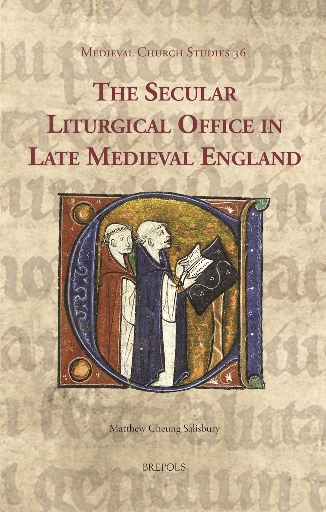
The Secular Liturgical Office in Late Medieval England
show More to view fulltext, buy and share links for:The Secular Liturgical Office in Late Medieval England show Less to hide fulltext, buy and share links for: The Secular Liturgical Office in Late Medieval EnglandUntil recently, research on the late medieval English Office liturgy has suggested that all manuscripts of the same liturgical Use, including those of the celebrated and widespread Uses of Sarum and York, are in large part interchangeable and uniform. This study demonstrates, through detailed analyses of the manuscript breviaries and antiphonals of each secular liturgical Use of medieval England, that such books do share a common textual core. But this is in large part restricted to a single genre of text - the responsory. Other features, even within manuscripts of the same Use, are subject to striking and significant variation, influenced by local customs and hagiographical and textual priorities, and also by varying reception to liturgical prescriptions from ecclesiastical authorities. The identification of the characteristic features of each Use and the differentiation of regional patterns have resulted from treating each manuscript as a unique witness, a practice which is not common in liturgical studies, but one which gives the manuscripts greater value as historical sources. The term ‘Use’, often employed as a descriptor of orthodoxy, may itself imply a greater uniformity than ever existed, for the ways that the ‘Use of Sarum’, a liturgical pattern originally designed for enactment in a single cathedral, was realised in countless other venues for worship were dependent on the times, places, and contexts in which the rites were celebrated.
-