


Brepols Online Books Medieval Monographs Collection 2015 - bob2015mome

Collection Contents
1 - 20 of 21 results
-
-
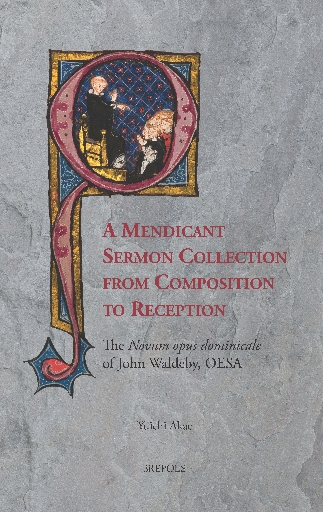
A Mendicant Sermon Collection from Composition to Reception
show More to view fulltext, buy and share links for:A Mendicant Sermon Collection from Composition to Reception show Less to hide fulltext, buy and share links for: A Mendicant Sermon Collection from Composition to ReceptionThis study analyzes in detail the Novum opus dominicale of John Waldeby, a member of the convent of the Augustinian friars in York. This unedited collection of some sixty sermons for Sundays and major feasts is extant in two manuscripts in the Bodleian Library (Oxford), MSS Laud misc. 77 and Bodley 687. The present study places the work and the preacher within the wider context of mendicant preaching as mass communication in the Middle Ages. In doing so, it focuses on the educational environment which encompasses conventual education and preaching to the laity, and on the library in which this model sermon collection was compiled and used, identifying the role and meticulous design of the mendicant library collection. Through a detailed examination of sermon form in conjunction with Robert of Basevorn’s Forma praedicandi, it tries to disentangle the intricate considerations involved in the processes of sermon composition and reveals the strategies of interpretation and communication in the use of exempla and imagery in preaching. It investigates the careful organization of Waldeby’s work as a cycle of sermons for an entire year. In this way, it makes possible a deeper understanding of a wide range of complex issues from composition to reception through the prism of this important fourteenth-century sermon collection.
-
-
-
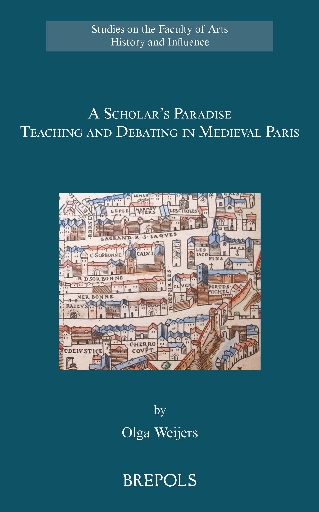
A Scholar's Paradise
show More to view fulltext, buy and share links for:A Scholar's Paradise show Less to hide fulltext, buy and share links for: A Scholar's ParadiseThis volume offers the general reader a synthesis of academic life in Paris during the first centuries of its existence. These early years were a period of excitement, discovery and intellectual freedom. Perhaps never again would a community of scholars engage in teaching and debate in such an astonishingly new and fresh world, with people, texts and ideas multiplying rapidly and surrounded by an equally rapidly developing city. From the perspective of the twenty-first century, it seems an enviable period, a time when optimism and eager research still went hand in hand with the idea that the whole of existence might be encompassed by the human mind.
Here, Olga Weijers offers a comprehensive re-working of her 1995 publication (Le maniement du savoir. Pratiques intellectuelles à l’époque des premières universités), which has been re-organized, extended to include less technical subjects, updated and translated into English.
-
-
-
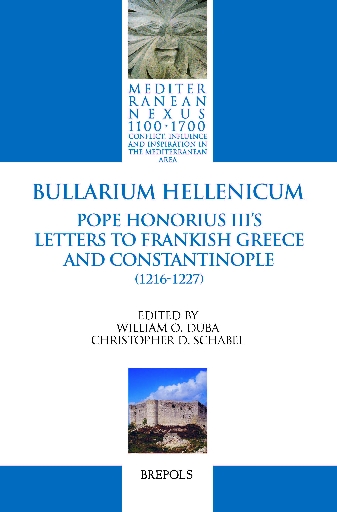
Bullarium Hellenicum
show More to view fulltext, buy and share links for:Bullarium Hellenicum show Less to hide fulltext, buy and share links for: Bullarium HellenicumThis volume gathers together 277 letters of Pope Honorius III (1216-1227) concerning Frankish Greece and Constantinople. These letters constitute an indispensable source for the early history of the territories conquered during and just after the Fourth Crusade of 1204, for which almost no local archival material survives. The Latin texts of many of the letters are published here for the first time, and almost all the letters have been reedited from the manuscripts, primarily the papal registers in the Vatican Archives. In addition, the volume makes the letters available to non-specialists through exhaustive English summaries of all the letters and complete translations of the most significant ones. A lengthy historical introduction uses these letters to portray the dynamic world of the Latin Empire of Constantinople, the Kingdom of Thessaloniki, and the other states that replaced Byzantium, as the precarious condition of the Latin states compelled the ecclesiastical authorities in Rome to temper their ambitions of transcultural religious unity with pragmatic measures. It explores how this mixture of cultural idealism, practical necessity, and divergent class structures manifested themselves in Honorius' policy towards the lower Greek clergy and Greek and Latin religious orders. Maps, tables, indices, and a guide to papal letters make the volume a useful tool for future studies of this fascinating and controversial phase in the history of Greece and the papacy.
-
-
-
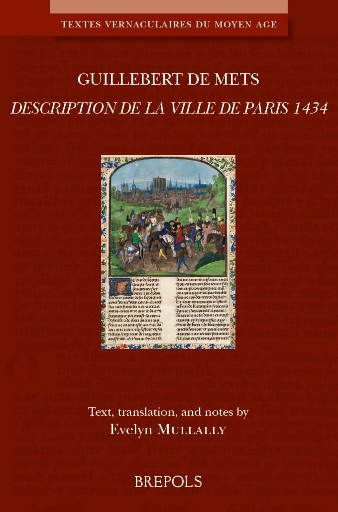
Description de la ville de Paris 1434
show More to view fulltext, buy and share links for:Description de la ville de Paris 1434 show Less to hide fulltext, buy and share links for: Description de la ville de Paris 1434In 1434 Guillebert from Geraardsbergen completed his description of Paris. It is a remarkable record of what was considered noteworthy at the time both historically and topographically. There are picturesque details which are often cited in annotations to the poetry of Francois Villon, notably concerning the Cemetery of the Innocents, the depiction of the Virgin and of heaven and hell in the Celestines and the reference to the famous beauties of the city. The author was an innkeeper and town councillor in his native Geraardsbergen, but also a profssional scribe involved in the book trade who was a 'libraire' for Philip the Good, Duke of Burgundy. The unique manuscript that contains this text also features an important illlustration by an otherwise unknown artist. A whole group of fifteenth-century Flemish manuscript illuminators is now associated with this master, who was given in 1915 the title 'Master of Guillebert De Mets'.
-
-
-
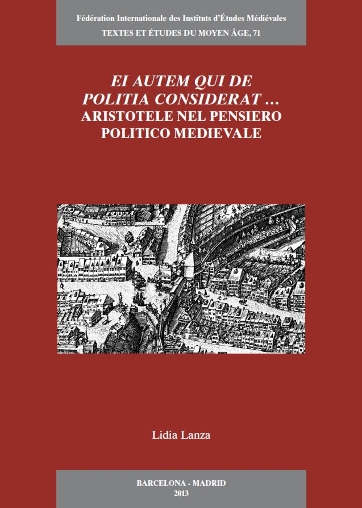
Ei autem qui de politia considerat …
show More to view fulltext, buy and share links for:Ei autem qui de politia considerat … show Less to hide fulltext, buy and share links for: Ei autem qui de politia considerat …Il volume raccoglie gli studi che l’Autrice ha dedicato alla ricezione della Politica di Aristotele nel Medioevo. L’indagine ruota innanzitutto intorno alle opere appartenenti al genere del commento filosofico, canali primi attraverso cui l’Occidente si riappropria della Politica - e tra queste il commento iniziato da Tommaso d’Aquino e ancor più la sua continuazione, opera di Pietro d’Alvernia, s’impongono alla riflessione successiva come "il commento", dettando la selezione delle questioni da affrontare e i modi con cui l’interpretazione delle asserzioni del Filosofo si attua -; annovera anche altri testimoni di tale ricezione, concepiti e realizzati a sostegno della politica reale (è il caso del De regimine principum di Egidio Romano). Nei capitoli dedicati alla riflessione sulla tirannide e sul finis hominis, l’indagine si amplia sino a comprendere l’elaborazione teorica precedente alla riscoperta dell’Aristotele etico-politico, permettendo in tal modo di cogliere i mutamenti che tale riscoperta consente. I temi oggetto d’analisi sono quelli fondanti della riflessione sulla politica: la determinazione della miglior forma di governo, la riflessione sulla cittadinanza, sulla guerra e la pace, sulla felicità individuale e collettiva, sulle degenerazioni della vita politica (la tirannide), sulle dinamiche economiche che regolano la vita della comunità politica.
-
-
-
Interpretation of Scripture: Practice
show More to view fulltext, buy and share links for:Interpretation of Scripture: Practice show Less to hide fulltext, buy and share links for: Interpretation of Scripture: PracticeThanks to the pathbreaking work of Beryl Smalley more than a half century ago, today we recognize the central place of the so-called School of Saint Victor in the history of biblical exegesis. By the mid-twelfth century, the abbey had gained a reputation for solid Christian teaching, with an emphasis on biblical studies and history. This volume contains commentaries and examples of biblical exegesis by Hugh and Andrew of Saint Victor, Sermons by Richard of Saint Victor and Maurice of Sully, the Quaestiones in divina pagina by Robert of Melun, Richard's invective against judaizers, De Emmanuele, and a poetic paraphrase of Ruth by Leontius of Saint Victor, encompassing the broad range of biblical exegetical practice at the abbey.
The editors of this volume are Frans van Liere (PhD, Groningen; Calvin College), editor of Andrew of St Victor’s commentaries on Samuel and Kings (1996; ET 2010) and on the Twelve Prophets (2007, with Mark Zier) (Corpus Christianorum, Continuatio Mediaeualis), and author of An Introduction to the Medieval Bible (2014); and Franklin T. Harkins (PhD, Notre Dame; Boston College), author of Reading and the Work of Restoration: History and Scripture in the Theology of Hugh of St Victor (2009).
-
-
-
Jacques de Vitry (1175/1180-1240)
show More to view fulltext, buy and share links for:Jacques de Vitry (1175/1180-1240) show Less to hide fulltext, buy and share links for: Jacques de Vitry (1175/1180-1240)Jacques de Vitry, né dans le troisième quart du XII e siècle et mort à Rome en 1240, est issu de la génération qui, au tournant du siècle, fut acteur et témoin des transformations intervenues en Occident chrétien et dans l'Église en particulier.
Homme de savoir et d'action, Jacques nous a laissé dans des écrits variés et nombreux le témoignage de ses expériences : l'étudiant parisien, le chanoine régulier du prieuré d'Oignies, le prédicateur de la croisade contre les Albigeois et les Sarrasins, l'évêque d'Acre acteur de la cinquième croisade, le cardinal de l'Église romaine.
On découvre ainsi une personnalité complexe et attachante chez laquelle trois traits de caractère ne cessent de se répondre : la passion de l'étude associée à l'acuité du regard ; l'ambition de servir ; la recherche d'une voie spirituelle patiemment explorée au fil de l'expérience et de l'âge.
-
-
-
L'ecclésiologie d'Anselme de Lucques (1036-1086) au service de Grégoire VII
show More to view fulltext, buy and share links for:L'ecclésiologie d'Anselme de Lucques (1036-1086) au service de Grégoire VII show Less to hide fulltext, buy and share links for: L'ecclésiologie d'Anselme de Lucques (1036-1086) au service de Grégoire VIILa monographie d’Andrey Mitrofanov traite de l’ecclésiologie d’Anselme, évêque de Lucques (1036-1086), considérée dans le cadre de la Réforme grégorienne et dans la perspective d’une comparaison avec la discipline générale de l’Église ancienne. La « Collection canonique » composée autour de 1083 et attribuée à Anselme de Lucques est un recueil de droit canonique, utilisé aux fins de la Réforme du pape Grégoire VII. Comme le montre l’auteur, l’idée de la monarchie pontificale était un élément principal et essentiel de l’ecclésiologie d’Anselme; or la vision anselmienne de l’Église exprimée dans ses œuvres s’appuyait sur les « Fausses Décretales » (IXe siècle). En outre, la discipline générale de l’Église ancienne - les canons des conciles tant locaux qu’œcuméniques - fournissait peu de ressources en accord avec cette conception. Comme le dit l'auteur, la contradiction entre l’ecclésiologie pontificale d’Anselme et la théorie byzantine de la pentarchie n’était que le résultat d’une adaptation différente des textes paléochrétiens.
-
-
-
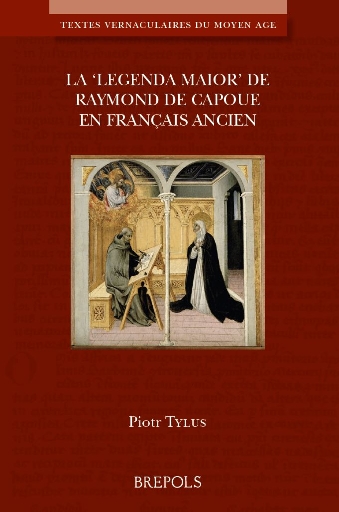
La 'Legenda Maior' de Raymond de Capoue en français ancien
show More to view fulltext, buy and share links for:La 'Legenda Maior' de Raymond de Capoue en français ancien show Less to hide fulltext, buy and share links for: La 'Legenda Maior' de Raymond de Capoue en français ancienCatherine Benincasa a marqué son époque. Elle naît à Sienne, en l’année 1347. Tertiaire dominicaine et théologienne ne sachant pas écrire et ignorant le latin, elle est proclamée Docteur de l’Église. Catherine, mystique portant les stigmates, a influencé la vie religieuse de plusieurs générations et est engagée en même temps dans les plus grands événements politiques. Elle est patronne et inspiratrice de la réforme dominicaine et du renouveau de l’Église. Catherine meurt à Rome le 29 avril 1380. Le pape Pie II prononce sa canonisation en 1461.
Il nous reste aujourd’hui deux rédactions, indépendantes l’une de l’autre, de la légende de sainte Catherine de Sienne en français médiéval. Toutes les deux descendent de la Legenda Maior de Raymond de Capoue, confesseur de la Sainte. L’une, composée en 1430 et conservée en deux manuscrits, est une traduction plutôt fidèle de la source latine. L'autre est une adaptation (au sens large) de l’original latin, et un abrégé en même temps. Composée en 1458, elle est conservée en six manuscrits. Alors, en somme huit éditions médiévales, ce qui est relativement beaucoup et ce qui est peu.
Les auteurs des versions françaises, dominicains du Nord et du Nord-Est de la francophonie, ont préféré garder l’anonymat.
-
-
-
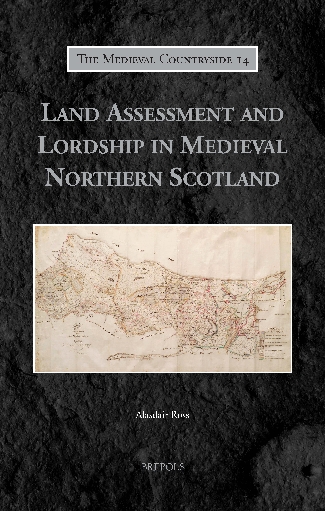
Land Assessment and Lordship in Medieval Northern Scotland
show More to view fulltext, buy and share links for:Land Assessment and Lordship in Medieval Northern Scotland show Less to hide fulltext, buy and share links for: Land Assessment and Lordship in Medieval Northern ScotlandThis book re-examines the ancient landscape divisions of medieval northern Scotland and discusses these in a European context. It demonstrates for the first time that the secular and ecclesiastical units of lordship across more than half of medieval and later Scotland were built out of an earlier Pictish (pre-ad 900) unit of land assessment, the dabhach (plural dabhaichean). It is also demonstrated that these dabhaichean remained in use as viable units of land assessment for many hundreds of years. Some were still being listed in estate rentals in the 1930s, giving them a working lifespan of over 1000 years.
Essentially, dabhaichean were the building blocks from which the medieval kingdom of the Scots was largely founded. They formed the basis of larger units of secular and ecclesiastical lordship, parishes, tax assessments, and common services. The latter included bridge service, road service, fighting service, and hunting service. They provided order for society. Importantly, this book also argues that each of these units contained all of the natural resources required to sustain communities from year to year, such as access to fishings, woodland, peat, meadows, arable land, and grazings. In terms of environmental history, the division of the landscape into dabhaichean resulted in the increasingly efficient exploitation (and management) of these resources across time.
-
-
-
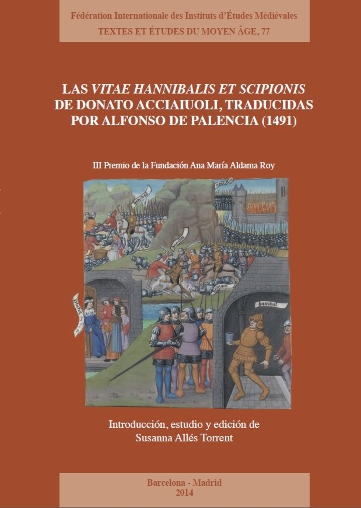
Las Vitae Hannibalis et Scipionis de Donato Acciaiuoli, traducidas por Alfonso de Palencia (1491)
show More to view fulltext, buy and share links for:Las Vitae Hannibalis et Scipionis de Donato Acciaiuoli, traducidas por Alfonso de Palencia (1491) show Less to hide fulltext, buy and share links for: Las Vitae Hannibalis et Scipionis de Donato Acciaiuoli, traducidas por Alfonso de Palencia (1491)Este volumen ofrece un texto, inédito hasta este momento, sobre dos figuras emblemáticas de la Antigüedad clásica: las de Aníbal y Escipión. La obra original con el título de Vitae Hannibalis et Scipionis, fue escrita hacia 1467 en latín por Donato Acciaiuoli, uno de los grandes humanistas italianos en la Florencia de los Medici; mientras que la traducción castellana se realizó unos años más tarde (Sevilla, 1491), a manos del que fuera cronista de los Reyes Católicos, Alfonso de Palencia.
El punto central de nuestra investigación ha sido el texto castellano y el método de traducción utilizado por el traductor castellano. Así mismo, ofrecemos, por primera vez, la edición de la traducción palentina acompañada del texto original latino utilizado (Venecia 1478).
Las Vitae Hannibalis et Scipionis han tenido una transmisión textual muy particular, pues des del 1470 entraron a formar parte de la edición príncipe de las traducciones latinas, realizadas por humanistas italianos, de las Vidas paralelas de Plutarco y no se desprendieron del corpus hasta bien entrado el siglo XVI; su simbiosis con esta colección de vidas ilustres fue tal que en múltiples ocasiones se confundieron y pasaron camufladas bajo la autoría del autor de Queronea. Tal fue el caso de Alfonso de Palencia que, creyendo traducir al historiador griego, trasladó una obra maestra del humanismo italiano que reconstruye una nueva imagen de dos de los más grandes generales de la historia antigua.
-
-
-

Medieval Welsh Perceptions of the Orient
show More to view fulltext, buy and share links for:Medieval Welsh Perceptions of the Orient show Less to hide fulltext, buy and share links for: Medieval Welsh Perceptions of the OrientThis book introduces a new theoretical framework for the examination of medieval Western European perceptions of the Orient. Through the application of the medieval concept of translatio studii et imperii, it proposes the identification of three distinct conceptions of the Orient in medieval sources: Biblical, Classical, and Contemporary. Welsh textual material from the twelfth and thirteenth centuries is used as a case-study to develop and illustrate this theory.
This study brings historical sources to bear on previously unexplained literary phenomena and it examines the evolution of texts and ideas in the process of transmission and translation. The sources analysed here include vernacular and Latin texts produced in Wales, as well as material that has been translated into Welsh such as Imago mundi and legends about Charlemagne. It thus combines an important and much-needed account of the development of Welsh attitudes to the East with a unique analysis of Oriental references across an extensive literary corpus.
-
-
-
Solitudes et solidarités en ville. Montpellier, mi XIIIe-fin XVe siècles
show More to view fulltext, buy and share links for:Solitudes et solidarités en ville. Montpellier, mi XIIIe-fin XVe siècles show Less to hide fulltext, buy and share links for: Solitudes et solidarités en ville. Montpellier, mi XIIIe-fin XVe sièclesLa solitude en milieu urbain est un champ de recherche contemporain, porté en particulier par la sociologie. Les sociétés urbaines médiévales comptaient aussi leur lot de solitaires : enfants orphelins et abandonnés, immigrants à la recherche d’une vie meilleure, veufs et veuves, personnes âgées isolées. Le contexte de la deuxième moitié du XIV e siècle, avec ses épidémies de peste récurrentes et les ravages causés par la guerre de Cent Ans aggrave le phénomène. Étudiée dans le cadre de la ville de Montpellier, des années 1250 à la fin du XV e siècle, à partir d’archives consulaires, fiscales et testamentaires, la solitude se révèle comme un phénomène fréquent : nombreuses sont les personnes seules dans l’espace urbain. La solitude apparaît sous de multiples formes et se manifeste tout au long du cours de la vie des individus, entrecoupant les cycles de développement familiaux. Or, entre la vie en solitaire et l’isolement social existe toute une palette de situations personnelles, dont on ne peut saisir la complexité que par l’étude des solidarités, recherchées par les personnes seules ou spontanément offertes par des parents, des amis, qui viennent pallier la solitude.
-
-
-
The Lion, the Lily, and the Leopard
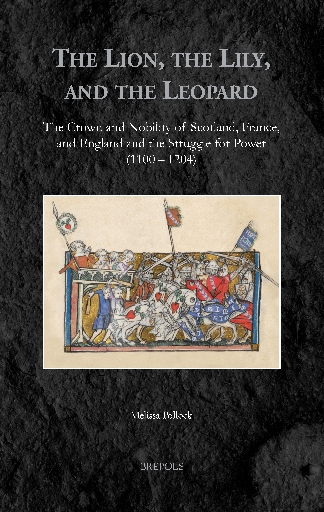
show More to view fulltext, buy and share links for:The Lion, the Lily, and the Leopard show Less to hide fulltext, buy and share links for: The Lion, the Lily, and the LeopardThis book examines the relationship between and identities within the three kingdoms of Scotland, France, and England from c. 1100 until the crown of England lost Normandy, Anjou, Maine, and Touraine in 1204. Diplomatic and political relations were unique in the twelfth century because the three kingdoms were united by a ruling class that spanned the Channel. This aristocratic, Anglo-French structure beginning with the Norman invasion in 1066 disrupted and delayed the development of a unitary national identity within each of the three kingdoms. Men and women identified themselves with more than one royal overlord as long as they held fees of multiple kings and, as such, national identity was a moveable feast. This situation created a complex political web that often damaged consistent loyalty to any one king or overlord, as each member of a kin group changed alliances based on territorial threats and on the interests of their familial networks. Furthermore, alliances formed between families in the Anglo-French realm had a significant impact on political decision-making in Scotland because the Anglo-French Scots were intimately bound to this structure through their own kin networks and land bases. Significantly, this work dispels the prevailing myth that the Anglo-French who settled in Scotland did not see themselves as part of the cross-Channel world but as ‘Scots’ by the end of the twelfth century.
-
-
-
The Secular Liturgical Office in Late Medieval England
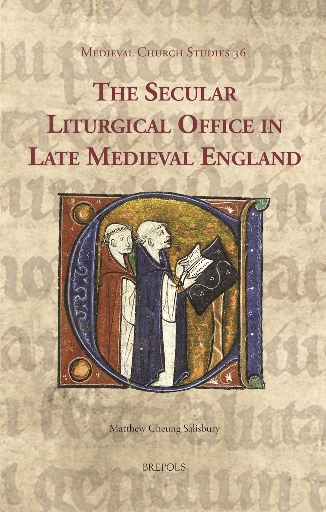
show More to view fulltext, buy and share links for:The Secular Liturgical Office in Late Medieval England show Less to hide fulltext, buy and share links for: The Secular Liturgical Office in Late Medieval EnglandUntil recently, research on the late medieval English Office liturgy has suggested that all manuscripts of the same liturgical Use, including those of the celebrated and widespread Uses of Sarum and York, are in large part interchangeable and uniform. This study demonstrates, through detailed analyses of the manuscript breviaries and antiphonals of each secular liturgical Use of medieval England, that such books do share a common textual core. But this is in large part restricted to a single genre of text - the responsory. Other features, even within manuscripts of the same Use, are subject to striking and significant variation, influenced by local customs and hagiographical and textual priorities, and also by varying reception to liturgical prescriptions from ecclesiastical authorities. The identification of the characteristic features of each Use and the differentiation of regional patterns have resulted from treating each manuscript as a unique witness, a practice which is not common in liturgical studies, but one which gives the manuscripts greater value as historical sources. The term ‘Use’, often employed as a descriptor of orthodoxy, may itself imply a greater uniformity than ever existed, for the ways that the ‘Use of Sarum’, a liturgical pattern originally designed for enactment in a single cathedral, was realised in countless other venues for worship were dependent on the times, places, and contexts in which the rites were celebrated.
-
-
-
Documenti pontifici nel "tabularium" dell'abbazia cistercense di Chiaravalle Milanese
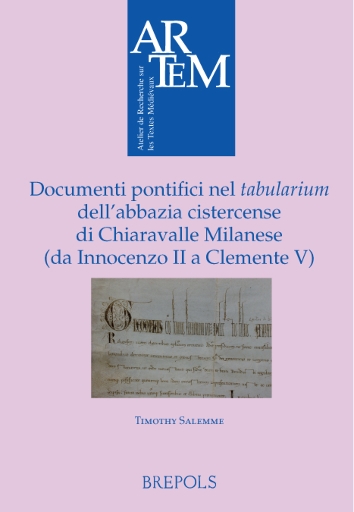
show More to view fulltext, buy and share links for:Documenti pontifici nel "tabularium" dell'abbazia cistercense di Chiaravalle Milanese show Less to hide fulltext, buy and share links for: Documenti pontifici nel "tabularium" dell'abbazia cistercense di Chiaravalle MilaneseFondée vers 1135 avec le concours des élites urbaines de Milan, l’abbaye de Chiaravalle Milanese était une des plus riches et plus puissantes institutions cisterciennes de la Lombardie médiévale. Titulaire d’un considérable complexe patrimonial, qui atteignait encore au milieu du XVe siècle presque 4000 hectares, l’abbaye de Chiaravalle participa activement pendant le Moyen Age à la vie politique, sociale, économique et religieuse de Milan et de son "contado". Pourtant, la ville ambrosienne et ses magistratures ne furent pas les seules « interlocutrices » de l’établissement : parmi celles-ci, la Papauté - à laquelle Chiaravalle, en tant que fondation cistercienne, était directement soumise - joua un rôle essentiel. L’ancien "tabularium" de Chiaravalle Milanese, aujourd’hui fragmenté dans plusieurs fonds d’archives milanais, nous offre un témoignage exceptionnel, voire unique, des liens étroits entre le Saint Siège et le chapitre monastique: ce témoignage se compose d'un dossier d’une centaine de documents pontificaux, depuis la fondation de l’abbaye jusqu’à la fin du pontificat de Clément V, auxquels il faut ajouter une dizaine d’actes accordés dans la même période à l’établissement cistercien par les légats pontificaux.
-
-
-
Famagusta
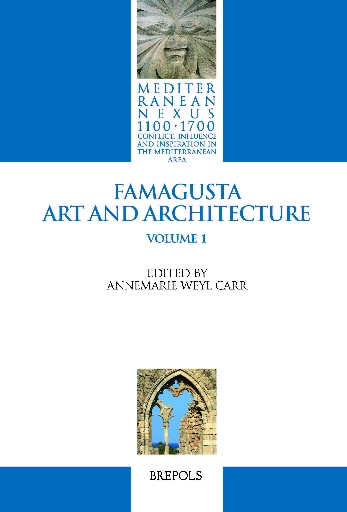
show More to view fulltext, buy and share links for:Famagusta show Less to hide fulltext, buy and share links for: FamagustaDuring the period of Latin rule on Cyprus (1191-1571), Famagusta went from being a small fishing village to a populous, cosmopolitan center of international trade by the early fourteenth century. After the fall of Acre in 1291 the Lusignan kings of Cyprus, now also kings of Jerusalem, made Famagusta a quasi capital-in-exile, with a new cathedral as the coronation church of the Kingdom of Jerusalem. The city began to stagnate with shifting trade patterns and the Black Death, was annexed by the Genoese after their invasion and partition of the island in 1374, and was only reunited with the Kingdom of Cyprus in 1464 with King James II “the Bastard’s” reconquest. With the Venetian takeover of the island in 1474, Famagusta experienced a demographic, economic, and artistic renaissance. In 1571, after an epic siege, the city fell to the Ottoman Turks, and from then on visitors described the ruins of the once great Gothic jewel of the Eastern Mediterranean with melancholic nostalgia.
In its heyday, Famagusta was home to Greeks, Franks, Armenians, Jews, Syrians of various religious backgrounds, and numerous merchants from the Italian trading cities, above all Genoa and Venice. Smaller groups completed the mix. With money pouring in from trade and the support of the crown, in the fourteenth century the town was encircled with impressive walls, still extant, and dozens of churches were constructed, adopting unique variations of the Gothic style, including large Latin, Greek, and Syrian cathedrals. Many of these are still intact, others consist of evocative ruins among the palm trees with the backdrop of the blue sea. This fascinating history and its heritage are dealt with within the present volume.
List of contributors: Annemarie Weyl Carr (editor), Justine M. Andrews, Michele Bacc i, Nicola Coldstream, Michalis Olympios, Tassos Papacostas, Maria Paschali
-
-
-
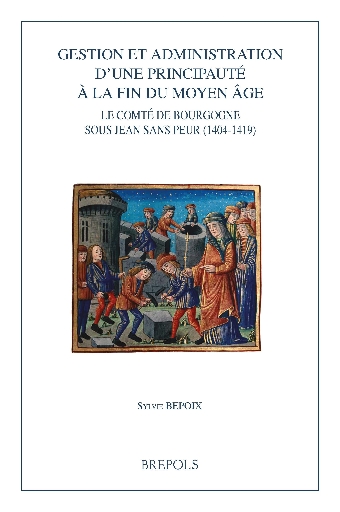
Gestion et administration d’une principauté à la fin du Moyen Âge
show More to view fulltext, buy and share links for:Gestion et administration d’une principauté à la fin du Moyen Âge show Less to hide fulltext, buy and share links for: Gestion et administration d’une principauté à la fin du Moyen ÂgeJean sans Peur qui succède à son père Philippe le Hardi à la tête du duché de Bourgogne en 1404, dut attendre la mort de sa mère Marguerite pour hériter du comté en 1405. L’historiographie l’a longtemps montré comme détaché de son petit territoire comtois en raison de sa forte implication dans la politique du royaume de France voisin et de son plus grand attachement au duché. Si la gestion de l’ordinaire requérait peu son attention, elle permettait des rentrées d’argent que le duc-comte ne dédaignait pas. Ses interventions démontrent parfois une volonté d’améliorer la gestion, la majorité prouvant surtout son désir d’accroitre ce qu’il en retirait. Jean sans Peur n’a pas négligé son comté malgré sa faible importance au cœur de l’ensemble bourguignon. Graphiques et tableaux systématiquement employés pour appuyer la démonstration livrent des approches chiffrées du rapport de ce domaine bourguignon, mettant en lumière la gestion et l’administration d’un domaine princier en cette fin de Moyen Âge.
-
-
-
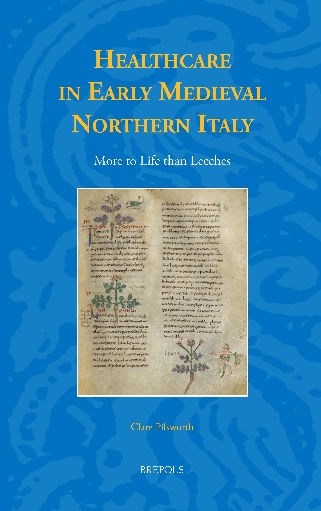
Healthcare in Early Medieval Northern Italy
show More to view fulltext, buy and share links for:Healthcare in Early Medieval Northern Italy show Less to hide fulltext, buy and share links for: Healthcare in Early Medieval Northern ItalyAfter the fall of the last Western Roman Emperor in 476 AD, Northern Italy played a crucial role - both geographically and culturally - in connecting East to West and North to South. Nowhere is this revealed more clearly than in the knowledge and practice of medicine. In sixth-century Ravenna, Greek medical texts were translated into Latin, and medical practitioners such as Anthimus, famous for his work on diet, also travelled from East to West. Despite Northern Italy’s location as a confluence of cultures and values, modern scholarship has thus far ignored the extensive range of medical practices in existence throughout this region. This book aims to rectify this absence. It will draw upon both archaeological and written sources to argue for redefinitions of health and illness in relation to the Northern-Italian Middle Ages. This volume does not only put forward new classifications of illness and understandings of diet, but it also demonstrates the centrality of medicine to everyday life in Northern Italy. Using charter evidence and literary sources, the author expands our understanding of the literacy levels and social circles of the elite medical practitioners, the medici, and their lesser counterparts. This work marks a significant intervention into the field of medical studies in the early to high Middle Ages.
-
-
-
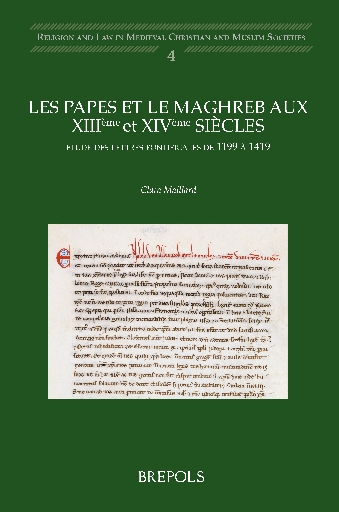
Les papes et le Maghreb aux XIIIème et XIVème siècles
show More to view fulltext, buy and share links for:Les papes et le Maghreb aux XIIIème et XIVème siècles show Less to hide fulltext, buy and share links for: Les papes et le Maghreb aux XIIIème et XIVème sièclesPour les papes il était inévitable d’entretenir des relations avec le monde arabo-musulman, oriental bien entendu - l’Égypte et le Moyen Orient - mais aussi occidental - l’Espagne et le Maghreb -. Ainsi dès 1199, Innocent III s’adressait-il au « Miramolin, roi du Maroc ». Quelque deux cent et une lettres, rédigées au cours des XIIIème et XIVème siècles et pour la plupart enregistrées dans les registres des Archives secrètes du Vatican, permettent d’éclairer la position du Saint-Siège face au Maghreb. Pour mener à bien leur politique et garder des liens avec les fidèles partis en terre lointaine, les papes écrivirent aux souverains - chrétiens ou musulmans -, envoyèrent des messagers par delà la mer Méditerranée, encouragèrent les œuvres des frères dans cette partie du monde et installèrent un évêché à Marrakech. Ils soutinrent régulièrement les tentatives d’expansion du christianisme en Afrique du Nord mais là n’était pas leur seule préoccupation. Ils se soucièrent également des chrétiens qui demeuraient au Maghreb, qu’ils soient marchands, mercenaires ou captifs. La papauté eut à concilier ces deux aspects et dut s’adapter à la réalité de la vie de ces communautés en terre d’Islam.
Clara Maillard a soutenu, à la MSH de Nantes le 8 décembre 2011, sa thèse en histoire médiévale intitulée: « Les papes et le Maghreb aux XIIIème et XIVème siècles, étude des lettres apostoliques de 1199 à 1419 », sous la direction de John Tolan, professeur à l'Université de Nantes. Elle a travaillé avec le projet RELMIN en 2014 en tant que post-doctorante sur les lettres pontificales concernant les chrétiens qui demeuraient au Maghreb.
-