


Brepols Online Books Other Monographs Collection 2016 - bob2016moot

Collection Contents
2 results
-
-
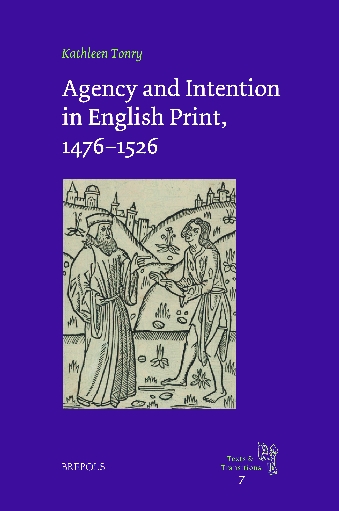
Agency and Intention in English Print, 1476–1526
show More to view fulltext, buy and share links for:Agency and Intention in English Print, 1476–1526 show Less to hide fulltext, buy and share links for: Agency and Intention in English Print, 1476–1526This volume offers a new intellectual framework for early print that bridges divisions between the study of print and the study of literature, between manuscripts and printed books, and between pre- and post-1500 textual cultures. Through an extensive focus on medieval texts and ideas, it is demonstrated here that in the half-century before the Reformation, English print was part of a highly energetic tradition of late medieval textual production. Central to this tradition was the expression of ethical agency, or moral ‘entente’, through the creation of texts and books. This insight reveals how the first English printed books expressed the deliberate moral and cultural commitments of individual printers.
By following early print across a range of genres (history writing, religious instruction, hagiography, law books, and translation), this study also sheds light on the contexts within which the agencies of early printers mattered, including mercantile politics, civic and statute law, and theological economics.
The volume, which treats the pre-Reformation press as a whole, is based in particular on the bibliographical evidence provided in editions by William Caxton, Wynkyn de Worde, Richard Pynson, John Rastell, and Thomas Berthelet, as well as on close readings of texts and contextual materials. The questions raised here, however, are about more than old books and early printers: ultimately, this study argues that the history of the material book is an intellectual history of agency and textual production.
-
-
-
Apuleius and the Metamorphoses of Platonism
show More to view fulltext, buy and share links for:Apuleius and the Metamorphoses of Platonism show Less to hide fulltext, buy and share links for: Apuleius and the Metamorphoses of PlatonismThis book presents a thorough re-examination of Apuleius’ Platonic philosophy, encompassing both his philosophical and literary works. Its primary concern lies in demonstrating how there is no significant gap between the Platonic philosophy of the Opuscula (De deo Socratis, De Platone et eius dogmate, De mundo) and the literary tastes of his rhetorical and most important output, such as the Apologia, the Florida, and foremost the Metamorphoses. Apuleius’ Middle-Platonism did not limit itself to technical works, but also influenced his literary interests.
Up to now, Apuleius’ Platonism has been very poorly investigated. It had attracted the attention of only a few - although prominent - scholars (Festugière, Dodds, Theiler), before being taken briefly into consideration in the monographs by John Dillon (The Middleplatonists, London 1977) and Stephen Gersh (Middle Platonism and Neoplatonism. The Latin Tradition, Notre Dame 1986). Because of his multifaceted interests and brilliant style, which is reflected in his conferences, judicial orations and in the novel, Apuleius was mainly treated as a sophist. In the wake of a recent revival of interest in Greek Middle Platonism and in its predecessors (such as Philo of Alexandria or Plutarch), the rhetor of Madauros is worthy of a new examination. This book aims at considering Apuleius as a Philosophus Platonicus who, at the same time, is a Latin Sophist, showing how the two aspects are closely intertwined.
Examining only one aspect would be easy, but would not do justice to Apuleius’ personality. In particular, it is necessary to insert him into a philosophical line, which runs from the first to the third century AD, thus outlining the specifics of Latin Platonism. On the other hand, it is necessary to take into account the concerns of the Second Sophistic in philosophy, though in a somewhat trivialized and less systematic way.
The title of the book (Apuleius and the Metamorphoses of Platonism) indeed underlines how Apuleius’ chameleonic Platonism ‘transforms’ itself, both in his philosophical and his literary works. While challenging the current scholarly trend that overrates the philosophical presence in the Metamorphoses, this book suggests new outlooks, as well as providing a new perspective on many hypotheses previously considered as a given. In order to do this, it investigates the literary, religious and philosophical, Graeco-Roman / African milieu in which Apuleius lived from a literary, religious and philosophical point of view, while considering his influence on authors from Late Antiquity.
-