


Brepols Online Books Other Monographs Collection 2016 - bob2016moot

Collection Contents
3 results
-
-
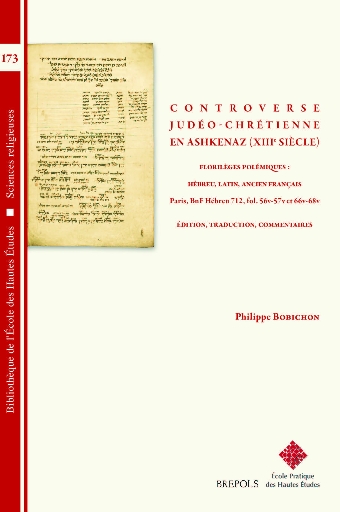
Controverse judéo-chrétienne en Ashkenaz (XIIIe siècle)
show More to view fulltext, buy and share links for:Controverse judéo-chrétienne en Ashkenaz (XIIIe siècle) show Less to hide fulltext, buy and share links for: Controverse judéo-chrétienne en Ashkenaz (XIIIe siècle)Ces documents inédits - et semble-t-il uniques - intéressent à la fois l’étude du latin médiéval et celle des relations entre juifs et chrétiens, en Ashkenaz, au XIIIe siècle. Ils offrent plusieurs pages de latin translittéré tout en se distinguant par leurs diverses caractéristiques des autres écrits destinés, dans la littérature hébraïque médiévale, à la controverse avec les chrétiens. L’argumentation se fonde exclusivement ici sur des emprunts à la tradition latine chrétienne invariablement restitués dans la langue originale (en caractères hébreux), généralement accompagnés d’une ébauche de traduction hébraïque et fréquemment précédés, en hébreu et en ancien français (caractères hébreux), d’indications relatives à leur utilisation polémique. Cette stratégie argumentative s’apparente à celle des chrétiens invoquant à la même époque, sur des questions analogues, la tradition rabbinique. Ces deux florilèges sont manifestement le fruit d’un travail collectif, encore inachevé, dont ils ne représentent que deux étapes distinctes et sans doute deux témoins parmi beaucoup d’autres. Ils attestent la réalité d’un débat judéo-chrétien qui n’était en aucune manière réservé à une élite, et l’imminence de ses enjeux. Ils sont la preuve d’une réaction concertée à l’entreprise chrétienne de conversion.
L’édition et la traduction s’accompagnent d’une analyse codicologique, paléographique, linguistique et textuelle. Les commentaires de la seconde partie situent le détail de l’argumentation dans l’ensemble des écrits de controverse judéo-chrétienne. Les conclusions, fondées sur la complémentarité des approches, s’achèvent par une mise en contexte prenant en compte les perspectives de recherche encore offertes par ces deux documents exceptionnels.
-
-
-
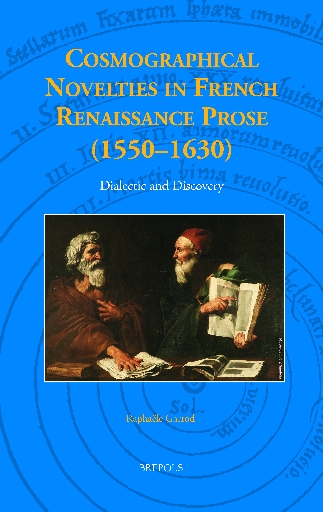
Cosmographical Novelties in French Renaissance Prose (1550–1630)
show More to view fulltext, buy and share links for:Cosmographical Novelties in French Renaissance Prose (1550–1630) show Less to hide fulltext, buy and share links for: Cosmographical Novelties in French Renaissance Prose (1550–1630)Contemporary historiography holds that it was the practices and technologies underpinning both the Great Voyages and the ‘New Science’, as opposed to traditional book learning, which led to the major epistemic breakthroughs of early modernity. This study, however, returns to the importance of book-learning by exploring how cosmological and cosmographical ‘novelties’ were explained and presented in Renaissance texts, and discloses the ways in which the reports presented by sailors, astronomers, and scientists became not only credible but also deeply disturbing for scholars, preachers, and educated laymen in sixteenth- and seventeenth-century France.
It is argued here that dialectic - the art of argumentation and reasoning - played a crucial role in articulating and popularizing new learning about the cosmos by providing the argumentative toolkit needed to define, discard, and authorize novelties. The debates that shaped them were not confined to learned circles; rather, they reached a wider audience via early modern vernacular genres such as the essay.
Focusing both on major figures such as Montaigne or Descartes, as well as on now-forgotten popularizers such as Belleforest and Binet, this book describes the deployment of dialectic as a means of articulating and disseminating, but also of containing, the disturbance generated by cosmological and cosmographical novelties in Renaissance France, whether for the lay reader in Court or Parliament, for the parishioner at Church, or for the student in the classroom.
-
-
-
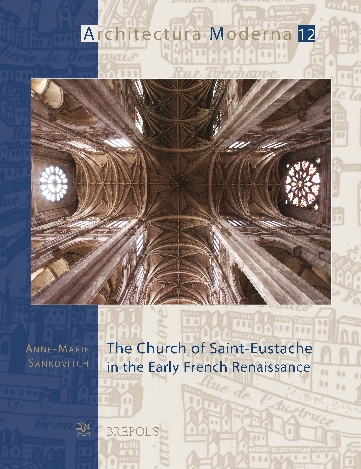
The Church of Saint-Eustache in the Early French Renaissance
show More to view fulltext, buy and share links for:The Church of Saint-Eustache in the Early French Renaissance show Less to hide fulltext, buy and share links for: The Church of Saint-Eustache in the Early French RenaissanceConsidered the most important French Renaissance church, Saint-Eustache in Paris has long remained an enigma. What new circumstances allowed its parishioners, long desirous of a new church, suddenly to begin buiding it 1532? Did Francis I play a role? Was the obscure Jean Delamarre possibly its architect? Could the ideas of the Italian theorist, Serlio, have affected his design? These and other key issues are resolved by the author in a sustained reading of all known evidence. The baffling formal complexity of the church is clarified through lucid analysis that employs hundreds of new photographs executed by the author. The building is studied within the context of sixteenth-century French architecture and its roots in antiquity, the Italian Renaissance, Romanesque and Gothic France, and the Flamboyant Style. Sankovitch’s work will serve as a standard for all those who desire to understand this mysterious building and its times. A bright, clear window revealing an unseen architecture, previously an invisible - or at best murky - episode in the history of art, it is a portal to all future research on the building, and a key to the architectural life of the period.
-