


Brepols Online Books Medieval Miscellanea Collection 2017 - bob2017mime

Collection Contents
3 results
-
-

From Carickfergus to Carcassonne
show More to view fulltext, buy and share links for:From Carickfergus to Carcassonne show Less to hide fulltext, buy and share links for: From Carickfergus to Carcassonne‘From Carrickfergus to Carcassonne…’ has its genesis in the IRC funded exhibition of the same name which explores the unlikely links between medieval Ulster and Languedoc.
Hinging upon the personal story of a charismatic individual - Hugh de Lacy, earl of Ulster, ‘From Carrickfergus to Carcassonne’ explores the wider interplay between the Gaelic, Angevin, Capetian and Occitan worlds in the late twelfth and early thirteenth centuries.
This book brings to light new research linking de Lacy to a conspiracy with the French king and details his subsequent exile and participation in the Albigensian Crusade in the south of France. The combined papers in this volume detail this remarkable story through interrogation of the historical and archaeological evidence, benefitting not just from adept scholarly study from Ireland and the UK but also from a Southern French perspective. The ensemble of papers describe the two realms within which de Lacy operated, the wider political machinations which led to his exile, the Cathar heresy, the defensive architecture of France and Languedoc and the architectural influences transmitted throughout this period from one realm to another.
In exploiting the engaging story of Hugh de Lacy, this volume creates a thematic whole which facilitates wide ranging comparison between events such as the Anglo-Norman take-over of Ireland and the Albigensian Crusade, the subtleties of doctrine in Ireland and Languedoc and the transmission of progressive castle design linking the walls of Carcassonne and Carrickfergus.
-
-
-
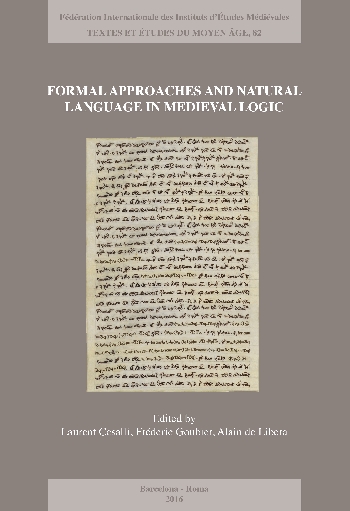
Formal Approaches and Natural Language in Medieval Logic
show More to view fulltext, buy and share links for:Formal Approaches and Natural Language in Medieval Logic show Less to hide fulltext, buy and share links for: Formal Approaches and Natural Language in Medieval LogicThe late medieval period is widely acknowledged as one of the most salient moments of the history of logic and semantics. It not only considered logic as a sine qua non condition for scientific knowledge, it also begot highly sophisticated theories about both argumentation and language. The last fifty years of increasingly intense research have brought about an ever more detailed knowledge of these theories. And yet, the questions as to what kind of logic is medieval logic, whether and to what extent it corresponds to our conception of logic, and, even, what the nature of its object was, remain challenging. That it has a formal character is widely accepted; and its semantic components display remarkable affinities with contemporary ones. But is it formal in the way modern logic is - or believes it is? Medieval logic does not really make recourse to symbolisms, after all, and the fact that the idea of formal validity might have been born in the twelfth century does not mean that developing formal approaches was an aim of medieval logicians. And what is its semantics a semantics of? Medieval logicians use Latin to deal with Latin constructions, but do these constructions belong to natural language or are they regimented to the point of forming some sort of ideal language?
The twenty-five papers gathered in this volume deal with these issues, thus allowing to reassess the broader questions of the formal character and formalising ambitions of medieval logic, as well as that of the natural character of the language in (and on) which it operated: in other words, they address the question of the nature, object and purpose of medieval logic.
-
-
-
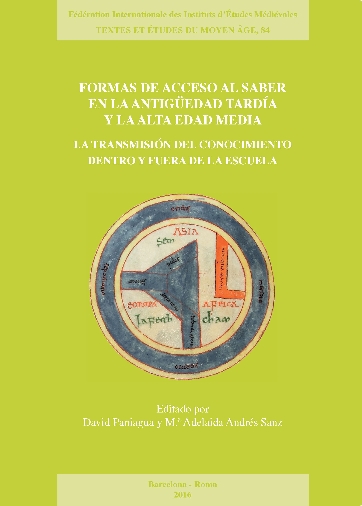
Formas de acceso al saber en la Antigüedad Tardía y en la Alta Edad Media
show More to view fulltext, buy and share links for:Formas de acceso al saber en la Antigüedad Tardía y en la Alta Edad Media show Less to hide fulltext, buy and share links for: Formas de acceso al saber en la Antigüedad Tardía y en la Alta Edad MediaEl presente volumen tiene su origen en el Coloquio Internacional Formas de acceso al saber de la Antigüedad Tardía a la Alta Edad Media (V), celebrado en la Universidad de Salamanca en octubre de 2014, bajo la dirección de D. Paniagua, en el marco de actuación del Proyecto de Investigación «La evolución de los saberes y su transmisión en la Antigüedad Tardía y la Alta Edad Media latinas II» (Investigadora Principal: M.a A. Andrés Sanz). El coloquio, al igual que el proyecto en el que se enmarcó, tuvo como objetivo profundizar en el conocimiento de las formas de evolución y de utilización de los textos latinos tardoantiguos y altomedievales ligados a la transmisión de conocimientos. Este conjunto de estudios, variados en sus diferentes aproximaciones filológicas, tiene como común denominador el interés por explorar las múltiples y ricas implicaciones culturales de estos textos, atendiendo no solamente al corpus escrito conservado -incluido el estudio de sus fuentes y de su posteridad literaria- sino también a su transmisión material concreta, generalmente en forma de códices, y a los entornos (escolares o no) en los que ésta tiene lugar.
-