


Brepols Online Books Medieval Miscellanea Collection 2018 - bob2018mime

Collection Contents
3 results
-
-
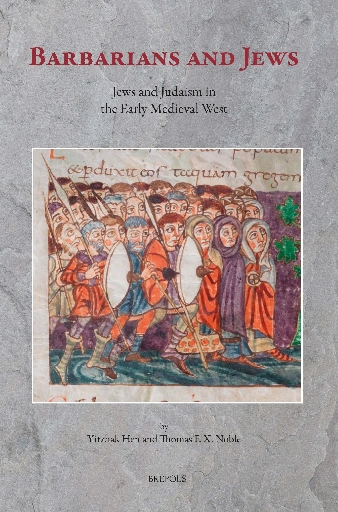
Barbarian and Jews
show More to view fulltext, buy and share links for:Barbarian and Jews show Less to hide fulltext, buy and share links for: Barbarian and JewsThe essays in this volume attempt to re-evaluate, understand and explain various aspects of Jewish history within the broader historical context of the post-Roman Barbarian world. They address a wide variety of topics, sources, and geographies, and together they provide a nuanced and more balanced history of the Jews in the early medieval West. Although written independently of one another by some of the most prominent historians of Late Antiquity and the early Middle Ages, the various essays collected here reveal a remarkable tension between the ‘imaginary’ (or ‘hermeneutical’) Jew and the ‘real’ one. As this volume demonstrates, Augustine’s positive theological understanding of Jews and Judaism was often overshadowed by anti-Jewish sentiments, and consequently anti-Jewish invective remained the drive wheel of Christian theology, especially in the context of debates and polemics among the Christians themselves.
-
-
-
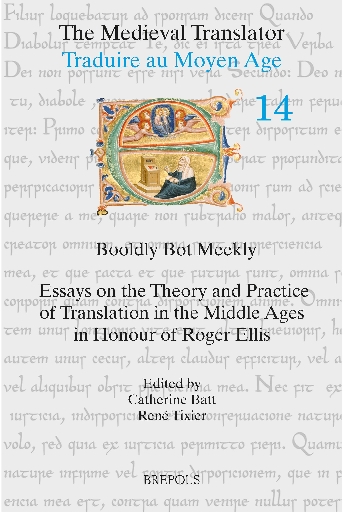
Booldly bot meekly
show More to view fulltext, buy and share links for:Booldly bot meekly show Less to hide fulltext, buy and share links for: Booldly bot meeklyWhen, back in the 1980s, Roger Ellis first sounded out academic colleagues in British universities and beyond about their possible interest and participation in a conference on medieval translation theory and practice, he perhaps did not envisage that the resulting gathering - intellectually curious, animated, convivial - at Gregynog Hall in Wales (1987) would be the first of a series of international conferences with a strong continental European base, which now provides a regular forum in which one can initiate, and engage with, research questions about this near all-encompassing aspect of medieval culture. Since that first meeting, the Cardiff Conferences on the Theory and Practice of Translation in the Middle Ages have charted and drawn anew the parameters of scholarly debate on the topic, while their Proceedings, hosted since 1996 by Brepols’ Medieval Translator series, cumulatively present a body of work valuable to anyone interested in translation in its medieval, broadly European, manifestations.
The contributors of this volume’s essays, assembled in tribute to Roger Ellis on the occasion of his seventieth birthday, have profited from the intellectual opportunities the Medieval Translator conferences foster, and in particular from Roger’s friendship and academic acumen. The essays draw in many cases on Roger’s work to inform a collective project that reflects on his specific interests in translation, including latemedieval piety and Birgittine texts, scholarly editions and studies of genre, considering literary and linguistic relations within and across languages, registers, national boundaries, time and space, refining, even re-defining, our understanding of translation. We offer these essays with warm thanks to and appreciation of Roger Ellis for his work in this field, not least for establishing, with this conference series, a means to demonstrate that translation, and translation studies, is above all a question of different voices speaking productively in dialogue.
-
-
-
Byzantine Hagiography: Texts, Themes & Projects
show More to view fulltext, buy and share links for:Byzantine Hagiography: Texts, Themes & Projects show Less to hide fulltext, buy and share links for: Byzantine Hagiography: Texts, Themes & ProjectsIn recent years Byzantine hagiography has attracted renewed interest of the international community of Byzantine scholars and not only thanks to studies dedicated to this subject and critical editions of individual texts, but also because hagiography has been the main focus of numerous major research projects: databases, new repertories, a new version of the Bibliotheca Hagiographica Graeca and some very useful handbooks dedicated to this literary genre during the Byzantine Empire. These researches have analysed Byzantine hagiography in relation to the hagiographic writings composed in neighbouring areas, the West, the Syriac and Arabic Middle East, the Southern Slavs, etc. but also the relations between the hagiographical texts and other literary genres.
This volume introduces the current developments of hagiographical studies and on-going projects on the subject, and investigates a variety of texts and authors from the Patristic period to the end of Byzantium.
-