Brepols Online Books Medieval Miscellanea Collection 2018 - bob2018mime

Collection Contents
21 - 40 of 42 results
-
-
Miracles in Medieval Canonization Processes
show More to view fulltext, buy and share links for:Miracles in Medieval Canonization Processes show Less to hide fulltext, buy and share links for: Miracles in Medieval Canonization ProcessesWhen a beneficiary or an eye-witness to a miracle met a scribe at a saint’s shrine or a notary at a canonization hearing, it was necessary to establish that the experience was miraculous. Later, the same incident may have been re-told by the clergy; this time the narration needed to entertain the audience yet also to contain a didactic message of divine grace. If the case was eventually scrutinized at the papal Curia, the narration and deposition had to fulfil the requirements of both theology and canon law in order to be successful. Miracle narrations had many functions, and they intersected various levels of medieval society and culture; this affected the structure of a collection and individual narration as well as the chosen rhetoric.
This book offers a comprehensive methodological analysis of the structure and functions of medieval miracle collections and canonization processes as well as working-tools for reading these sources. By analysing typologies of miracles, stages of composition, as well as rhetorical elements of narrations and depositions, the entertaining, didactic, and judicial aspects of miracle narrations are elucidated while the communal and individual elements are also scrutinized.
-
-
-
Nuns’ Literacies in Medieval Europe: The Antwerp Dialogue
show More to view fulltext, buy and share links for:Nuns’ Literacies in Medieval Europe: The Antwerp Dialogue show Less to hide fulltext, buy and share links for: Nuns’ Literacies in Medieval Europe: The Antwerp DialogueThe present volume is the third in a series of three integrated publications, the first produced in 2013 as Nuns’ Literacies in Medieval Europe: The Hull Dialogue and the second in 2015 as Nuns’ Literacies in Medieval Europe: The Kansas City Dialogue. Whereas the first volume focused primarily on Northern Europe, the second expanded the range to include material in minority languages such as Old Norse and Old Irish and focused particularly on education and other textual forms, such as the epistolary and the legal.
The third volume expands the geographical range by including a larger selection of female religious, for instance, tertiaries, and further languages (for example, Danish and Hungarian), as well as engaging more explicitly on issues of adaptation of manuscript and early printed texts for a female readership. Like the previous volumes, this collection of essays, focused on various aspects of nuns’ literacies from the late seventh to the mid-sixteenth century, brings together the work of specialists to create a dialogue about the Latin and vernacular texts that were read, written, and exchanged by medieval nuns. Contributors to this volume investigate the topic of literacy primarily from palaeographical and textual evidence and by discussing information about book ownership and production in convents.
-
-
-
Outsiders and Forerunners
show More to view fulltext, buy and share links for:Outsiders and Forerunners show Less to hide fulltext, buy and share links for: Outsiders and ForerunnersThis book focuses on the emergence and development of philosophical historiography as a university discipline in the 18th and 19th centuries. During that period historians of philosophy evaluated medieval philosophical theories through the lenses of modern leitmotifs and assigned to medieval thinkers positions within an imaginary map of cultural identities based on the juxtaposition of ‘self ’ and ‘other’. Some medieval philosophers were regarded as ‘forerunners’ who had constructively paved the way for modern rationality; whereas others, viewed as ‘outsiders’, had contributed to the same effect by way of their struggle against established forms of philosophy. The contributions gathered in this volume each deal with the creative reception of a particular figure in modern history of philosophy. From the 9th century, with al-Fārābī, to the 16th century, these philosophers belong to four historical worlds which have been characterized by European cultural history or have defined themselves as such: the (Jewish-)Arabic world (al-Fārābī, Avicenna, Maimonides), Latin scholasticism (Roger Bacon, Henry of Ghent, William of Ockham, Marsilius of Padua), medieval lay philosophy (Ramon Lull, Petrarch), and Humanism in a broader sense (Nicholas of Cusa, Petrus Ramus, Andrea Cesalpino).
-
-
-
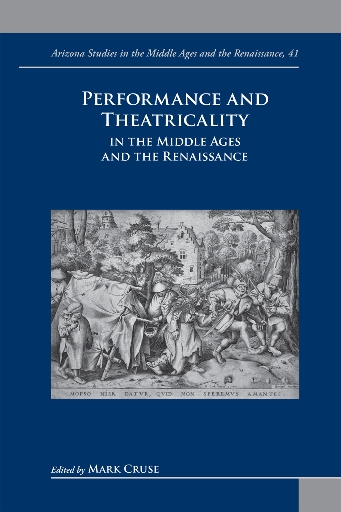
Performance and Theatricality in the Middle Ages and the Renaissance
show More to view fulltext, buy and share links for:Performance and Theatricality in the Middle Ages and the Renaissance show Less to hide fulltext, buy and share links for: Performance and Theatricality in the Middle Ages and the RenaissanceThis volume is a contribution to the cross-cultural study of theater and performance in the Middle Ages and the Renaissance. The studies gathered here examine material from Austria, England, France, Germany, Italy, the Netherlands, Russia, and Spain from the thirteenth to the eighteenth century. Underlying all of these essays is the understanding that performance shapes reality - that in all of the cultural contexts included here, performance opened a space in which patrons, rulers, writers, painters, spectators, and readers could see themselves or their societies differently, and thereby could assume different identities or construct alternative communities. Addressing confession and private devotion, urban theater and pageantry, royal legitimacy and religious debate, and a wide range of genres and media, this volume offers a panoramic mosaic of theater’s world-making role in medieval and early modern European societies.
-
-
-
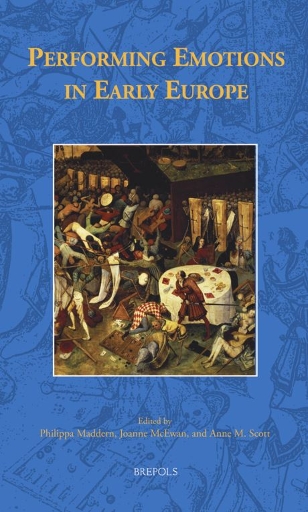
Performing Emotions in Early Europe
show More to view fulltext, buy and share links for:Performing Emotions in Early Europe show Less to hide fulltext, buy and share links for: Performing Emotions in Early EuropeDrawing on a range of interdisciplinary approaches and innovative methodologies, this collection contributes ground-breaking new scholarship in the burgeoning field of emotions studies by examining how medieval and early modern Europeans communicated and ‘performed’ their emotions. Rejecting the notion that emotions are ‘essential’ or ‘natural’, this volume seeks to pay particular attention to cultural understandings of emotion by examining how they were expressed and conveyed in a wide range of historical situations. The contributors investigate the performance and reception of pre-modern emotions in a variety of contexts — in literature, art, and music, as well as through various social and religious performances — and in a variety of time periods ranging from the twelfth to the eighteenth centuries. These studies provide both case-studies of particular emotions and emotional negotiations, and examinations of how their categorisation, interpretation, and meaning has changed over time.
The contributors provide new insights into the expression and performance of pre-modern emotions from a wide range of disciplinary fields, including historical studies, literature, art history, musicology, gender studies, religious studies, and philosophy. Collectively, they theorise the performativity of medieval and early modern emotions and outline a new approach that takes fuller account of the historical specificity and cultural meanings of emotions at particular points in time.
This volume forms a companion to Understanding Emotions in Early Europe, edited by Michael Champion and Andrew Lynch (2015); http://www.brepols.net/Pages/ShowProduct.aspx?prod_id=IS-9782503552644-1
-
-
-
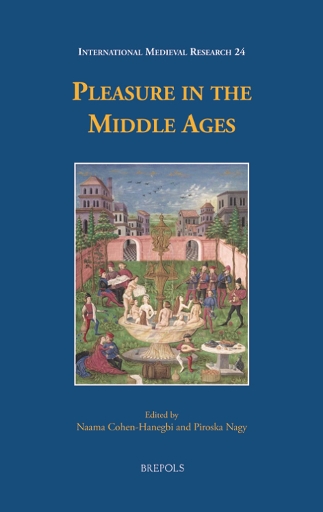
Pleasure in the Middle Ages
show More to view fulltext, buy and share links for:Pleasure in the Middle Ages show Less to hide fulltext, buy and share links for: Pleasure in the Middle AgesThis volume explores the diverse manifestations and uses of pleasure in medieval culture. Pleasure is a sensation, an affirmation, a practice, and is at the core of the medieval worldview, no less than pain.
Applying a variety of methodological perspectives, the essays collected here analyse the role of pleasure in relation to a variety of subjects such as the human body, love, relationships, education, food, friendship, morality, devotion, and mysticism. They also integrate a wide range of sources including literature (monastic to courtly), medical texts, illuminated prayer books, iconography, and theatrical plays.
Each document, each discipline, and thus each essay combine to provide a complex and diversified picture of medieval joys and delights - a picture that shows the extent to which pleasure is engrained in the period’s culture. This collection shows how pleasure in the Middle Ages is at once a coveted feeling and a constant moral concern, both the object and the outcome of a constant negotiation between earthly and divine imperatives.
-
-
-
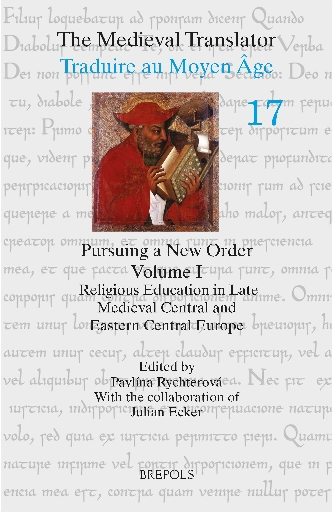
Pursuing a New Order I.
show More to view fulltext, buy and share links for:Pursuing a New Order I. show Less to hide fulltext, buy and share links for: Pursuing a New Order I.Concentrating on the period of the emergence of the vernaculars in the context of religious text production in Central and Eastern Central Europe from the fourteenth to the sixteenth centuries, the individual studies in this volume present material so far neglected by nationally defined historiographies and literary studies. The process of vernacularization created a new sociolinguistic field for the negotiation of social order through the choice of texts and topics. This volume seeks to answer the questions of whether, why and how distinctive new communicative, literary, and political cultures developed after the vernacular languages had acquired ever higher levels of literacy and education. The volume fills a gap in contemporary scholarship on the role of the vernaculars and vernacular literatures in European medieval societies and with the focus on Eastern European regions it breaks new ground in regard to questions that have so far only been explored on the basis of material from Europe’s ‘West’.
-
-
-
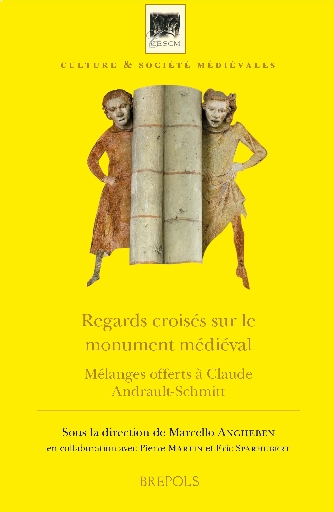
Regards croisés sur le monument médiéval
show More to view fulltext, buy and share links for:Regards croisés sur le monument médiéval show Less to hide fulltext, buy and share links for: Regards croisés sur le monument médiévalClaude Andrault-Schmitt a consacré la majeure partie de sa carrière d’enseignant-chercheur à l’étude des arts de l’ancien duché d’Aquitaine, en accordant un intérêt particulier à l’architecture religieuse. Dans sa démarche intellectuelle, elle s’est constamment interrogée sur les questions d’historiographie, de méthodologie et d’épistémologie, ce qui l’a amenée à défendre plusieurs principes qui lui sont chers : appliquer à l’architecture un vocabulaire adapté aux réalités et aux usages médiévaux, se méfier des idées reçues héritées de l’historiographie et des étiquettes - à commencer par le traditionnel clivage entre le roman et le gothique -, aborder les rapports entre les formes et les différentes fonctions d’une église et rassembler le plus grand nombre de disciplines autour d’un même édifice pour en comprendre toutes les facettes : historiens, archéologues, spécialistes des matériaux, de l’épigraphie, de l’iconographie, musicologues.
À l’occasion de son départ à la retraite, ses collègues et ses élèves ont souhaité lui rendre hommage en lui dédiant trente et une contributions reflétant ces différentes préoccupations, regroupées dans quatre sections intitulées Contextualisations, De l’archéologie monumentale à l’archéologie du bâti, Les ordres réformés et Le décor monumental . Ces contributions forment ensemble un panorama très représentatif de l’état de la recherche actuelle dans ces différents domaines et des orientations encouragées par Claude Andrault-Schmitt, que ce soit dans ses publications ou dans son enseignement.
-
-
-
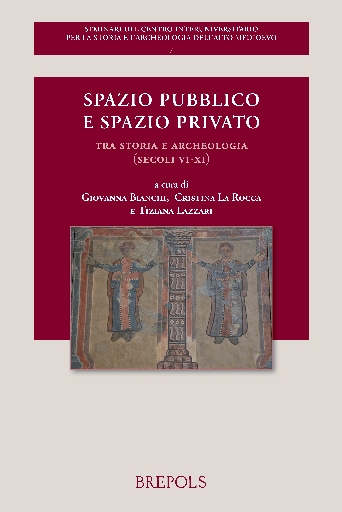
Spazio pubblico e spazio privato
show More to view fulltext, buy and share links for:Spazio pubblico e spazio privato show Less to hide fulltext, buy and share links for: Spazio pubblico e spazio privatoI contributi contenuti nel volume affrontano il tema degli spazi materiali e simbolici, di ambito pubblico e privato, tra Tarda Antichità e Alto Medioevo, attraverso ricerche condotte su fonti scritte e materiali.
Il volume è suddiviso in tre sezioni. La prima, Una nuova dimensione del pubblico e del privato, raccoglie lavori che offrono quadri di insieme ampi, ciascuno su un problema di lunga tradizione storiografica. La seconda sezione, I luoghi del potere e gli spazi privati, accosta ricerche basate sia su fonti scritte sia su fonti archeologiche, per meglio definire gli spazi destinati all’esercizio del potere e quelli relativi alla sfera domestica. Nella terza sezione, Gestione e controllo delle risorse, sono contenuti contributi che, attraverso i dati offerti dalle fonti materiali, riflettono sui sistemi economici in relazione ai regimi proprietari e di sfruttamento delle risorse, alla creazione di riserve, alle forme di produzione destinate sia a una circolazione ristretta sia a una distribuzione di controllo pubblico.
La scelta di tematiche ad ampio raggio ha inteso offrire una riflessione articolata sull’utilità - e sulla possibilità stessa - di applicare la contrapposizione pubblico/privato allo studio degli spazi fisici e simbolici tardo antichi e altomedievali. Il volume, raccogliendo l’insieme delle prospettive di indagine che sul rapporto pubblico/privato si sono sviluppate negli ultimi anni, intende contribuire con nuovi spunti e strumenti di analisi alle future ricerche sul tema.
-
-
-

Supernatural Encounters in Old Norse Literature and Tradition
show More to view fulltext, buy and share links for:Supernatural Encounters in Old Norse Literature and Tradition show Less to hide fulltext, buy and share links for: Supernatural Encounters in Old Norse Literature and TraditionThe Icelandic sagas have long been famous for their alleged realism, and within this conventional view, references to the supernatural have often been treated as anomalies. Yet, as this volume demonstrates, such elements were in fact an important part of Old Norse literature and tradition, and their study can provide new and intriguing insights into the world-view of the medieval Icelanders.
By providing an extensive and interdisciplinary treatment of the supernatural within sagas, the eleven chapters presented here seek to explore the literary and folkloric interface between the natural and the supernatural through a study of previously neglected texts (such as Bergbúa þáttr, Selkollu þáttr, and Illuga saga Gríðarfóstra), as well as examining genres that are sometimes overlooked (including fornaldarsögur and byskupa sögur), law codes, and learned translations. Contributors including Ármann Jakobsson, Margaret Cormack, Jan Ragnar Hagland, and Bengt af Klintberg explore how the supernatural was depicted within saga literature and how it should be understood, as well as questioning the origins of such material and investigating the parallels between saga motifs and broader folkloric beliefs. In doing so, this volume also raises important questions about the established boundaries between different saga genres and challenges the way these texts have traditionally been approached.
-
-
-
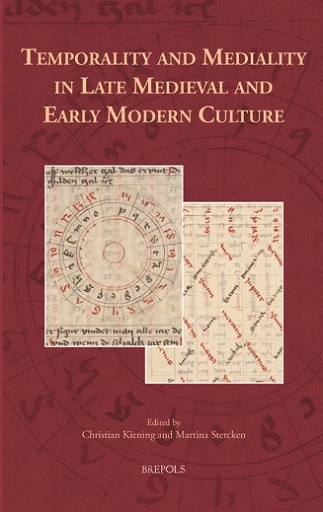
Temporality and Mediality in Late Medieval and Early Modern Culture
show More to view fulltext, buy and share links for:Temporality and Mediality in Late Medieval and Early Modern Culture show Less to hide fulltext, buy and share links for: Temporality and Mediality in Late Medieval and Early Modern CultureThis interdisciplinary volume explores the ways in which time is staged at the threshold between the Middle Ages and the early modern period. Proceeding from the reality that all cultural forms are inherently and inescapably temporal, it seeks to discover the significance of time in mediations and communications of all kinds.
By showing how time is displayed in diverse cultural strategies and situations, the essays of this volume show how time is intrinsic to the very concept of tradition. In exploring a variety of medial forms and communicative practices, they also reveal that while the beginning of the age of printing (around 1500) may mark a fundamental change in terms of reproduction and circulation, artefacts and other historical traditions continue to employ earlier systems and practices relating time and space.
The volume features articles by leading researchers in their respective fields, including studies on mosaics as a medium reflecting space and time; the triptych’s potential as a time machine; winged altarpieces mediating eternity; texts and images of the passion of Christ permeating past, present, and future; dimensions of time embedded in maps; a compendium of world knowledge organized by forms of time and temporality; the figuration of prophecy in times of crisis; the portrayal of time in architecture.
The volume thus provides a new approach to media and mediality from the perspective of cultural history.
-
-
-
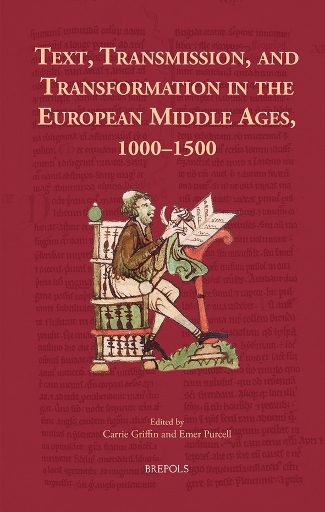
Text, Transmission, and Transformation in the European Middle Ages, 1000–1500
show More to view fulltext, buy and share links for:Text, Transmission, and Transformation in the European Middle Ages, 1000–1500 show Less to hide fulltext, buy and share links for: Text, Transmission, and Transformation in the European Middle Ages, 1000–1500These essays are concerned primarily with the different ways in which European writers, translators, and readers engaged with texts and concepts, and with the movement and exchange of those texts and ideas across boundaries and geographical spaces. It brings together new research on Anglophone and Latinate writings, as well as on other vernaculars, among them Old Norse, Anglo-Saxon, Medieval Irish, Welsh, Arabic, Middle Dutch, Middle German, French, and Italian, including texts and ideas that are experienced in aural and oral contexts, such as in music and song. Texts are examined not in isolation but in direct relation and as responses to wider European culture; several of the contributions theorize the translation of works, for example, those relating to spiritual instruction and prayer, into other languages and new contexts.
The essayists share a common concern, then, with the transmission and translation of texts, examining what happens to material when it moves into contexts other than the one in which it was produced; the influence that scribes, translators, and readers have on textual materiality and also on reception; and the intermingling different textual traditions and genres. Thus they foreground the variety and mobility of textual cultures of the Middle Ages in Europe, both locally and nationally, and speak to the profound connections and synergies between peoples and nations traceable in the movement and interpretation of texts, versions, and ideas. Together the essays reconstruct an outward-looking, networked, and engaged Europe in which people used texts in order to communicate, discover, and explore, as well as to record and preserve.
-
-
-
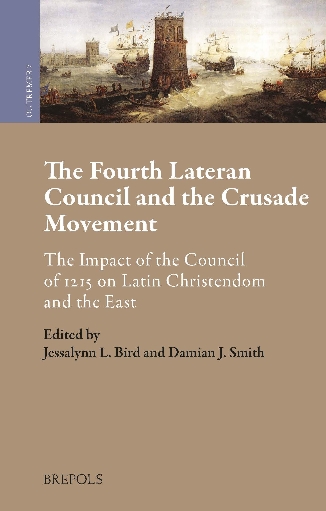
The Fourth Lateran Council and the Crusade Movement
show More to view fulltext, buy and share links for:The Fourth Lateran Council and the Crusade Movement show Less to hide fulltext, buy and share links for: The Fourth Lateran Council and the Crusade MovementThe Fourth Lateran Council of 1215 is often considered as the high water-mark for the medieval church with its decisions affecting the cultural, social, religious and intellectual history of the later medieval world. The council was also a major event in the history of the crusades not only because the reform of the church and the recovery of the Holy Land were the central concerns of Pope Innocent III (1198-1216) but also because at the time of the council political decisions were made which affected all theatres of crusading and the canons of the council dealt with issues concerning piety and economics which had very long-term implications for the crusading movement. This book, bringing together an international team of scholars, is the first to deal with Fourth Lateran and the crusades in entirety and argues for the centrality of the council in the history of the crusades. It will be of interest not only to scholars of the history of the crusades but also to those interested in the history of the religious life of the Middle Ages as well to students of the particular areas and themes under discussion.
-
-
-

The Idea of the Gothic Cathedral
show More to view fulltext, buy and share links for:The Idea of the Gothic Cathedral show Less to hide fulltext, buy and share links for: The Idea of the Gothic CathedralCentral to many medieval ritual traditions both sacred and secular, the Gothic cathedral holds a privileged place within the European cultural imagination and experience. Due to the burgeoning historical interest in the medieval past, in connection with the medieval revival in literature, visual arts, and architecture that began in the late seventeenth century and culminated in the nineteenth, the Gothic cathedral took centre stage in numerous ideological discourses. These discourses imposed contemporary political and aesthetic connotations upon the cathedral that were often far removed from its original meaning and ritual use.
This volume presents interdisciplinary perspectives on the resignification of the Gothic cathedral in the post-medieval period. Its contributors, literary scholars and historians of art and architecture, investigate the dynamics of national and cultural movements that turned Gothic cathedrals into symbols of the modern nation-state, highlight the political uses of the edifice in literature and the arts, and underscore the importance of subjectivity in literary and visual representations of Gothic architecture. Contributing to scholarship in historiography, cultural history, intermedial and interdisciplinary studies, as well as traditional disciplines, the volume resonates with wider perspectives, especially relating to the reuse of artefacts to serve particular ideological ends.
-
-
-
Towards the Authority of Vesalius
show More to view fulltext, buy and share links for:Towards the Authority of Vesalius show Less to hide fulltext, buy and share links for: Towards the Authority of VesaliusThe authority of Andreas Vesalius (1514-1564) in reviving human anatomy is without any doubt a landmark in the history of science. Yet his breakthrough was inconceivable without his predecessors’ works. Moreover, later on, his own legacy would not remain untouched or undisputed. The question of scientific authority is not new; however it has hardly been tackled in a multidisciplinary and diachronic way. This volume brings together contributions from international scholars working in the field of theology, art history, philosophy, history of science and historical linguistics. Its goal is to contextualize and analyse the complex interaction between dogma and authority on the one hand and empirical progress on the other, both in the development of anatomy and the views on the human body, mainly before Vesalius’s time. Indeed, it is not the volume’s aim to focus exclusively on the role of Vesalius nor to assess the concept of medical and anatomical authority in a comprehensive way. Avoiding to repeat insights from the history of science as such, it intends to put old views to the test, and to bring up new questions and answers from diverse perspectives concerning the work of Vesalius and his predecessors and successors, by presenting different case studies from Antiquity to the Early Modern Times.
-
-
-
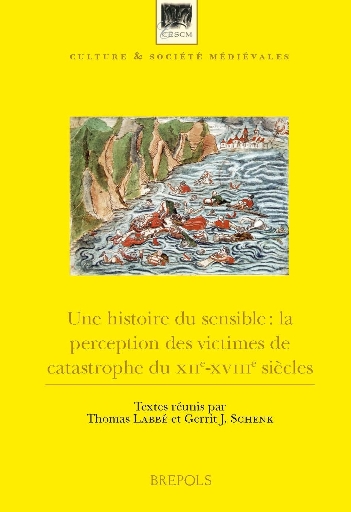
Une histoire du sensible : la perception des victimes de catastrophe du xii e au xviii e siècle
show More to view fulltext, buy and share links for:Une histoire du sensible : la perception des victimes de catastrophe du xii e au xviii e siècle show Less to hide fulltext, buy and share links for: Une histoire du sensible : la perception des victimes de catastrophe du xii e au xviii e siècleCet ouvrage se propose de réfléchir à la construction historique de la condition de victime, en relation avec les événements traumatiques dans l'Europe médiévale et moderne. Dans le contexte contemporain, le discours et la gestion des situations de catastrophe ou de mort de masse s'organisent en priorité autour de la place des victimes dans la fabrique événementielle. Cette attitude de la société contemporaine face à la dévastation, qualifiée tantôt de « compassionnelle », tantôt « d'humanitaire », ou bien encore de « tragique », reflète une forme de sensibilité qui définit en premier lieu la réalité catastrophique comme un drame.
Une telle approche de la souffrance possède-t-elle cependant une histoire ou constitue-t-elle une constante anthropologique de la société occidentale ? Quel regard les sociétés médiévales et modernes ont-elles posé sur cet aspect autant éthique que social du réel ? Les essais réunis dans ce volume proposent d'offrir quelques pistes de réflexion. À la lecture ambiguë de la victime au Moyen Âge, entre souffrance et responsabilité, la Renaissance semble commencer à proposer une vision plus « tragique » des individus souffrants. Les victimes peuvent dès lors entrer progressivement dans une politique des émotions qui triomphe au xviii e siècle.
-
-
-
Victorine Christology
show More to view fulltext, buy and share links for:Victorine Christology show Less to hide fulltext, buy and share links for: Victorine ChristologyThe Canons following the Rule of St Augustine at St Victor in Paris were some of the most influential religious writers of the Middle Ages. They combined exegesis and spiritual teaching in a theology that was deeply rooted in tradition but also attuned to current developments in the schools of Paris. The importance of Victorine Christology in this great age of theological speculation is unquestionable. The writings translated in this volume cover the foundational and maturing periods of Victorine Christology during the 1130s to the 1150s when Hugh of St Victor championed the paradigm of the “assumed man” (homo assumptus) and Robert of Melun advanced his Christology into the most comprehensive treatment in the twelfth century.
-
-
-
Visions of North in Premodern Europe
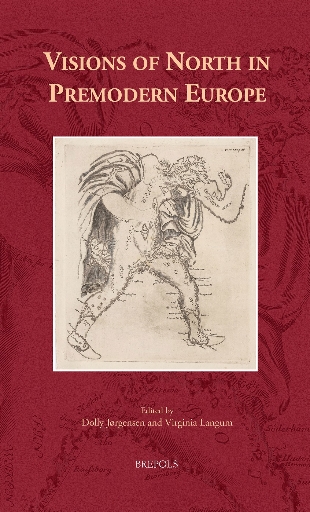
show More to view fulltext, buy and share links for:Visions of North in Premodern Europe show Less to hide fulltext, buy and share links for: Visions of North in Premodern EuropeThe North has long attracted attention, not simply as a circumpolar geographical location, but also as an ideological space, a place that is ‘made’ through the understanding, imagination, and interactions of both insiders and outsiders. The envisioning of the North brings it into being, and it is from this starting point that this volume explores how the North was perceived from ancient times up to the early modern period, questioning who, where, and what was defined as North over the course of two millennia.
Covering historical periods as diverse as Ancient Greece to eighteenth-century France, and drawing on a variety of disciplines including cultural history, literary studies, art history, environmental history, and the history of science, the contributions gathered here combine to shed light on one key question: how was the North constructed as a place and a people? Material such as sagas, the ethnographic work of Olaus Magnus, religious writing, maps, medical texts, and illustrations are drawn on throughout the volume, offering important insights into how these key sources continued to be used over time. Selected texts have been compiled into a useful appendix that will be of considerable value to scholars.
-
-
-
Late Antique Calendrical Thought and its Reception in the Early Middle Ages
show More to view fulltext, buy and share links for:Late Antique Calendrical Thought and its Reception in the Early Middle Ages show Less to hide fulltext, buy and share links for: Late Antique Calendrical Thought and its Reception in the Early Middle AgesLate antique and early medieval science is commonly defined by the quadrivium, the four subjects of the seven liberal arts relating to natural science: astronomy, geometry, arithmetic, and music. The seven-fold division of learning was designed in Late Antiquity by authors such as Martianus Capella, and these authors were studied intensively from the Carolingian age onwards. Because these subjects still have currency today, this leads to the anachronistic view that the artes dominated intellectual thought in Late Antiquity and the early Middle Ages.
Quite the contrary, the artes were an idealized curriculum with limited application in practice. Certainly, the artes do not help in our understanding of the intellectual endeavour between the early fifth and the late eighth centuries. This period was dominated by computus, a calendrical science with the calculation of Easter at its core. Only computus provides a traceable continuation of scientific thought from Late Antiquity to the early Middle Ages. The key questions were the mathematical modeling of the course of the sun through the zodiac (the Julian calendar) and of the moon phases (in various lunar calendars).
This volume highlights key episodes in the transmission of calendrical ideas in this crucial period, and therewith helps explaining the transformation of intellectual culture into its new medieval Christian setting.
-