


Brepols Online Books Medieval Miscellanea Collection 2018 - bob2018mime

Collection Contents
41 - 42 of 42 results
-
-
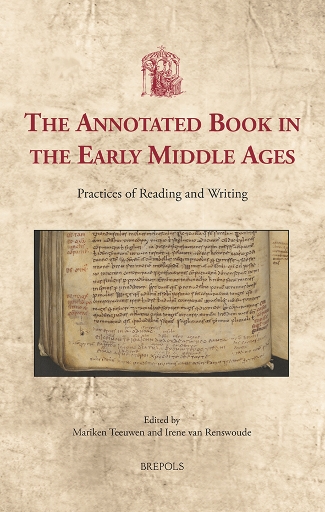
The Annotated Book in the Early Middle Ages
show More to view fulltext, buy and share links for:The Annotated Book in the Early Middle Ages show Less to hide fulltext, buy and share links for: The Annotated Book in the Early Middle AgesAnnotations in modern books are a phenomenon that often causes disapproval: we are not supposed to draw, doodle, underline, or highlight in our books. In many medieval manuscripts, however, the pages are filled with annotations around the text and in-between the lines. In some cases, a ‘white space’ around the text is even laid out to contain extra text, pricked and ruled for the purpose. Just as footnotes are an approved and standard part of the modern academic book, so the flyleaves, margins, and interlinear spaces of many medieval manuscripts are an invitation to add extra text.
This volume focuses on annotation in the early medieval period. In treating manuscripts as mirrors of the medieval minds who created them - reflecting their interests, their choices, their practices - the essays explore a number of key topics. Are there certain genres in which the making of annotations seems to be more appropriate or common than in others? Are there genres in which annotating is ‘not done’? Are there certain monastic centres in which annotating practices flourish, and from which they spread?
The volume investigates whether early medieval annotators used specific techniques, perhaps identifiable with their scribal communities or schools. It explores what annotators actually sought to accomplish with their annotations, and how the techniques of annotating developed over time and per region.
-
-
-
Toward a Historical Sociolinguistic Poetics of Medieval Greek
show More to view fulltext, buy and share links for:Toward a Historical Sociolinguistic Poetics of Medieval Greek show Less to hide fulltext, buy and share links for: Toward a Historical Sociolinguistic Poetics of Medieval GreekHow can historical sociolinguistic analyses of Medieval Greek aid in the interpretation of Medieval Greek texts? This is the main question addressed by the papers collected in this volume. Historical sociolinguistics (HSL) is a discipline that combines linguistic, social, historical, and philological sciences, and suggests that a language cannot be studied apart from its social dimension. Similarly, the study of a language in its social dimension is nothing else than the study of communication between members of a given speech community by the means of written texts, the shared “signs” used by authors to communicate with their audiences.
This volume is divided into two parts. In the first, Cuomo’s and Bentein’s papers aim to offer an overview of the discipline and examples of applied HSL. Valente’s, Bianconi’s, and Pérez-Martín’s papers show how the context of production and reception of Byzantine texts should be studied. These are followed by Horrocks’ study on some features of Atticized Medieval Greek. In the second part, the contributions by Telelis, Odorico, and Manolova focus on the context of reception of texts by Georgios Pachymeres, Theodoros Pediasimos, and Nikephoros Gregoras respectively.
-