


Brepols Online Books Other Miscellanea Collection 2018 - bob2018miot

Collection Contents
5 results
-
-
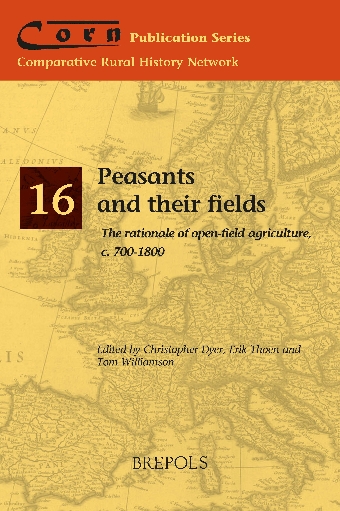
Peasants and their fields
show More to view fulltext, buy and share links for:Peasants and their fields show Less to hide fulltext, buy and share links for: Peasants and their fieldsIn the Middle Ages and the Early Modern Period open fields could be found in many if not most countries in Europe. They took a wide variety of forms, but can in essence be defined as areas of cultivated land in which the intermingled plots of different cultivators, without upstanding physical boundaries, were subject to some degree of communal management, in terms of cropping and grazing. Sometimes such fields occupied a high proportion of the land in a district, but often they formed a relatively minor element in landscapes which also contained enclosed fields, woodland or expanses of pasture. In some areas, open-field agriculture had already been abandoned before the end of the Middle Ages, but in others it continued to flourish into the nineteenth or even twentieth centuries.
Although open fields have long been studied by geographers, historians and archaeologists, much about their origins, development and rationale remains contentious. Why, across wide areas of Europe, did such fields sometimes become central to the experience of so many of our ancestors, shaping not only farming practices but also the basic structures of their everyday lives? And why, in contrast, did they fail to develop, or have a less significant role, elsewhere?
Over recent decades open fields have been investigated in new, interdisciplinary ways, and as a Europe-wide phenomenon. In this book, more than ever before, their development and operation are explained in terms of economic, social, agrarian and environmental developments which were shared, to varying degrees, by all parts of the continent. It contains ten new studies from a wide range of regions, together with important comparative research from South America and Japan. This collection of essays represents a milestone in the study of open-field agriculture, and is a major contribution to the study of the rationale of field systems more generally.
-
-
-
Poeti in Agone
show More to view fulltext, buy and share links for:Poeti in Agone show Less to hide fulltext, buy and share links for: Poeti in AgoneL’agonismo fu una componente intrinseca, pervasiva e connotante dell’attività poetica e musicale nella Grecia antica. Fu uno dei più importanti veicoli di identità, condivisione comunitaria e acculturazione interna. Questo volume, affrontando la problematica sia da un punto di vista sincronico che diacronico, cerca di lumeggiarne gli aspetti particolarmente significativi: in Atene, i concorsi tragici come performance rituale e atto politico; le multiformi relazioni genetiche, strutturali e funzionali tra le esecuzioni corali drammatiche e i generi della poesia melica; la ‘Nuova Musica’ e il clima di rinnovamento culturale che si affaccia nell’Atene di V sec. a.C. che, a partire dal ditirambo, investe tutte le forme poetiche; la centralità, la vitalità e la varietà degli agoni delfici; l’agonistica poetica e musicale come argomento di interesse, narrazione e riflessione nell’opera di scrittori tra l’epoca ellenistica e quella imperiale; l’iconografia di figure mitiche di eccellenza musicale e le riprese dell’antico.
-
-
-

Postérités européennes de Quinte-Curce
show More to view fulltext, buy and share links for:Postérités européennes de Quinte-Curce show Less to hide fulltext, buy and share links for: Postérités européennes de Quinte-CurcePendant des siècles, Quinte-Curce a été l’un des historiens d’Alexandre le Grand les plus lus en Europe. Limitée jusqu’au xiv e siècle, la diffusion de ses Historiae s’amplifie grâce à la lecture et à la plume d’humanistes italiens ; les copies manuscrites, puis les traductions et les éditions se multiplient en Europe. Le présent ouvrage se donne pour objet d’étude leurs réceptions multiples du xiv e au xviii e siècle, c’est-à-dire durant les siècles de leur plus grand succès, il étudie les modalités de leur transmission et ses acteurs, ainsi que leurs exploitations politiques, historiques, linguistiques, littéraires et esthétiques. Au-delà de ses usages scolaires, l’œuvre de Quinte-Curce a en effet suscité des jugements divers et des adaptations variées, qui interrogent le statut que les auteurs et les peintres lui ont donné, ainsi que les finalités de leurs appropriations. Alors que leur célébration comme modèle historique et stylistique domine jusqu’au xvii e siècle, philosophes et historiens les contestent ensuite pour leurs inexactitudes et leurs enjolivements romanesques, même si ce rejet des savants n’entame pas leur succès auprès des écrivains, des lecteurs, des peintres et des artistes passionnés d’Alexandre. Les réceptions ont été d’autant plus nombreuses que les Historiae ont été prises dans des réflexions et des démarches créatrices multiples, durant plusieurs siècles : la pensée politique sur le pouvoir royal et la conquête ; les débats autour de l’écriture de l’histoire ; les réflexions sur les méthodes et les enjeux de la traduction ; la question de l’illustration des langues et l’élaboration de modèles stylistiques ; les transpositions et les recréations de l’histoire et d’un texte historique dans des genres littéraires fictionnels, le théâtre et le roman, et aussi dans les arts visuels, avec les illustrations des manuscrits et plus encore les peintures d’histoire.
-
-
-
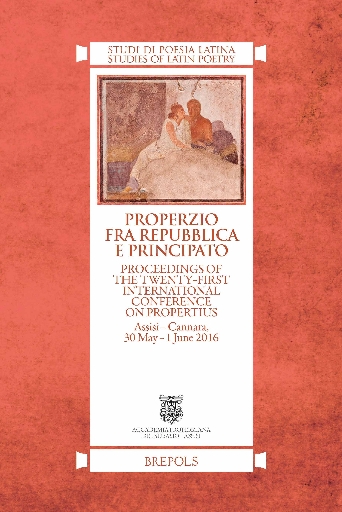
Properzio fra Repubblica e Principato
show More to view fulltext, buy and share links for:Properzio fra Repubblica e Principato show Less to hide fulltext, buy and share links for: Properzio fra Repubblica e PrincipatoThe 2016 conference’s aim was to place Propertius in context. The papers focused on the compatibility between the choice of the elegiac form and the political framework, with special emphasis on Propertius’ relationship to Tullus before his approach to Maecenas and the more direct contact with Augustus subsequent to Maecenas’ removal. While not overstepping the bounds of the genre, the poet was able to contrive a set of references to the princeps and the political reality, thus originally achieving a balanced attitude. It is impossible, however, to grasp any growing alignment with Augustan policies. Rather, the recognition of the collective perception of the turning point marked by the victory at Actium, though within the patterns typical of the elegiac genre, can be perceived.
-
-
-
Per i testi latini: Prime riflessioni sul fondo inedito di Robert Marichal
show More to view fulltext, buy and share links for:Per i testi latini: Prime riflessioni sul fondo inedito di Robert Marichal show Less to hide fulltext, buy and share links for: Per i testi latini: Prime riflessioni sul fondo inedito di Robert MarichalRobert Marichal (1904-1999) was one of the most famous Latin paleographers of the Twentieth Century. His broad production is precious and well-known by scholars from all over the world, but his recently discovered Archive at the École Pratique des Hautes Études (Paris) offers a further and impressive contribution to the knowledge we have of ancient Latin texts, from Latin papyri from Herculaneum, to Latin ostraka from Northen Africa, and to Latin graffiti the ancient Latium and Campania.
This volume moves from the pioneer work on this Archive by the ERC project PLATINUM. It collects eight papers from leading specialists and highlights how promising is the work on such an unpublished Archive.
-