


Brepols Online Books Medieval Miscellanea Collection 2019 - bob2019mime

Collection Contents
5 results
-
-
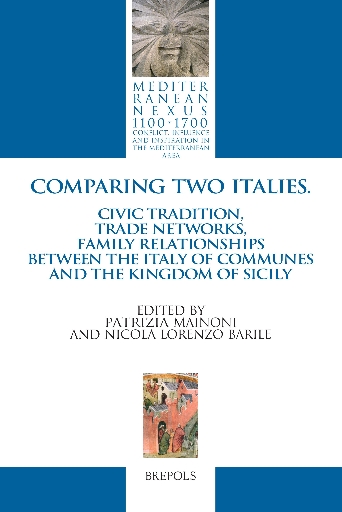
Comparing Two Italies. Civic Tradition, Trade Networks, Family Relationships between the Italy of Communes and the Kingdom of Sicily
show More to view fulltext, buy and share links for:Comparing Two Italies. Civic Tradition, Trade Networks, Family Relationships between the Italy of Communes and the Kingdom of Sicily show Less to hide fulltext, buy and share links for: Comparing Two Italies. Civic Tradition, Trade Networks, Family Relationships between the Italy of Communes and the Kingdom of SicilyThe title of this volume recalls the famous 1977 book by David Abulafia, The Two Italies, about the origins of the so-called ‘unequal exchange’ and ‘dual economy’ between Northern and Southern Italy. These are supposed to have provided the ground for the so-called ‘Southern question’ (‘questione meridionale’), one of the foremost topics in the whole of Italian history. However, trade is not the only relevant theme in a comparison between the Italy of Communes and the Kingdom of Sicily. This collection of essays points to different interpretative paths, which concern not only trade networks, but also less well-known aspects of the interrelation, such as the rise of civic tradition, the spread of Mendicant Orders, and the circulation of wealth through family relationships, women, marriage and patrimonial assets.
-
-
-
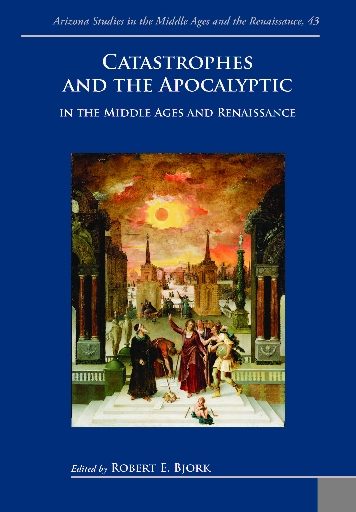
Catastrophes and the Apocalyptic in the Middle Ages and the Renaissance
show More to view fulltext, buy and share links for:Catastrophes and the Apocalyptic in the Middle Ages and the Renaissance show Less to hide fulltext, buy and share links for: Catastrophes and the Apocalyptic in the Middle Ages and the RenaissanceIn the twenty-first century, insurance companies still refer to 'acts of God' for any accident or event not influenced by human beings: hurricanes, floods, hail, tsunamis, wildfires, earthquakes, tornados, lightning strikes, even falling trees. The remote origin of this concept can be traced to the Hebrew Bible. During the Second Temple period of Judaism a new literary form developed called 'apocalyptic' as a mediated revelation of heavenly secrets to a human sage concerning messages that could be cosmological, speculative, historical, teleological, or moral. The best-known development of this type of literature, however, came to fruition in the New Testament and is, of course, the Book of Revelation, attributed to the apostle John, and which figures prominently in the Middle Ages and Renaissance.
This collection of essays, the result of the 2014 ACMRS Conference, treats the topic of catastrophes and their connection to apocalyptic mentalities and rhetoric in the Middle Ages and the Renaissance (with particular reference to reception of the Book of Revelation), both in Europe and in the Muslim world. The twelve authors contributing to this volume use terms that are simultaneously helpful and ambiguous for a whole range of phenomena and appraisal.
-
-
-
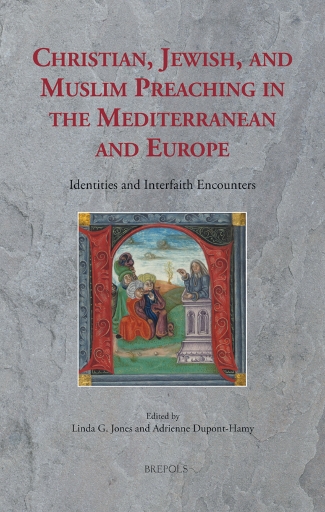
Christian, Jewish, and Muslim Preaching in the Mediterranean and Europe
show More to view fulltext, buy and share links for:Christian, Jewish, and Muslim Preaching in the Mediterranean and Europe show Less to hide fulltext, buy and share links for: Christian, Jewish, and Muslim Preaching in the Mediterranean and EuropeThis volume explores the sermons and activities of Christian, Jewish, and Muslim preachers who shaped ideas about religious and gendered identities and alterity throughout the Mediterranean and northern Europe. Preachers of all three traditions played a decisive role in defining the religious identities of their communities, often in response to negative images projected onto religious others. The studies cover a broad spectrum of premodern Europe and the Mediterranean and address the ways that preaching reflects transcultural contacts as well as social, intellectual, and hermeneutical encounters among diverse societies and religious communities.
The essays are divided into three themes. Part One, ‘Religious and Gendered Identities and Alterities,’ examines how religious identity is inflected by the presence or the ‘absent presence’ of religious others and interrogates how gender informs religious identity, piety, and alterity. The chapters in Part Two, ‘Hermeneutical Identities, Alterities, and Transcultural Relations in Christian and Jewish Preaching’, offer contrasting interpretations of the impact of anti-Judaism in Christian preaching and analyse Jewish responses to Christian polemic. Part Three, ‘Muslim and Christian Orators and Inter-faith Encounters,’ explores these encounters from the dual perspectives of Crusade and military conflict and interreligious dialogue, disputation, and proselytization. The volume positions itself at the intellectual crossroads between comparative medieval sermons studies and transcultural Mediterranean and European studies.
-
-
-

Crossing Borders in the Insular Middle Ages
show More to view fulltext, buy and share links for:Crossing Borders in the Insular Middle Ages show Less to hide fulltext, buy and share links for: Crossing Borders in the Insular Middle AgesThis volume offers an in-depth exploration of the cultural connections between and across Britain, Ireland, and Iceland during the high and late Middle Ages. Drawing together new research from international scholars working in Celtic Studies, Norse, and English, the contributions gathered together here establish the coherence of the medieval Insular world as an area for literary analysis and engage with a range of contemporary approaches to examine the ways, and the degrees to which, Insular literatures and cultures connect both with each other, and with the wider European mainstream.
The articles in this collection discuss the Insular histories of some of the most widely read literary works and authors of the Middle Ages, including Geoffrey of Monmouth and William Langland. They trace the legends of Troy and of Charlemagne as they travelled across linguistic and geographical borders, give fresh attention to the multilingual manuscript collections of great households and families, and explore the political implications of language choice in a linguistically plural society. In doing so, they shed light on a complex network of literary and cultural connections and establish the Insular world not as a periphery, but as a centre.
-
-
-

Crusading Europe
show More to view fulltext, buy and share links for:Crusading Europe show Less to hide fulltext, buy and share links for: Crusading EuropeThe image of the crusades often connotes exoticism and foreign adventuring. However, the underlying motivations, daily practicalities, and lasting impact of the crusades on their European birthplace are equally important. How did European anxieties, prejudices, and priorities propel the crusading movement? How did crusaders understand and manage the particularly European geographical, legal, and financial dimensions of their campaigns? How did the crusades mark medieval European architecture, spirituality, and literature? This volume not only engages these provocative questions but also serves as a monument to the career of Christopher Tyerman, who has done so much to integrate European and global crusading history. The collection of essays gathered here by leading crusade historians, Tyerman’s friends and former students, furthers study of the crusades within their European context, highlighting intriguing new directions for teaching and researching the crusades and their impact.
-