


Brepols Online Books Medieval Miscellanea Collection 2019 - bob2019mime

Collection Contents
3 results
-
-
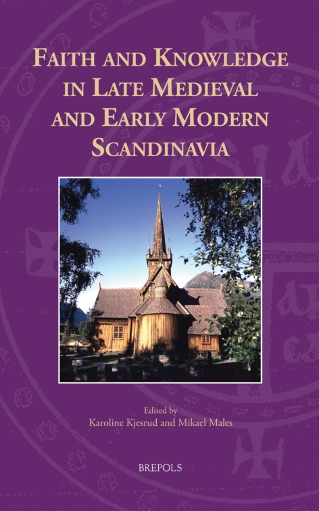
Faith and Knowledge in Late Medieval and Early Modern Scandinavia
show More to view fulltext, buy and share links for:Faith and Knowledge in Late Medieval and Early Modern Scandinavia show Less to hide fulltext, buy and share links for: Faith and Knowledge in Late Medieval and Early Modern ScandinaviaThis book investigates the interface between faith and knowledge in Scandinavia in the centuries before and after the Reformation, a period in which the line between belief and knowledge was often blurred, and local traditions remained influential. While Scandinavia was undoubtedly an integral part of Latin Christendom before the arrival of Lutheranism, the essays gathered together in this volume demonstrate that religious discourse still took a unique form in this region. Faith was influenced by magical practices centred on remnants of Nordic paganism, local wisdom literature, and metaphoric language about the divine that diverged considerably from that of the Judeo-Christian tradition. Texts, motifs, and practices that were common throughout Europe were also transformed and altered within this northern setting.
Covering the late medieval up to the early modern period, this volume offers new insights into intellectual culture in Scandinavia, and the remarkable longevity of local beliefs even into the early post-Reformation period.
-
-
-
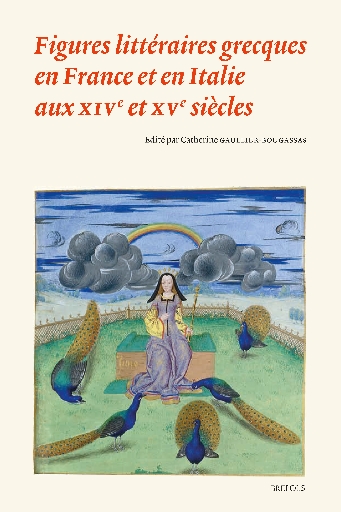
Figures littéraires grecques en France et en Italie aux xiv e et xv e siècles
show More to view fulltext, buy and share links for:Figures littéraires grecques en France et en Italie aux xiv e et xv e siècles show Less to hide fulltext, buy and share links for: Figures littéraires grecques en France et en Italie aux xiv e et xv e sièclesAux xiv e et xv e siècles, la Grèce suscite en Italie et en France un engouement nouveau, dans une tension entre admiration et méfiance face à l’altérité mal connue et mal perçue tant de son univers ancien que de son devenir byzantin. Se multiplient les œuvres en latin, en français et en italien qui évoquent le passé de la Grèce ancienne. Les héros et les héroïnes de la Grèce ancienne entrent dans des univers scripturaires nombreux qui manifestent des exploitations littéraires et esthétiques, mais aussi politiques, religieuses et éthiques très diverses. Ces appropriations ne cessent de s’élargir à des formes d’écriture nouvelles jusqu’à la fin du xv e siècle, entre réinterprétation, instrumentalisation, recréation poétique ou fidélité aux textes peu à peu redécouverts. Le présent ouvrage étudie la présence et l’exploitation des figures de la Grèce ancienne en France et en Italie aux xiv e et xv e siècles, et les nouvelles formes d’ « actualité » qu’elles prennent dans les textes, avec l’évolution du regard et de l’interprétation des auteurs, avec aussi les décalages qui existent entre l’Italie et la France.
-
-
-
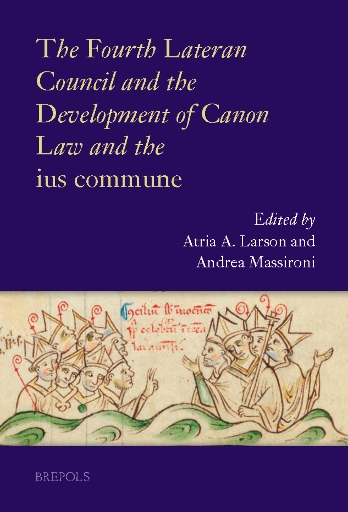
The Fourth Lateran Council and the Development of Canon Law and the ius commune
show More to view fulltext, buy and share links for:The Fourth Lateran Council and the Development of Canon Law and the ius commune show Less to hide fulltext, buy and share links for: The Fourth Lateran Council and the Development of Canon Law and the ius communeThis volume collects essays from an international group of scholars who treat various aspects of the Fourth Lateran Council's placement within the development of the ius commune. Topics include the canon law about armsbearing clergy, episcopal elections, heresy, degrees of affinity within marriage, the oversight of relic veneration; two essays highlight the council's reaction to the Fourth Crusade's sack of Constantinople in trying to incorporate the eastern church into the ecclesiastical structure and liturgical norms of the Roman Church; several essays concentrate on the usage of Roman or civil law in some of Lateran IV's constitutions and emphasize issues of private and procedural law. Collectively, and headed by an essay by Anne J. Duggan on the relationship of Pope Alexander III's pontificate to the Lateran IV constitutions, the essays create a fuller picture of Innocent III and his curia's reliance on developments within the jurisprudence of the preceding half century, but they also reveal the ways in which they forged new paths and made significant contributions to guide canon law in the years following the council.
-