


Brepols Online Books Medieval Miscellanea Collection 2019 - bob2019mime

Collection Contents
4 results
-
-
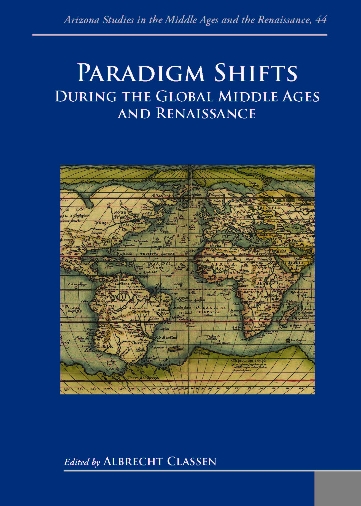
Paradigm Shifts During the Global Middle Ages and Renaissance
show More to view fulltext, buy and share links for:Paradigm Shifts During the Global Middle Ages and Renaissance show Less to hide fulltext, buy and share links for: Paradigm Shifts During the Global Middle Ages and RenaissanceFor a long time we have naively talked about the Middle Ages, the Renaissance, and other periods, but at closer analysis all those terms prove to be constructed models to help us understand in rough terms profound changes that affected human conditions throughout time. As the contributions to the present volume indicate, paradigm shifts have occurred regularly and constituted some of the critical developments in human existence. The notion of paradigm shift as first developed by Thomas Kuhn is here considerably expanded to address also literary, religious, scientific, and cultural-historical phenomena, to deal with contrasting conceptions of various parts of the world (China versus Europe), conflicts between genders, economic changes pertaining to women's roles, social and political criticism, models of how to explain our existence, ideological positions, and epistemological approaches. The study of paradigm shifts makes it possible to grasp fundamental movements both horizontally (the present world in global terms) and vertically (from the past to the present), exposing thereby central forces leading to shifts in power structures and in the mental-historical world-views. Focusing on paradigm-shifts allows us to gain deep insight into conflicting discourses throughout time and to illuminate the struggle between dominant and competing models explaining or determining reality.
-
-
-
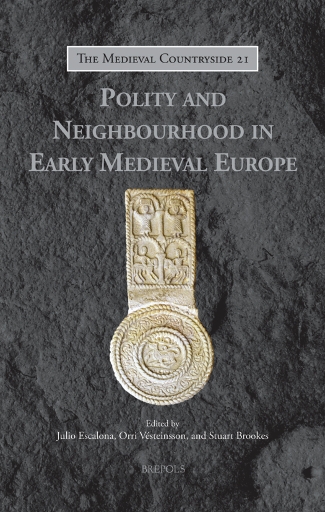
Polity and Neighbourhood in Early Medieval Europe
show More to view fulltext, buy and share links for:Polity and Neighbourhood in Early Medieval Europe show Less to hide fulltext, buy and share links for: Polity and Neighbourhood in Early Medieval EuropeHow were early medieval people connected to each other and to the wider world? In this collection, archaeologists and historians working in very different areas of early medieval Europe explore diverse evidence - from landscape and burial archaeology to charters and chronicles - to discuss the relationships that constituted neighbourhoods and the roles these played in the processes of state formation that can be observed in the peripheries of the Frankish world. What these case-studies teach us, the contributors argue, is that polities are formed not through the exclusive operation of either top-down or bottom-up agencies, but from the interplay between them. By exploring the ways in which local knowledge, social ties, and understandings of landscape interacted with higher-level authorities and institutions, we can gain real insights into the nature of early medieval power and people’s experiences of it.
Marking the culmination of a collective effort that has spanned over a decade and three funded projects, this volume brings together case-studies from Spain, Italy, England, northern Frankia, Norway, and Iceland to offer a comparative view of polities and neighbourhoods in early medieval Europe. Drawing on new research, and offering new perspectives driven by an interdisciplinary approach, this volume is of relevance to a range of disciplines including archaeology, history, onomastics, geography, and anthropology.
-
-
-
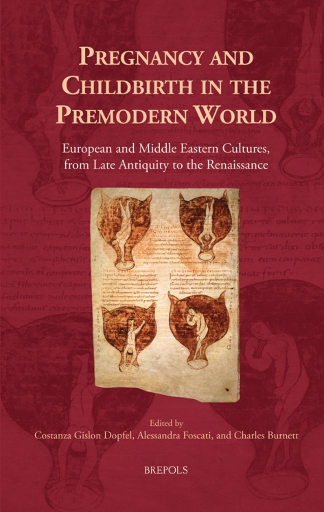
Pregnancy and Childbirth in the Premodern World
show More to view fulltext, buy and share links for:Pregnancy and Childbirth in the Premodern World show Less to hide fulltext, buy and share links for: Pregnancy and Childbirth in the Premodern WorldThis volume of contributions from international scholars offers a cross-cultural and multi-period analysis of pregnancy and childbirth traditions in Western and Middle Eastern cultures. The studies focus on the ideas, practices, and visual representations surrounding pregnancy and birth-giving from Late Antiquity to the Renaissance and offer the reader the possibility of observing the perception, representation, and theoretic paradigm of these events in a wide range of cultural contexts. The collection fits within multiple traditions of specialized scholarship, yet its scope suggests a geographically global approach and a new, multicultural methodology that encompasses a wide range of practices, historical periods, and topics. On one hand, it participates in the well-established medical, historical, and iconographic discourse on childbirth and family that has enticed much interest over the last two decades; on the other, its unique thematic structure includes cultures and periods previously ignored in similar collections of essays. The articles span from Northern Europe to the Mediterranean, the Middle East, and India, and connect the experience of childbirth to the exchanges of knowledge, religious beliefs, and social practices. With its variety of topics and specializations, the volume encourages a global comparative approach to the cultural narrative surrounding the activities and attitudes connected to conception and birth, paying particular attention to material culture, religion, history, and iconography, as well as to the exchange and dispersion of medical knowledge.
-
-
-
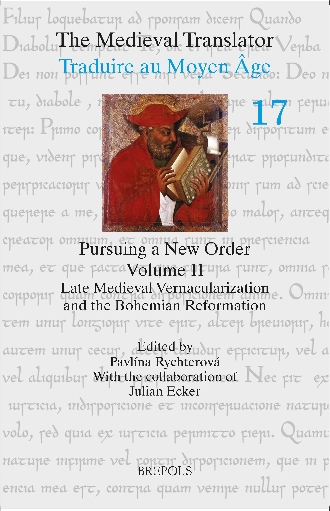
Pursuing a New Order II.
show More to view fulltext, buy and share links for:Pursuing a New Order II. show Less to hide fulltext, buy and share links for: Pursuing a New Order II.In the first two decades of the fifteenth century, the Hussite religious reform movement emerged in Bohemia; it used one of the realm's vernacular languages, Czech, both to disseminate its reform ideas, and to establish strong foundations for the reform. The vernacular became a significant strategy for identification, capable of binding together disconnected religious, ethnic, political and regional identities and generating a very potent aggregate of identifications. This volume considers material from the second half of the fourteenth century to the first half of the sixteenth, beginning with the so-called Hussite ‘forerunners’ and ending with the early German reformation. Individual essays discuss the various functions of the vernaculars in different text types, social situations and religious and political contexts. Together, they correct former assumptions about the topic and provide a basis for further study of Hussite vernacular theology and contribute to the transformation of scholarly narratives about the Hussite movement by including works of vernacular religious education among the most important source material. It offers a basis for the comparative research on the role of the vernaculars in late medieval European religious reform movements.
-