


Brepols Online Books Medieval Miscellanea Collection 2020 - bob2020mime

Collection Contents
4 results
-
-
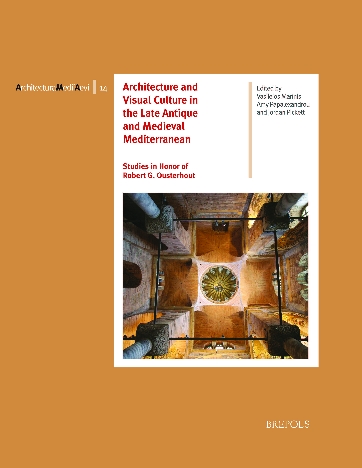
Architecture and Visual Culture in the Late Antique and Medieval Mediterranean
show More to view fulltext, buy and share links for:Architecture and Visual Culture in the Late Antique and Medieval Mediterranean show Less to hide fulltext, buy and share links for: Architecture and Visual Culture in the Late Antique and Medieval MediterraneanThis book comprises sixteen essays addressing issues of art and architecture together with archaeology within the context of sacred space, broadly defined. It encompasses a wide range of territories, methodologies, perspectives, and scholarly concerns. Our point of departure is the built environment, with all that this entails, including religious and political ceremony, painted interiors, patronage, contested spaces, structural and environmental concerns, sensory properties, the written word as it pertains to architectural projects, and imagined spaces. In all, the scholars involved in this project find fresh approaches and uncover new meanings and interpretations in the material examined within this volume, including buildings and objects from Europe to Asia, and spanning from Late Antiquity through the end of the Middle Ages.
-
-
-
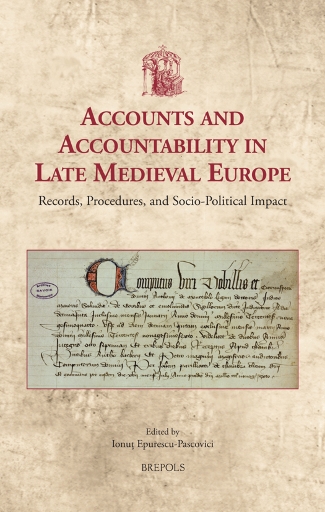
Accounts and Accountability in Late Medieval Europe: Records, Procedures, and Socio-Political Impact
show More to view fulltext, buy and share links for:Accounts and Accountability in Late Medieval Europe: Records, Procedures, and Socio-Political Impact show Less to hide fulltext, buy and share links for: Accounts and Accountability in Late Medieval Europe: Records, Procedures, and Socio-Political ImpactAccounts and Accountability in Late Medieval Europe traces the momentous transformation of institutions and administration under the impact of accounting records and procedures, c. 1250-1500. The volume’s focus on the materiality and organising logic of a range of accounts is complemented by close attention to the socio-political contexts in which they functioned and the agency of central and local officials.
The volume is divided into three parts: the role of financial accountability in the political designs of late medieval states, the uses of accounts auditing and information management as tools for governance, and their impact on the everyday life of local communities. Covering both the centre and the periphery of medieval Europe, from England and the Papal curia to Savoy and Transylvania, the case studies evince the difficult passage from the early experiments with financial accounts towards an accountability of office.
-
-
-
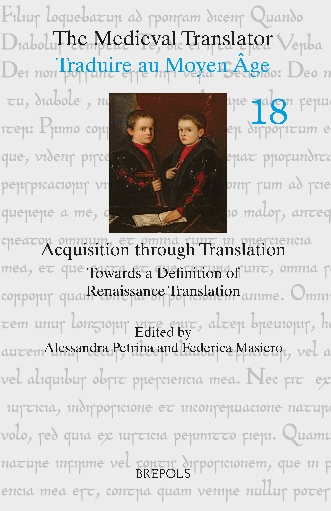
Acquisition through Translation
show More to view fulltext, buy and share links for:Acquisition through Translation show Less to hide fulltext, buy and share links for: Acquisition through TranslationThe definition of translation in Renaissance Europe is here proposed as a process of acquisition: the book studies how a number of European languages, finding their identification in the newly evolving concept of nation, shape their countries’ vernacular libraries by appropriating ancient and contemporary classics.
The emergence of standard modern languages in early modern Europa entailed a competition with the dominant Latin culture, which remained the prevalent medium for the language of science, philosophy, theology and philology until at least the eighteenth century. In this process, translation played a very special role: in a number of significant instances we can identify in the undertaking of a specific translation a policy of acquisition of classical - and by definition authoritative - texts that contributed to the building of an intellectual library for the emerging nation. At the same time, the transmission of ideas and texts across Europe constructed a diasporic and transnational culture: the emerging vernacular cultures acquired not only the classical Latin models, incorporating them in their own intellectual libraries, but turned their attention also to contemporary, or near-contemporary, vernacular texts, conferring on them, through the act of translation, the status of classics. Through the examination of case studies, that take into account both literary and scientific texts, this volume offers an overview of how early modern Europe developed its vernacular national literatures, following the model suggested in the late Middle Ages, through a process of acquisition and translation.
-
-
-
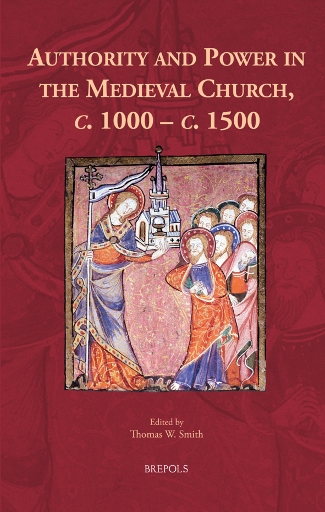
Authority and Power in the Medieval Church, c. 1000–c. 1500
show More to view fulltext, buy and share links for:Authority and Power in the Medieval Church, c. 1000–c. 1500 show Less to hide fulltext, buy and share links for: Authority and Power in the Medieval Church, c. 1000–c. 1500While they often go hand-in-hand and the distinction between the two is frequently blurred, authority and power are distinct concepts and abilities - this was a problem that the Church tussled with throughout the High and Late Middle Ages. Claims of authority, efforts to have that authority recognized, and the struggle to transform it into more tangible forms of power were defining factors of the medieval Church’s existence.
As the studies assembled here demonstrate, claims to authority by members of the Church were often in inverse proportion to their actual power - a problematic paradox which resulted from the uneven and uncertain acceptance of ecclesiastical authority by lay powers and, indeed, fellow members of the ecclesia. The chapters of this book reveal how clerical claims to authority and power were frequently debated, refined, opposed, and resisted in their expression and implementation. The clergy had to negotiate a complex landscape of overlapping and competing claims in pursuit of their rights. They waged these struggles in arenas that ranged from papal, royal, and imperial curiae, through monastic houses, law courts and parliaments, urban religious communities and devotional networks, to contact and conflict with the laity on the ground; the weapons deployed included art, manuscripts, dress, letters, petitions, treatises, legal claims, legates, and the physical arms of allied lay powers.
In an effort to further our understanding of this central aspect of ecclesiastical history, this interdisciplinary volume, which effects a broad temporal, geographical, and thematic sweep, points the way to new avenues of research and new approaches to a traditional topic. It fuses historical methodologies with art history, gender studies, musicology, and material culture, and presents fresh insights into one of the most significant institutions of the medieval world.
-