


Brepols Online Books Medieval Miscellanea Collection 2020 - bob2020mime

Collection Contents
4 results
-
-
Historiography and Identity III: Carolingian Approaches
show More to view fulltext, buy and share links for:Historiography and Identity III: Carolingian Approaches show Less to hide fulltext, buy and share links for: Historiography and Identity III: Carolingian ApproachesThis volume explores the extent to which the reinstitution of the Empire in Western Europe brought about new ways of reconciling the multitude of post-Roman identities with the way the past was shaped in historiographical narratives. From universal histories to local chronicles, and from narratives that support Carolingian rule to histories with a more local focus, the centralization of power and authority in the course of the eighth and ninth centuries forced those who engaged with their own past and that of their community to acknowledge the new situation, and situate themselves in it. The contributions in this volume each depart from a single source, event, or community, and relate their findings to the broader issue of whether the rise of the multi-ethnic Carolingian court allowed for more inclusive narratives to be created, or if their self-proclaimed place at the centre of the Frankish world actually created a context in which local communities were given new tools to assert themselves.
-
-
-
Historiography and Identity II: Post-Roman Multiplicity and New Political Identities
show More to view fulltext, buy and share links for:Historiography and Identity II: Post-Roman Multiplicity and New Political Identities show Less to hide fulltext, buy and share links for: Historiography and Identity II: Post-Roman Multiplicity and New Political IdentitiesThe six-volume sub-series Historiography and Identity unites a wide variety of case studies from Antiquity to the Late Middle Ages, from the Latin West to the emerging polities in Northern and Eastern Europe, and also incorporates a Eurasian perspective which includes the Islamic World and China. The series aims to develop a critical methodology that harnesses the potential of identity studies to enhance our understanding of the construction and impact of historiography.
This second volume of the series studies the social function of historiography in the Justinianic age and the post-Roman kingdoms of the West. The papers explore how writers in Constantinople and in the various kingdoms from Italy to Britain adopted late antique historiographical traditions and adapted them in response to the new needs and challenges created by the transformation of the political and social order. What was the significance of their choices between different models (or their creation of new ones) for their ‘vision of community’? The volume provides a representative analysis of the historiographical resources of ethnic, political, and religious identifications created in the various Western kingdoms. In doing so, it seeks to understand the extant works as part of a once much wider and more polyphonic historiographical debate.
-
-
-
Homo, Natura, Mundus: Human Beings and Their Relationships
show More to view fulltext, buy and share links for:Homo, Natura, Mundus: Human Beings and Their Relationships show Less to hide fulltext, buy and share links for: Homo, Natura, Mundus: Human Beings and Their RelationshipsThe present volumes contain a number of studies first presented at the XIV International Congress of the Société Internationale pour l’Étude de la Philosophie Médiévale, July 24-28, 2017, Porto Alegre, Brazil - which happened to be the first SIEPM Congress in Latin America and the first in the Southern Hemisphere. In 65 essays on current research questions in Latin, Jewish, and Arabic Philosophy, and Early Modern Scholasticism, the contributors explore the general theme of "Homo - Natura - Mundus: Human Beings and their Relationships," and lead us to new perspectives. These essays relate to the following areas of interest: the human being’s self-understanding as a rational creature in multiple relationships (with God, the other, the community, the fellow and the different); the human being’s place in the natural world and the possibility of relating to nature through knowledge; medieval philosophical traditions and the challenges introduced by the "discovery" of the "New World" (dominium, war, hierarchies, and new areas of concern with respect to justice, the human good, and the law). Thus, these volumes offer a unique sample of scholarly studies that work with the idea of "relationships" in two distinct, but not opposing, directions. Firstly, they explore the ways in which human beings, according to the reach of their soul’s powers, construct their self-understanding and existence in relation to God, themselves, others and the natural world. Secondly, they explore the ways in which the philosophical bases for the understanding of these relationships were challenged by the transportation of medieval ideas to the "New World" and by the reception of these ideas in early modern times.
-
-
-
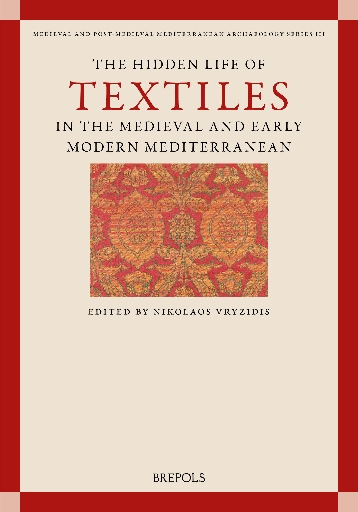
The Hidden Life of Textiles in the Medieval and Early Modern Mediterranean
show More to view fulltext, buy and share links for:The Hidden Life of Textiles in the Medieval and Early Modern Mediterranean show Less to hide fulltext, buy and share links for: The Hidden Life of Textiles in the Medieval and Early Modern MediterraneanThe book contains published papers of the conference 'Textiles & Identity in the Medieval and Early Modern Mediterranean: Paradigms of Contexts and Cross-Cultural Exchanges' of the British School at Athens held at the (Benaki) Museum of Islamic Art in 2016, as well as some new contributions.
The focus in this wide-ranging collection of studies by key scholars in the field is on textiles and their functions in various Mediterranean contexts (and beyond) during medieval and post-medieval times (ca. 10th-19th c.). The scope of the contributions encompasses archaeological, anthropological and art historical perspectives on a great variety of subjects, such as textiles from the Byzantine Empire and the Medieval Islamic World (e.g. Spain, Mamluk Egypt, Seljuk Anatolia), as well as the production and use of textiles in Italy, the Ottoman Empire, Armenia and Ethiopia. The volume offers a state-of-the-art of an often still hardly known area of study of textiles as historical and cultural sources of information, which makes it essential reading for scholars and a larger audience alike.
The book includes contributions by Laura Rodríguez Peinado, Ana Cabrera-Lafuente, Avinoam Shalem, Scott Redford, Maria Sardi, Vera-Simone Schulz, Nikolaos Vryzidis, Marielle Martiniani-Reber, Elena Papastavrou, Jacopo Gnisci and Dickran Kouymjian.
-