


BOB2020MOOT

Collection Contents
3 results
-
-

Court Festivals of the Holy Roman Empire, 1555–1619
show More to view fulltext, buy and share links for:Court Festivals of the Holy Roman Empire, 1555–1619 show Less to hide fulltext, buy and share links for: Court Festivals of the Holy Roman Empire, 1555–1619This study represents a new approach to the analysis of early modern court festivals, setting the question of identity at its heart. It explores identity as it was portrayed, constructed, and upheld through court festivals within the Holy Roman Empire of the German Nation in the period between the Peace of Augsburg in 1555 and the coronation of Friedrich V, Elector Palatine, as King of Bohemia in 1619. Structured thematically, this detailed analysis touches on core themes of early modern European history including state formation, princely courts, gender, religion, science and the natural world, and cultural encounters. In doing so, it draws on, and speaks to, scholarly literature not only from different historical sub-disciplines but also from sociology and anthropology. Ultimately, Morris argues that these court festivals provided a flexible, albeit contested, rhetoric of identity, grounded in the performance of humanist virtue. Through the performed, material, and literary rhetoric of court festivals, the concept of nobility through virtue was reworked, refined, and given a new vocabulary within the German context. This was inextricably linked with politics in light of the reforms made to the Holy Roman Empire at the end of the fifteenth century, the confessional divisions of the sixteenth century, and the mounting tensions of the early seventeenth century which were to culminate in the Thirty Years War.
-
-
-
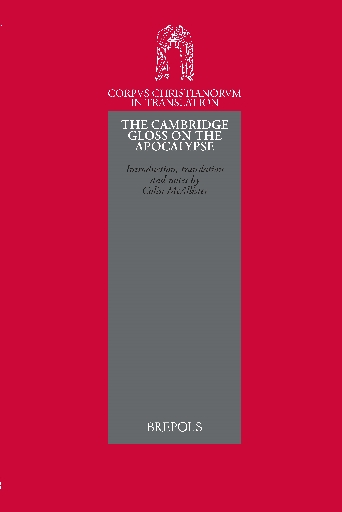
The Cambridge Gloss on the Apocalypse
show More to view fulltext, buy and share links for:The Cambridge Gloss on the Apocalypse show Less to hide fulltext, buy and share links for: The Cambridge Gloss on the ApocalypseThe Glossa in Apocalypsin (Cambridge Gloss on the Apocalypse) is a recently-discovered anonymous Hiberno-Latin (that is, authored by an Irish cleric writing in Latin) commentary on the Apocalypse of John found in a tenth-century manuscript at Cambridge University Library. This gloss is written in a similar style to other Irish-authored exegetical texts of the same period. That is, the author proceeds verse by verse through the entire Apocalypse, citing short phrases or even single words of the biblical text, followed by brief explanations that serve to clarify meaning and are often moral or allegorical in nature, as well as offering alternative interpretations of a given passage. The text has a marked dependence on the hermeneutical method of the fourth-century Donatist Tyconius as laid out in his Liber Regularum (Book of Rules), and applied in his Exposition on the Apocalypse. The Cambridge Gloss promotes an ecclesiological and spiritual interpretation of the Apocalypse, muting speculation about an imminent endtime scenario. The gloss contains numerous references to heretics, emphasises the hierarchy and the privileged role of teachers within the church, and likely dates from the eighth century, the ‘Northumbrian Golden Age’, exemplified by the works of Bede the Venerable and Alcuin of York. This English translation (accompanied by numerous notes) is intended to give readers an insight into understanding the viewpoint that medieval exegetes held in explaining the Apocalypse of John.
The source text of this volume appeared in Corpus Christianorum Series Latina as Glossa in Apocalypsin e codice Bibliothecae Vniuersitatis Cantabrigiensis Dd.X.16 (CCSL 108G). References to the corresponding pages of the Corpus Christianorum edition are provided in the margins of this translation.
-
-
-
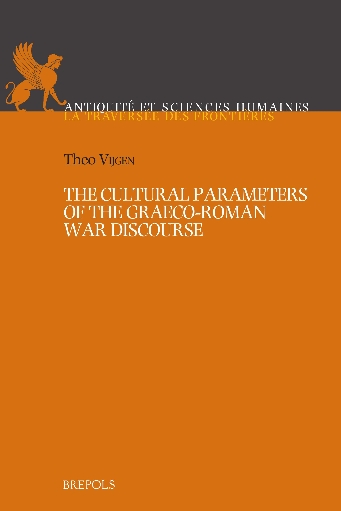
The Cultural Parameters of the Graeco-Roman War Discourse
show More to view fulltext, buy and share links for:The Cultural Parameters of the Graeco-Roman War Discourse show Less to hide fulltext, buy and share links for: The Cultural Parameters of the Graeco-Roman War DiscourseWhat were the ideas that the ancient Greeks and Romans held about warfare? What do contemporary sources tell us about this? Is it possible to trace a development in the way of thinking about war in antiquity? These are the questions that are discussed (and answered) in this study. It combines a close reading of all the sources that we have - mostly written, like literary and historiographical, but also non-written, like art, monuments and coinage. The analysis of the discourse is accompanied by and contrasted with arguments raised by today’s specialists in the field of warfare and culture of ancient Greece and Rome.
The study treats recurrent cultural themes like courage, fatherland, or victory within a chronological framework, for discourse features cannot be isolated from the context of their time. For each specific period - Greek, Hellenistic and the six parts of the long and diverse Roman time - conclusions are drawn. The remarkable developments in time that can be observed, especially in Rome, are brought together in the final chapter.
-