


Brepols Online Books Medieval Miscellanea Collection 2021 - bob2021mime

Collection Contents
4 results
-
-
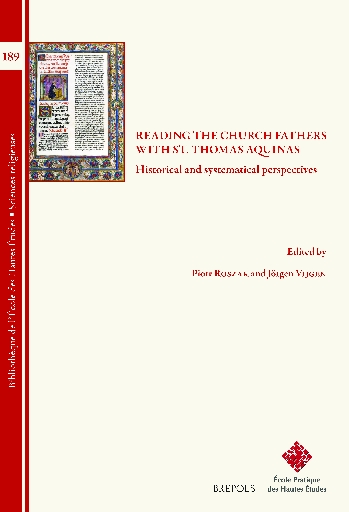
Reading the Church Fathers with St. Thomas Aquinas
show More to view fulltext, buy and share links for:Reading the Church Fathers with St. Thomas Aquinas show Less to hide fulltext, buy and share links for: Reading the Church Fathers with St. Thomas AquinasIn his richly documented and still valuable study of Aquinas and the Church Fathers, published in 1946, Gottfried Geenen, o.p. noted that the study of this aspect of Thomas Aquinas’s thought was just beginning to take place. More than seventy years later considerable progress has been made, both historically and doctrinally, not at least due to the technological advances in the area of the study of Aquinas’s writings. It has been argued both that Aquinas had a remarkable knowledge of a wide range of the Church Fathers and that he was actively engaged in acquiring new material from hitherto unknown Fathers. Due to Thomas’s profound commitment to both Latin and Greek patristic sources he was not only able to draw on the rich tradition of the past but also to explore new possibilities and solutions. This commitment and interaction between tradition and speculative reason has led some to claim tentatively that one might characterize Thomas Aquinas’s theology as being ad mentem patrum.
The goal of this volume is to explore ways to corroborate this claim. In order to do so, the contributions investigate the presence and use of the Church Fathers in Aquinas’s thought both historically and systematically.
-
-
-

Religious Connectivity in Urban Communities (1400–1550)
show More to view fulltext, buy and share links for:Religious Connectivity in Urban Communities (1400–1550) show Less to hide fulltext, buy and share links for: Religious Connectivity in Urban Communities (1400–1550)The boundaries between sacred and secular in the late Middle Ages, traditionally perceived as separate domains, are nowadays perceived as porous or non-existent. This collection on religious connectivity explores a new approach to religious culture in the late Middle Ages. In assessing the porosity of the domains of sacred and secular, and of religious and lay, the contributors to this collection investigate processes of transfer of religious knowledge, literature, and artefacts, and the people involved.
Religious connectivity describes people in networks. This concept emphasises dynamics and processes rather than stability, and focuses on all persons involved in transfer and appropriation, not just the producers. It is therefore a fruitful concept by which to explore medieval society and the continuum of sacred and secular. By using the lens of religious connectivity, the authors of this collection shed new light on religious activities and religious culture in late medieval urban communities.
-
-
-
Rome on the Borders. Visual Cultures During the Carolingian Transition
show More to view fulltext, buy and share links for:Rome on the Borders. Visual Cultures During the Carolingian Transition show Less to hide fulltext, buy and share links for: Rome on the Borders. Visual Cultures During the Carolingian TransitionBased upon the conference Rome in a Global World: Visual Cultures During the Carolingian Transition (Brno, 14th-15th October 2019), this Supplementum volume of Convivium collects eleven articles that look at Rome’s artistic production in the Carolingian era across historiographical, disciplinary, methodological and geopolitical borders.
-
-
-
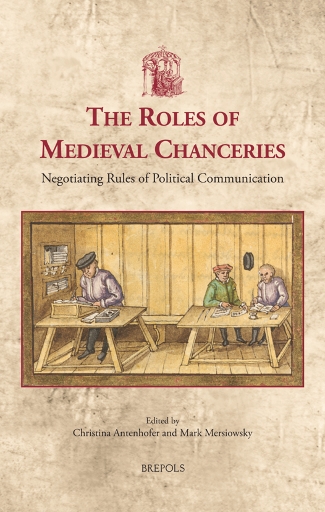
The Roles of Medieval Chanceries
show More to view fulltext, buy and share links for:The Roles of Medieval Chanceries show Less to hide fulltext, buy and share links for: The Roles of Medieval ChanceriesMedieval communication followed rules that were defined, negotiated, and altered in processes of exchange. Conflicts resulting from different communication practices, as well as forms of innovation, revolve around rules that are not self-evident. Political actors such as princes and cities, chanceries, secretaries, ambassadors, and councillors formed rules of political participation, which became visible in written documentation. These rules were both formed and negotiated via processes of communication. Medieval chanceries can thus be understood as a vast field of experimentation where different solutions were tested, passed on, or discarded.
This book explores communication practices in German, French, Italian, Tyrolian, and Gorizian chanceries, as well as at diets from the tenth to the sixteenth century. Its chapters examine royal, monastic, princely, and communal chanceries. For the early and high Middle Ages, a close analysis of documents will reconstruct negotiation and communication from within the documents themselves. For the later Middle Ages, focus will turn to the chancery, with the appearance of chancery orders and chancery annotations that provide explicit insight in communication between the chancellors, secretaries, and political authorities. The growing amount and variety of documents issued in the late Middle Ages allows us to retrace conflicts resulting from differing chancery practices as well as attempts to reorganise the chancery into a political instrument for the prince. The processes of political communication will be followed in three parts. Part I focuses on the rules within documents. Part II looks at administrative processes within specific chanceries, while Part III explores forms of exchange between the chancery and other political actors.
-