


Brepols Online Books Medieval Miscellanea Collection 2022 - bob2022mime

Collection Contents
2 results
-
-
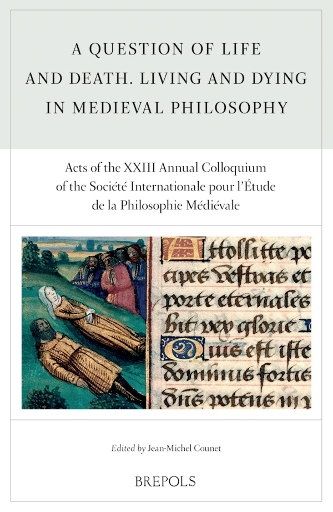
A Question of Life and Death. Living and Dying in Medieval Philosophy
show More to view fulltext, buy and share links for:A Question of Life and Death. Living and Dying in Medieval Philosophy show Less to hide fulltext, buy and share links for: A Question of Life and Death. Living and Dying in Medieval PhilosophyLiving and dying are essential concepts in Aristotelian natural philosophy and psychology. It is then no surprise that when the libri naturales were translated into Latin from the twelfth century onwards, this gave birth to an extensive interpretative tradition in the Latin West in which life and death as conceived by Aristotle were theorized and reflected upon, for example in the numerous commentaries of the De Anima but also of the Parva Naturalia. Yet the medieval inquiry into living and dying is not limited to natural philosophy nor the Aristotelian tradition but can also be found in ethics, metaphysics, theology, medicine and others domains. Many topics are addressed in the volume: radical moisture and the possibility of increasing lifespan, suicide, essence of life, contrast between life of the body and life of the soul, future life, and so on. The volume is also a hommage to Pieter De Leemans, an eminent specialist of the Latin translations of Aristotle’s books on natural philosophy, who was the intitiator of this scientific project.
-
-
-

Qui nous délivrera du grand Alexandre le Grand
show More to view fulltext, buy and share links for:Qui nous délivrera du grand Alexandre le Grand show Less to hide fulltext, buy and share links for: Qui nous délivrera du grand Alexandre le GrandBien que la dérision s’inscrive aux marges du corpus littéraire et artistique sur Alexandre, il existe une veine comique qui rabaisse le souverain le plus prestigieux de l’Antiquité, avec une tonalité joyeuse ou bien plus grave et accusatrice. Si elle ne cesse d’évoluer au fil des siècles tant le rire, l’irrévérence et la satire sont ancrés dans l’historicité, elle s’affirme, dans ses différentes incarnations esthétiques, comme un discours parallèle, un discours d’à côté, qui devient parfois un véritable contre-discours. L’objet de ce volume est ainsi d’entamer une analyse diachronique - qui n’a encore jamais été menée - des modes de dérision à l’encontre d’Alexandre et de ce qu’il incarne, de leurs significations et de leurs motivations. Comique divertissant, célébration paradoxale d’une icône de la royauté, satire politique de la mégalomanie et de l’autoritarisme, ou parodie révélatrice d’un rejet de conventions esthétiques et de leurs instrumentalisations politiques et culturelles : les écritures visuelles et textuelles de la dérision à l’encontre du grand Alexandre le Grand engagent tous ces aspects depuis l’Antiquité.
-