


Brepols Online Books Medieval Miscellanea Collection 2022 - bob2022mime

Collection Contents
6 results
-
-
Rewriting History in the Central Middle Ages, 900–1300
show More to view fulltext, buy and share links for:Rewriting History in the Central Middle Ages, 900–1300 show Less to hide fulltext, buy and share links for: Rewriting History in the Central Middle Ages, 900–1300In the Middle Ages, rewriting history was a distinct activity within the larger sphere of historical writing. Rewriting started with existing historical accounts, recasting them into new forms as new stories about the past. Changes in circumstances drove rewriting, encouraging historically literate writers and their patrons to examine their histories anew, to jettison what no longer made sense or was useful, and to supply new material to fill gaps or expand ideas. Writers rewrote not only for the present and future, but also for the past. They curated the past and reorganized its intellectual artifacts, thereby revealing new facets of old history to future eyes.
Rewriting was a defining characteristic of the central Middle Ages (900-1300), distinct both from earlier traditions of universal history and from later traditions of making continuations which left the narrative core intact. Reimagining the past by rewriting happened across genres, in the vernaculars as well as the universal languages of Latin and Greek, and across Europe, west and east. The chapters in this book explore the reasons and methods for rewriting, ranging across the Anglo-Norman realm, France and Flanders, Christian Iberia, Norman Italy and the Mediterranean, Byzantium, and Georgia and Armenia. Together, they show a set of rewriters who made themselves the authorities for their own age.
-
-
-
Royal Nunneries at the Center of Medieval Europe
show More to view fulltext, buy and share links for:Royal Nunneries at the Center of Medieval Europe show Less to hide fulltext, buy and share links for: Royal Nunneries at the Center of Medieval EuropeThe contributions of this special issue - proceedings of the conference on royal nunneries that took place in Prague in July 2020 - focus on the monasteries connected to the ruling houses, which were endowed with special privileges and enriched by royal and aristocratic donations, often serving as instrumenta regni. They are introduced as active cultural hubs, stages for royal and courtly promotion, and places of personal and dynastic self-representation. This includes female monasteries, the agency of female élites in medieval society and their role as patrons and addressees of works of art.
-
-
-
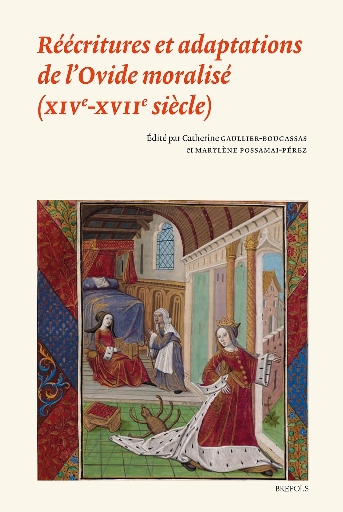
Réécritures et adaptations de l’Ovide moralisé (xiv e-xvii e siècle)
show More to view fulltext, buy and share links for:Réécritures et adaptations de l’Ovide moralisé (xiv e-xvii e siècle) show Less to hide fulltext, buy and share links for: Réécritures et adaptations de l’Ovide moralisé (xiv e-xvii e siècle)L’Ovide moralisé a joué un rôle significatif pour la connaissance des mythes antiques et la création de nouvelles œuvres littéraires qui se les approprient au moins jusque dans la première moitié du xvi e siècle, avant qu’il ne soit moqué et condamné. Dès son écriture au xiv e siècle, cette traduction en langue française des Métamorphoses d’Ovide accompagnée d’interprétations chrétiennes a rapidement connu le succès et une diffusion large auprès de publics divers qui la lisaient souvent, elle et ses gloses, plutôt que l’œuvre latine d’Ovide. De nombreux auteurs en français, en latin ou en anglais se sont inspirés de son texte pour créer leurs propres représentations littéraires de héros et héroïnes antiques, dans des œuvres poétiques, didactiques et historiographiques, ou pour élaborer leurs écritures de la moralisation. Les deux mises en prose de l’Ovide moralisé à la cour d’Anjou et à la cour de Bourgogne, les réécritures et remaniements qui sont ensuite imprimés, la traduction anglaise imprimée par William Caxton ont aussi contribué à prolonger l’influence qu’il a exercée. Cette dernière se lit aussi sans nul doute dans certaines des nouvelles traductions des Métamorphoses qui sont composées au xvi e siècle. Si cette influence a souvent été notée, si des emprunts de poètes du xiv e et du xv e siècles - Guillaume de Machaut, Jean Froissart, Eustache Deschamps, Christine de Pizan, Chaucer, Gower - ont été étudiés, la postérité de l’Ovide moralisé reste encore pour une large part à explorer. C’est l’objet de ce volume collectif, le premier qui soit consacré à la réception du texte du xive au xviie siècle.
-
-
-
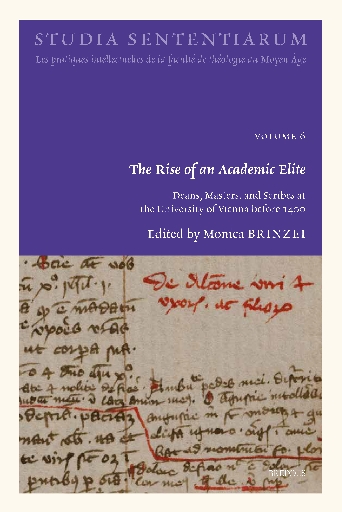
The Rise of an Academic Elite : Deans, Masters, and Scribes at the University of Vienna before 1400
show More to view fulltext, buy and share links for:The Rise of an Academic Elite : Deans, Masters, and Scribes at the University of Vienna before 1400 show Less to hide fulltext, buy and share links for: The Rise of an Academic Elite : Deans, Masters, and Scribes at the University of Vienna before 1400Henry of Rheinfelden, a Dominican from Basel, spent the last decade of the fourteenth century at the University of Vienna studying theology. During this time he took notes on the academic activities of the first rectors of the university and deans of the Faculties of Arts and Theology. This volume explores Rheinfelden’s contribution to our understanding of the doctrinal, curricular, administrative, and prosopographical history of the early University of Vienna. Deciphering Rheinfelden’s surviving notebooks in the Universitätsbibliothek Basel sheds new light on the rise of an academic elite in Vienna. His manuscripts reveal a network of scholars sharing a passion for knowledge and supply a gallery of intellectual profiles, starting with the mentors of the group, Henry of Langenstein and Henry Totting of Oyta, and continuing with the lesser-known figures Stephen of Enzersdorf, Gerhard Vischpekch of Osnabrück, Paul (Fabri) of Geldern, Andreas of Langenstein, Rutger Dole of Roermond, Nicholas of Hönhartzkirchen, Nicholas of Dinkelsbühl, John Berwart of Villingen, John Stadel of Russbach, Peter de Treysa, Michael Suchenschatz of Hausleiten, Peter Schad of Walse, Thomas of Cleves, and Leonhard of Dorffen. The papers gathered in this volume highlight the intricate relationship between a commitment to administrative duty and an appetite for the creation of a doctrinal tradition via debating, forging arguments, defending and attacking positions, commenting on authorities, and adopting and adapting academic practices imported from Paris, since the majority of the authors in our gallery were educated in Paris and built their careers in Vienna. Through Rheinfelden’s notebooks, this volume provides access to unique and previously unknown texts that together offer a new image of the medieval University of Vienna.
-
-
-

Religious Practices and Everyday Life in the Long Fifteenth Century (1350–1570)
show More to view fulltext, buy and share links for:Religious Practices and Everyday Life in the Long Fifteenth Century (1350–1570) show Less to hide fulltext, buy and share links for: Religious Practices and Everyday Life in the Long Fifteenth Century (1350–1570)The essays in this book bring to light and analyse the continuities and shifts in daily religious practices across Europe - from Portugal to Hungary and from Italy to the British Isles - in the transition from the Middle Ages to the early modern period. While some of these changes, such as the increasing use of rosaries and the resort to Ars Moriendi, were the consequence of the rise of a more personal and interiorized faith, other changes had different causes. These included the spreading of the Reformation over Europe, the expulsion or compulsory conversion of the Jews in the Iberian Peninsula, and the conquest of large portions of eastern Christianity by the Turks - all of which forced people, who suddenly found that they had become religious minorities, to adopt new ways of living and new strategies for expressing their religiosity.
By recovering and analysing the cultural dynamics and connections between religious power, knowledge, culture, and practices, this collection reconsiders and enriches our understanding of one of the most critical phases of Europe’s cultural history. At the same time, it challenges existing narratives of the development of (early) modern identities that still, all too often, dominate the self-understanding of contemporary European society.
-
-
-
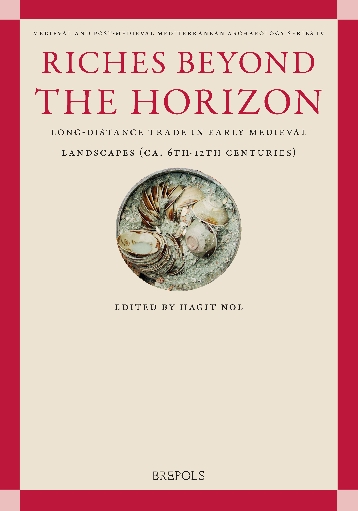
Riches Beyond the Horizon
show More to view fulltext, buy and share links for:Riches Beyond the Horizon show Less to hide fulltext, buy and share links for: Riches Beyond the HorizonThis book offers new and innovative perspectives on long-distance trade between Europe, the Mediterranean area, the Middle East, Africa, India and China during the Early Medieval period. The archaeological data and historical insights presented in this volume are without exception of great interest, often exciting, and more than once astonishing. The goods which travelled between the continents in the timespan under discussion (ca. 6th to 12th centuries) include pottery in all shapes and forms, textiles, coins, metal, lava millstones, glass, marble columns, rock-crystal beads, and also plants used for incense. The scope of the contributions includes the wide-ranging economic contacts of a Viking community, the changing patterns of long-distance trade in the Byzantine Empire, the spread of Chinese pottery to Africa, the Near East and Europe, the information on maritime routes provided by shipwrecks in the Java Sea, the reconstruction of an incense trade network, and the production and distribution of textiles as well as stone objects in the Middle East and beyond. The varied approaches in this volume underline that the movement of objects in Early Medieval times over vast distances not only reflect mechanisms of exchange, but also imply social networks and the transfer of ideas. Thus, Riches Beyond the Horizon sheds compelling light on a world which was much more complex and much more interconnected than has often been assumed.
-