


BOB2022MIOT

Collection Contents
8 results
-
-

Language Commonality and Literary Communities in Early Modern England
show More to view fulltext, buy and share links for:Language Commonality and Literary Communities in Early Modern England show Less to hide fulltext, buy and share links for: Language Commonality and Literary Communities in Early Modern EnglandIn the early modern period, the humanist practice of translation of sacred as well as secular texts created new readerships in the vernacular for authoritative texts, religious or classical. As the circulation of languages within Europe reshuffled hierarchies between classical languages and vernacular tongues, transmission via translation was not only vertical, but also horizontal, and the contacts between European languages enabled the expansion of local lexicons from sources other than Latin or Greek.
This volume focuses on the role of translation and lexical borrowing in the expansion of specific English lexicons (erudite, technical, or artisanal) as evidenced in printed texts from the early modern period. It considers how language shapes identity in social, religious, philosophical, artistic, and literary contexts, and is in turn shaped by claims of social, religious, philosophical, artistic, and literary identity.
-
-
-
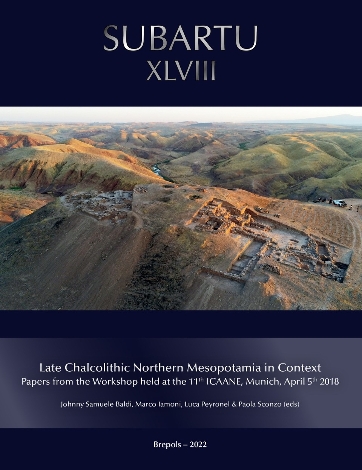
Late Chalcolithic Northern Mesopotamia in Context
show More to view fulltext, buy and share links for:Late Chalcolithic Northern Mesopotamia in Context show Less to hide fulltext, buy and share links for: Late Chalcolithic Northern Mesopotamia in ContextMany of the debates that have until recently driven research into Mesopotamia’s proto-urban phase (5th- 4th millennia bce) have now been reassessed thanks to new fieldwork in Iraqi Kurdistan and new data into the relationships between the north and south of the Alluvium from hitherto poorly-documented regions. These debates were re-examined in the light of this new material during a workshop held at the ICAANE in 2018 in Munich, leading to unprecedented perspectives on the patterns of early urbanization, social mobility, and the organization of Late Chalcolithic communities. Drawing on research first presented at ICAANE, and building on the most recent data from surveys and excavations, this volume engages with one key question from different angles: namely, how can we reconcile detailed analysis of the multifaceted local variations of proto-urbanism with the supra-regional, intricate, and more widespread nature of this same phenomenon across Mesopotamia?
-
-
-
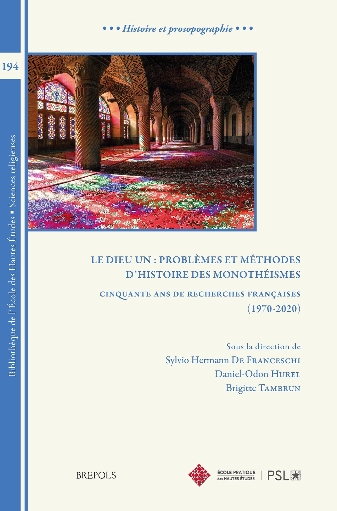
Le Dieu un : problèmes et méthodes d’histoire des monothéismes
show More to view fulltext, buy and share links for:Le Dieu un : problèmes et méthodes d’histoire des monothéismes show Less to hide fulltext, buy and share links for: Le Dieu un : problèmes et méthodes d’histoire des monothéismesFondé au début de l’été 1969 et labellisé laboratoire associé du CNRS à partir du 1er janvier 1970, le Centre d’études des religions du Livre (CERL), dont est issu l’actuel Laboratoire d’études sur les monothéismes (LEM, UMR 8584), a été créé au tournant crucial des années 1960 et 1970, quand, sous l’impulsion du CNRS, le modèle du laboratoire, exporté depuis le champ des sciences exactes, se généralise pour favoriser l’essor d’investigations collectives également en sciences humaines et sociales.
Dans le vaste mouvement de restructuration de la recherche en cours dans la France d’après Mai 68, les sciences religieuses devaient prendre la place qu’elles méritaient. Les objectifs du CERL se sont alors définis essentiellement selon deux mots d’ordre : procéder à une étude comparative des trois monothéismes classiques (judaïsme, christianisme et islam) ; allier aussi rigoureusement que possible sciences des religions et histoire de la philosophie.
La mémoire collective du CERL a voulu retenir qu’il avait été conjointement fondé par Paul Vignaux (1904-1987), Georges Vajda (1908-1981) et Henry Corbin (1903-1978) - triade savante qui représentait les trois grandes religions du Livre. Henry Corbin a pourtant été l’unique architecte d’un projet dont Paul Vignaux a assuré la réalisation institutionnelle. Le présent ouvrage revient sur un demi-siècle de recherches françaises consacrées à l’étude non confessante des monothéismes.
-
-
-

Le doute dans l’Europe moderne
show More to view fulltext, buy and share links for:Le doute dans l’Europe moderne show Less to hide fulltext, buy and share links for: Le doute dans l’Europe moderneL’époque moderne, depuis l’Humanisme et la Renaissance jusqu’aux Lumières, fut propice au doute et largement travaillée par celui-ci. La découverte de nouvelles techniques, l’exploration de nouveaux espaces, le développement de nouvelles disciplines, la formulation de nouvelles doctrines religieuses et politiques, la circulation accélérée et élargie des productions écrites par la voie de l’imprimerie ont favorisé, notamment dans les villes, la pluralité et la confrontation des idées et des opinions et l’émergence du doute dans tous les domaines. L’ambition de ce volume est de contribuer à une histoire culturelle du doute, qui reste largement à construire à partir de l’exploration de ses divers aspects. Là où le scepticisme, qui renvoie d’abord à un système, une position ou un argument philosophique, oriente l’enquête vers l’histoire intellectuelle, le doute, qui désigne un état de l’esprit ou une attitude mentale, s’applique à tous les modes de la connaissance, théoriques et pragmatiques, et invite à élargir son étude à l’histoire des émotions, des mentalités, des comportements et des pratiques. S’agissant de l’époque moderne, il a paru particulièrement opérant de privilégier le fil directeur du rapport à la religion, considérée aussi bien comme croyance que doctrine et église. En effet, loin de refermer l’enquête sur l’histoire confessionnelle, ce rapport ouvre sur les différents champs culturels, du droit aux sciences et à la littérature, et contribue à révéler les enjeux anthropologiques de la question.
Les développements du doute au début de l’époque moderne semblent bien avoir introduit des attitudes que l’on retrouve dans le monde contemporain : le relativisme culturel ; la suspicion envers une information souvent surabondante et/ou peu fiable ; un élément personnel dans l’adhésion aux croyances religieuses ; la prédominance dans l’espace public de l’opinion sur le savoir. Une raison qui rend d’autant plus nécessaire la construction d’une histoire culturelle du doute à l’époque moderne.
-
-
-
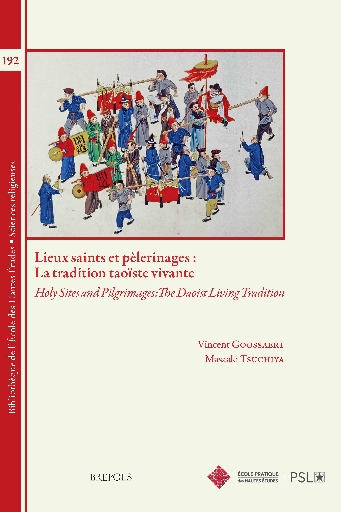
Lieux saints et pèlerinages : la tradition taoïste vivante
show More to view fulltext, buy and share links for:Lieux saints et pèlerinages : la tradition taoïste vivante show Less to hide fulltext, buy and share links for: Lieux saints et pèlerinages : la tradition taoïste vivanteThe Chinese territory is densely meshed with holy sites (mountains, caves, springs...) where the gods manifest themselves and where pilgrims come to meet them. The present volume, the result of a Franco-Japanese conference held in Paris in 2017, includes fifteen chapters in French and English, exploring the conceptions and practices at these holy sites; they build the analysis around the Daoist notion of “grotto-heavens and blessed lands” (dongtian fudi) and its long historical continuity for two millennia while addressing hybridizations with Buddhist and folk practices, and comparing with Japanese holy sites. These case studies cover both the ascetic practices of religious virtuosos and the popular associations whose members dance for the gods on the mountains.
-
-
-
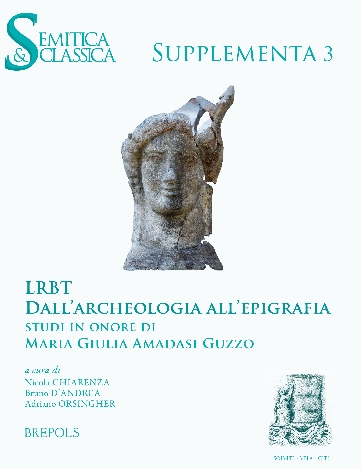
LRBT. Dall’archeologia all’epigrafia / De l'archéologie à l'épigraphie
show More to view fulltext, buy and share links for:LRBT. Dall’archeologia all’epigrafia / De l'archéologie à l'épigraphie show Less to hide fulltext, buy and share links for: LRBT. Dall’archeologia all’epigrafia / De l'archéologie à l'épigraphieThis volume intends to pay tribute to Professor Maria Giulia Amadasi Guzzo, who is one of the leading experts in Semitic epigraphy and North-West Semitic philology. This Festschrift mirrors her multifaceted intellectual interests by gathering together eighteen original contributions of students, friends and colleagues. Although with a focus mainly on the Phoenician-Punic Mediterranean of the 1st millennium bc, this volume also addresses other neighbouring regions and extends up to the Roman imperial period. In doing so, it encompasses the publication of new inscriptions and epigraphic corpora, provides a fresh look at remarkable finds, groups of artefacts and specific sites, but also shows a variety of new approaches and issues in historical and religious studies.
-
-
-
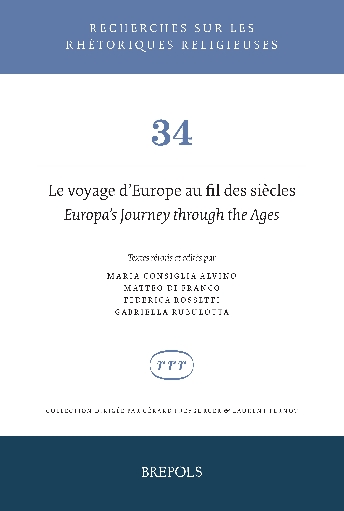
Le voyage d’Europe au fil des siècles / Europa’s Journey through the Ages
show More to view fulltext, buy and share links for:Le voyage d’Europe au fil des siècles / Europa’s Journey through the Ages show Less to hide fulltext, buy and share links for: Le voyage d’Europe au fil des siècles / Europa’s Journey through the AgesThe myth of Europa, first attested in the eighth century bce in Homeric Poems and Hesiod’s Theogony, shapes new visions, figures and images in European literary productions as well as in artistic circles from Graeco-Roman antiquity to the present day. It is an enigmatic journey whose true beginnings cannot be determined and whose end is probably still far off. The centre of attention in this volume is Europa, Phoenician princess, and not Europe, geopolitical idea. With a multidisciplinary and diachronic view, this book explores different facets of the reception of the myth. The contributors offer reflections on the characterization of the mythical figure of Europa, for the archaic and classical periods, and on the reworking of the myth in the Hellenistic and humanistic period. The investigation extends to the study of the persistence of the myth of Europa in the art and literature of modern and contemporary times.
-
-
-
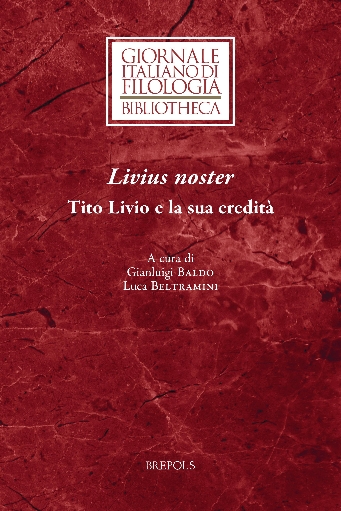
Livius noster
show More to view fulltext, buy and share links for:Livius noster show Less to hide fulltext, buy and share links for: Livius nosterThis book stems from a conference on Livy held at the University of Padua, on the occasion of the bimillenary of the historian’s death (6-10 November 2017). The aim of the volume is to shed new light on lesser-known aspects of Livy’s historiography, by approaching his work from a broad and interdisciplinary perspective. The papers, written by established scholars as well as by younger researchers, span from classical philology to ancient history and archaeology, also incorporating an in-depth investigation of Livy’s reception through the centuries (from the Middle Ages to the Modern Era) and different fields of the humanities (philosophy, political thought, figurative arts).
-