


BOB2022MIOT

Collection Contents
2 results
-
-

Passeurs de culture
show More to view fulltext, buy and share links for:Passeurs de culture show Less to hide fulltext, buy and share links for: Passeurs de cultureIf the word « culture » comes from the Latin word cultura, the concept itself, which means general knowledge acquired through schools, books and cultural institutions, is related, in the Roman world of the first centuries ad to Greek paideia. As for paideia, which was then restricted to social elite, it covered literary education formulated and conveyed by sophists and grammarians in the time of the Roman Empire, as well as other forms of Greek culture like music, philosophy and sports.
This book focuses on cultural mediators, first of all professors, who are examined from various points of view: social and cultural status, teaching practices or ambivalent representations. Nevertheless, transmission of knowledge exceeds the environment of school; it is performed through literary and intellectual productions, within specialized disciplines, and through reinterpretations which convey a singular world view.
The present collection of essays displays the circulation of culture between the Greek and Roman worlds, throughout an Empire whose epicentre is paideia.
-
-
-
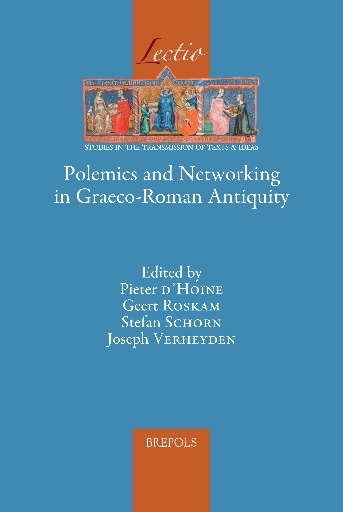
Polemics and Networking in Graeco-Roman Antiquity
show More to view fulltext, buy and share links for:Polemics and Networking in Graeco-Roman Antiquity show Less to hide fulltext, buy and share links for: Polemics and Networking in Graeco-Roman AntiquityDisagreement, rivalry and dispute are essential to any intellectual development. This holds true for ancient cultures no less than for us today. From the classical period to the Hellenistic age and to Late Antiquity, competition and polemics have shaped the course of intellectual history in Antiquity. Polemical encounters and controversies are often linked to group identities and intellectual networks such as philosophical schools, textual traditions, artistic circles and religious communities. This collection of studies sprang from the ambition to study the interplay between polemics and intellectual networks from a variety of perspectives and disciplines.
The volume gathers fifteen case studies by leading scholars and young researchers alike. They address a wide range of topics, from the Old Academy and the Hellenistic schools to the Neoplatonic commentators of Late Antiquity, from biographical literature to literary criticism, from artistic manuals to scientific treatises, and from pagans to Christians. As multi-sided as the picture that emerges from these case studies may be, they all testify to the fact that implicit and explicit polemics are ubiquitous in ancient Greek and Roman literature and have served as triggers of intellectual progress across times and disciplinary boundaries.
-