


BOB2022MIOT

Collection Contents
21 - 34 of 34 results
-
-
Hieronymus Romanus
show More to view fulltext, buy and share links for:Hieronymus Romanus show Less to hide fulltext, buy and share links for: Hieronymus RomanusRome, be it as a concrete space or as a concept and idea, occupies an outstanding place in the thoughts and actions of Jerome of Stridon (c. 347-419). Glowing propagandist of the ideal of asceticism in the Latin sphere and highly influential scholar of the Bible, he received his philological education here as well as his baptism. Beyond this background of study and adherence to the church of Rome, the Vrbs continued to hold a key position for him, who under the pontificate of Damasus established himself as a mediator between East and West and translator of Scripture. A sharp-tongued and increasingly controversial figure at the same time, Jerome subsequently turned into the target of antiascetic criticism and, once bereft of papal protection, had to leave Rome for good. However, even in distant Palestine, the city on the Tiber and its memories remained present in the writings of Jerome, who did not stop using a Roman network in order to have his works circulate within the Vrbs and eventually lamented its fall as that of “the entire world in a city”.
From multifaceted perspectives - historical, philological, theological, exegetical and archaeological - the papers collected in this volume explore Rome’s unique and exemplary meaning for Jerome’s life and works. In the juxtaposition of both lieux de mémoire, the father of the Church and the Vrbs, this reciprocal thematic cut illuminates additional aspects of a Roma Christiana as imagined by Jerome, and of the Stridonian himself as both key figurations of Late Antiquity.
-
-
-
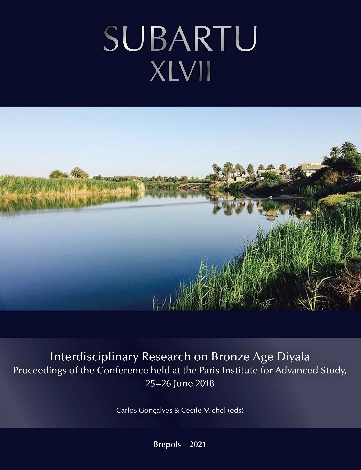
Interdisciplinary Research on the Bronze Age Diyala
show More to view fulltext, buy and share links for:Interdisciplinary Research on the Bronze Age Diyala show Less to hide fulltext, buy and share links for: Interdisciplinary Research on the Bronze Age DiyalaThe Diyala region in eastern Iraq has long been a focal area of study for scholars of the Bronze Age, thanks both to its long history of human occupation, and its position as a site of strategic importance. Drawing on this strong tradition of scholarship and the results of numerous excavations and collections in the area, the seven contributions gathered in this volume aim to offer new insights into the cultures and societies of the Bronze Age Diyala by proposing new questions, problems, and approaches. Exploring subjects as widespread as architecture and iconography, cultural and economic history, the study of social networks, historiography, and the identification of ancient cities, these chapters explore the richness of the Bronze Age Diyala from a range of perspectives, and together offer important new insights into our understanding of the area.
-
-
-
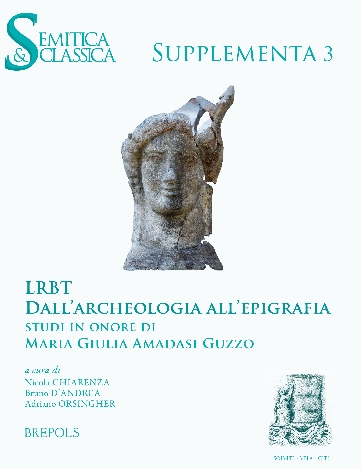
LRBT. Dall’archeologia all’epigrafia / De l'archéologie à l'épigraphie
show More to view fulltext, buy and share links for:LRBT. Dall’archeologia all’epigrafia / De l'archéologie à l'épigraphie show Less to hide fulltext, buy and share links for: LRBT. Dall’archeologia all’epigrafia / De l'archéologie à l'épigraphieThis volume intends to pay tribute to Professor Maria Giulia Amadasi Guzzo, who is one of the leading experts in Semitic epigraphy and North-West Semitic philology. This Festschrift mirrors her multifaceted intellectual interests by gathering together eighteen original contributions of students, friends and colleagues. Although with a focus mainly on the Phoenician-Punic Mediterranean of the 1st millennium bc, this volume also addresses other neighbouring regions and extends up to the Roman imperial period. In doing so, it encompasses the publication of new inscriptions and epigraphic corpora, provides a fresh look at remarkable finds, groups of artefacts and specific sites, but also shows a variety of new approaches and issues in historical and religious studies.
-
-
-
Le voyage d’Europe au fil des siècles / Europa’s Journey through the Ages
show More to view fulltext, buy and share links for:Le voyage d’Europe au fil des siècles / Europa’s Journey through the Ages show Less to hide fulltext, buy and share links for: Le voyage d’Europe au fil des siècles / Europa’s Journey through the AgesThe myth of Europa, first attested in the eighth century bce in Homeric Poems and Hesiod’s Theogony, shapes new visions, figures and images in European literary productions as well as in artistic circles from Graeco-Roman antiquity to the present day. It is an enigmatic journey whose true beginnings cannot be determined and whose end is probably still far off. The centre of attention in this volume is Europa, Phoenician princess, and not Europe, geopolitical idea. With a multidisciplinary and diachronic view, this book explores different facets of the reception of the myth. The contributors offer reflections on the characterization of the mythical figure of Europa, for the archaic and classical periods, and on the reworking of the myth in the Hellenistic and humanistic period. The investigation extends to the study of the persistence of the myth of Europa in the art and literature of modern and contemporary times.
-
-
-
Livius noster
show More to view fulltext, buy and share links for:Livius noster show Less to hide fulltext, buy and share links for: Livius nosterThis book stems from a conference on Livy held at the University of Padua, on the occasion of the bimillenary of the historian’s death (6-10 November 2017). The aim of the volume is to shed new light on lesser-known aspects of Livy’s historiography, by approaching his work from a broad and interdisciplinary perspective. The papers, written by established scholars as well as by younger researchers, span from classical philology to ancient history and archaeology, also incorporating an in-depth investigation of Livy’s reception through the centuries (from the Middle Ages to the Modern Era) and different fields of the humanities (philosophy, political thought, figurative arts).
-
-
-
Means of Christian Conversion in Late Antiquity
show More to view fulltext, buy and share links for:Means of Christian Conversion in Late Antiquity show Less to hide fulltext, buy and share links for: Means of Christian Conversion in Late AntiquityThis volume presents the proceedings of the conference Materiality and Conversion: The Role of Material and Visual Cultures in the Christianization of the Latin West organized by the Centre for Early Medieval Studies in 2020. Its contributions thus focus on the Christianization of the Roman Empire between the fourth and sixth centuries. The studies examine the religious change through the “material turn” approach, building on the material and sensorial dimension of Christian conversion and especially the baptismal rite as one of the key components of the process. The material and visual cultures are regarded as vectors and witnesses of conversion to Christianity, while human body is viewed as one of the agents in ritual actions. The volume covers a wide range of topics, including the prebaptismal purification, the moment of immersion in the baptismal font, the postbaptismal alteration of perception, as well as the continuous changes in funeral forms. As such, the papers attempt to shed more light on the role of materiality in the complex and rapid conversion to Christianity in Late Antique West.
-
-
-
Orthodox Christianity and Modern Science
show More to view fulltext, buy and share links for:Orthodox Christianity and Modern Science show Less to hide fulltext, buy and share links for: Orthodox Christianity and Modern ScienceOrthodox Christian theology is based on a living tradition that is deeply rooted in Greek Patristic thought. However, few systematic proposals about how this theology can respond to questions that arise from modern science have yet appeared. This volume, consisting of eleven essays by different authors about how this response should be formulated, therefore represents a significant contribution to Orthodox thinking as well as to the broader science-theology dialogue among Christians. The variety of approaches in the essays indicates that there does not yet exist among Orthodox a consensus about the methodology that is appropriate to this dialogue or about how the questions that arise from specific scientific insights should be answered. Nevertheless, they indicate the ways in which Orthodox approaches to science differ significantly from most of those to be found among Western Christian scholars, and in this way they point to an underlying unity of perspective that is rooted in the Orthodox Tradition.
-
-
-
Polemics and Networking in Graeco-Roman Antiquity
show More to view fulltext, buy and share links for:Polemics and Networking in Graeco-Roman Antiquity show Less to hide fulltext, buy and share links for: Polemics and Networking in Graeco-Roman AntiquityDisagreement, rivalry and dispute are essential to any intellectual development. This holds true for ancient cultures no less than for us today. From the classical period to the Hellenistic age and to Late Antiquity, competition and polemics have shaped the course of intellectual history in Antiquity. Polemical encounters and controversies are often linked to group identities and intellectual networks such as philosophical schools, textual traditions, artistic circles and religious communities. This collection of studies sprang from the ambition to study the interplay between polemics and intellectual networks from a variety of perspectives and disciplines.
The volume gathers fifteen case studies by leading scholars and young researchers alike. They address a wide range of topics, from the Old Academy and the Hellenistic schools to the Neoplatonic commentators of Late Antiquity, from biographical literature to literary criticism, from artistic manuals to scientific treatises, and from pagans to Christians. As multi-sided as the picture that emerges from these case studies may be, they all testify to the fact that implicit and explicit polemics are ubiquitous in ancient Greek and Roman literature and have served as triggers of intellectual progress across times and disciplinary boundaries.
-
-
-
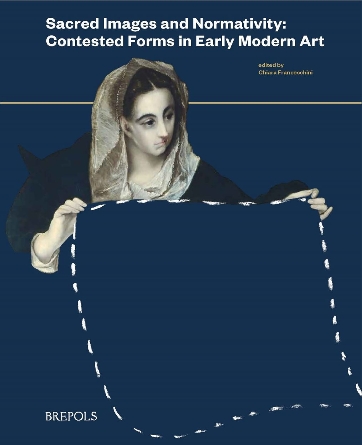
Sacred Images and Normativity: Contested Forms in Early Modern Art
show More to view fulltext, buy and share links for:Sacred Images and Normativity: Contested Forms in Early Modern Art show Less to hide fulltext, buy and share links for: Sacred Images and Normativity: Contested Forms in Early Modern ArtEarly modern objects, images and artworks often served as nodes of discussion and contestation. If images were sometimes contested by external and often competing agencies (religious and secular authorities, image theoreticians, inquisitions, or single individuals), artists and objects were often just as likely to impose their own rules and standards through the continuation or contestation of established visual traditions, styles, iconographies, materialities, reproductions and reframings.
Centering on the capacity of the image as agent - either in actual legal processes or, more generally, in the creation of new visual standards - this volume provides a first exploration of image normativity by means of a series of case studies that focus in different ways on the intersections between the limits of the sacred image and the power of art between 1450 and 1650.
The fourteen contributors to this volume discuss the status of images and objects in trials; contested portraits, objects and iconographies; the limits to representations of ering; the tensions between theology and art; and the significance of copies and adaptations that establish as well as contest visual norms from Europe and beyond.
-
-
-
Studies in Theodore Anagnostes
show More to view fulltext, buy and share links for:Studies in Theodore Anagnostes show Less to hide fulltext, buy and share links for: Studies in Theodore AnagnostesIn spite of its importance, Theodore Anagnostes’ Church History has attracted only little scholarly attention so far. To a large extent, we still rely on the assertions of philologists and historians from around the turn of the 19th to the 20th centuries, and the authoritative edition of the text is still the one published by C. G. Hansen in 1971, which for the most part remained unchanged in its 1995 reissue. The studies collected in this volume aim to fill this gap in the literature and to answer three main questions: (1) How can Theodore’s working method and the aim of his work be reconstructed? (2) To what extent can the Church History be considered a reliable historical source? And (3) which impact did the work have on contemporary and later historiography? In close connection with the bilingual (Greek-English) edition of the Church History that was recently published, the present volume thus aims to provide a closer and more differentiated appraisal of Theodore Anagnostes and his historiographical project.
-
-
-

The Discoveries of Manuscripts from Late Antiquity
show More to view fulltext, buy and share links for:The Discoveries of Manuscripts from Late Antiquity show Less to hide fulltext, buy and share links for: The Discoveries of Manuscripts from Late AntiquityThis book offers an anthology from the proceedings of the Second International Conference on Patristic Studies, “The Discoveries of Manuscripts from Late Antiquity: Their Impact on Patristic Studies and the Contemporary World”, which took place in San Juan, Argentina, in March 2017. The aim of this event was to analyze and assess 20th- and 21st-century discoveries of manuscripts from Late Antiquity. Indeed, complete libraries of manuscripts, as well as individual documents of great importance for our understanding of historical authors and situations, have come to light after having been buried for millennia. Just some examples are the incredible discoveries of the Nag Hammadi Gnostic library, the Dead Sea Scrolls, Origen of Alexandria’s homilies, and Augustine’s sermons, among others. Rather than being passive documents, these manuscripts pose numerous questions to specialists from a diverse array of fields, demanding new evaluations of a past that was already thought to be understood and judged.
-
-
-
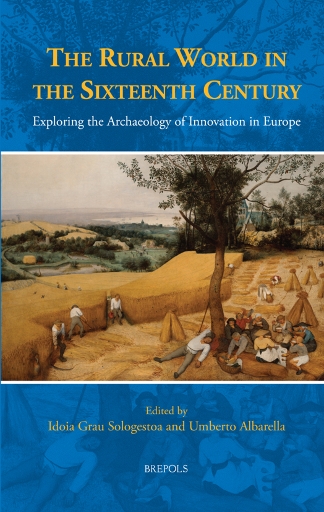
The Rural World in the Sixteenth Century
show More to view fulltext, buy and share links for:The Rural World in the Sixteenth Century show Less to hide fulltext, buy and share links for: The Rural World in the Sixteenth CenturyThe sixteenth century in Europe was a time of profound change, the threshold between the ‘medieval’ and the ‘modern’, as new technologies were introduced, distant lands explored, oceanic trade routes opened, and innovative ideas pursued in fields as varied as politics, science, philosophy, law, and religion. But sweeping transformations also occurred in the rural world, profoundly altering the countryside in both appearance and practices. Crucially for historians, there is abundant documentary evidence for these changes but, while they are less well-documented, their impact can also be traced archaeologically.
This cutting-edge volume is the first to explore the archaeology of the rural world across the ‘long’ sixteenth century and to investigate the changing innovations that were seen in landscape, technology, agriculture, and husbandry during this period. Drawing together contributions from across Europe, and from a range of archaeological disciplines, including zooarchaeology, archaeobotany, landscape archaeology, material culture studies, and technology, this collection of essays sheds new light on a key period of innovation that was a significant precursor to modern economies and societies.
-
-
-

Theatres of Belief: Music and Conversion in the Early Modern City
show More to view fulltext, buy and share links for:Theatres of Belief: Music and Conversion in the Early Modern City show Less to hide fulltext, buy and share links for: Theatres of Belief: Music and Conversion in the Early Modern CityThese eleven essays, all centrally concerned with the intimate relationship between sound, religion, and society in the early modern world, present a sequence of test cases located in a wide variety of urban environments in Europe and the Americas. Written by an international cast of acclaimed historians and musicologists, they explore in depth the interrelated notions of conversion and confessionalisation in the shared belief that the early modern city was neither socially static nor religiously uniform. With its examples drawn from the Holy Roman Empire and the Southern Netherlands, the pluri-religious Mediterranean, and the colonial Americas both North and South, this book takes discussion of the urban soundscape, so often discussed in purely traditional terms of European institutional histories, to a new level of engagement with the concept of a totally immersive acoustic environment as conceptualised by R. Murray Schafer. From the Protestants of Douai, a bastion of the Catholic Reformation, to the bi-confessional city of Augsburg and seventeenth-century Farmington in Connecticut, where the indigenous Indian population fashioned a separate Christian entity, the intertwined religious, musical, and emotional lives of specifically grounded communities of early modern men and women are here vividly brought to life.
-
-
-
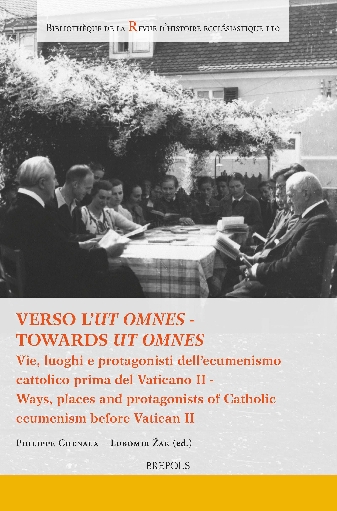
Verso l' Ut Omnes - Towards Ut Omnes
show More to view fulltext, buy and share links for:Verso l' Ut Omnes - Towards Ut Omnes show Less to hide fulltext, buy and share links for: Verso l' Ut Omnes - Towards Ut OmnesThe studies collected in this volume highlight the rising of an ecumenical consciousness within the Catholic Church in the early twentieth century. The Catholic paths, suggested in view of the hoped-for Christian unity before the Second Vatican Council, were different but complementary: the path of prayer and liturgy, that of theological refl ection, that of fraternal witness and that of martyrdom. The text offers valuable contributions on all these paths, written by specialists in the history of ecumenism.
-