


BOB2022MOME

Collection Contents
5 results
-
-
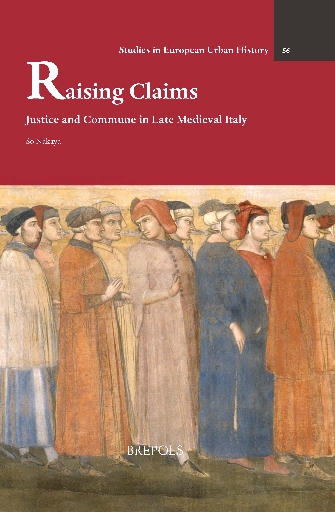
Raising Claims
show More to view fulltext, buy and share links for:Raising Claims show Less to hide fulltext, buy and share links for: Raising ClaimsCeccholo, making a claim against Nello for the payment of unpaid land rent. Jacopo, Giovanni and Turi, appealing for an exemption from tax. The long queue of claimants that formed in front of the communal palace was an everyday scene in fourteenth century Lucca. What is remarkable is the enormous ubiquity of such claims. In this Tuscan city of only twenty thousand people, an average of ten thousand claims were filed at the civil court each year. Why did local residents submit claims to the commune in such numbers? And what effect did this daily accumulation have on the development of the commune?
In the fourteenth century, Italian communes, the established public authorities that governed the populace, underwent a shift toward becoming oligarchic regimes. The communes’ character as a form of government in which power was held ‘in common’ by ‘the public’ seemed be on the verge of disappearing. At this time, political leaders and judicial magistrates began to rely on their own discretion when rendering their decisions, a practice that was recognized as legitimate even when such decisions deviated from positive law. By the beginning of the fifteenth century, this shift in the underlying logic of the legitimacy of rulings became entrenched in the jural and political character of the commune, portending the advent of the modern era. Based on the archival records from law courts and councils, this book elucidates the process of the emergence and shaping of a new form of justice and the transformation of the commune by focusing on everyday practices that unfolded in the spheres of civil and criminal justice by inhabitants who raised claims and the governors who heard them.
-
-
-
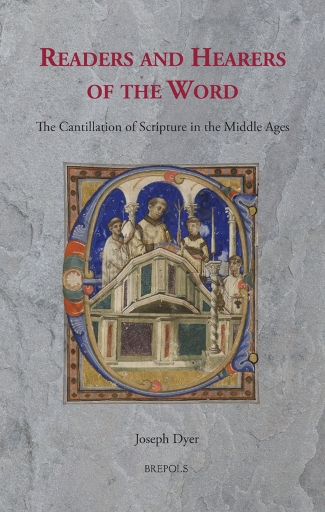
Readers and Hearers of the Word
show More to view fulltext, buy and share links for:Readers and Hearers of the Word show Less to hide fulltext, buy and share links for: Readers and Hearers of the WordReaders and Hearers is a broad, multi-disciplinary treatment of the chanting of the Scriptures (epistle and gospel) at Mass in the Middle Ages. This form of chanting followed a procedure that continued to be used in the western Latin liturgy until the mid-twentieth century and in the traditional Latin Mass today. The readings were not simply spoken, but chanted to formulae that stood halfway between heightened speech and song (cantillation). Specific clerics (lectors, subdeacons, deacons), distinctively vested, were commissioned to chant the Scriptures, employing a ritual that came to be surrounded by an elaborate ceremonial. For the gospel this involved acolytes, processional movement, and the employment of ecclesiastical ‘furniture’ (pulpit, ambo, and choir screen).
While the laity attending Mass could generally see all of the ritual actions, what did they understand of the Latin text they were hearing? In areas where Latin was spoken in Antiquity the ability to comprehend Latin passively as it morphed into the Romance vernaculars survived longer than generally assumed. Naturally, in Germanic lands, christianized in the early Middle Ages, that capability never existed. Several manuals were created to guide layfolk to engage in devotions suitable to the various parts of the Mass. How all of these elements - ceremony and devotional aids - united ‘readers’ with ‘hearers’ at Mass is the theme of the present volume, which also covers Martin Luther’s guidelines for the chanting of the Scriptures in German.
-
-
-
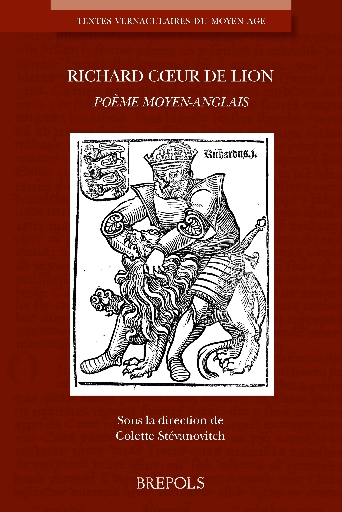
Richard Cœur de Lion
show More to view fulltext, buy and share links for:Richard Cœur de Lion show Less to hide fulltext, buy and share links for: Richard Cœur de LionCe poème moyen-anglais relate les exploits du roi Richard Coeur de Lion lors de la troisième croisade. Il occupe une place à part dans le corpus des romans moyen-anglais du fait que son héros est un roi anglais et que les événements racontés sont historiques. Cependant, au fil des réécritures, la vérité historique est progressivement déformée et le roi Richard devient un héros de roman. Sous sa forme définitive ce texte se singularise par la présence d’éléments macabres et en particulier de scènes de cannibalisme. Très célèbre de son temps, encore édité au xvi e siècle, le poème est redécouvert au xix e siècle et notamment exploité par Walter Scott.
Ce volume présente, à côté du texte moyen-anglais dans l’édition de Larkin (2015), la première traduction française du poème. Les notes et l’introduction attachent une importance toute particulière à l’étude des sources et à l’élaboration du texte version après version.
-
-
-
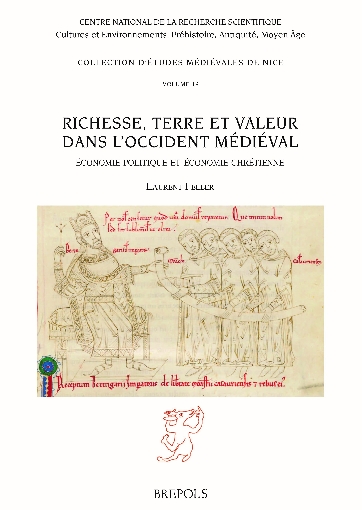
Richesse, terre et valeur dans l'occident médiéval
show More to view fulltext, buy and share links for:Richesse, terre et valeur dans l'occident médiéval show Less to hide fulltext, buy and share links for: Richesse, terre et valeur dans l'occident médiévalQuelles sont les conséquences de l’encastrement de l’économique dans le social ? Posée dès les années 1940 par Karl Polanyi à propos des sociétés qui se situent de l’autre côté du « grand partage », cette question est déterminante pour comprendre les conditions autant culturelles que matérielles du développement au sein de l’Occident médiéval. Sans renoncer à un certain nombre d’interrogations de l’économie politique, l’ouvrage de Laurent Feller intègre les méthodes et les résultats des sciences sociales afin de parvenir à une description du réel qui rend compte de l’action des hommes sur les choses et de ce que font les agents, dans la société chrétienne du Moyen Âge, lorsqu’ils produisent, échangent et consomment. Il s’intéresse notamment à l’attitude des élites à l’égard de la terre, à la fois outil de production et vecteur de prestige, aux instruments cognitifs des moines, des évêques et des aristocrates laïcs qui manipulent les richesses, aux modes d’évaluation et aux façons de solder les échanges.
-
-
-
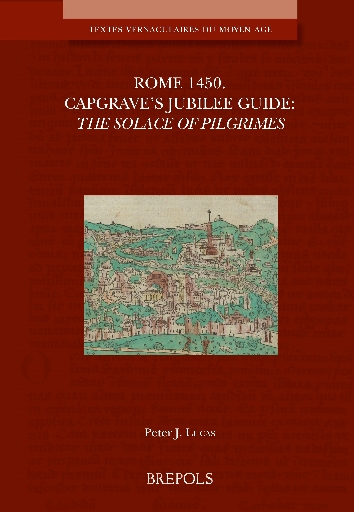
Rome 1450. Capgrave's Jubilee Guide
show More to view fulltext, buy and share links for:Rome 1450. Capgrave's Jubilee Guide show Less to hide fulltext, buy and share links for: Rome 1450. Capgrave's Jubilee GuideThe scene is Rome in the fi fteenth century, Golden Rome, a magnet drawing pilgrims by its architectural attractions and the magnitude of its religious importance as the mother of faith. The Austin friar John Capgrave attended Rome for the Jubilee in 1450, including the Lenten stations, and his Solace of Pilgrimes, intended as a guide for subsequent pilgrims, was written up following the author’s own pilgrimage. In three parts it covers the ancient monuments, the seven principal churches and the Lenten stations, and other churches of note, especially those dedicated to the Blessed Virgin Mary. The work has been described as the most ambitious description of Rome in Middle English. The present edition offers a new Text based on a transcription of the author’s holograph manuscript. Parallel with the Text there is a modern English Translation. The illustrations, mostly from a period slightly later than the 1450 Jubilee, aim to give some visual clue as to what Capgrave saw. There is a full account of the multiple sources that he used, most of which is the product of new research. Following the Text there is a Commentary that aims to provide some background information about the buildings and monuments that Capgrave focuses on, and to explain and illuminate any diffi culties or points of interest in the Text. Capgrave is an omni-present guide leading us towards what he considered an appropriate interpretation of the classical past as a foundation for the Christian present, which built on it and surpassed it.
-