


Brepols Online Books Medieval Miscellanea Collection 2023 - bob2023mime

Collection Contents
3 results
-
-
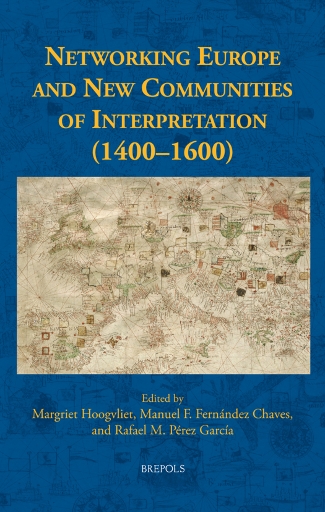
Networking Europe and New Communities of Interpretation (1400–1600)
show More to view fulltext, buy and share links for:Networking Europe and New Communities of Interpretation (1400–1600) show Less to hide fulltext, buy and share links for: Networking Europe and New Communities of Interpretation (1400–1600)Long-distance ties connecting Europeans from all geographical corners of the continent during the fifteenth and sixteenth century facilitated the sharing of religious texts, books, iconography, ideas, and practices. The contributions to this book aim to reconstruct these European networks of knowledge exchange by exploring how religious ideas and strategies of transformation ‘travelled’ and were shared in European and transatlantic cultural spaces. In order to come to a better understanding of Europe-wide processes of religious culture and religious change, the chapters focus on the agency of the laity in ‘new communities of interpretation’, instead of intellectual elites, the aristocracy, and religious institutions. These new communities of interpretation were often formed by an urban laity active in politics, finance, and commerce. The agency of religious literatures in the European vernaculars in processes of religious purification, reform, and innovation during the long fifteenth century is still largely underestimated. ‘Networking Europe’ aims to step away from studying ‘national’ textual production and consumption by approaching these topics instead from a European and interconnected perspective. The contributions to this book explore late medieval and early modern networks connecting people and transporting texts following three main axes of investigation: ‘European Connections’, ‘Exiles, Diasporas, and Migrants’, and ‘Mobility and Dissemination’.
-
-
-
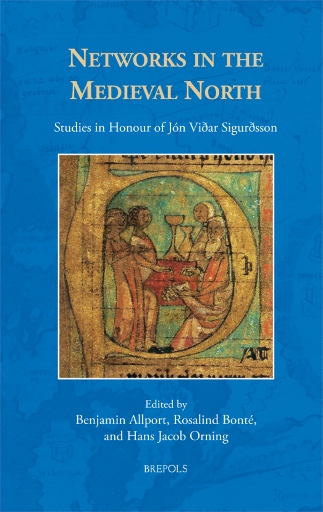
Networks in the Medieval North
show More to view fulltext, buy and share links for:Networks in the Medieval North show Less to hide fulltext, buy and share links for: Networks in the Medieval NorthBy the late thirteenth century, Norgesveldet - the Norwegian realm - stretched far beyond its core in western Scandinavia. At its height in 1264, Norgesveldet connected Norse speakers in tributary territories ranging from the Irish Sea to Orkney and across the Atlantic to the Faroes, Iceland, and Greenland. But what held this disparate realm together? What were the dynamics of power between the men and women of the governing and elite classes of Norgesveldet? And what roles did different bodies play at different levels of society in creating and maintaining these networks - from kings and bishops to scribes and scholars, traders, and law-makers?
This volume aims to expand on and further recent important research into connections between Norway and the wider Norse North Atlantic from the eleventh century, during which the Norwegian kingdom began to emerge, through to the fourteenth-century decline of Norgesveldet with the creation of the Kalmar Union. Each chapter addresses a different facet of the Norgesveldet networks, building a complex picture of both their function and their evolving nature. Taking as its inspiration the research and career of its honorand, Jón Viðar Sigurðsson, the volume explores medieval Norway and its wider connections using three key frameworks - sociopolitical networks, legal and material networks, and literary networks - with the aim of shedding new light on the people and processes of this North Atlantic polity.
-
-
-
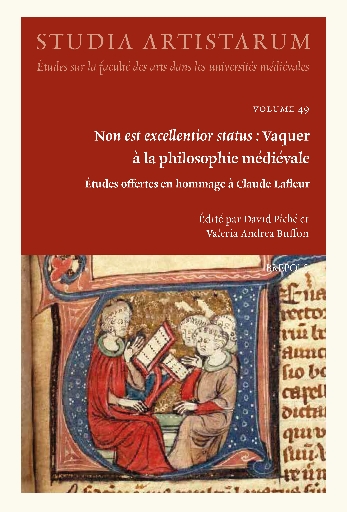
Non est excellentior status : Vaquer à la philosophie médiévale
show More to view fulltext, buy and share links for:Non est excellentior status : Vaquer à la philosophie médiévale show Less to hide fulltext, buy and share links for: Non est excellentior status : Vaquer à la philosophie médiévaleCe volume regroupe les contributions de vingt-deux chercheur.es universitaires, collègues et ami.es de Claude Lafleur, qui ont voulu lui rendre hommage à l’occasion de son départ à la retraite en tant que professeur titulaire à la Faculté de philosophie de l’Université Laval. La diversité des aires géographiques et la pluralité des strates générationnelles auxquelles appartiennent les chercheur.es qui ont contribué à ce livre témoignent éloquemment de l’envergure de la « sphère d’influence » des productions intellectuelles de Claude Lafleur.
Les textes réunis relèvent des principaux champs de recherche que leur ami et mentor a patiemment labourés au cours de sa carrière académique : histoire des corpus et des manuscrits; transmission des textes philosophiques et de leurs notions fondamentales, de l’Antiquité au Moyen Âge; éditions critiques de textes issus des Facultés des arts et de théologie de l’Université de Paris aux xiiie-xive siècles; enseignement de la philosophie au xiiie siècle à la lumière des textes didascaliques; histoire des pratiques discursives dans les Facultés des arts médiévales; étude de concepts clés de la pensée de Thomas d’Aquin; discussion médiévale sur les universaux; philosophie de l’histoire des médiévistes contemporains.
Ce recueil d’études souhaite ainsi se faire le reflet de certains des intérêts heuristiques, des orientations méthodologiques et des thématiques historico-philosophiques que Claude Lafleur a poursuivis, explorées et étudiées dans ses propres écrits, ayant toujours été convaincu « qu’il n’y a pas de statut plus excellent que de vaquer à la philosophie ».
-