


Brepols Online Books Medieval Miscellanea Collection 2024 - bob2024mime

Collection Contents
8 results
-
-
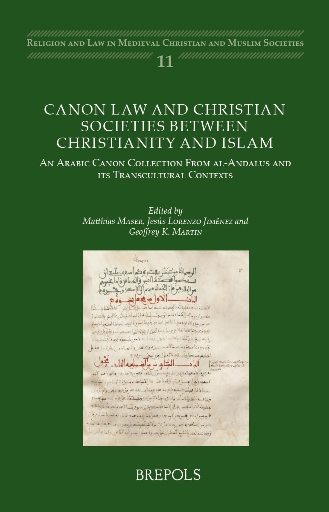
Canon Law and Christian Societies between Christianity and Islam
show More to view fulltext, buy and share links for:Canon Law and Christian Societies between Christianity and Islam show Less to hide fulltext, buy and share links for: Canon Law and Christian Societies between Christianity and IslamThe unique Arabic version of the Iberian canon law code 'Collectio Hispana', preserved in a mid-eleventh-century manuscript of the Royal Library of El Escorial, has been deemed “the most distinguished and characteristic” work of medieval Andalusi Christian writing. It represents an exceptional source witness to the internal legal organisation of Christian communities in Muslim-dominated al-Andalus as well as to their acculturation to Islamicate environments. Yet, the Arabic collection has received only little scholarly attention so far. This volume presents the results of a recent interdisciplinary research project on the Arabic canon law manuscript, flanked by contributions from neigbouring fields of research that allow for a comparative assessment of the substantial new findings. The individual chapters in this volume address issues such as the origins of the Arabic law code and its sole transmitting manuscript, its language and translation strategies, its source value for both the persistence and transformation of ecclesiastical institutions after the Muslim conquest, or the law code's position in the judicial practice of al-Andalus. The volume brings together the scholarly expertise of distinguished specialists in a broad range of disciplines, e.g. history, Arabic and Latin philology, medieval palaeography and codicology, archaeology, coptology, theology and history of law.
-
-
-
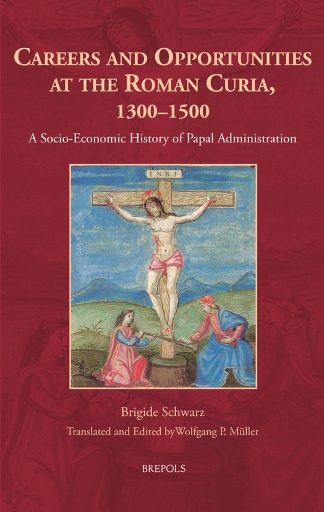
Careers and Opportunities at the Roman Curia, 1300–1500
show More to view fulltext, buy and share links for:Careers and Opportunities at the Roman Curia, 1300–1500 show Less to hide fulltext, buy and share links for: Careers and Opportunities at the Roman Curia, 1300–1500Brigide Schwarz (1940–2019), a leading German historian of the Renaissance papacy, is presented here for the first time in a dossier of ten previously untranslated scholarly studies.
The volume brings the mechanisms of late medieval career building back to life. Success among churchmen was measured in access to ever more lucrative ecclesiastical endowments (or benefices). As the fifteenth century progressed, their treatment assumed highly monetized and abstract dimensions. Guided by Dr Schwarz, economic historians can discern many transactions that foreshadow the asset management of present-day Wall Street.
From the 1400s, administrative positions at the papal court (or Curia) were increasingly auctioned off. This created a marketplace for bidders expecting returns by way of ‘creative’ fee regulations or through the cornering of services in monopolies.
Only recently, scholarship has begun to question older depictions of the late medieval Church as one of decay and moral corruption. Dr Schwarz points to the ‘modernity’ of the fiscal arrangements which nation states like France soon copied as an efficient model of public financing.
-
-
-
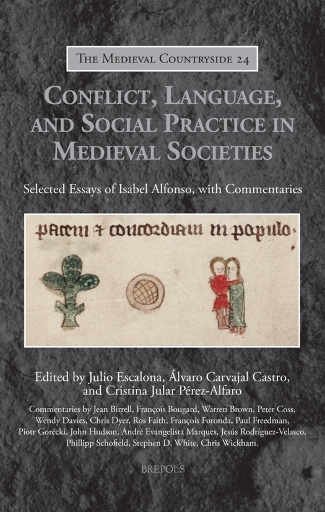
Conflict, Language, and Social Practice in Medieval Societies
show More to view fulltext, buy and share links for:Conflict, Language, and Social Practice in Medieval Societies show Less to hide fulltext, buy and share links for: Conflict, Language, and Social Practice in Medieval SocietiesIsabel Alfonso is one of the finest scholars on the rural and political history of the European Middle Ages. She is widely known for her contributions to the study of the peasantry, social conflict, and political discourses. Her research has transcended the boundaries of medieval studies, incorporating insights from disciplines beyond including legal anthropology, philology, and discourse analysis, among others. Over her academic career Isabel Alfonso has made a continued effort to make the work of international scholars known in Spain and to communicate advancements in Spanish historiography to international audiences; and yet most of her own research has only been published in Spanish. As a means to acknowledge her long-standing commitment to bridge different historiographies and overcome national boundaries, this unusual Festschrift offers a selection of her most relevant publications, many of which appear in English for the very first time. Each paper is preceded by commentaries by leading scholars that discuss the enduring relevance of Isabel Alfonso’s work, its richness and complexity, and its potential to inspire further research along a vast array of lines.
Commentaries by Jean Birrell, François Bougard, Warren Brown, Peter Coss, Wendy Davies, Chris Dyer, Ros Faith, François Foronda, Paul Freedman, Piotr Gorécki, John Hudson, André Evangelista Marques, Jesús Rodríguez-Velasco, Phillipp Schofield, Stephen D. White, Chris Wickham.
-
-
-
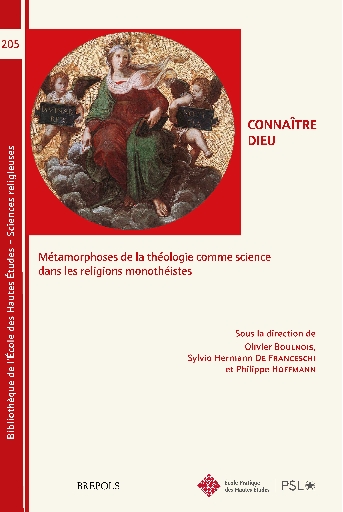
Connaître Dieu
show More to view fulltext, buy and share links for:Connaître Dieu show Less to hide fulltext, buy and share links for: Connaître DieuLa théologie est née comme science métaphysique. Dès Aristote, la science la plus haute se présente comme une discipline philosophique qu’il appelle épistémè théologikè, « science théologique ». Ce que nous appelons aujourd’hui « métaphysique », c’est ce que les traductions latines d’Aristote appellent scientia divina, « science divine ». Or cette « science divine » aristotélicienne ne porte pas sur les dieux de la religion. Aristote emploie d’ailleurs un terme tout à fait différent pour désigner le discours mythique et religieux sur les dieux : il parle alors de theologia ; la theologia est une autre sorte de discours, celui des mythologies sur les dieux, tandis que la « science divine » du philosophe porte sur une substance première, séparée du monde sensible et principe de son mouvement, soit le premier moteur. Ce principe n’opère aucun salut. Il ne faut donc pas confondre le discours scientifique (la « science théologique » ou « science divine », sur le premier moteur) et le discours religieux. La difficulté est alors de comprendre quand, comment et pourquoi cette discipline philosophique suprême, la science théologique, s’est orientée vers les religions vécues par les hommes. Quand le mur séparant la theologia de la « science théologique » a-t-il été abattu ? Le présent volume s’est donné pour visée de se confronter à la nécessité d’une prise en compte, non seulement du fait religieux, mais aussi de la rationalité religieuse. Le terme « théologie » est ambigu. Il désigne tantôt la compréhension d’une religion par elle-même, tantôt la compréhension du divin par un discours rationnel. C’est pourquoi une étude comparée de la théologie comme science dans les monothéismes a un double objet : il s’agit d’abord d’étudier comment la spéculation métaphysique sur les dieux, le divin et Dieu s’est transformée en « science théologique » ; il convient ensuite de montrer comment les religions monothéistes se sont construites en théologies sur les canons de la rationalité grecque.
-
-
-
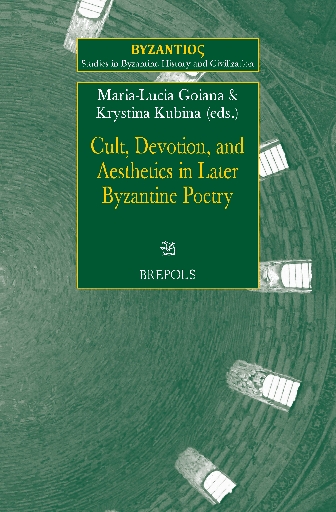
Cult, Devotion, and Aesthetics in Later Byzantine Poetry
show More to view fulltext, buy and share links for:Cult, Devotion, and Aesthetics in Later Byzantine Poetry show Less to hide fulltext, buy and share links for: Cult, Devotion, and Aesthetics in Later Byzantine PoetryPublic religious ritual and private devotional practice together occasioned much of the production of Byzantine poetry. This includes not only hymns, an integral part of the liturgy since Late Antiquity, but also versified texts with a specific liturgical function (synaxaria, calendars, metrical prefaces), metrical hagiography, epigrams (inscribed on church buildings, icons, religious objects, books), or poems with a more personal character, such as versified prayers, catanyctic poems (i.e., poems of contrition) and self-addressed poems (eis heauton). These texts often have much in common, well beyond their metrical form: from their contexts of performance and reception to the themes, literary motifs, and rhetorical devices they contain. It was not uncommon for a single author to write in a variety of the aforementioned genres; and yet these texts are rarely studied together (not least due to the specialized nature of the expertise of individual scholars). Later Byzantium offers us a particularly rich spectrum of sacred poetry, which has only recently started to arouse significant interest. While most of its poetic genres have a long history in Byzantine literature, their metamorphoses in this period – connected to changes in socio-political, cultural and religious conditions – deserve closer study. It is the purpose of this volume to propose a broader scholarly approach to the aesthetics of Byzantine poetry, taking into consideration the contexts of religious practice and devotion from c. the 11th to the 15th centuries.
-
-
-

The Cult of Saints and Legitimization of Elite Power in East Central and Northern Europe up to 1300
show More to view fulltext, buy and share links for:The Cult of Saints and Legitimization of Elite Power in East Central and Northern Europe up to 1300 show Less to hide fulltext, buy and share links for: The Cult of Saints and Legitimization of Elite Power in East Central and Northern Europe up to 1300While Northern and East Central Europe are often considered to have been peripheral parts of medieval Latin Christendom, they nevertheless embraced many of the same cultural impulses found in more central areas. Key among these was the way in which social elites, in the first centuries after the introduction of Christianity, recognized the potential to exploit the cult of saints as a way of legitimizing their own social standing. Taking this thematic focus as its starting point, this volume explores the intersection of religion, power, and the reception and development of new impulses from abroad within Northern and East Central Europe. It does so by comparing and contrasting cults that emerged locally with cults that were imported to the region. Through this comparative overview, the chapters of this volume not only contribute to a more nuanced understanding of these outlying regions, but also shed new light on Latin Christian Europe as a whole.
-
-
-
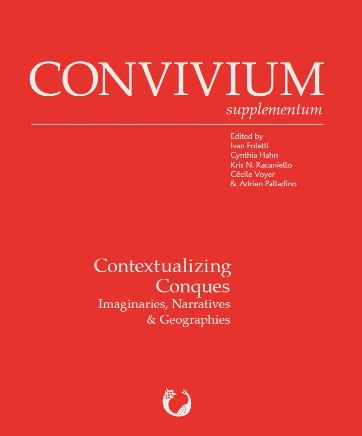
Contextualizing Conques. Imaginaries, Narratives & Geographies
show More to view fulltext, buy and share links for:Contextualizing Conques. Imaginaries, Narratives & Geographies show Less to hide fulltext, buy and share links for: Contextualizing Conques. Imaginaries, Narratives & GeographiesReapproaching Conques from new contexts is the basis of the present volume, a product of the international project “Conques in the Global World. Transferring Knowledge: from Material to Immaterial Heritage” (Marie Skłodowska-Curie Research and Innovation Staff Exchange H2020). Although it is an important location of cultural heritage and has been consequential historiographically and in the formation of art history, there has never been a comprehensive, interdisciplinary approach to this momentous site. Thus, this volume publishes the first results of the interdisciplinary and international project, which were initially presented at a conference and enriched by workshops held in New York City in the summer of 2022. The collected essays open with reflective and historiographic work on Conques in the nineteenth century. These segue into essays reconsidering specific integral elements of extant medieval materials at the site. Finally, the volume concludes with a series of essays devoted to placing Conques in a broader context. The entire volume aims to open to as yet unaddressed questions in scholarship on Conques, with the hope that this work will provide a foundation for future studies.
-
-
-

A Cathedral of Constitutional Law
show More to view fulltext, buy and share links for:A Cathedral of Constitutional Law show Less to hide fulltext, buy and share links for: A Cathedral of Constitutional LawThe Belgian Dominican friar Antoninus Hendrik Thomas published a critical reconstruction of the earliest Constitutions of the Dominican Order. He identified meticulously where Saint Dominic and his first brothers had borrowed material from other religious and secular juridical systems, as well as where they had been original, thus uncovering the foundational charism of the Order. Even today, researchers in the field regard Fr Thomas’s work as indispensable. Unfortunately, many of his insights are difficult to access for a wider audience, since Fr Thomas wrote his work in his native language, Dutch. To mark the eighth centenary of the death of Saint Dominic in 2021, the Belgian Dominican province therefore decided to publish Fr Thomas’s work in an English translation, as well as to complement this with a selection of essays written by contemporary experts, who – from their particular perspectives – engage with Fr Thomas’s main insights. The essays deal with the historiographical tradition to which Fr Thomas belonged, the Premonstratensian, Cistercian and secular sources of the Constitutions, the manuscript tradition and editing process of the earliest Constitutions, and their reception in the first century of the Order and by the late medieval observant movement.
-