


Brepols Online Books Medieval Miscellanea Collection 2024 - bob2024mime

Collection Contents
2 results
-
-

Ibn Gabirol (Avicebron)
show More to view fulltext, buy and share links for:Ibn Gabirol (Avicebron) show Less to hide fulltext, buy and share links for: Ibn Gabirol (Avicebron)One of the most important thinkers of the Middle Ages, the Jewish philosopher Solomon Ibn Gabirol (known in the Latin Middle Ages as ‘Avicebron’) greatly contributed to the history of metaphysics. His most famous work, the Fons vitae, was the source of sophisticated, radical doctrines (like universal hylomorphism and the plurality of substantial forms) that were rigorously debated in the Latin world for centuries.
Breaking a long period of scholarly neglect of his thought, this volume scrutinises Ibn Gabirol’s philosophical contributions by disentangling his original theories from the misconceptions originated by his medieval readers and critics, like Thomas Aquinas and Albert the Great. The first part of the volume expands on the Latin translation of Ibn Gabirol’s philosophical work, the Fons vitae, from which many of these misconceptions seems to have originated. The second part focuses on the sources used by Ibn Gabirol and reconstructs the philosophical framework of his reflections. The final two parts of the volume are dedicated to the influence on Ibn Gabirol’s thought on the Latin and Hebrew traditions, respectively.
Authored by some of the most renowned worldwide experts on Hebrew and Latin philosophy, the cutting-edge contributions included in the volume give a lively picture of a complex yet fascinating medieval philosopher and his unique interpretation of the universe.
-
-
-
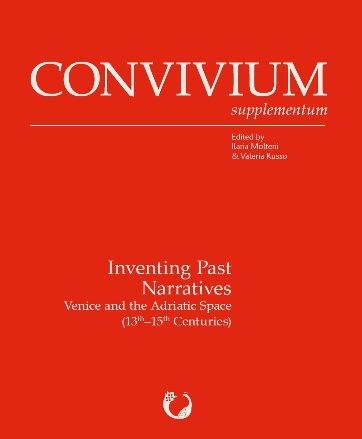
Inventing Past Narratives. Venice and the Adriatic Space (13th–15th Centuries)
show More to view fulltext, buy and share links for:Inventing Past Narratives. Venice and the Adriatic Space (13th–15th Centuries) show Less to hide fulltext, buy and share links for: Inventing Past Narratives. Venice and the Adriatic Space (13th–15th Centuries)During the Middle Ages, new past narratives emerged, but several of these narratives are not based on the archaeological rediscovery of a lost history. On the contrary, in many cases that impression of a unique, grandiose, and ancient past is partly the result of accurate dissimulation. Yet, it would not be exact to consider the myth of Venice as a fiction or, somehow, as a fabricated invention – an apocryphal creation that does not include any historical component. Instead, the myth of Venice has been generated through an intricate operation of composing unconnected pieces, through a process of attributing new meanings to previously unconnected pieces of different histories or objects from other pasts. The result is a patchwork that, through the longue durée, has been articulated around both new and ancient stories, local and foreign myths, reconstructed or rediscovered objects and narratives. By the late Middle Ages Venice becomes the main stage of a national and international myth: while enhancing its historical role in the past, the city demonstrates the legitimacy of its role in the present. In light of such phenomenon, this volume will try to demonstrate that Venetian past narratives bring together heterogeneous materials to achieve a common result: that of celebrating Venice’s triumph and erasing its weaknesses and defeats.
-