


BOB2024MOME

Collection Contents
41 - 45 of 45 results
-
-

Scotland’s Royal Women and European Literary Culture, 1424–1587
show More to view fulltext, buy and share links for:Scotland’s Royal Women and European Literary Culture, 1424–1587 show Less to hide fulltext, buy and share links for: Scotland’s Royal Women and European Literary Culture, 1424–1587Scotland’s Royal Women and European Literary Culture, 1424–1587 seeks to fill a significant gap in the rich and ever-growing body of scholarly work on royal and aristocratic women’s literary culture in the fifteenth and sixteenth centuries. There has, to date, been no book-length study of the literary activities of the female members of any one family across time and little study of Scotland’s royal women in comparison to their European and English counterparts. This book adopts the missing diachronic perspective and examines the wives and daughters of Scotland’s Stewart dynasty and their many and various associations with contemporary Scottish, English, and European literary culture over a period of just over 150 years. It also adopts a timely cross-border and cross-period perspective by taking a trans-national approach to the study of literary history and examining a range of texts and individuals from across the traditional medieval/early modern divide. In exploring the inter-related lives and letters of the women who married into the Scottish royal family from England and Europe — and those daughters who married outwith Scotland into Europe’s royal families — the resultant study consistently looks beyond Scotland’s land and sea borders. In so doing, it moves Scottish literary culture from the periphery to the centre of Europe and demonstrates the constitutive role that Scotland’s royal women played in an essentially shared literary and artistic culture.
-
-
-
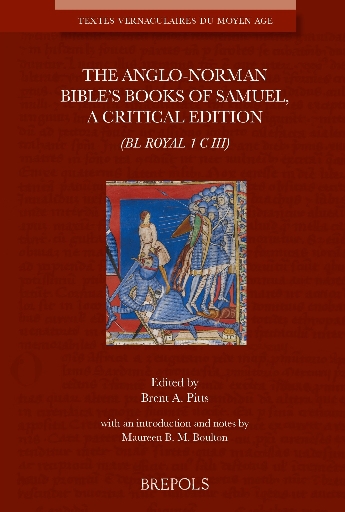
The Anglo-Norman Bible’s Books of Samuel, a Critical Edition
show More to view fulltext, buy and share links for:The Anglo-Norman Bible’s Books of Samuel, a Critical Edition show Less to hide fulltext, buy and share links for: The Anglo-Norman Bible’s Books of Samuel, a Critical EditionTales of treachery and friendship, adultery and murder, rape and revenge, as well as prophecy, repentance, forgiveness and thanksgiving — such is the stuff of the Anglo-Norman Bible’s Books of Samuel. They recount the life of the last of Israel’s judges but include some of the world’s best-known characters — Saul, David and Jonathan, Goliath, Bathsheba, and Absalom.
The first book traces the life of Samuel, and the initial success of King Saul, chosen to satisfy the Israelites’ demand for a king. After Saul loses God’s favour, David enters his court to console him, but Saul envies David’s success. When Saul dies in battle, David succeeds him. In book two, David consolidates control over his kingdom, but his adultery with Bathsheba precipitates the reverses of the final chapters. Historically, the Books of Samuel trace the creation of Israel’s monarchy and explain its ultimate failure. Religiously, they relate Israel’s continuing relationship with God and the establishment of Jerusalem as the religious and political capital of the new kingdom.
Two mid-fourteenth-century manuscripts preserve the text of the Anglo-Norman Bible’s Samuel. The base manuscript (L), British Library Royal 1 C III, notable for its inclusion of multi-lingual glosses, was acquired by Henry VIII from the Benedictine Abbey of Reading in 1530. The lavishly illustrated Paris, Bibliothèque nationale de France, MS français 1 (P), produced in England for the baronial de Welles family, later belonged to King Louis XII of France. Brent A. Pitts has prepared the critical edition and Maureen Boulton’s introduction and notes elucidate the text and its interpretation by medieval commentators.
-
-
-
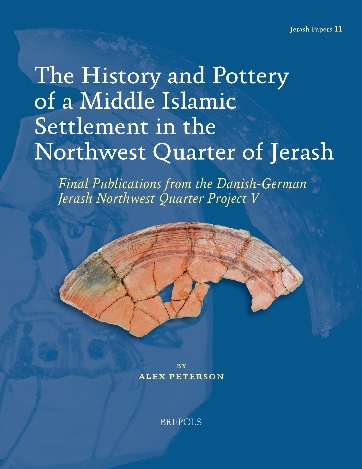
The History and Pottery of a Middle Islamic Settlement in the Northwest Quarter of Jerash
show More to view fulltext, buy and share links for:The History and Pottery of a Middle Islamic Settlement in the Northwest Quarter of Jerash show Less to hide fulltext, buy and share links for: The History and Pottery of a Middle Islamic Settlement in the Northwest Quarter of JerashIn 2015, the Danish-German Northwest Quarter Project working in Jerash uncovered a Middle Islamic farmstead. Subsequent excavations revealed that this settlement, far from marking a decline at the site, is in fact indicative of a broader active and dynamic rural community living within the ancient urban landscape of Jerash.This volume offers an in-depth focus on this Islamic settlement, with a particular focus on the ceramic material yielded by the site, which is here fully quantified and contextually analysed alongside historical sources. Through this approach, the author has reconstructed a new synthesis of Middle Islamic settlement history, shedding new light on the economic and social structures of a rural community in northern Jordan, as well as establishing a typology that can be used to refine the chronologies of Middle Islamic Jerash.
-
-
-
The Life of Count Charles of Flanders and The Life of Lord John, Bishop of Thérouanne
show More to view fulltext, buy and share links for:The Life of Count Charles of Flanders and The Life of Lord John, Bishop of Thérouanne show Less to hide fulltext, buy and share links for: The Life of Count Charles of Flanders and The Life of Lord John, Bishop of ThérouanneThis volume revolves around three men who knew each other well, oversaw the political and spiritual life of much of northern France and Flanders during the first third of the twelfth century, and died within five years of one another: Charles the Good, count of Flanders from 1119 to 1127; John of Warneton, archdeacon of Arras from 1096 to 1099 and bishop of Thérouanne from 1099 to 1130; and their common biographer, Walter, archdeacon of Thérouanne from 1116 to 1132. The volume includes a detailed historical introduction and offers the first English translations of Walter's biographies of Charles and John and of several other texts: Lambert of Saint-Omer’s Genealogy of the Counts of Flanders and its continuation, poems on the death of Charles the Good, the inquest into his murder, and selections from Galbert of Marchiennes’ The Transferal of Saint Jonatus to the Village of Sailly-en-Ostrevant, Simon of Saint Bertin’s continuation of the Deeds of the Abbots of Saint ertin’s, Andreas of Marchiennes’ The Miracles of Saint Rictrude, and the third Genealogy of the Flemish Counts (Flandria generosa). The works translated in this volume are the principal sources for the reign and assassination of Charles the Good and the bishopric of John of Warneton that have not yet been translated into English. This volume will be of particular interest to scholars of medieval Flanders and to medieval legal, ecclesiastical, political and social historians in general.
Most of the source texts of this volume were edited in 2006 by Jeff Rider (Corpus Christianorum, Continuatio Mediaevalis, vol. 217). References to the corresponding pages of the Corpus Christianorum edition are provided in the margins of this translation.
-
-
-
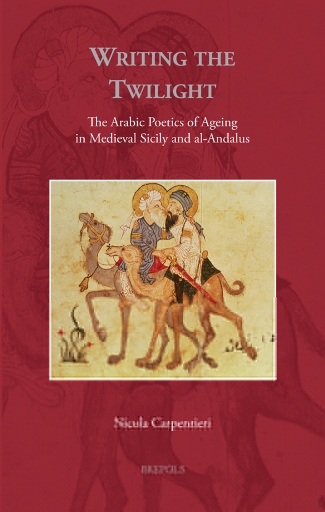
Writing the Twilight
show More to view fulltext, buy and share links for:Writing the Twilight show Less to hide fulltext, buy and share links for: Writing the TwilightIn the eleventh century, as Muslim sovereignty in the Western Mediterranean was eroded by both internal divisions and external attacks, Sicily fell to the Normans. At the same time, al-Andalus fragmented into a series of small kingdoms that were then picked off by powerful conquerors. Against this backdrop, Arabic poets made use of their craft to try and explain the changes in their world. Among them were the Andalusian Abū Ishāq and the Sicilian Ibn Hamdīs, both of whom wrote vividly about their own ageing and mortality, as well as about the broader twilight of the worlds they knew.
Taking these two protagonists as its starting point, this extraordinary volume explores how Abū Ishāq and Ibn Hamdīs, despite their different locations, both made use of poetry. For them, it was a tool to confront their mortality, lament their own physical decay, and appeal to their age and experience, as well as a way of juxtaposing their concerns with the political and social dismemberment of their wider societies and the need for a restoration of world order. The result is also a broader discussion of the relationship between poetry and politics in Maghribī Islam, and a reminder of poetry’s importance as a medium to engage with the world.
-